

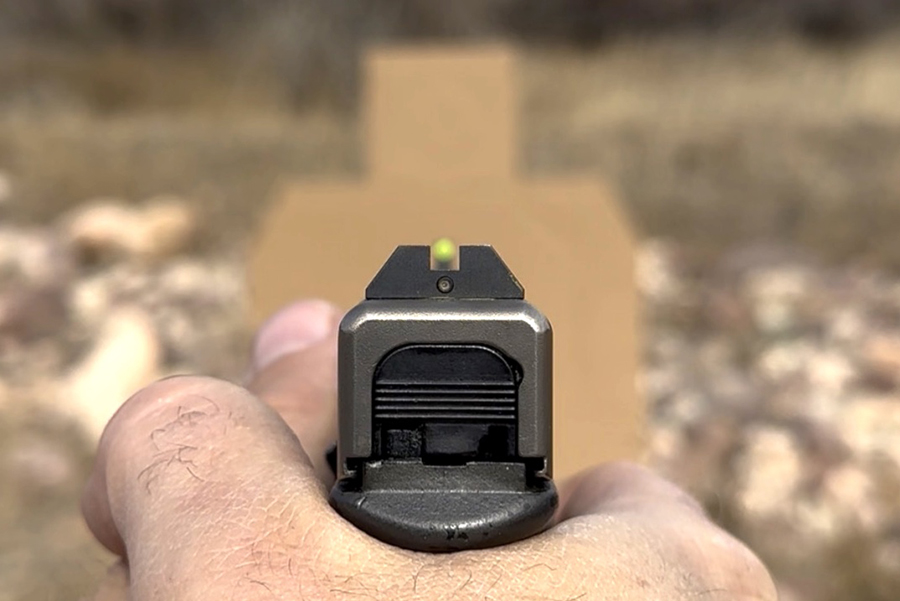
I have been paying attention to the gun world since long before I could purchase a firearm. When I was fourteen, maybe fifteen, I recall buying long since out-of-print magazines, such as Eagle and Gung-Ho. I would read them from cover to cover, eyeing the ads in the margins and on the back pages for interesting products and accessories.
Like Solomon advised in Ecclesiastes, there is nothing new under the sun. The full quote is “What has been will be again, what has been done will be done again; there is nothing new under the sun.” In the gun world that advice certainly holds true. For as long as I have been paying attention to the gun world, there have been companies marketing products which they claim will make you a better shooter or make your gun “more accurate.”
While the dead tree magazines of my youth are largely a thing of the past, we still find ads for products that claim to make our guns more accurate or make us better shooters. We’re going to take a moment to consider whether or not something that you can purchase online can actually make you shoot better. Specifically, we’ll focus on sights and optics for handguns.
Two Things
When it comes to hitting your intended target with projectiles from your handgun, there are two things you need to do. First, align the bore of the gun with the target. Then you apply enough muscle tension to the trigger to cause the cartridge to ignite without disturbing the bore alignment. The front sight is the most important one because it’s sitting right over the muzzle, indicating the alignment of the bore.
That’s it. Those two things are all you need to do to hit your target every single time. Sounds easy, right?
Decades ago, during an instructor development course, I came across an explanation that, while simple, seems to be lost on many folks who own firearms. It went something like this: The purpose of sights on a firearm is to align the shooter’s eye with the bore of the gun. Notice that the definition didn’t say that sights make the gun more accurate.
The barrel of the gun doesn’t know that sights exist. Nor does it care. If you were to put your pistol into a Ransom Rest, fire five shots, then take a Dremel tool, remove the front and rear sights, and fire five more shots. Guess what? The second five shots would go the same place as the first five shots. Yes, it might seem silly to offer such an explanation. Regardless, we constantly hear folks asserting that their gun would be “more accurate” if they only had this set of sights or that optic.
Human Vision
Alright, if the sights don’t make the gun more accurate, we need to go back to the explanation above. Sights and optics are there to align the shooter’s eye, their vision, with the bore of the firearm. What that means is when choosing sights we need to consider how human vision works.
Rear sights are designed to be looked through not looked at.
First, we need to address foveal vision, the sharp, detailed central vision provided by the fovea, a tiny pit in the retina packed with cone cells, allowing for tasks like reading and color perception, contrasting with blurrier peripheral vision. Your eyes can only focus at one distance and on one object at a time. Yes, you can rapidly alter your focus from one object to another, but we still need to accept this limitation.
It might help to acknowledge the perceptual span that combines with foveal vision. The perceptual span is the amount of visual information processed during a single eye fixation, primarily in the act of reading, but this can be a factor in other endeavors, such as firing a handgun. The perceptual span is extremely limited when compared to the peripheral span.
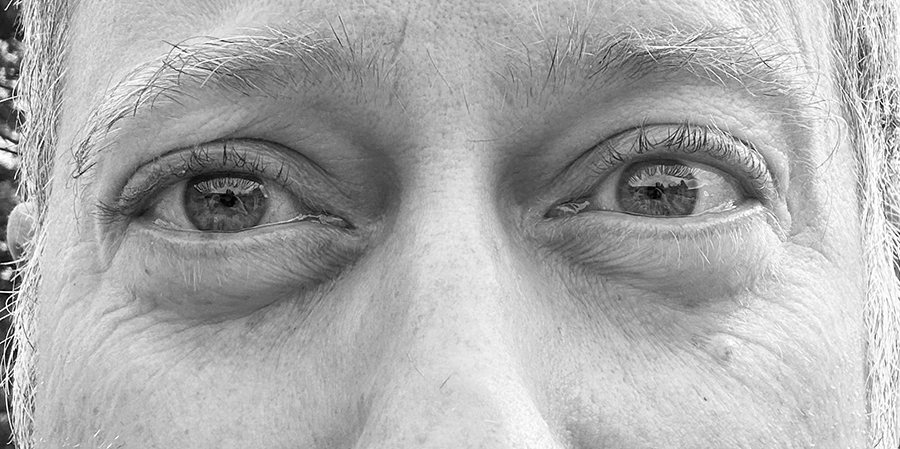
Also, normal human vision includes the tendency of the human eye to center objects that are in focus in foveal vision. This is referred to as center bias or central fixation bias. For example, when you use your foveal vision to clearly focus on the front sight of your handgun, natural central fixation bias will align or center the front sight in the rear sight that you’re looking through (not at). That’s right…rear sights are meant to be looked through, not looked at.
We’ve all seen the two-dimensional posters on the walls of gun ranges or shooting sports clubs that are supposed to help us understand how to align our sights. I’m here to tell you that, while the intentions were honorable, those posters are essentially worthless for two reasons. First, and most importantly, your eyes have a built-in central fixation bias, so you will center the front sight in the rear sight as long as your clear foveal focus is on the front. Secondly, posters are flat and two-dimensional. The picture of the sights on the poster doesn’t account for three-dimensional reality and the fact that the rear sight should be out of focus or slightly blurry.
Additionally, we should acknowledge the existence of rods and cones in the retina of the human eye. Rods and cones are the two types of photoreceptor cells in your retina that are crucial for vision. Rods handle low-light, peripheral, and night (scotopic) vision, while cones function in bright light (photopic), providing color perception and sharp central detail (visual acuity).
Human vision is attracted to two things: light and movement. Your peripheral vision can’t provide you with detailed information, but it can pick up movement and light. Your foveal vision provides clear, detailed information for your brain and sees color vividly.
We should also consider that foveal vision (cones) requires ample light to function and see color while the rods function in low light, but don’t perceive color…only black and white and shades of gray. When available light diminishes, the first color spectrum to be lost is the red spectrum and the last one to be lost is what we call in our modern world “safety green,” that super bright yellow/green color. After the color spectrum is lost, black is black, white is white and everything in between is a shade of gray.
Sight Design Based On Vision Science
None of the aforementioned information regarding human vision and the science of sight is new or groundbreaking. It’s been available for a long time. Therefore, you would think that those who design sights for handguns would do so based on that science. You’d be sadly disappointed.
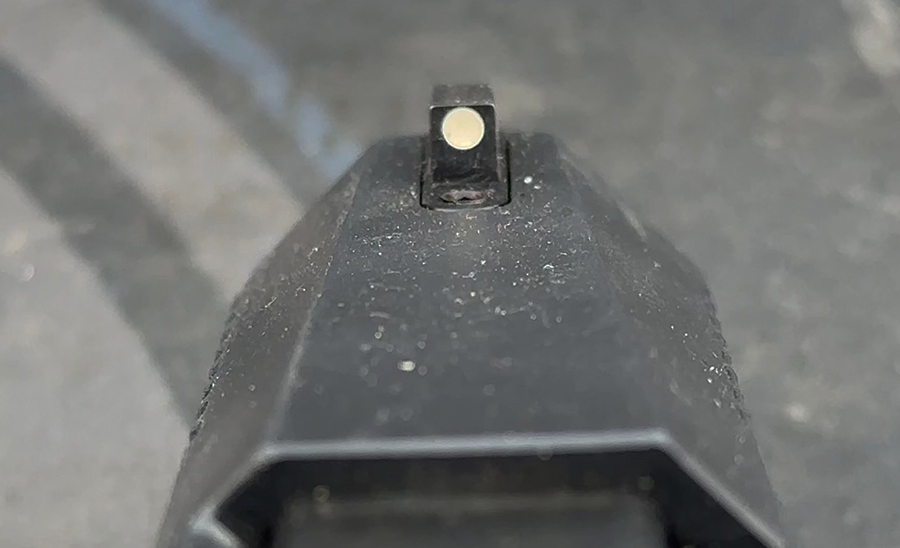
All vision is based on light or how light is reflected off of the objects that our vision perceives. Therefore, it would make sense that we would want the most important sight — the front sight — to reflect the most light. In our modern world, that’s accomplished through the use of brightly colored polymer materials. In the olden days, brass and gold were used to reflect light, as was genuine ivory and marble.
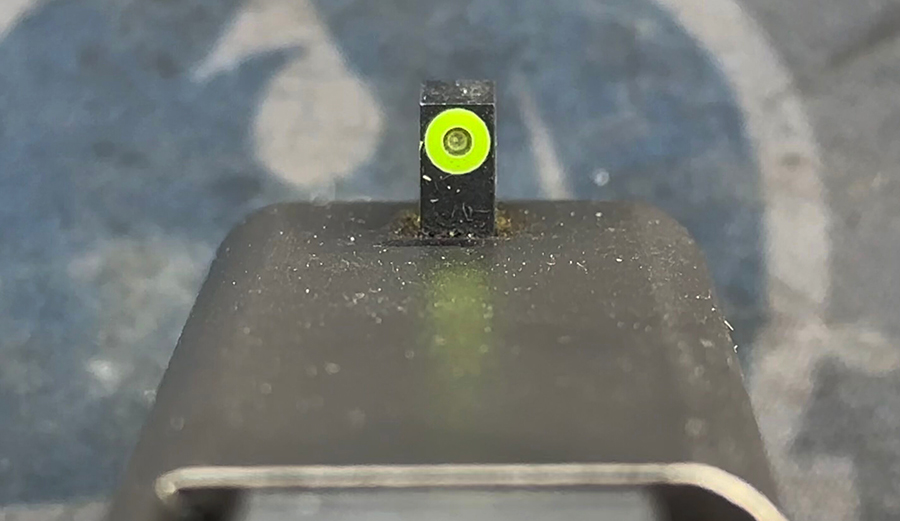
Thanks to modern technology, we now have tritium-filled sights which, rather than reflecting light, produce their own. When you wrap a tritium vial in a brightly colored polymer insert, you have the best of both worlds.
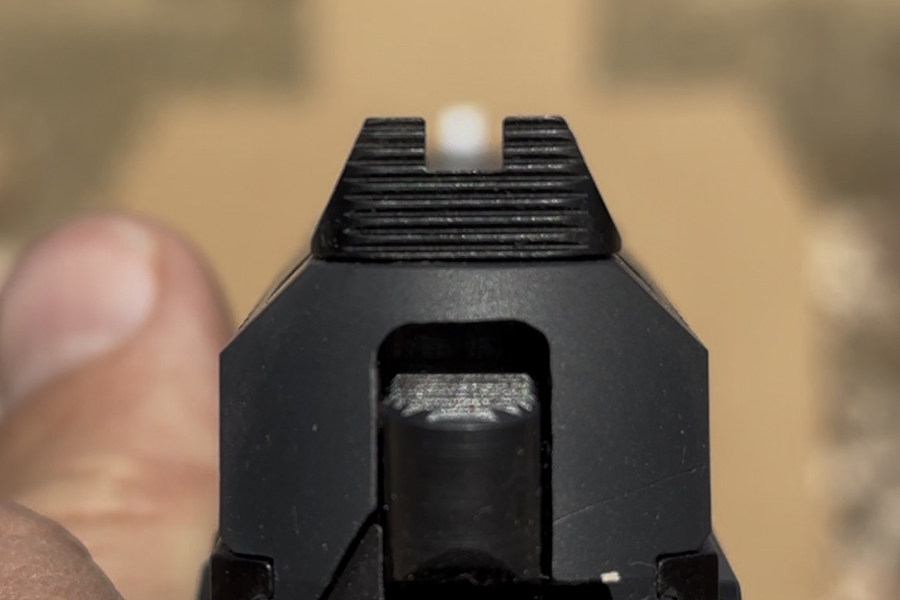
If we accept that rear sights are supposed to be designed to look through, not at, we’d design them in such a way that they don’t attract the focus of our foveal vision. Remember, the rear and front sights are located on two different planes and only one can be in focus at a time.
If we put more light-reflecting or, in the case of tritium, light-producing material on the rear sight, our foveal vision will be drawn to the rear which is closer to the eye. Drawing foveal vision to the rear sight is not what we should be doing.
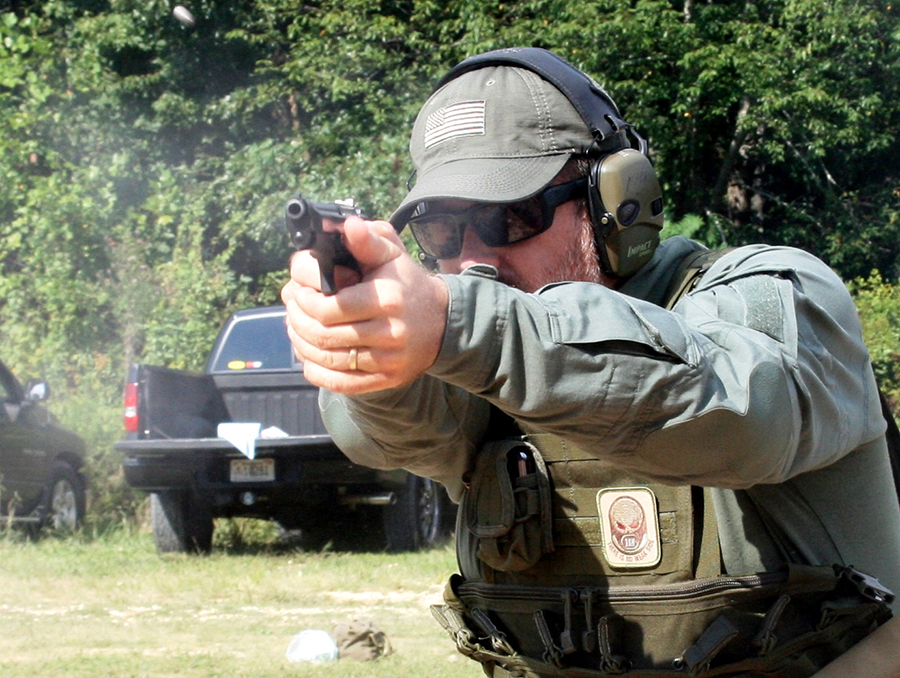
“But, I need the three dots to line up my sights,” one of you just said. No, you don’t. First, it’s impossible for human eyes to focus on the rear and front sights at the same time. That means you’ll be shifting your foveal vision from front to rear to front again. That will tremendously increase the amount of time it takes you to make an accurate shot.
Also, thanks to your built-in central fixation bias, as long as you focus on the front sight, your eyes will naturally center that sight in the opening of the rear sight without the need for additional dots, or “U”s or whatever distracting color or design may be at the rear.
End of Part 1
Thirty-plus years of writing for the gun world has taught me a few lessons. One of those is to understand the average attention span of a reader. Therefore, it behooves me to push the pause button on this piece and label it as “Part 1” as there’s an equal amount of information to share in regards to training with iron sights as well as optics sights.
To be continued….
You can read part two of this post here.
Paul G. Markel is a combat decorated United States Marine veteran. He is also the founder of Student the Gun University and has been teaching Small Arms & Tactics to military personnel, police officers, and citizens for over three decades.
“ ‘But, I need the three dots to line up my sights,’ one of you just said. No, you don’t. First, it’s impossible for human eyes to focus on the rear and front sights at the same time. That means you’ll be shifting your foveal vision from front to rear to front again. That will tremendously increase the amount of time it takes you to make an accurate shot. ”
Exactly!
For people I help out, I’ve been telling people that for years for their defensive shooting wants…after working on the draw, grip, and stance I start them out with a basic “You don’t need to line up the dots. Grip gun properly, stance, align gun pointed at bad guy and in line with your eyes, focus on the front sight, let the rear sight be blurry and out of focus. Do not try to focus on both front and rear sights because you can’t, focus on just the front sight. Your natural vision capability will cause you to center that front sight in the opening of the rear sight. Squeeze trigger, put bullets in bad guy.” – and then refine from there.
This is not some new thing. Its what I learned as a child staring at age 5, its what my mom taught the students who took her classes. And in today’s world with all the various sights and gimmicks for them, for such a simple thing to do its is one of the most difficult things for some new gun people to understand after they have paid money for iron sights that promise to help them be ‘accurate’ because someone on the internet said ‘line up the dots’.
Overall, an excellent ‘teaching’ article Paul, Thank You.
“the rear and front sights are located on two different planes and only one can be in focus at a time.”
I know what you were trying to say, but actually they are located on the same (geometric) plane (axis) just at different spots on the same plane when aiming – this is called coplanar.
We we align gun sights with our eyes we are establishing three points on the same plane (mounted iron gun sights, front-rear are always physically and geometrically in the same plane)
Three distinct (existing) points located on the same plane are referred to as coplanar. Any three distinct (existing) points on the same (geometric) plane (axis) are always coplanar, in this case (‘aiming’) the three distinct points are eyes – rear sight – front sight – but for aiming we want focus on the front sight, but because we focus on the front sight does not mean the rear sight is not in the same plane.