
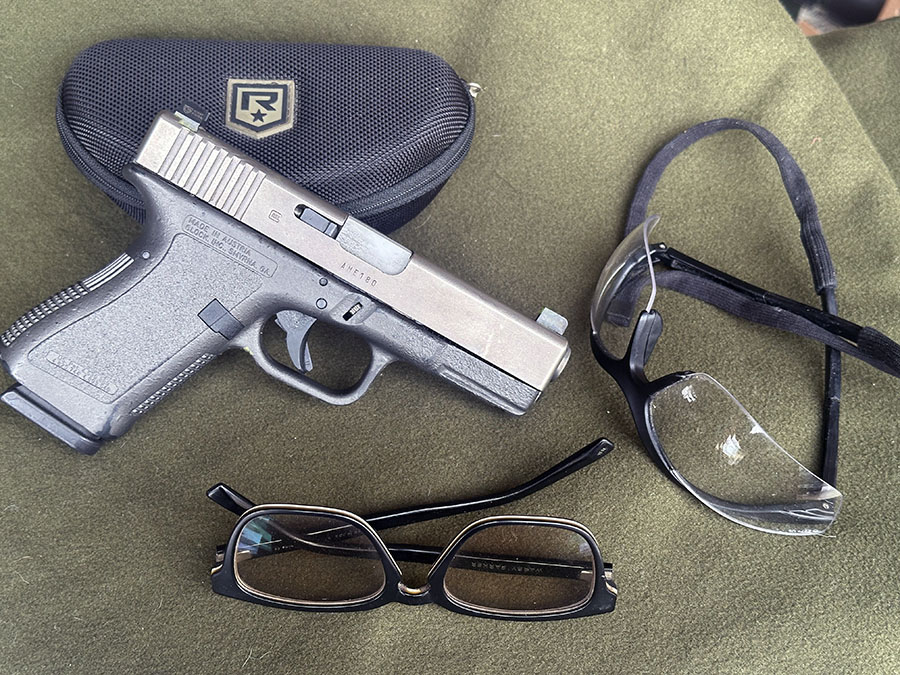
If you have made it this far in life without the need for prescription glasses, count yourself as fortunate. However, not needing glasses and being too stubborn to get glasses are not the same thing. If you have prescription glasses, but don’t need them all the time, as in you can recognize people’s faces or drive without glasses, you’re also fortunate. Even though I’ve had prescription glasses for decades, I was able to take my driver’s license vision test without them and pass for over twenty years.
Last year it caught up to me.
When it comes to the use of a firearm in self-defense, your vision plays a major factor in determining whether A) you are shooting at a genuine threat and B) whether or not you can hit the target. If you cannot recognize faces beyond a few feet without your glasses on, you had better take a moment to grab your spectacles before investigating that bump in the night. The silhouette at the end of the hallway might be your college-age daughter coming home early and not wanting to wake the family or a teenager sneaking back into the house.
No Glasses?
But, what if you can’t find your glasses in the dark? Or, what if your glasses get knocked off of your head in a fight? That second example happened to me when I was a police officer. In the middle of going hands-on and breaking up a fight, I was struck in the side of the head and my prescription glasses went flying.
Fortunately, I didn’t have to use my sidearm during that altercation. That wasn’t the case for FBI Special Agent Ben Grogan who lost his glasses during the car crash that started the famous FBI Miami Shootout. Grogan was an expert marksman with his Rx glass on, but was tremendously handicapped without them.
If you are, for all intents and purposes, “legally blind” without your prescription glasses, you might consider some kind of a strap or “croakie”. Some of these are actually fashionable and don’t look too nerdy. If you can’t see past five feet without your glasses and you lose them, your concealed carry pistol won’t do you much good unless you’re contact shooting.
Training and Testing
Most people who wear prescription glasses aren’t legally blind without them and fall into the “I can still see, but I see better with my glasses on” category. I fully admit that I’m not the first person to consider this topic. My colleague, Massad Ayoob, was writing articles for dead tree magazines decades ago about the subject of training and practicing with and without your prescription glasses.
Mas even went so far as to suggest that law enforcement officers participate in their state’s mandatory qualification course with both their prescription glasses on and off. Let’s face it, most people want to look good in front of their peers and will not risk a low score or potentially poor showing by shooting without their glasses.
The one way to deal with the peer pressure issue would be for departments or agencies to require officers who wear prescription glasses to do both. However, we hit a reality wall here. Most agencies are happy to have all of their officers pass the annual qualification at all, since a good portion of their personnel barely manage to pass or have to do so after being given a “second chance.” Only the most forward thinking law enforcement administrators would require their people to qualify minus prescription glasses.
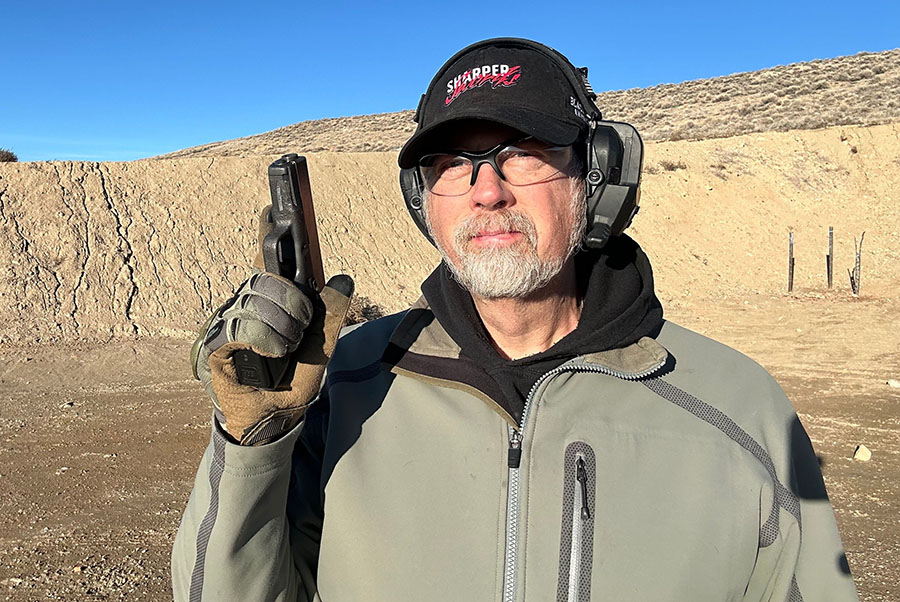
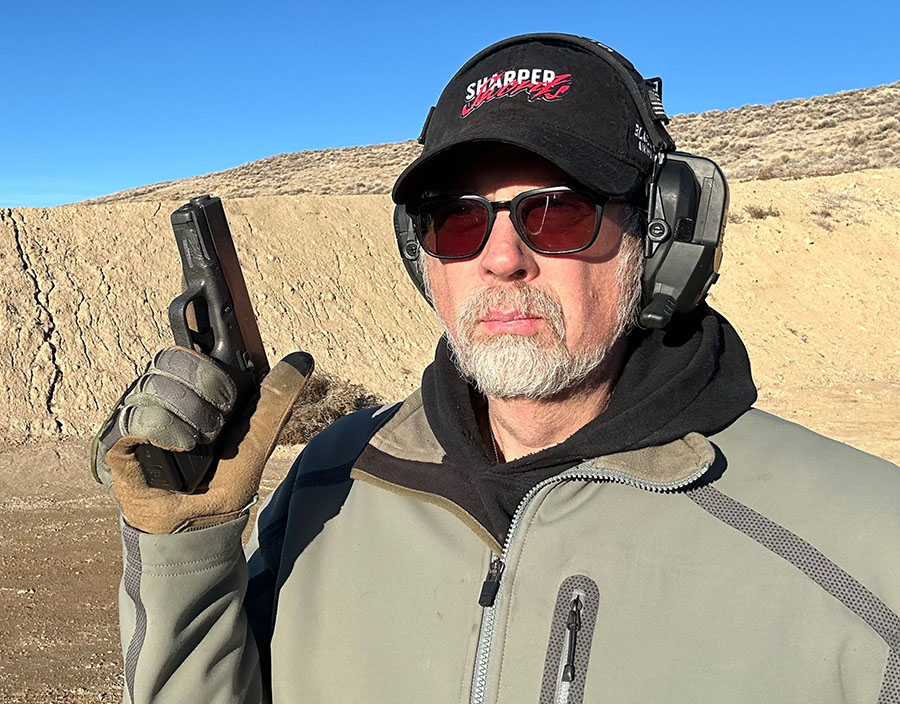
So, where does this leave us? It leaves us with personal responsibility and mental maturity. You have to decide that such an endeavor is not only worth your time, but critically important. Naturally, we want to protect our eyes from debris or ricochet fragments, and so when we remove our prescription glasses we will substitute them for some type of safety glasses.
Realistic Exercises
I have taken to the habit of shooting both traditional iron-sighted handguns as well as those with some type of dot optic in place with and without my Rx glasses on. As mentioned during previous reviews, I am nearsighted. This means that my front sight is clear in my vision without glasses but a bit blurry with them. The reticle in a dot optic is clear with my glasses on but a bit fuzzy without them.
The big question, however, is whether or not the blur or fuzziness is enough to prevent me from hitting targets at practical ranges. The vast majority of law enforcement qualification courses are shot from fifty feet and in, with fifty feet or seventeen yards being the farthest target distance.
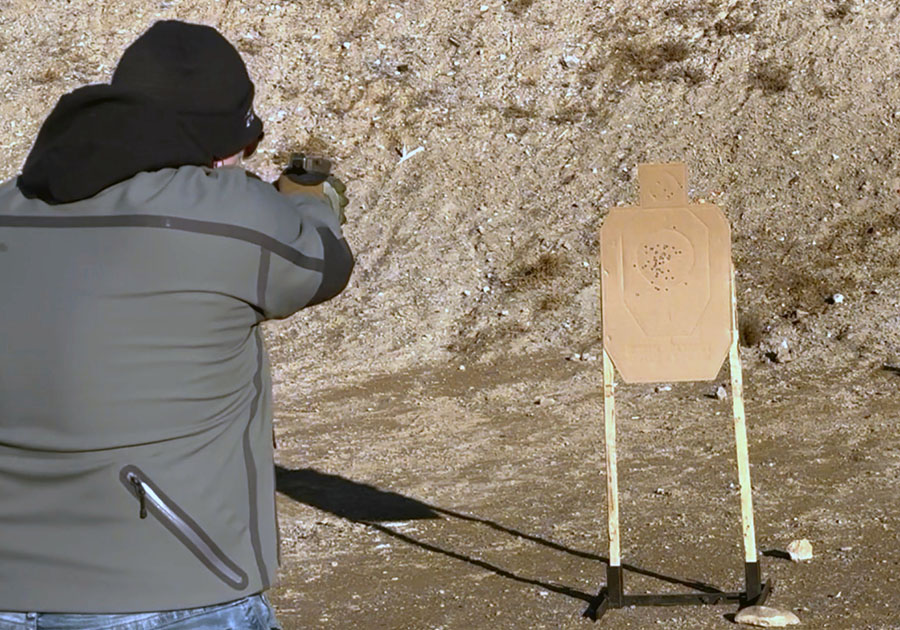
For realistic and practical exercises, I use both cardboard and steel reactive targets. Naturally, the cardboard allows you to evaluate the consistency of your shots and the steel gives instant confirmation. I like to use an 8-inch steel plate for these practice sessions. I figure if I can consistently hit a “head plate” at fifteen yards without my Rx glasses that I am doing pretty well.
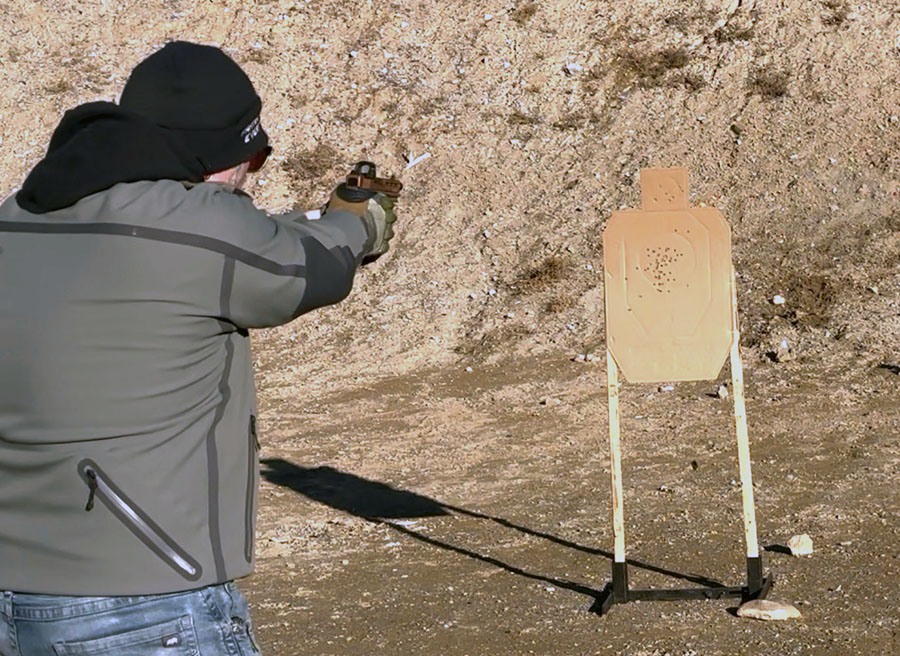
My suggestion to you is to first engage in some basic shooting drills from 3,5,7, and 10 yards…maybe 15 yards if you are feeling froggy, with your Rx glasses on. Take a moment to evaluate your performance and then substitute your Rx for simple safety glasses and repeat the process.
It should go without saying, but I will say it anyway, these practice drills should be performed with the gun you are actually carrying for self-defense or as a duty gun, not your favorite tricked out race gun. Genuine confidence in your ability with your EDC gun is the goal, not how cool you look with your “custom” pistol.
Parting Shots
Good, bad, or indifferent, if you take the time to shoot both with and without your Rx glasses on your face, you will come away with a realistic understanding of your ability. If you discover that you can’t hit the south end of a northbound elephant without your specs, you’d better make keeping them on your face a priority.
Subsequently, you might actually be surprised at your performance and come away with a genuine sense of confidence knowing that even without your Rx glasses, you can reliably put rounds where they need to go. Regardless of the outcome, the most important aspect is to force yourself to engage in the behavior that tests your limits.
Paul G. Markel is a combat decorated United States Marine veteran. He is also the founder of Student the Gun University and has been teaching Small Arms & Tactics to military personnel, police officers, and citizens for over three decades.
I wonder if/how accurate vision matters if your aiming process is almost exclusively what we frequently call “instinctive shooting”?
Because of the nature of ‘instinctive shooting’ probably not much up closer, if you don’t have to try and extrapolate with thinking “what is that fuzzy blob?”
I’m getting along in years and no longer a young buck, but am fortunate enough to not be anywhere near needing prescription glasses (I only need basic readers for certain conditions such as menus in low lit restaurants or detailed content on computer screens). I grew up with “iron sights” for all firearms – handgun and long gun – and have trained thusly in all the many courses I’ve taken over my lifetime, whether for certifications or for CCW. I’ve used some selected red dots or optics, and I think they’re great with definite advantages for certain applications and/or people, but I always prefer iron sights.
That being said, and more to your comment, I’ve developed a lifelong skill of what I agree could be termed as “instinctive shooting”, where I focus on the target and bring my weapon up into view to act as an extension of myself, instead of relying on an optic which would require my vision to tunnel down to a small reticle. TEHO of course, and I support whatever method each POTG uses to effectively place rounds on target in a controlled manner. But I’m still in the iron sights and instinctive shooting camp.
Learn to shoot by echolocation. Follow the screams.