

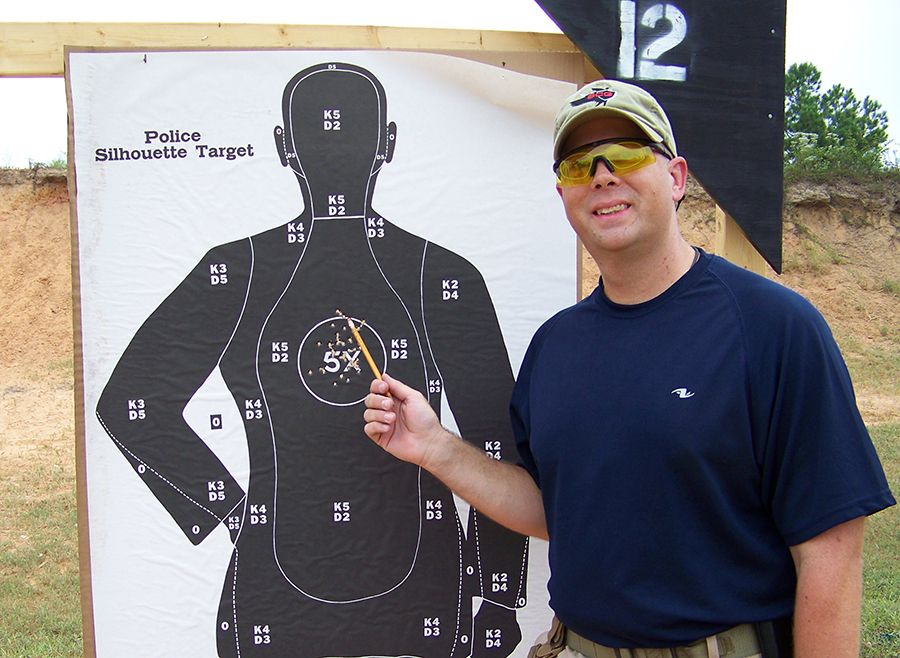
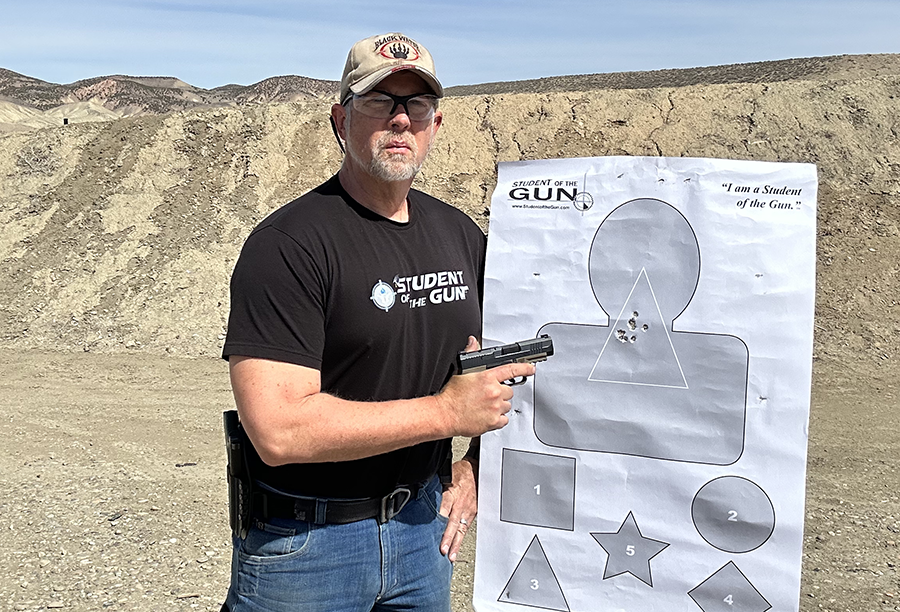
“I’m sorry, I only count nine holes.” So said the XO, a 1st Lieutenant, who was likely only a couple of years my senior. The XO and I were standing next to my paper bullseye target which was the standard at that time for the USMC Pistol Qualification Course.
That particular stage of fire required ten shots of .45ACP from our M1911A1 service pistols. My shot group was a tight cluster of holes, with many touching. And so, unable to discern ten distinct holes in the paper, the XO awarded me nine 5s (the highest score on the paper) and one 0, a miss.
The idea that I had put nine rounds into a tight cluster of shots and my tenth round had somehow completely missed the paper seemed ludicrous. Nonetheless, as a Lance Corporal, I was in no position to argue the matter with an officer. His word was final, if questionable.
Despite the 0, I qualified as Expert and got my name on the plaque as “High Shooter,” but that extra 5 points would have been my highest qualification score giving me a 246 out of a possible 250 rather than a 241 that went into my service record. The lesson I learned that day was that consistent performance isn’t always rewarded, at least on paper.
The Goal
What is our goal in carrying handguns as defensive weapons? Is it to scare off boogymen by brandishing it? Is the goal to make loud noises to frighten off threats? Is our goal to make #EDC videos for our Instagarbage fans?
At the risk of sounding rhetorical, the goal when carrying a handgun for self-preservation purposes is to develop the skill and ability to deliver rounds on target, on demand, regardless of circumstances, and do so as consistently as possible. When it comes to delivering rounds on target, on demand, consistency is critically important.
We teach consistency in the manner in which we grip the gun, in how we remove it from a holster and present the muzzle to the target. We preach consistency in how we align our sights on the target and in how we depress the trigger and follow through during the eventual recoil impulse.
If you have more than a smattering of experience with firearms, you should know that inconsistency in any of the aforementioned areas will lead to an inconsistency in where our rounds impact on the target. That inconsistency of impacts might be a difference of a few inches from round one to round two or it could be the difference between hitting the target and missing it. Yes, tactics play a major role in fighting, but let’s stick with the subject of skill development.
A Surplus of Hogwash
A couple of decades after the aforementioned incident with the XO, I had another opportunity to consistently apply the fundamental principles of handgun marksmanship. In that case, I was able to use the M9 service pistol to score a 250 out of a possible 250 on the prescribed target which had been altered from the old bullseye to a black silhouette with varied scoring rings.
Yes, I was proud of my accomplishment, but the man whose target was next to mine decided to try and pop my bubble. “Well, you might have put them all in one spot, but I would rather spread them out because that’s more tactical. If a bullet goes into the same hole it’s not doing any damage.”
I believe the look on my face was enough to let the gentlemen in question to know that I thought he was full of sh*t, spewing a load of hogwash, insert whichever euphemism you like. I knew that the man was disappointed, perhaps a bit angry for not having been the “top shot” that day. As a student of human psychology, I understood the words he spoke were a defense mechanism to mentally justify not shooting a smaller shot group. But, did he really believe what he was saying?
Regardless, such balderdash gave me the opportunity to consider the assertion that rather than apply consistency to the greatest level possible, a person should try to deliberately spread out their shots. Keep in mind, for our purposes, we are substituting paper and cardboard for the actual human threat for which we are preparing to deal.
The Variables
When the time arrives for you to defend your life, or of the innocent lives of others, with your handgun, there will be a large number of variables that will combine to preclude your shots from entering the same hole. During a sudden lethal force encounter you must deal with movement; both yours and the threat’s. You have the physiological effects that humans undergo during life-threatening events. The event will occur at an unknown distance, in potential poor lighting, and you may have to mentally sort through the problem of multiple attackers. Also, let’s not forget, you might start your fight being knocked to the ground or injured; as in you might not realize it is time for fighting until after you have been hurt.
As you can see from the above list of variables, you have enough to deal with without applying some kind of “be sure to spread out your shots” logic. With the understanding that humans do not magically gain superpowers during life-threatening events, but instead will default to whatever level of skill they have previously mastered, the best you can hope for is to revert to a level of consistent mastery when it comes to putting rounds on target.
The US Army Special Forces community, with Delta in the lead, has been studying performance under stress for decades. They found that marksmanship performance will potentially degrade twenty-five to fifty percent when a person is thrust into a sudden deadly force scenario.
If your ten-round shot groups average four to five inches at ten yards when you’re calm, you can expect eight to ten inches when you’re under stress. If your calm practice is to deliberately spread out your shots to ten-inch groups, that would seem to translate to genuine misses or peripheral hits under stress.
Real Threats are Made of Flesh, Not Cardboard
During a recent conversation with a fellow small arms and tactics instructor, he shared a real life incident that occurred with one of his graduates. The man was confronted by a deadly attacker, drew his pistol and fired what has been termed either a “double-tap” or “hammer pair,” one sight picture for two fast shots. Shot one entered the “T-box” area (eyes/bridge of nose) on his attacker and the second round sailed over the suspect’s head, fortunately embedding in a brick wall behind him not an innocent bystander.
That led my friend to do some research. He found that an object — in this case a human — under the effects of gravity, will fall between six and seven inches in 0.20 seconds. A “split time” of two tenths of one second is often held out as a standard for firing two fast shots. To put it another way, a human can move or shift laterally between six and ten inches in only 0.20 seconds.
The monsters who would attack and kill us aren’t made of paper or cardboard and they aren’t held in place by staples on target stands. They’re free-floating. To the main point, even if your goal was to put your bullets into the same hole, the reaction of the living human attacker is going to preclude that. Living humans move when struck by bullets, they don’t stand perfectly still like an IPSC silhouette.
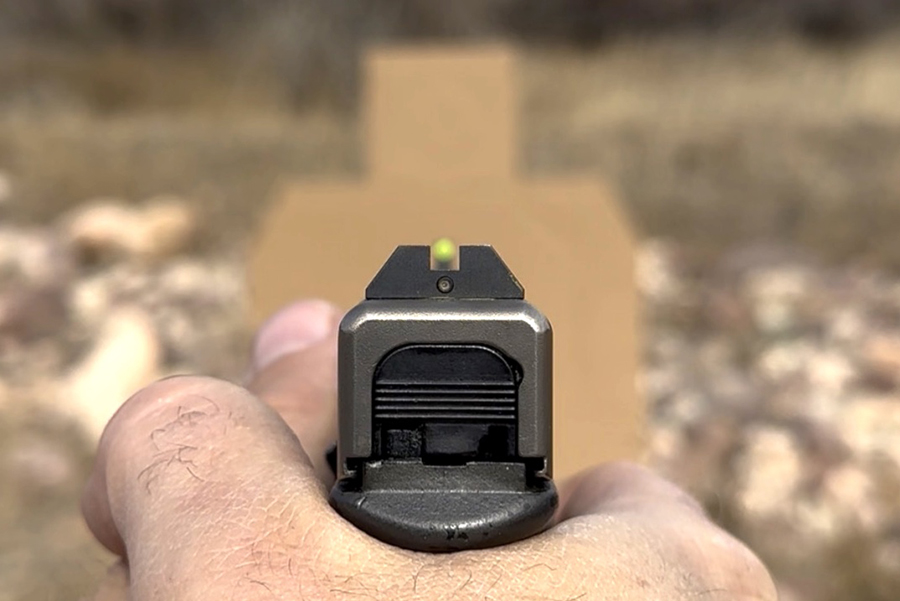
Now’s the part where you say, the guy who told you that spreading out rounds is more tactical for combat shooting was just one dude, a long time ago. I wish that were the case. Before I sat down to write this, I watched a video where a man, who’s an instructor at a known shooting school was filmed for a training video. The man stated to the camera that he doesn’t need to put rounds close together and it’s better to spread them out because that does more damage.
While I had once thought such thinking was a relic of the past, I was sad to hear that it’s not.
During a life-threatening encounter, you can’t control all of the aforementioned variables. However, what you do have the power to control is your own performance and that performance is either going to be a mastery of consistent shot placement or it will be built on hogwash and pseudo-tactical advice.
You are an American. Take your pick.
Paul G. Markel is a combat decorated United States Marine veteran. He is also the founder of Student the Gun University and has been teaching Small Arms & Tactics to military personnel, police officers, and citizens for over three decades.
This happened to me during my qualifying shooting skills test for my last CCW renewal. I had to fire 40+ rounds at 5-, 7-, and 10-yd distances onto a paper target, yet my shots resulted in a small grouping in which a substantial portion of the paper was entirely gone, and the instructor could not identify 40 separate holes. He told me I had to re-take the test and ensure that he could visually identify, circle (with a Sharpie), and photograph all 40 holes to confirm 40 qualifying rounds actually fired. Because L.A. County standards require it, so I was told. I therefore did it all again, taking care to space the holes within the center mass outline. I scored a 100% with full points…again. Also scored 100% on the written portion.
And I have to go through the next renewal cycle soon because our permits are good for only two years. Never mind I’ve already had multiple CCWs (CA and outside CA), 250+ hours of professional certification including advanced tactics, Handgun Combat Master, etc. Our overlords in Sacramento have allowed CADOJ to require double the hours and fees for renewal than the last time I did it. Absurd.
Basically, I was told not to shoot at my best for my CCW, but to dumb it down because the paper pushers at CADOJ supersede the instructor who’s actually with you witnessing your skill set.