

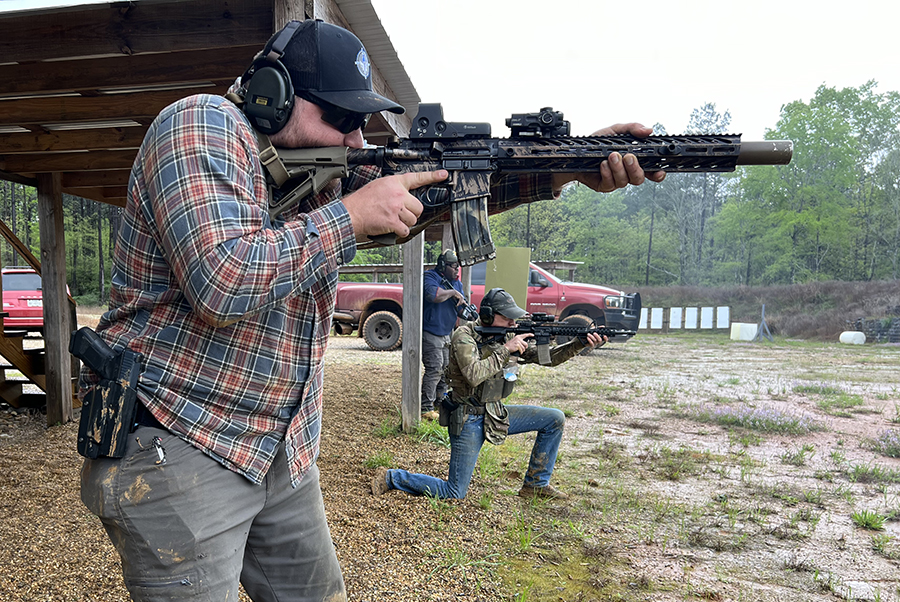
While I generally view social media as a vapid waste of time, every once in a while something will come to my attention that gives me pause to think and consider the subject. This morning a video link appeared with a title to the effect that most people are untested, particularly when it comes to dealing with a crisis.
The upshot was, thanks to our relatively comfortable standard of living in the modern world, most people rarely have to face a serious or potentially life-threatening crisis. The majority of adults in the United States think that they know how they’d react to such a situation, but most just assume or base their belief upon feelings. They have no concrete proof or experience on which to base their beliefs.
Such feelings or beliefs can be attached to the Dunning-Kruger effect. That’s a cognitive bias in which people wrongly overestimate their knowledge or ability in a specific area. This tends to occur because a lack of self-awareness prevents them from accurately assessing their own skills. Taking a step back to the topic of social media, there’s another article which asserts that the advent of social media is making the Dunning-Kruger effect even worse. How can we address this situation? Should we?
Plans Versus Planning
“No plan survives first contact with the enemy.” That saying has been attributed to Prussian Field Marshal Helmuth von Moltke. If that’s true, then why are officers and NCOs taught the Five Paragraph Order or SMEAC for mission planning? The acronym stands for Situation, Mission, Execution, Admin/Logistics, Commands/Signals. If we accept that no plan survives the first contact with the enemy, then why do we waste our time planning?

There’s another quote, one from General Dwight D. Eisenhower, who said, “Plans are worthless, but planning is everything.” Is that contradictory? I believe both von Moltke and Eisenhower wanted to instill in their men that, while the details of a specific plan might come apart under the unpredictable circumstances of combat, the act of planning and preparation shouldn’t be underestimated.
You may have heard the quote, “Fortune favors the prepared.” Louis Pasteur is often given credit for it. A similar version is “Luck favors the prepared.” Naturally, the intent here is to insure you are as prepared as possible rather than to simply leaving it all to chance. Another way to look at it is to consider that people who are prepared for opportunities are much more likely to be successful.
And then there’s, “Everyone has a plan until they get punched in the face” from the famous philosopher Mike Tyson. Do you believe that Tyson’s boxing coaches sent him into the ring without a specific strategy or game plan for his opponents? Should we believe that before the Holyfield or Lewis fights that Tyson’s coaches just said, “You’re a good boxer, Mike. Get in there and do your best.”
Preparing for the Gravest Extreme
Our long-time compatriot, Massad Ayoob, has been using “gravest extreme” to describe a deadly force situations, regardless of the specific circumstances, for decades now and we think that’s fitting.
When American gun owners and carriers think of a life-or-death situation, it’s often framed as dealing with a deadly force attack: a home invasion, a robbery/mugging, or a rampage killing attack such as we’ve witnessed in our schools, churches, shopping centers. Most of those who carry a concealed firearm, whether they verbalize it or not, have concocted what trainers refer to as “My Gunfight” in their heads.

In the “My Gunfight” scenario, the person in question always sees the attack coming, draws their gun and instantly neutralizes the threat with zero innocent casualties or any injury to themselves. Yes, that can happen, but as often as not, deadly force attacks don’t fit into our preconceived notions. A “My Gunfight” scenario is akin to the plans that von Moltke and Tyson were talking about.
Going back to Dunning-Kruger and the consideration that the majority of adults are truly untested, one of the biggest problems encountered by the untested is to realize the threat or to accept that it’s happening. Over and over again, we hear witness say in the aftermath of some violent criminal attack, “I couldn’t believe it was happening.” People see the clues, but their brains can’t accept that what they are seeing is real or an actual threat.
If you had the opportunity to talk to seasoned police officers or military vets with combat experience, they’d tell you that after their first couple of dangerous encounters, they learned to see the clues and they were no longer in denial as to what was happening. The truth is that the more often you deal with such situations, the better you’re anle to deal with them and the higher your survival rate.

The big question, then, is obvious. How do we prepare people to survive the first deadly crisis? The answer is simple and complicated at the same time…training. Training is a broad term. Learning how to load ammunition into a handgun and manipulate the trigger until the device makes a loud noise can be considered training. But, is that enough to survive a deadly force encounter against an experienced attacker? How do we develop the proper mindset to survive and prevail?
Plans, Planning, and Tactics
While it may be true that no plan survives the first encounter with the enemy or a punch to the face, we can and should engage in planning. Undergoing formalized training is planning. The first live round that I fired in combat was actually an M67 hand grenade I threw into an enemy bunker. Despite the noise of gunfire and stress of combat, as I threw that grenade I went through the steps I’d been taught years before and had practiced over and over. In my head I said, “Thumb clip, pull pin, throw grenade.” just like I’d done it in training. Only that time it was for real.
The first time I had to draw a pistol and point it at a human threat, it was as though the gun just appeared in my hand extended out, with the safety in the off position. That happened because, prior to that moment, I had trained and likely gone through that drawstroke process thousands of times. It became second nature.
While specific plans may fall apart, tactics remain true. Proper use of cover is a tactic. You can’t predict what manner of cover might be available when the gravest extreme happens, but you can use whatever cover is available correctly. If you are not behind cover when the threat materializes, you need to “get off the X” and move your feet. That’s more of a tactic than a plan.

Planning also includes redundancy. Alternative actions. When armed with a long gun and a sidearm, our primary fighting tool is the long gun. However, if the long gun refuses to make noise, we don’t just call time out, we move to the sidearm. When I was a cop many years ago, seasoned officers carried their primary sidearm and a backup gun. We also practiced scenarios where we had to go for our backup gun…at least the serious ones did.
Mindset
While a plan might not work, planning does. Think of planning as a mindset. Before you find yourself in the gravest extreme, you can and should be working on developing the proper mindset. The training you engage in must be serious and rigorous. It should make you uncomfortable. Only through the act of overcoming both mental and physical discomfort can you develop the proper mindset and prepare your mind to make the correct decisions.
For centuries, the militaries of the world have taken untested young men and put them through rigorous and stress-filled training. They have done in order to give those men the greatest opportunity for survival and success in their first deadly encounter. This form of planning has proven to be effective time and again.
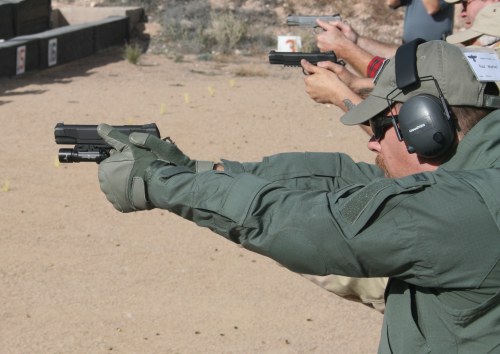
When I said earlier that the answer to preparation was both simple and complicated, I did so because, while the act of training isn’t hard to do, it’s shunned by the majority of gun owners and carriers because it is not easy or comfortable. Our modern world has convinced people that everything we want is supposed to be convenient and easy. We embrace comfort and avoid discomfort to our detriment.
While you can’t change the fact that you might be untested, you have the power to engage in planning, mindset development, and preparation. When you find yourself in the gravest extreme, you won’t magically rise to the occasion, but you will react with the level of training that you’ve mastered. What that level might be is up to you.
Paul G. Markel is a combat decorated United States Marine veteran. He is also the founder of Student the Gun University and has been teaching Small Arms & Tactics to military personnel, police officers, and citizens for over three decades.
I am surprised you left out proper planning prevents piss poor performance…
The real enemy in our lives is time and complexity. “How so?” you ask? Back in the day our lives were relatively simple and we had more time AND ENERGY to take on something like fight training. Not so much anymore. Example: I have to wear a personal health device (a device on my wrist) or else pay an extra $720 per year for health insurance. While that may not sound like a big deal, it is when you realize that entails charging it (without forgetting to put it back on as soon as it is finished charging), keeping it linked to my cell phone, keeping its application running on my cell phone, and keeping the associated health insurance application running on my cell phone. For the uninitiated, that previous list can be problematic–especially when you buy a new cell phone.
Anyhow, this article is very good. I just don’t know how to add more stuff into my life that is already overflowing.
Was this device requirement established by your insurance carrier, or your physician? Out of the blue, or in follow-up to a medical event that warranted monitoring?
The Dunning-Kruger effect was publicized before it was rigorously tested. The original paper was laughable statistically, but once senses the authors knew it. It wound up not being replicable…..that is, it’s horseshit. It had, however, already escaped into the pseudo-intellectual cocktail party circuit, and through that became immortal.