

For those of you who were kids back then, when the completely unconstitutional Clinton Assault Weapons Ban sunset in 2004, just about every gun maker had previously prohibited firearms ready to ship. The great one, Rush Limbaugh, once stated, liberalism always generates the exact opposite of its stated intent. He has been proven right time and again.
Prior to 1994 and the full court press to demonize certain types of firearms referred to as “assault weapons”, those guns were actually rather niche items. Prior to the 1994 AWB, you could count the number of AR-15 style gun makers in the United States on one hand, seriously. According to the internet machine, today there are over 500 manufacturers, large and small, making some type of Stoner-based rifle.
In 2004, not only were the flood gates opened for Americans to purchase AR-15 style rifles, were we in the early and heated stages of the Global War on Terror. The United States Army was looking to upgrade and improve the standard issue rifle. Also, the US Army Special Forces Operational Detachment Delta had been testing out a hybrid AR style firearm called the Heckler & Koch 416. The 416 had many similarities to the Stoner AR, but the operating system was akin to the HK G36; a gas-piston operation.
When it became public that Delta was using the HK416, other special forces units started adopting them and putting them into combat operations, particularly in Afghanistan. Well, as you can imagine, when the American gun community and gun industry found out that the Army was using a gas-piston 5.56mm gun, they viewed that as the wave of the future.
Kurt’s Kustom Firearms
This is where our story truly begins. In the early to mid-2000s in addition to doing bodyguard work, I started looking into military contracting. At that time I had two Marine Corps enlistments under my belt and I had been writing articles for the gun industry for over ten years. That led me to become acquainted with Kurt Wala who owned Kurt’s Kustom Firearms of Bushnell, Florida.
I suppose it was around 2005 when I first spoke with Kurt on the phone. He specialized in custom AR style firearms; producing both pistol and rifle caliber variants. I tested a couple of his products and reviewed them for gun magazines. Sometime around mid to late 2006, Kurt called me on the phone and was excited to describe to me his new gas-piston conversion kit for standard direct gas-impingement ARs. I must admit that I am a kinesthetic learner and while I was trying to imagine in my mind’s eye just how this new system worked, I really needed to see it up close.
Kurt called his invention the “M9Evo” gas piston conversion kit for AR-15 rifles. During our conversation, Kurt said that he could get me a 16-inch barreled upper receiver with his M9Evo installed. I had a Rock River AR that I was currently reviewing so the receiver swap would be easy.
My first experience with Kurt’s gas piston upper was extremely positive. It worked and functioned exactly as advertised. The next step was for me to send a carbine length upper to Florida for the conversion. I had just received my DPMS AP4 carbine back from Robar Companies where my friend Robbie Barrkman has treated the BCG with his NP3 metal finish as well as some other work.
Long story short, the DPMS 16-inch barreled upper with a short DI operating system was shipped to KKF in Florida. I cannot recall how long it was gone. A few weeks, a month? Regardless, let me tell you what Mr. Wala did.
The Conversion
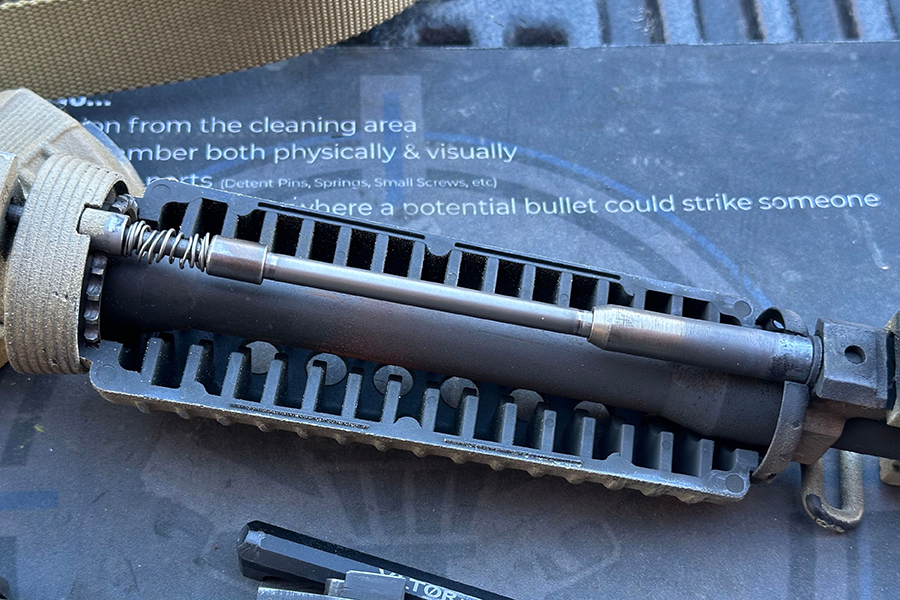
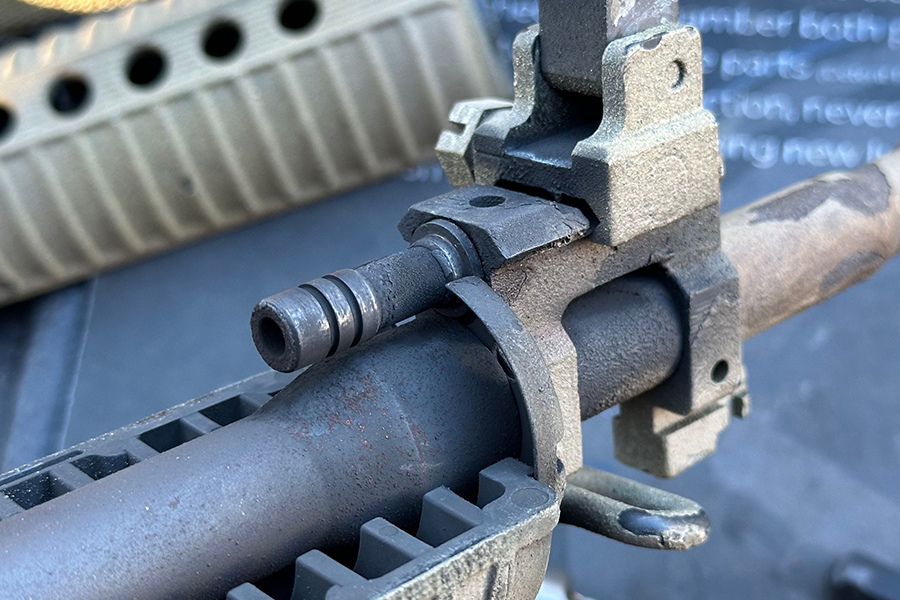
Starting up front, the standard A-frame front sight housing which also secures the forward portion of the DI gas tube needed to be replaced. The new front sight housing included an M1913 Picatinny base to allow aftermarket front sights to be installed. A gas piston is installed in the sight housing and secured over the gas port in the barrel. From the gas piston moving back, you have a gas cup which rides over the piston. Then there is a push rod assembly which mates with the piston cup and the operating rod. The op rod is the component that makes contact with the bolt carrier group.
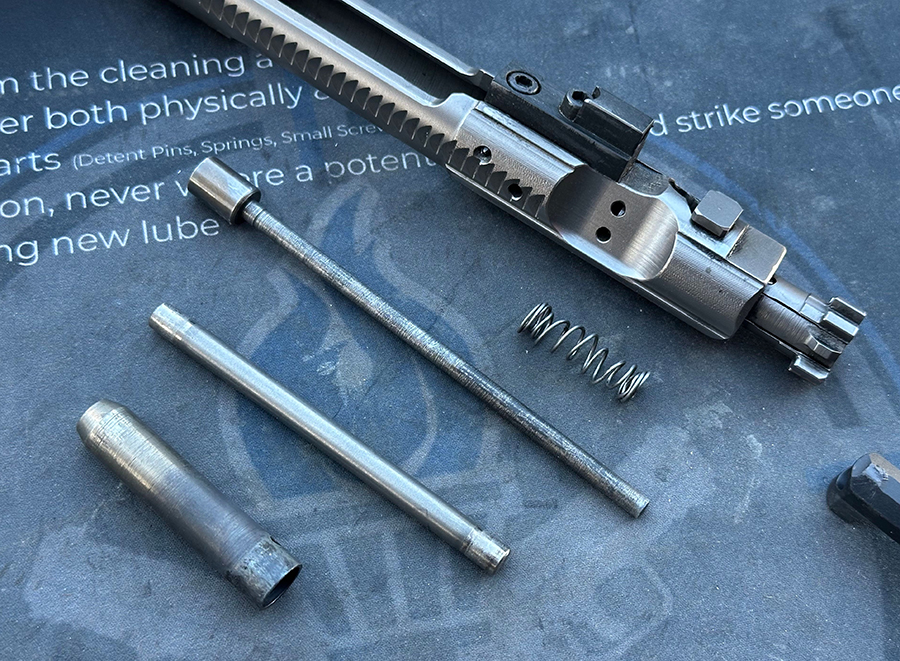
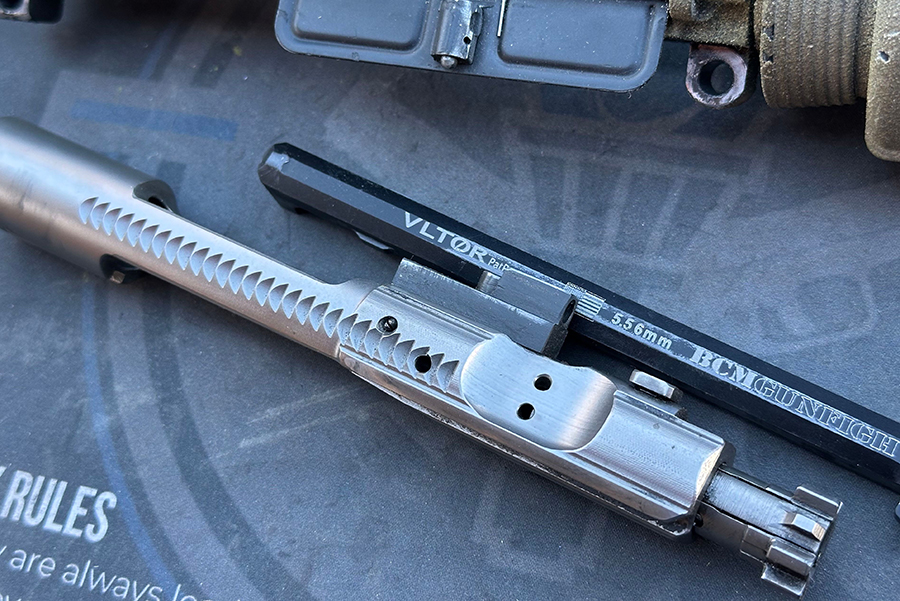
On the BCG, the gas key was replaced by an op rod receiver that has a recessed cup to mate perfectly with the rod. Like the original gas key, this new component was mounted and staked in place. The op rod needs to pass directly over the barrel nut, just like the original gas tube on an impingement gun.
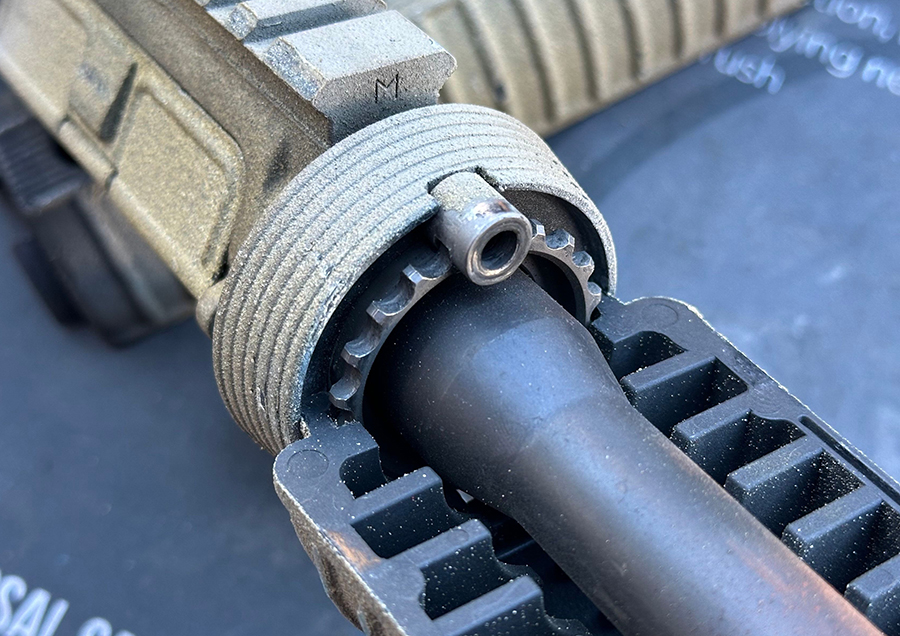
Kurt installed an op rod guide on the barrel nut to both stabilize the op rod and keep it from actually making contact with the barrel nut. Additionally, Kurt put a spring between the rod guide and the op rod. I recall talking to Kurt on the telephone and him relating that he was not certain that the spring was absolutely necessary, but he felt that it was still a worthy addition.
When my DPMS upper arrived home from Florida, I installed it onto a lower and got to shooting. Hundreds and then thousands of rounds cycled through the upgraded receiver without any issues whatsoever. Sadly, my friend Kurt was killed in a motorcycle crash in 2009.
Go Piston or Go Home
What I had no way of knowing in late ‘06, early ‘07, during my interaction with Kurt was that the AR-15 gun industry was in the early stages of creating gas-piston ARs for the larger market. The AR world was about to go nuts for gas-piston guns.
Barrett Firearms introduced their REC7 gas-piston rifle in 2007. Ruger announced their SR-556 gas-piston gun in 2009. Likewise, Smith & Wesson announced an M&P15 carbine with a “short-stroke gas-piston” in early ‘09. By the 2010 SHOT Show, it seemed as though every company making ARs either had a gas-piston version on display or they were promising that they would have one soon. Interestingly, many of the operating systems on these new guns bore a striking resemblance to the KKF M9Evo.
Naturally, the gun press was all over the new gas-piston ARs. In the gun community, by 2010, maybe 2011 at the latest, if you were still running a direct gas-impingement AR, you were looked down on as a “poor”, a peasant, an uninformed troglodyte to be either shamed or pitied; perhaps both.
Current View
If you only got into ARs in the last five to ten years, you likely missed out on the gas-piston craze. Trust me when I say, for a few years at least, it was all anyone talked about. If your gun company did not offer a gas-piston AR, you were lagging behind. Now, consider the catalogs of the AR style gun makers today.
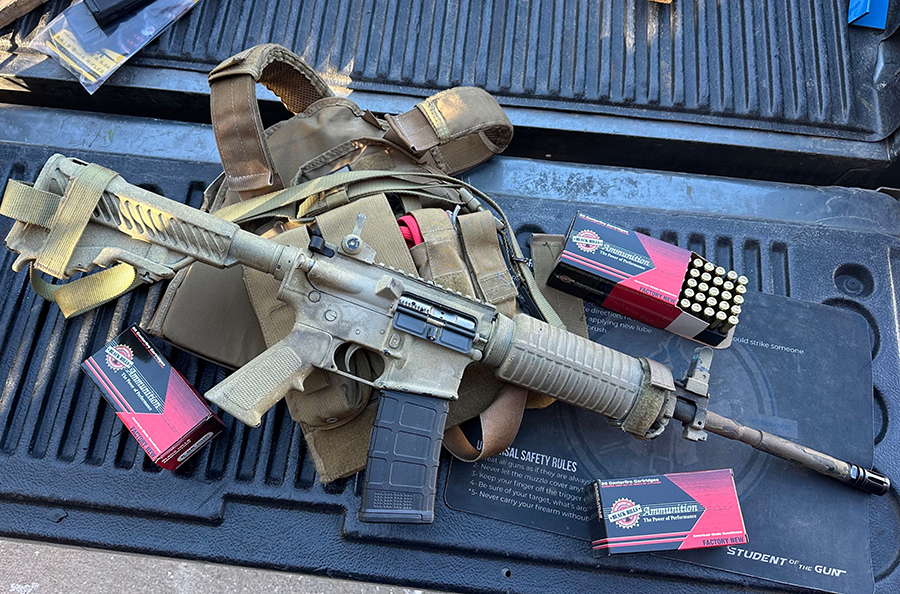
Unless you are running an AR suppressed or have the privilege of running a short-barreled AR on full auto, does the gas piston offer any real benefit over the original direct gas-impingement (DI)? If we are to be honest, the answer is no. This is particularly true if you are using a full or mid-length gas system on a 16 or 20 inch rifle.
If you would have listened to gun forum gossip in 2010, you would have believed that by the current time in history every AR coming off of the assembly line would have some form of gas-piston operation. In our current world, where price point is a key factor for many gun buyers, a gas-piston gun, which costs several hundred dollars more to produce than a DI gun, is a hard sell. How do you convince a neophyte gun buyer to pony up $500 more for a gas piston rifle?
The realistic answer is, you don’t. Where gas-piston ARs were once considered must-haves and the future of the industry, they are now relegated to their original position; specialty tools for special purposes. We live and we learn.
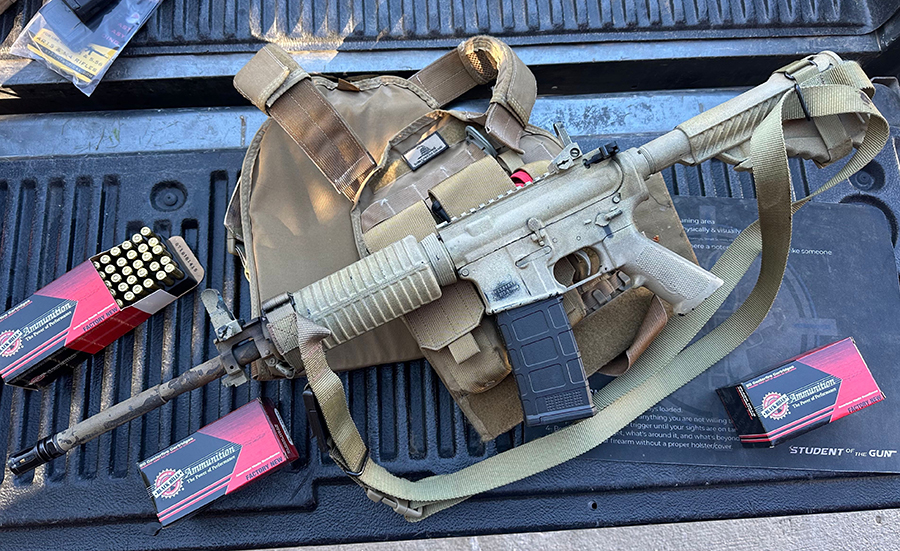
For what it’s worth, I had a blast taking my KKF converted AR out to the range to knock the dust off for this review. It gave me the chance to try out a couple of new AR magazines from a company called XTech Tactical.
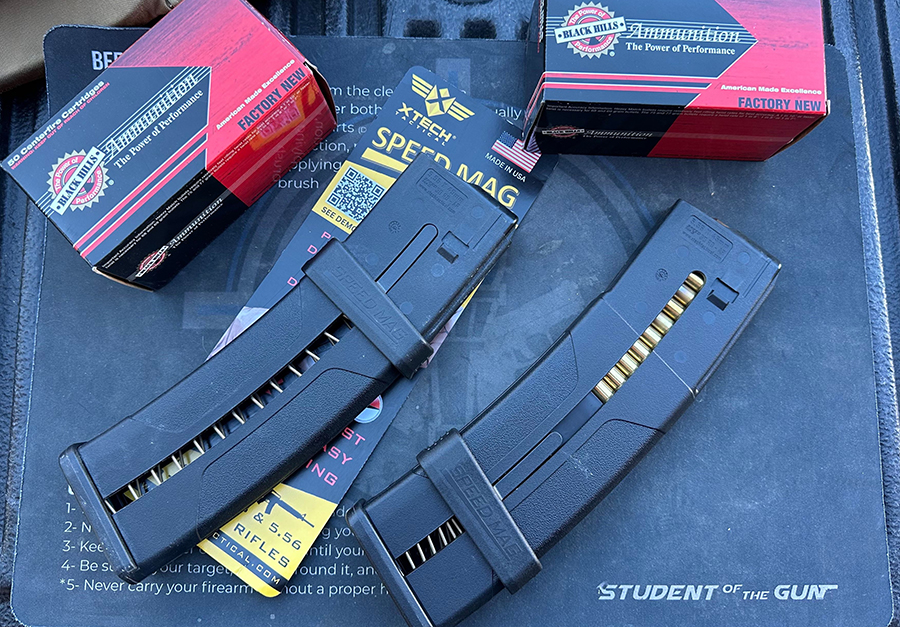
They are now making a Speedmag; 30 round AR magazine that has an easy to load spring compression device. I had two of these and they both worked just fine on the range. They have an open slot and are longer than a standard AR magazine so I would not put them in my fighting kit. However, for range practice they worked out fine.
Paul G. Markel is a combat decorated United States Marine veteran. He is also the founder of Student the Gun University and has been teaching Small Arms & Tactics to military personnel, police officers, and citizens for over three decades.
Nothing happened to gas piston AR’s. Technically, what you call a ‘direct impingement’ AR is actually a gas piston system AR. Even the original AR-15 design listed “bolt and carrier piston system”, but it was first used on the AR-10. Gas is routed from a port in the barrel through a gas tube, directly to a chamber inside the bolt carrier. The bolt within the bolt carrier is fitted with piston rings to contain the gas. In effect, the bolt and carrier act as a gas piston and cylinder.
i know they get the dis more accurate. i’d be happy with 3moa for my intended use.
short barrel piston subsonic.
Being a mechanic not a plumber, I never could understand why sending hot gasses and burning particles of gun powder through a small diameter tube, to a bolt receptacle, to a bolt piston, to be exhausted as close to your face as possible, makes any sense. When all that process could be handled at the other end of the gun. I would never buy or build any AR platform that wasn’t a piston gun. The DOW’s adoption the Sig Sauer’s Spear and Spear LT are all the proof of that I need.