

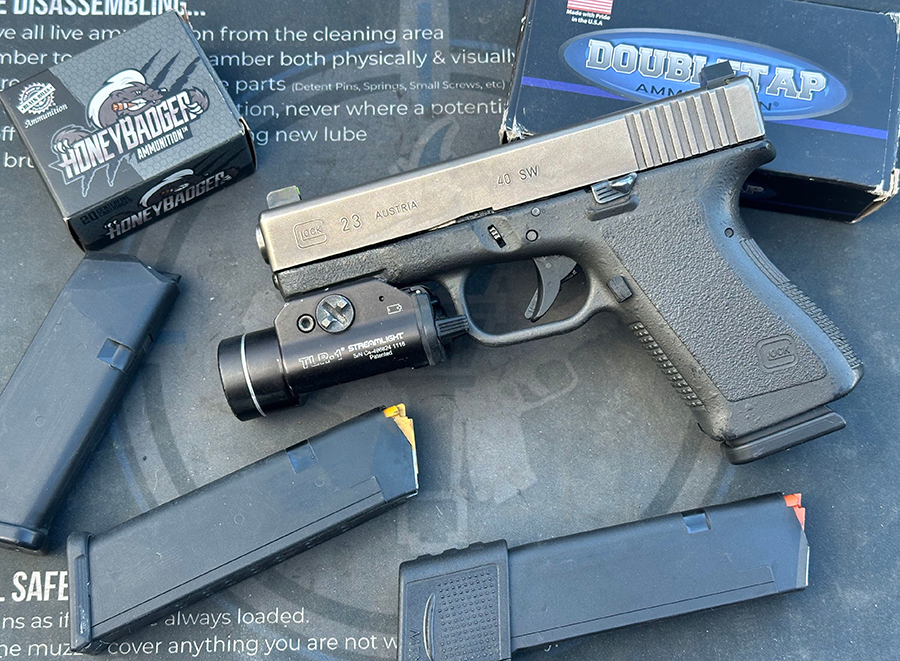
Travel back in time with me to the year 1990. George Bush (the first one) was President. The Cold War had just ended. MTV was still showing music videos. I was stationed at Camp Geiger in Jacksonville, North Carolina as a member of 1st Battalion 6th Marine Regiment. Oh, and GLOCK introduced two new pistols in .40 S&W: the G22 and G23.
As many firearms historians will tell you, the .40 Smith & Wesson cartridge was conceived on April 11, 1986 in Miami, Florida as a result of the famous FBI Miami Shootout. As bureaucracies tend to do, rather than lay blame on human decisions, an FBI report that laid the blame on the Winchester Silvertip Hollowpoint 9mm round.
At that time, the Winchester STHP was arguably the most popular service pistol round for American law enforcement agencies. The FBI report did critical damage to Winchester’s LE sales and, in an effort to recover, they worked with the FBI to develop the “10mm FBI” load as the Bureau had scrambled to adopt the S&W 1076 10mm auto pistol. The 10mm FBI was a lighter-recoiling, reduced power load. Some even called it the “10mm Lite.”
Best intentions aside, the Feds quickly ditched their 10mm handguns because the guns were too big for their agents to carry and “kicked too hard.” Having invested a lot of money, time, and energy trying to please the Feds, Smith & Wesson and Winchester got together and came up with the .40 Smith & Wesson cartridge. same bullet as the 10mm auto, but in a cut-down 10mm auto case to fit in 9mm-sized service pistols. The FBI finally found something that they liked and the die was cast. Soon, every duty gun manufacturer was putting out .40 cal pistols and every ammo maker tooled up to produce it.
In 1990, I was an assaultman with Charlie Company and carried the M9 Beretta 9mm pistol in addition to rocket-launchers. However, I subscribed to various gun magazines and consumed all the information I could about the new .40 S&W and how it was being viewed as the “perfect solution” for power and practical carry size. At that time my primary handgun experience was with the M1911A1 in .45 ACP and, of course, the M9.
GLOCK 23
GLOCK upgraded their 17 and 19 pistols to the Gen 2 in 1988 and then in 1990 released the GLOCK 22 (duty) and GLOCK 23 (compact). During this timeframe, gun makers were not building .40 S&W pistols from the ground up. Rather they took their existing 9x19mm pistols and dropped in .40 caliber barrels while tweaking the slides ever so slightly. For a short time, some companies tried to use the same magazines, but these proved to be unreliable and dedicated .40 S&W mags were made. (Yes, in the early 1990s I had .40 S&W pistols with magazines that were marked 9mm/.40)
Having read innumerable articles from the gunwriter experts of the day, the new GLOCK 23 compact .40 seemed to me like the ultimate concealed carry pistol and I could not wait to get one. Keep in mind, in the early 1990s, GLOCK was just another gun company. Smith & Wesson was still the King when it came to American law enforcement.
In 1991, after Desert Storm ended, the US DoD did as they always do after a conflict, they reduced the size of the military. When my contract was up in April of 1991, the Marine Corps Career Planner did not even try to convince me to re-enlist. I recall that he used a type of Jedi mind trick on me. “You don’t want to re-enlist, do you?” And so, I took my terminal leave, got out, and did what tens of thousands of other veterans did, I went to the Police Academy.
Christmas of 1993 was fast approaching and I really wanted a GLOCK 23. I even drug my poor wife into a gun shop to show her the G23. Apparently I had been talking about that pistol a lot because, when we were back in the car, she said, “Do not buy yourself that gun. I already bought it for you for Christmas.” Like a good wife, she made me wait until December 25th to take possession of the gun. I went immediately to my local gun shop to buy ammunition and I recall that the only .40 S&W they had in stock was Winchester 180 grain jacketed hollowpoint. I didn’t care, I bought it and loaded up the magazines.
Soon I was shooting that pistol at any opportunity I could. In 1993, despite having graduated first in my academy class, and being a veteran, I was up against Cliton-era EEOC and cop jobs were not available, at least not to me. And so, I kept a part-time commission and started working as a bodyguard.
A couple of my teammates were shooters as well and we made a habit of going to the local indoor range at least twice a month. It was not long before I had put hundreds and then thousands of rounds through my G23 pistol. It was a stock gun and had plastic sights, but the more I shot it, the smoother the trigger pull became.
Having been a United States Marine, I understood the importance of maintenance and gun cleaning and I keep that GLOCK 23 clean and well-lubricated. However, back then no one ever mentioned to me that part of long term maintenance is to replace the recoil spring. It was not until many years later that a friend at GLOCK told me that I should be replacing the recoil spring in my G23 every three thousand rounds.
When GLOCK introduced their 3rd Generation pistol in 1998 with the “Universal GLOCK Rail” I will admit that I felt like I was missing out. My G23 was a Gen 2. Should I buy a new gun? Some time after 1998, I cannot recall the exact date, I was on the phone with Robbie Barrkman, then owner of Robar Companies: custom gunsmiths and finishers.
During our phone conversation, the subject of GLOCK pistols and the upgrades that Robar was doing came up. I asked Robbie if he thought it was possible to machine an accessory rail into a Gen 2 GLOCK frame. His response was, “Ship me the gun and I will figure it out.”
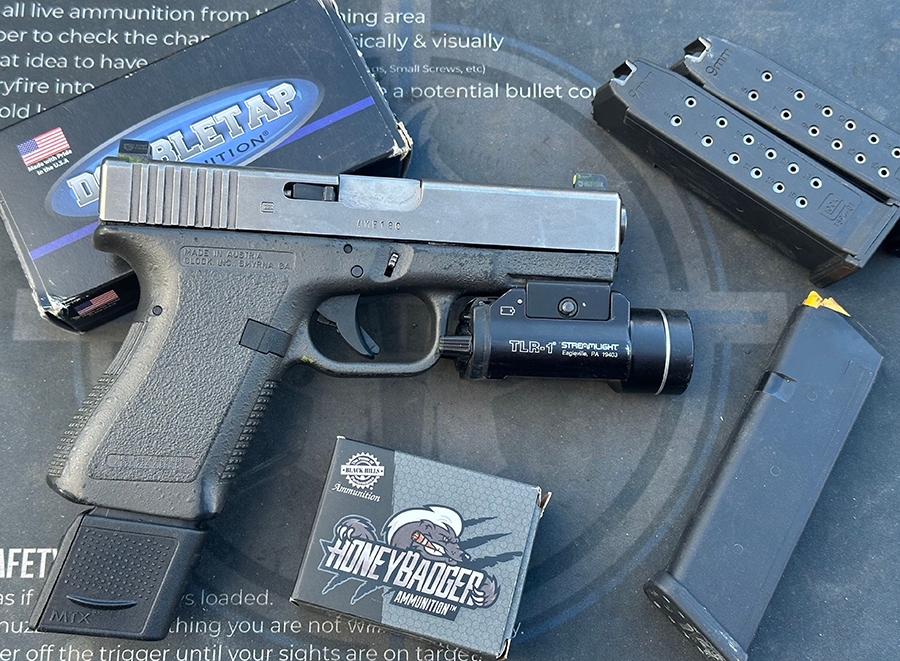
Well, that is what I did and not only did Robbie machine a rail into the frame, he removed the silly triggerguard hook and added just a bit of grip texture. Robbie also applied his patented NP3 finish to the slide. By this time I had gotten rid of the plastic sights and replaced them with steel Tritium versions.
.40 S&W to 9mm
I can’t recall who it was that hipped me to the idea that it was possible to convert a .40 S&W pistol to a 9mm by swapping barrels and magazines, but twenty years ago, perhaps a bit longer, that’s what I did. It has been as long since I realized that I did not really need the .40 cartridge. Yes, I admittedly still have an ammo can of .40 S&W. Maybe I should shoot it up one of these days.
Keep in mind, you cannot just take a factory 9mm barrel and throw it into your .40 S&W pistol. There is just enough difference that it will not function reliably. What you need is a genuine conversion barrel.
I am actually on my second 9mm conversion barrel for my GLOCK 23. This barrel came from Lone Wolf Distributors. Naturally, I needed 9mm magazines which were not hard to come by. While some folks commented that 9mm would not cycle reliably in my G23, twenty plus years of experience and thousands upon thousands of rounds of all manner of 9x19mm ammunition have proven otherwise.
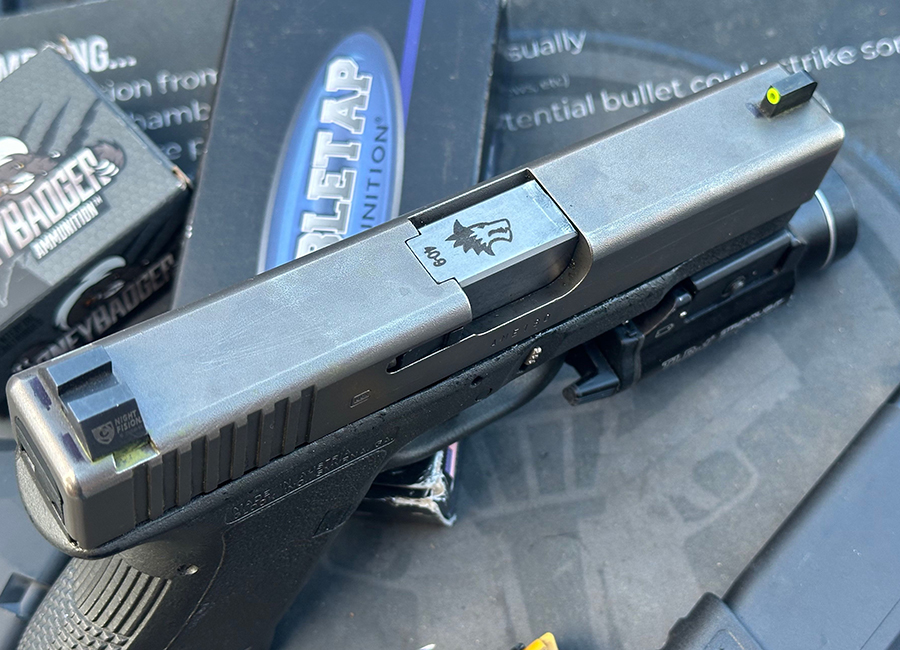
I have had this GLOCK pistol so long that it is now on its third set of Tritium sights. The current sight up is the Accur8 sights developed by myself and Night Fision to provide reliable point of aim/point of impact from 5 yards to 50 feet for 9mm GLOCK pistols. The super-bright “safety green/yellow” front sight truly pops on the range.
Range Testing
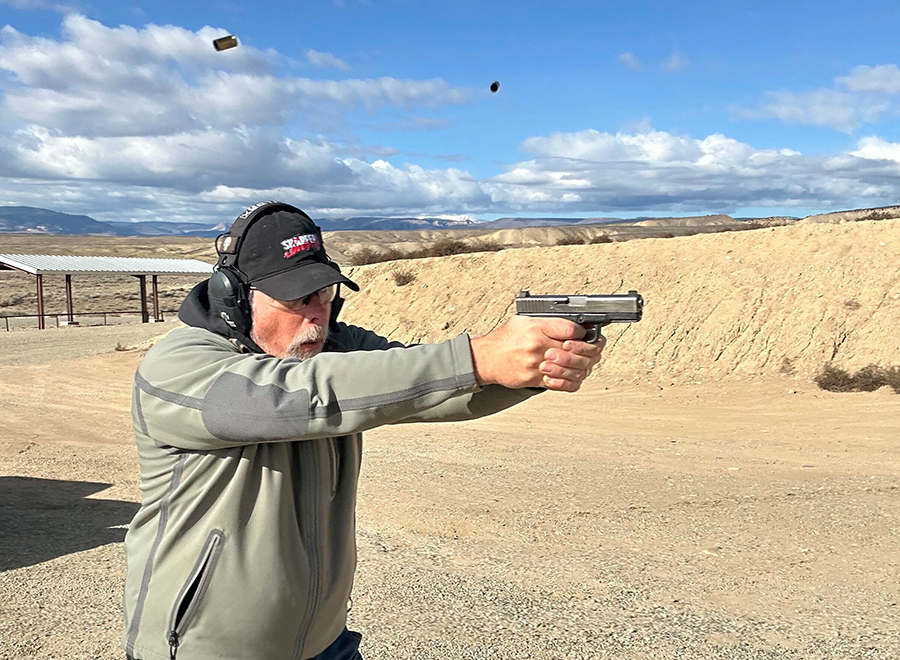
Between the .40 S&W and 9mm, I would say that it is safe to estimate the round count in my G23 in the tens of thousands of rounds. In preparation for this review, I had a couple of new accessories that I wanted to try out with my old friend.
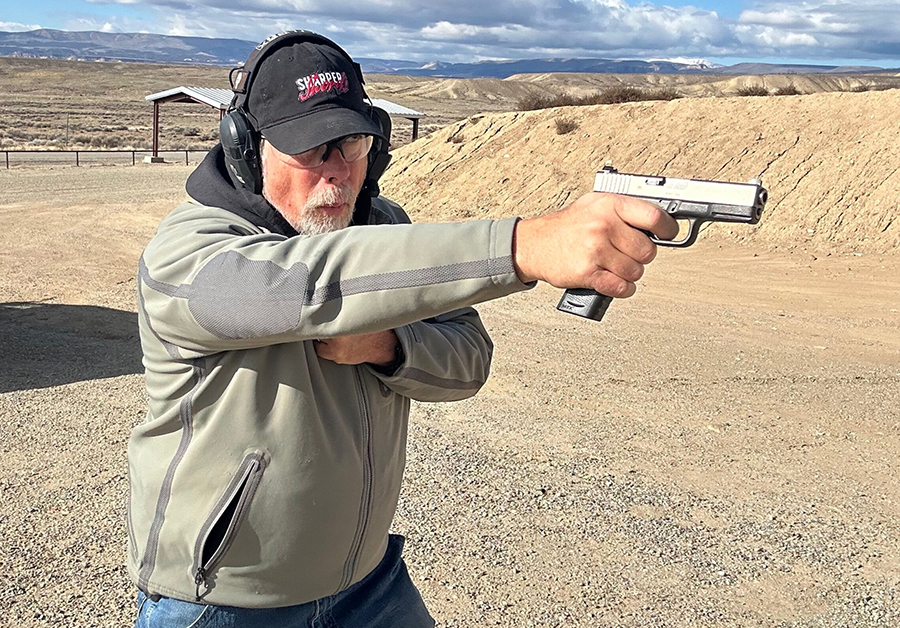
XTech Tactical has several products for GLOCK pistols including their MAG17-17 round 9mm GLOCK mags and a MAG19 EXT, a five round extender for GLOCK 19 magazines. I converted one of my factory G19 15 round magazines to hold twenty rounds with the XTech extender.
The XTech MAG17 pistol magazines are advertised as having an “extra power” spring and I believe they do. My experience was such that for the last few rounds, I decided to save my thumb and use a GLOCK mag-loading tool.
Parting Shots
The only question marks for the range session were the new XTech products. I can report that both the MAG17 and the extended G19 magazine performed without flaw. The GLOCK pistol ran with monotonous reliability and accuracy.
My GLOCK 23 was a constant companion from 1993 to about 2008. Of late, I have gravitated toward the compact Canik MC9 pistol for everyday use. However, taking that gun to the range was a pleasure and it ran as well as the day I first shot it. It may not be new or improved, but my G23 is a true modern classic.
Specifications
Caliber .40 S&W
Capacity 13 (others)
Action Semi-Auto
Barrel Length 4.02 inches
Overall Length 6.85 inches
Weight (empty) 21.16 ounces
MSRP $539
Paul G. Markel is the founder of Student the Gun University and has been teaching Small Arms & Tactics to military personnel, police officers, and citizens for over three decades. He is the author of numerous books and is a combat decorated United States Marine veteran.
“I even drug my poor wife into a gun shop to show …”
‘I even dragged my poor wife into a gun shop to show …’
It’s either ‘dragged’ or ‘drag’ unless you intended to say …’I even drugged my poor wife to get her to go to gun show…’
‘drug’ is an ‘improper English’ ‘U.S. regional dialect’ usage in this usage context.
I like the .40 S&W. Another cool thing about this is being able to use 357 Sig with a simple barrel change.
“Another cool thing about this is being able to use 357 Sig with a simple barrel change.”
Or 9mm…
Shooting 9mm out of it requires a different magazine. 357 Sig uses the same magazine as .40 S&W.