

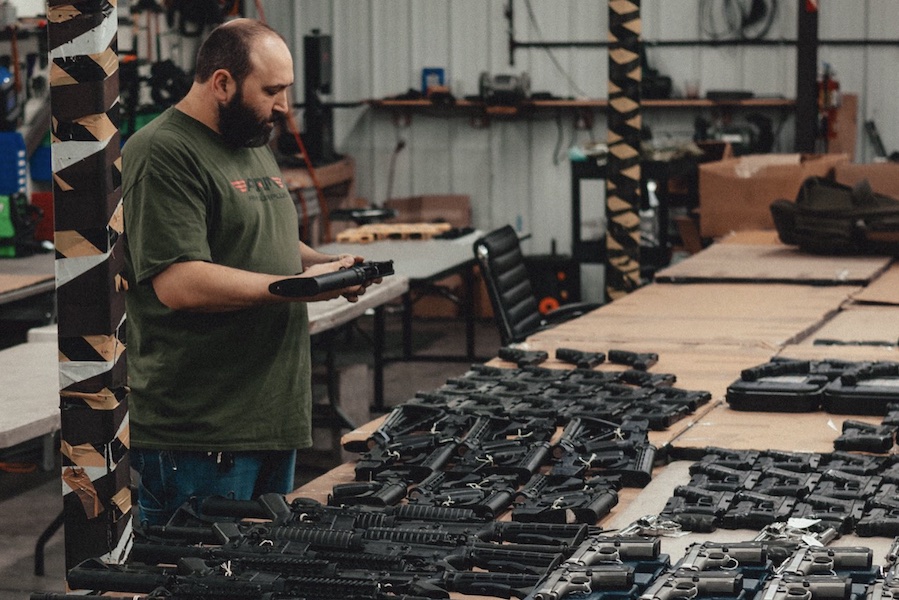
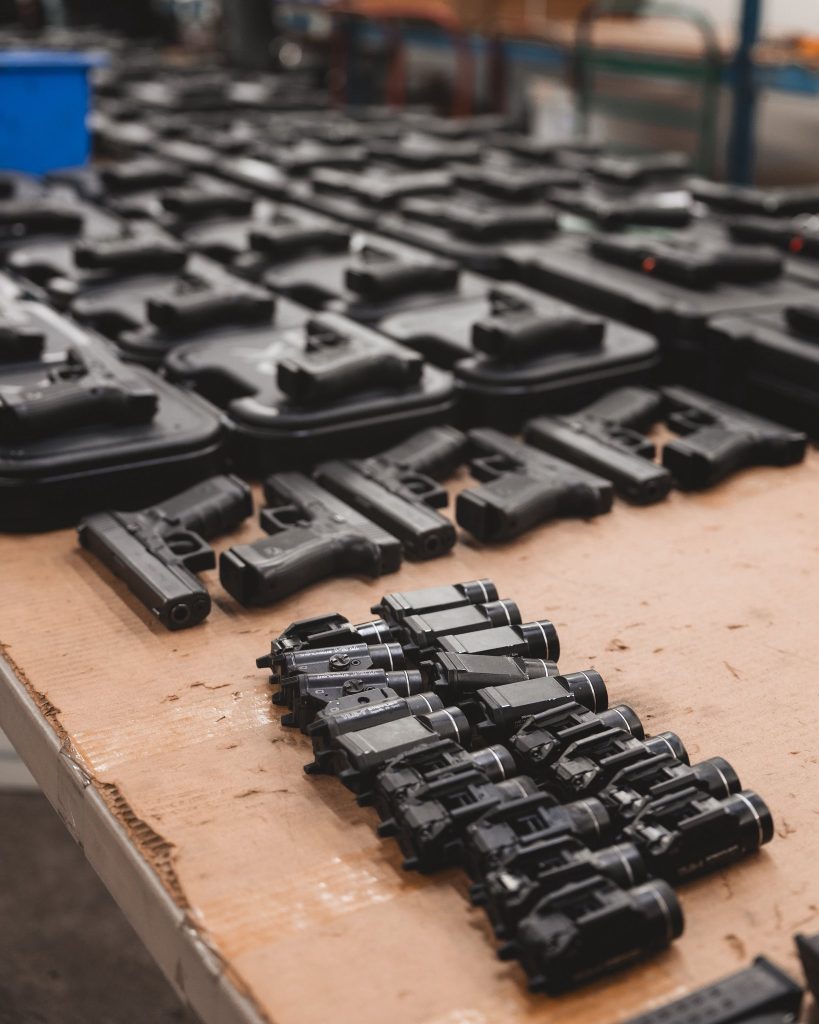
Thanks to the internet, finding good deals on used guns is easier now than ever. This is particularly true when it comes to law enforcement trade-in guns. Twenty years ago, if you wanted to take advantage of the bargain prices on LE trade-in guns your local gun store needed to be in the pipeline for such or you shopped from paper catalogs and flyers.
Over the years, I’ve taken advantage of deals that seemed at the time to be too good to pass on. Deals like GLOCK 22 trade-ins for $249 or compact G23 pistols for $299. I would bet that right now more than half of my reading audience could go to their email inbox and find a message from one of numerous online retailers advertising various LE trade-ins. Just for fun, I stopped writing and searched my inbox. It took me about 60 seconds to find an advertisement offering trade-ins.
What You Need to Know
The old adage about police agency guns is that they’re carried a lot and shot very little. While that can be true, you need to consider what “very little” means when stretched out over the life of the gun in question.
First, if you feel like doing a little bit of research, you can search and figure out what model of gun you are looking at, when they went into production and whether or not they’re still in production. For our example, let’s consider the GLOCK 22 in .40 S&W. For a couple of decades that gun was essentially the standard issue for 75 to 80 percent of LE agencies in the US.
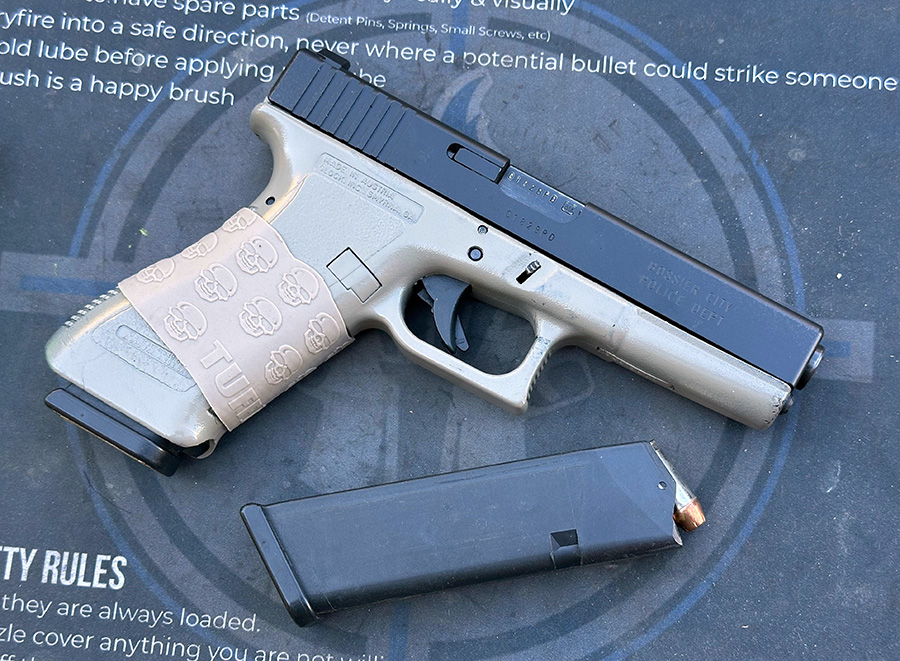
I have a G22 Gen 2 (no accessory rail) that I picked up at a Police Supply/Gun Store for the aforementioned price of $249 before tax. That gun was released around 1990 when the .40 S&W cartridge became the new hotness. In 1998, GLOCK introduced the G22 Gen 3 with the accessory rail, thus making the first model of the G22 obsolete, at least in the eyes of many LE agencies.
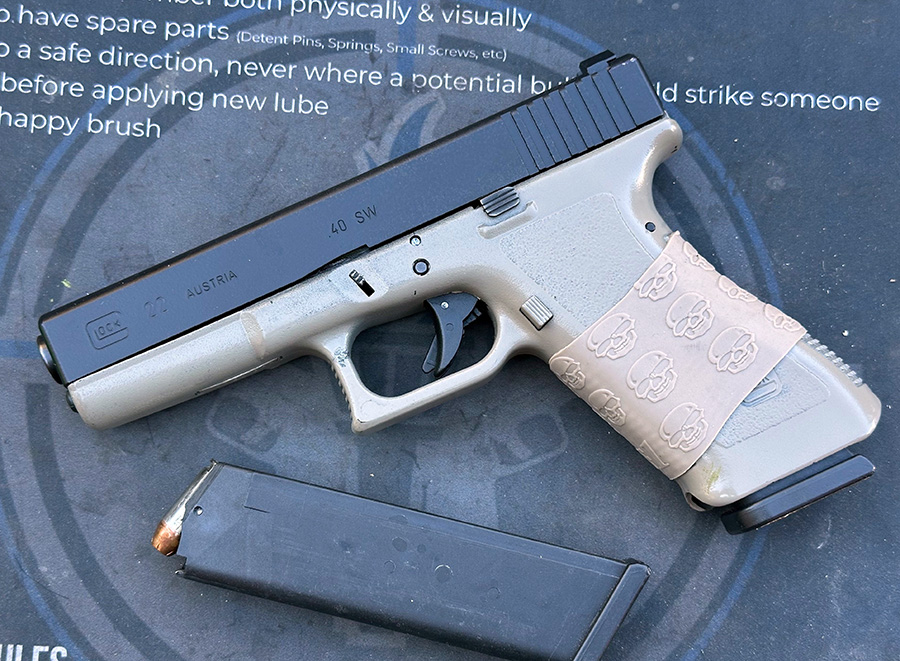
My LE trade-in G22 was initially purchased by the Bossier City (Louisiana) Police Department and it says so right there on the slide. For those unfamiliar with Louisiana geography, BC is right across the Red River from Shreveport, a wonderful place to raise a family.
Let’s say that BCPD bought the guns in the early 1990s and upgraded to the Gen 3 models in the early 2000s. If the officer or officers who carried my pistol fired a hundred rounds a year, that’s only a thousand rounds or so. If said officer was a gun guy, as many southerners and country folk are, he might have fired twice, maybe three times or more that number. I have absolutely no way of knowing.
You could tell the pistol was carried a lot as there were noticeable holster wear marks in the usual places on the slide. Also, the gun had the GLOCK factory option night sights (tritium front and rear).
The normal ‘glow life’ for tritium sights on handguns is about ten years, maybe a bit longer. One of the selling features on many LE trade-in pistol advertisements is “Includes Night Sights.” Yeah, sure. That sounds cool, but let’s face it, by the time the agency traded in their pistols, the tritium sights were either dead or almost there. The dealer should be paying you a hazmat disposal fee for replacing them.
The good news about original GLOCK night sights is they’re made of steel, not plastic, so that’s a plus. However, if you want sights that (still) glow in the dark, as I did, you’ll need to replace them. GLOCK pistol sights are probably the easiest setup to switch out. I did so by installing a new set from Night Fision. They also sell a very handy and inexpensive sight installation tool kit.
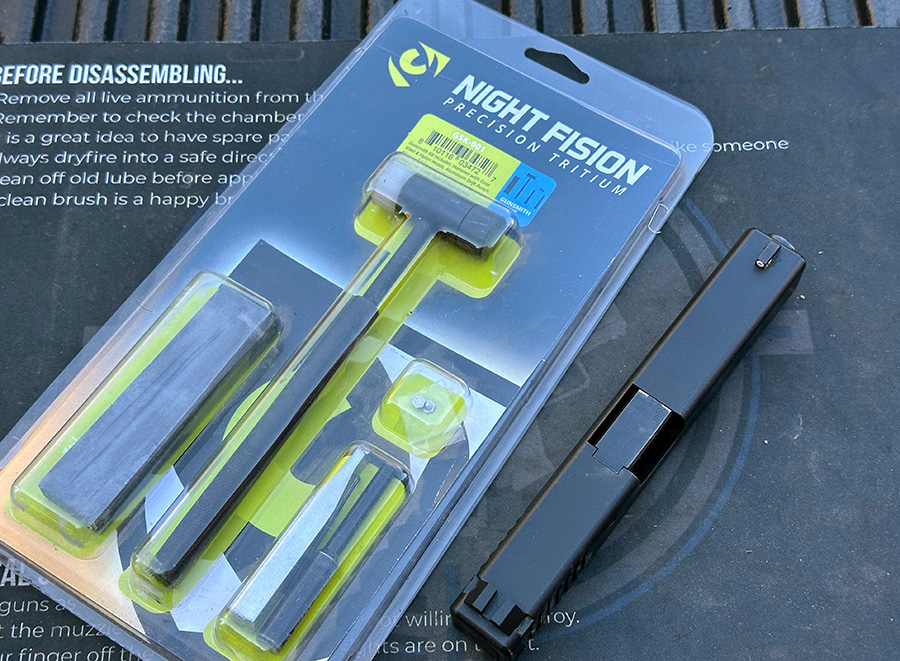
As for the finish on the gun, just for fun, I used Duracoat FDE brown (tan) on the frame and put a Slightly Darker Black finish on the slide. That’s the great thing about being an American, you have choices. As for the barrel, there was plenty of the polygonal rifling left in the tube.
“.40 Smith & Breaker”
Just like its daddy — the 10mm Auto – the .40 S&W round has always been a high pressure cartridge. As such, shooting the .40 puts a lot of stress on the internal parts of the pistol. Remember, when the .40 came about, what every gun maker in the world did was take their existing 9mm pistols and modify them ever so slightly to take the new 10mm Short cartridge.
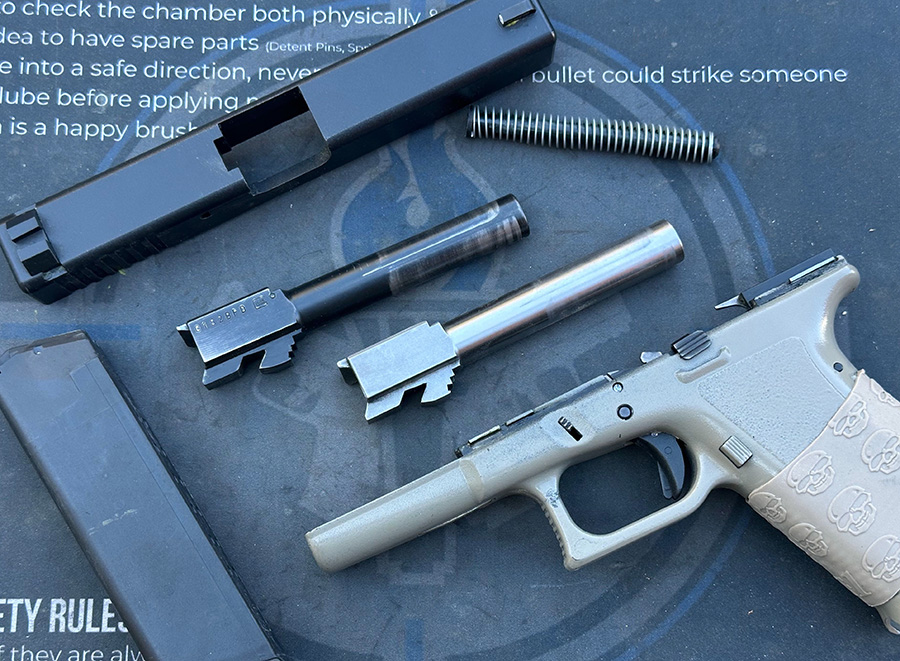
Folks, 9x19mm is a low pressure cartridge. When you put a high pressure cartridge in a pistol designed for low pressure, eventually parts are going to break. No, the barrels/chambers won’t break, but you know what will? The pins and the locking block.
During the decade of the 1990s when I was a police officer and everyone was shooting the .40, I fired a lot of that ammo. By “a lot” I mean tens of thousands of rounds. I have witnessed broken locking block pins, broken trigger pins and even locking blocks that when removed from the frame came out in two pieces (Note: they are supposed to be only one piece).
Although no police armorer ever mentioned it to me, after I’d been shooting .40 for years, I was told by my friend at GLOCK that they recommend that the recoil springs in their .40 S&W pistols be replaced every 3000 rounds. My experience with law enforcement armorers is very similar to that of my experience with military armorers — they don’t replace anything on a pistol until something breaks.
My other experience with the Gen 2 GLOCK .40 pistols was that the trigger spring had a tendency to break. A broken trigger spring means a dead gun. I experienced this personally and spoke with others who also had the same experience. GLOCK fixed this issue with the Gen 3. However, if you find a ‘great deal’ on a Gen 2 GLOCK in .40, I would go ahead and order a new trigger spring now. That investment will set you back about $3. A 3-pin set for the G22 will cost you around $20. A new locking block is $20 to $30.
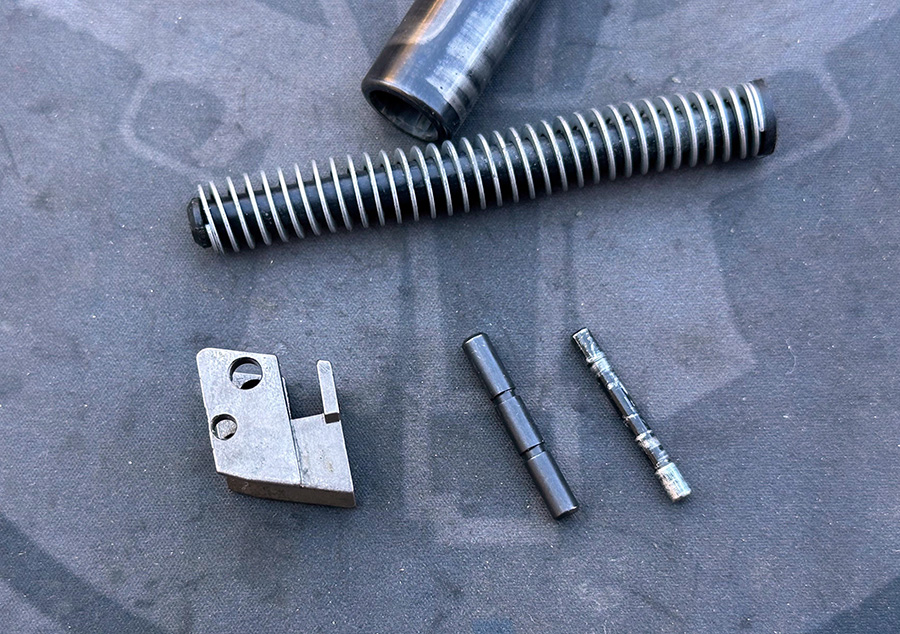
You can pull out the pins and the locking block on your G22 and inspect them visually. You might see tiny, microscopic cracks or you might not. If you’re able to see the cracks, that part is going to break sooner rather than later. If you are unsure how to completely disassemble a GLOCK pistol, Brownells has a full series of excellent videos.
Funny story. About 15 years ago I was on the phone with a buddy and we were talking about taking out a GLOCK trigger. He said, “You’re a GLOCK armorer, right?” I had to admit that I was not. “Geez,” he replied sarcastically, “my grandmother is a GLOCK armorer.” Shortly thereafter I took an online GLOCK armorer’s course and fixed myself.
9mm Conversion
One of the big drivers for folks buying a LE trade-in GLOCK .40s is the vast availability of aftermarket conversion barrels that allow you to convert your .40 to shoot 9x19mm. It took me only a few weeks before I ordered just such a conversion barrel from Lone Wolf Distributors The only other items I needed were G17 magazines of which I already had plenty.
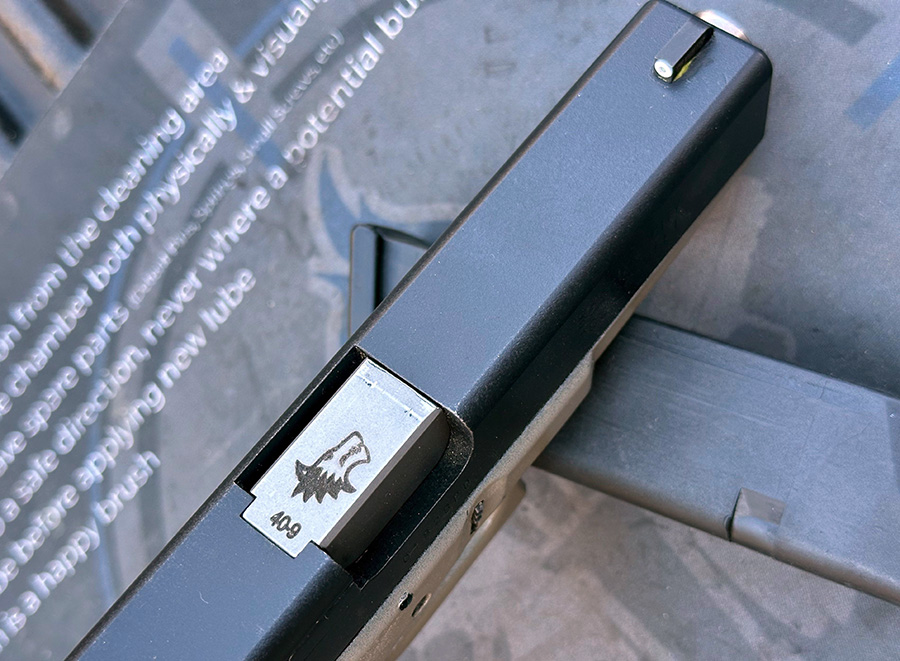
For those who might say 9mm won’t run (cycle) in a .40 because the extractor/ejector are different, I say, that’s a cool story, but I’ve shot thousands of rounds of 9mm from my converted guns and have yet to experience that issue.
Parting Shots
While we’ve been focusing on the G22, I have also converted a LE trade-in S&W M&P in .357 SIG from that (obscure) cartridge to a fine-shooting 9mm. Even if you have no desire to swap pins, etc., if nothing else, I suggest shelling out the money for a brand new recoil spring for about $7. It’s an inexpensive investment that could add years or decades to your surplus pistol’s useful life.
Paul G. Markel is the founder of Student the Gun University and has been teaching Small Arms & Tactics to military personnel, police officers, and citizens for over three decades. He is the author of numerous books and is a combat decorated United States Marine veteran.
“For those who might say 9mm won’t run (cycle) in a .40 because the extractor/ejector are different, I say, that’s a cool story, but I’ve shot thousands of rounds of 9mm from my converted guns and have yet to experience that issue.”
First of all, I love the way Mr. Markel worded that! More importantly, reliable function (when shooting 9mm Luger cartridges in a conversion barrel in slide chambered for .40 S&@) is most certainly NOT a guarantee in any given handgun. While it clearly has been reliable in Mr. Markel’s particular handgun, it may be very unreliable in your conversion. And if your conversion handgun is a “fun gun” for recreational shooting, that is fine–whether or not it is reliable–as long as you enjoy shooting it. If you plan to use your conversion gun as a self-defense firearm, I highly recommend against that. Choose wisely.
On the other hand, my Glock 35/9mm conversion (barrel and recoil spring) has about 10,000 competition rounds through it. It’s malfed only a couple of times, all related to a chipped extractor. When I replaced it, I also did the recoil spring and a few others. I have more rounds through this than all my other pistols combined. I call it good-to-go for self defense.