

“Well, the .223 might be good outside your house, but I would never use it inside.” So said the unsolicited advice from a random commenter on the internet. One might think that, given the last 20 years or so of 5.56mm carbines and rifles being used by US law enforcement, as well as myriad uses of the M4 in close quarters MOUT fighting, that such mythology would have been sufficiently debunked. One would be wrong.
If we were to have only encountered one single such response, we might write it off as a rare case of misunderstanding. Sadly, such has not been the case. As recently as a few months ago, I encountered a piece written in one of the few remaining dead-tree gun magazines where the author, held out as some kind of expert, regurgitated the age-old advice that “handguns are the best home defense tools.”
My attempt here will be to address some of the misunderstanding as well as mythology surrounding the use of a centerfire rifle cartridge for home defense.
To STOP, Not to Slow Down
Before we address hardware, we first need to consider mindset and our goal for home defense. During the terrifying moments of a home invasion — not an empty house burglary — where you are in your castle and one or more violent monsters have broken in, what’s the goal? Is the goal to wound the invader or invaders? Keep in mind, a large percentage of home invasions involve multiple armed attackers.
First, you are at a distinct disadvantage from the standpoint that the invaders will choose the time, often late at night when you are sleeping, but not always. Also, chances are good that there will be one lone defender facing one or more attackers. This is horrifying and an extremely distasteful idea for most people. So much so, that many choose not to voluntarily think about it.
Therefore, given all the previous, what should your goal be as the home defender…to slow down the invaders or to stop them from harming you and your family as rapidly as science and physics will allow? If you’re of the opinion that you don’t want to stop them as fast as possible, you can stop reading right now. There is nothing else here for you here.
Centerfire Rifle vs. Centerfire Handgun Cartridges
Now we come to the reality of physics or ballistic science. There’s no centerfire handgun cartridge that’s capable of delivering the on-target ballistics that a centerfire rifle cartridge can. Sorry, magic bullets and magnum rounds from handguns don’t trump rifles. Even though your great Uncle Jim still refers to the 5.56mm NATO as a “gopher round,” that doesn’t alter reality.
Remember, our goal is to stop the attacker(s), not merely wound him. Wounded attackers tend to keep on attacking and killing.
About three decades ago, John Farnam, a Vietnam conflict combat veteran and trainer of some note, posed a question to the class of students of which I was a participant. “What do attackers do when shot with a handgun?” The question was rhetorical, but Mr. Farnam paused for a moment to let it sink in. “They keep doing what they were doing before you shot them.” Naturally, the purpose of that statement was to flush out the Hollywood and TV programming that we might have had where a single round from a pistol or revolver lifts the bad guy up and throws him backwards.
Those who might disagree should consider the much-discussed FBI Miami Shootout during which Michael Platt took 12 hits from shotguns and handguns before finally stopping. His partner, William Matix, took six rounds from handguns before he finally stopped. Matix was even shot in the head with a 9mm during the opening salvo and got out of his car and moved to an FBI vehicle in an attempt to escape. Look it up if you don’t believe me.
Platt was shot in the chest with a 9mm in the opening seconds of the fight and received what doctors described as an “unsurvivable gunshot wound,” but he kept moving. Platt went on to kill two and critically injure three FBI agents. Platt did that damage with a Ruger Mini-14 using 55 grain .223 Remington ammunition.
Think that’s just one instance? Emil Mătăsăreanu, one of the two North Hollywood bank robbers, was shot 29 times with handguns and shotgun pellets before he eventually bled to death. While he was bleeding out, Mătăsăreanu continued to fight. Twelve officers and eight civilians were wounded. Miraculously, none died during that incident.
Now that we understand that centerfire cartridges are infinitely better fight-stoppers than handgun cartridges, we can proceed to the next topic.
5.56mm/.223 Remington
The Armalite Rifle Model 15 is 69 years old at this writing and has undergone innumerable improvements during that time. Ditto the cartridge for which it was originally chambered: the 5.56x45mm NATO. The fact that the AR-15 was designed to be lightweight and easy to handle with a low recoil impulse benefits the American home owner as much as it did the GIs for whom it was originally intended.
While the 55 grain FMJ load from a 5.56mm is nothing to sneeze at, the ammunition available today is even better at stopping bad guys and home invaders. We used to call them BTHP (boat-tail, hollowpoints), but now the cool vernacular is “OTM” (open-tipped match). Same basic bullets, different names.
The OTM projectiles were used initially by USSOCOM forces during GWoT to great effect. The Mk262 from Black Hills ammunition was actually developed in conjunction with USSOCOM and the folks in South Dakota in 1999. The current iteration is the Mk262 Mod1-C with a 77 grain Sierra Matchking projectile. It also uses flash-reducing powder and NATO spec brass cases.
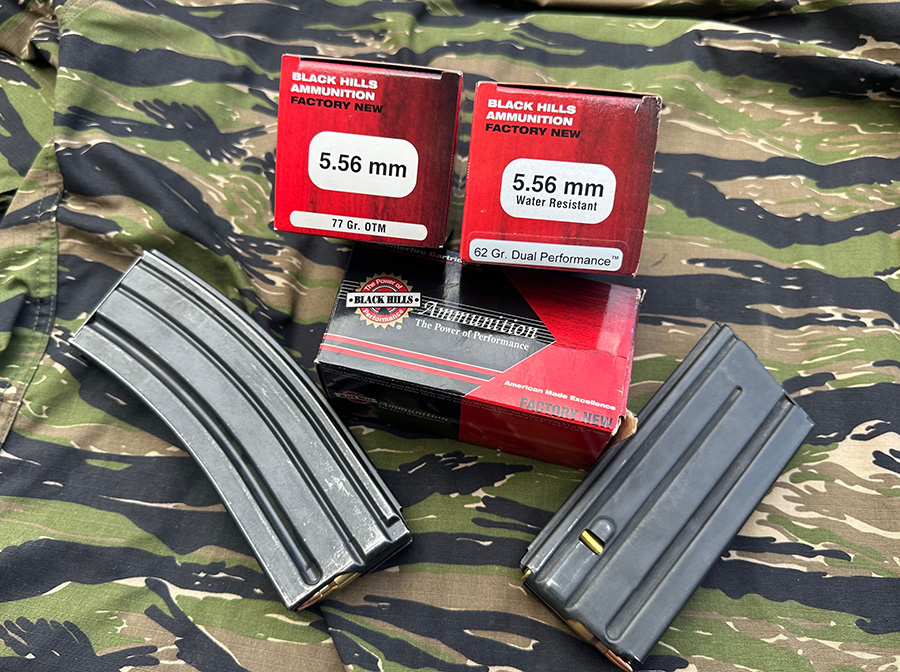
I have several friends from “the community” who absolutely swear by that load when it comes to 5.56mm ammunition. From a personal standpoint, I have used it on living targets and it performs as advertised, if not better.
The Overpenetration Boogeyman
“I would never use a rifle in my house due to overpenetration” or so the story goes. The question is, what are you afraid the bullet is going to overpenetrate?
If the answer is interior walls, I have some bad news for you. Many moons ago, we conducted penetration testing on standard drywall construction, interior walls. Guess what…every round we fired, even down to the pipsqueak .22 LR and .25 ACP passed completely through an interior wall. The only hope for slowing down the small bullets was hitting a 2×4 stud. Larger bullets, like 9mm, .38 Spl, and .45ACP, easily pass through wall studs at close ranges.
Now, if you’re talking about overpenetration of the home invader(s) who smashed in your door and ais trying to hurt your family, read the next sentence very carefully. An OTM or ballistic-tipped 5.56mm round is less likely to penetrate through-and-through a human torso than a handgun round. A slow, heavy bullet like the .40 S&W that has a terrible reputation, is far more likely to pass through and keep going than a hyper-sonic, lightweight 5.56mm bullet. That’s not my opinion, that’s reality based on science and empirical evidence from thousands of deadly force shootings.
Light Switches and Door Knobs
“I use a handgun because in a home invasion I might need to turn on lights and open doors, and you can’t do that with a rifle.” First of all, who told you that? Second of all, bullsh!t. There is this thing called a pistol grip on an AR that gives you solid control of the gun while using a single hand. That’s why modern long guns have them and old style guns don’t.
If you can’t maneuver through your house and flip light switches or open doors while holding a carbine, you need to go to a training course and learn how to use it in a martial fashion.
Carbines are Too Long to Maneuver Inside Houses
When it comes to the modern AR variants, particularly rifle caliber pistols, they are far easier to maneuver in a MOUT environment than something like an M14 or an FN FAL. I have run shoot-houses and MOUT training with a full-sized G3 and a 20 inch-barreled M16. Yes, those require special training and skill, but that’s not what we are discussing here.
Let’s say that you have an AR pistol with an 11-inch barrel and a stabilizing brace. How does the length of that compare to holding a G17 pistol in both hands extended in a firing position? To find out, I had my daughter measure from the back of my shoulder to the tip of the muzzle on my home defense AR pistol and then measure the same way to the muzzle of a G17 that I extended in a two-handed firing position. The distance was identical. Both were 35 inches.
The Noise
Are rifle cartridges noisy? Yes, they are. Handguns fired in a hallway aren’t exactly quiet either. This is where you need to think ahead. In our modern age, there are numerous solutions to both dampening the noise and redirecting it forward toward the intended target.
The obvious solution is to get a dedicated short, fat 5.56mm suppressor and affix it to your home defense carbine. I have had people reply to that suggestion with some absolutely stupid sh!t. “But, the cops will take my silencer as evidence and I’ll lose it.” Folks, what in the name of all that is holy are your priorities? Is the priority to stop the deadly home invaders immediately and save your life and the lives of your kids (along with your hearing) or is it to protect the sanctity of your precious suppressor?
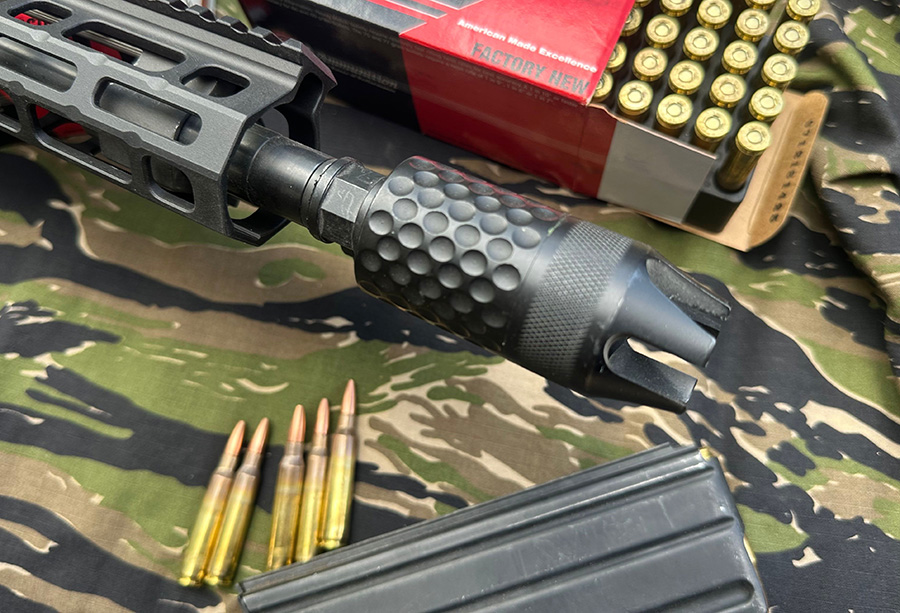
For those who don’t want to or can’t own a true suppressor, there are other options. The Barking Spider II muzzle brake from Spikes Tactical can be purchased online and it effectively reduces flash while redirecting much of the noise away from the shooter toward the target.
The worst possible thing you can do is to attach a “competition brake” to your home defense gun. These wastes of steel and abominations to the Lord make the gun even louder and increase the flash. Save those for your range toys. Even the M16 style “birdcage” flash hider are a better choice.
My Home Defense AR Pistol Project
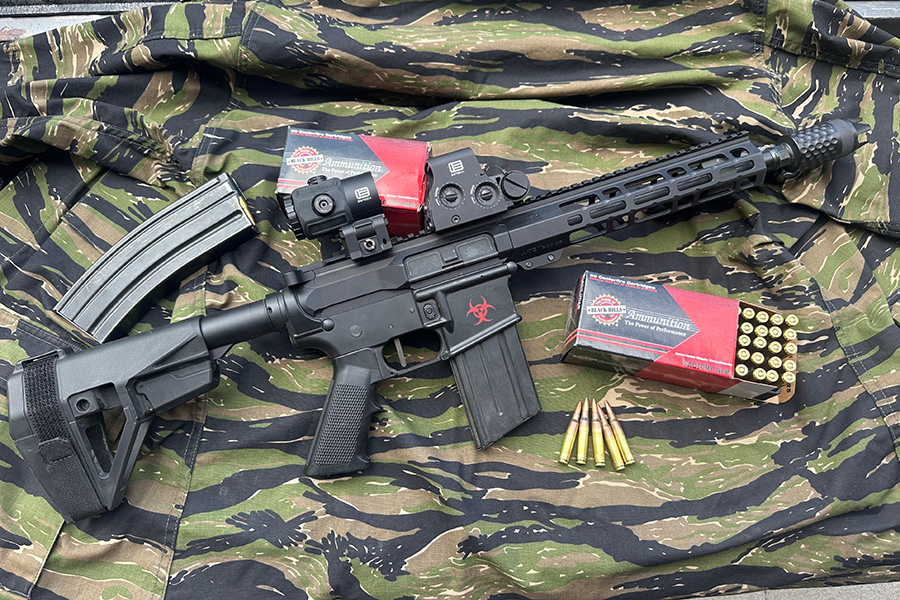
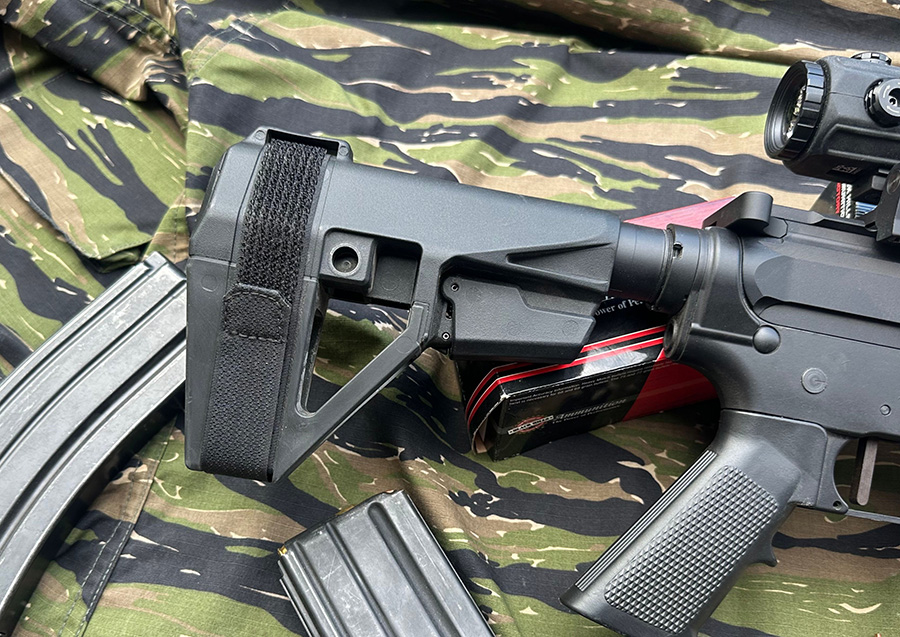
Given all of the above, I set out to assembling a home defense AR pistol. The lower is typical AR with an SB Tactical SBA5 brace. The SBA5 fits on standard AR buffer tubes and is adjustable.
The upper receiver came from AT3 Tactical. This complete upper assembly has a 10.5 inch Faxon barrel, an M-Lok aluminum free-float handguard, a nickel boron bolt carrier group and standard configuration charging handle. Onto the muzzle I attached the aforementioned Barking Spider II brake.
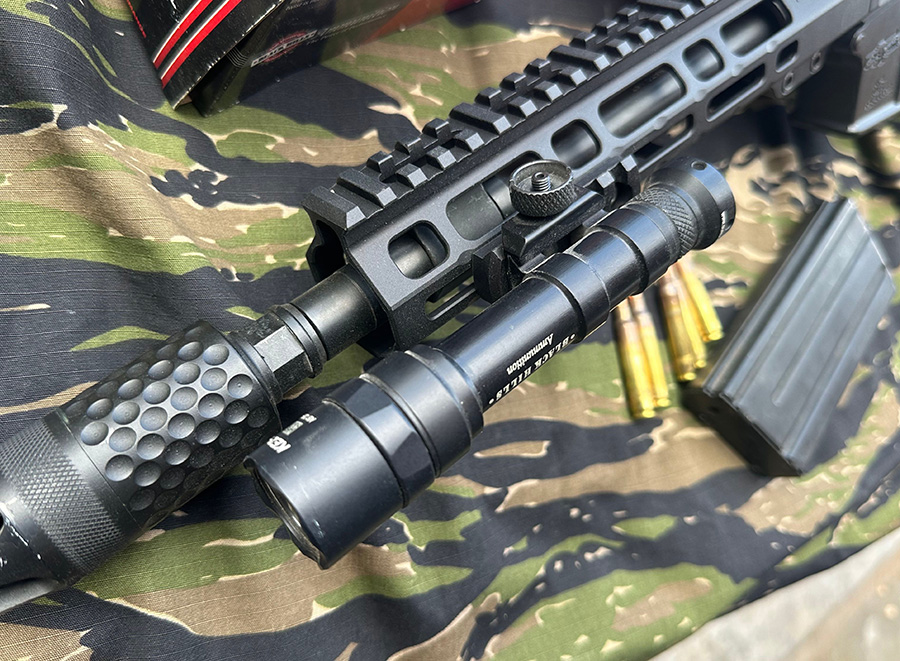
We, as the good guys, can’t just shoot at shadows or in the general direction of scary sounds. Therefore, onto the rail I attached a Surefire Scout Light. I chose a push-button over using the tape switches for simplicity and ease of use.
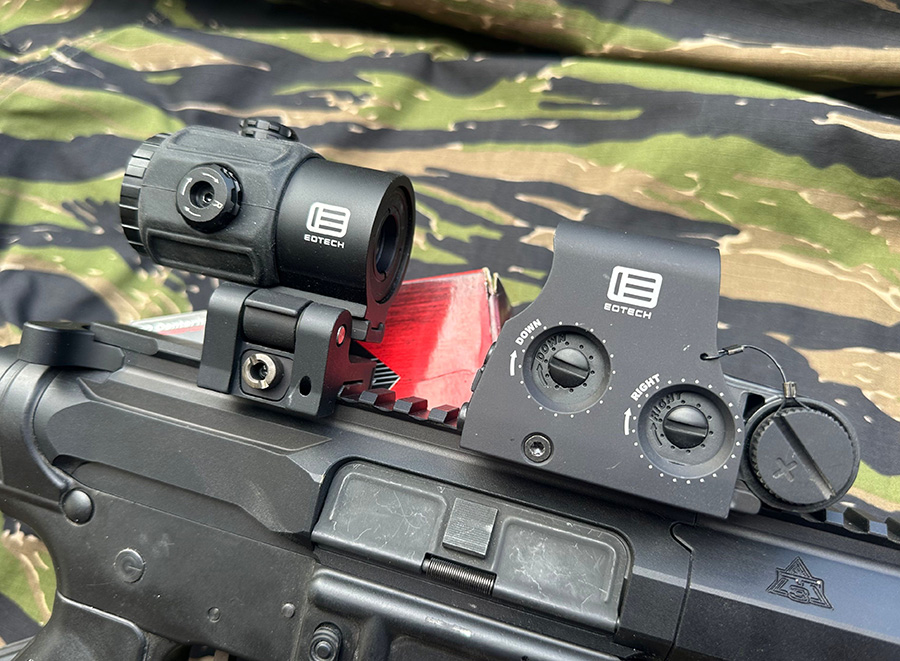
I live on a small ranch in the mountains and I’m as concerned with four-legged threats as I am with the two-legged kind. If a predator threatens our livestock, they need to be dispatched forthwith. Given that, I decided to use a combination EOTech HWS optic with one of their 3X magnifiers. The 3X easily rotates out of the way when it’s not needed, but can be put into service in about one second.
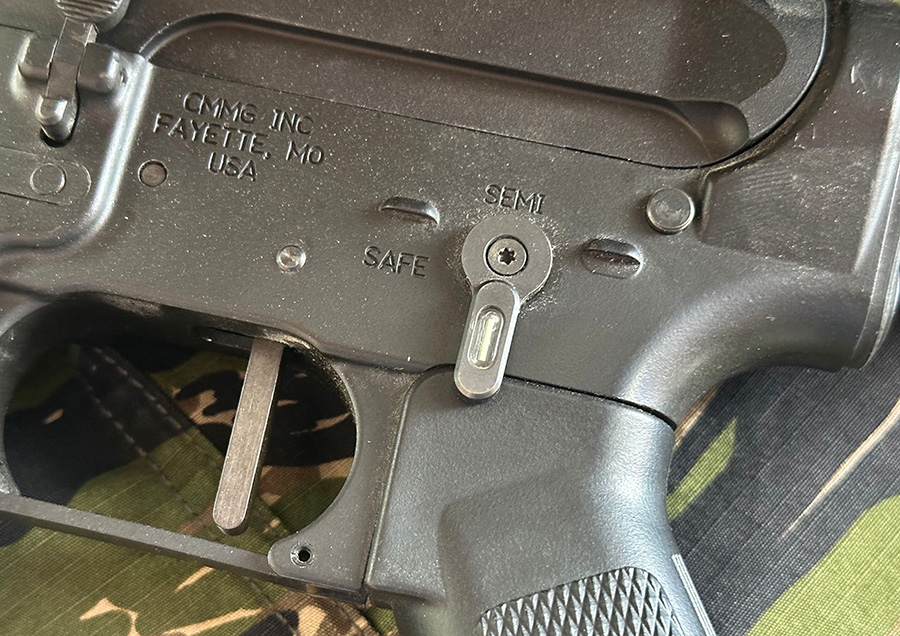
The last unique feature on my HD gun was the addition of a Tritium safety lever from Night Fision. No, I don’t need to see the safety lever on an AR to operate it. However, when the gun is staged, in darkness I can make out the dim green glow. Is this a must-have feature? Nope, but it might just give you a warm fuzzy. Either way, it doesn’t detract from the gun’s function.
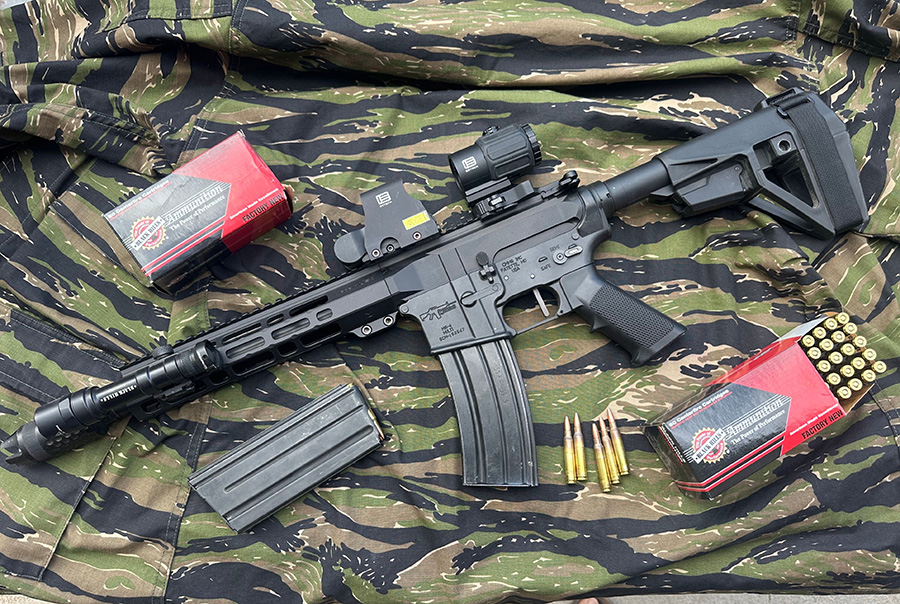
You will not be surprised by my desire to load the gun with Black Hills Mk262 Mod1-C ammunition which I plan to do. However, for those who really like mid-weight projectiles — say 62 grains — Black Hills has a 62g. DP (dual performance) load. Rather than paraphrase what dual performance means, I decided to go to the source in South Dakota.
Here is the official explanation . . .
The Dual Performance is a monolithic (all copper) projectile designed to have good terminal performance due in part to its intentional design to fragment the petals after formation of the temp cavity (with added terminal effect due to the fragments cutting additional wound tracks) and with the shank of the bullet now free of added drag of the petals, now penetrating significantly further than it could otherwise. Similar effects, but different construction and design.
If I’m forced by circumstance to use the home defense gun, I want to stop the threat using as few rounds as I can. Either the 77grain OTM or the 62grain DP round seems superior in that regard. Remember, you don’t lose points for having rounds still in your magazine when the fight is over.
Parting Shots
If you have come all this way and still remain convinced that a handgun is the best tool for home defense, that’s your choice to make as an American. However, if you are going to make a choice, it should be based on practical reality and historical precedence, not online gossip or outdated, regurgitated nonsense from people who should know better.
Paul G. Markel is a combat decorated United States Marine veteran. He is also the founder of Student the Gun University and has been teaching Small Arms & Tactics to military personnel, police officers, and citizens for over three decades.
Exactly… thanks Paul.
My home defense rifles are AR’s with 77 gr OTM.
I agree. It’s the best HD option. I also have a dedicated HD handgun ready with a light. I keep both out of sight. I can get to the handgun a few seconds quicker than the AR.
“For those who don’t want to or can’t own a true suppressor, there are other options. The Barking Spider II muzzle brake from Spikes Tactical can be purchased online and it effectively reduces flash while redirecting much of the noise away from the shooter toward the target.”
I’ve tried the Barking Spider II for sound redirection, it was kinda so-so. The Strike Industries Oppressor does a better job with the sound, it does weigh about 2 ounces more than the Barking Spider though and only works with one of their muzzle devices which is uses to mount. The Strike Industries J-Comp Gen2 and the Oppressor combo does a better job for both muzzle brake and sound redirection.
Your Caliber Might Fail To Stop The Threat – Do You Carry Enough Gun?
https://www.youtube.com/watch?v=vTJ8mi86iGc
Thanks for the article. Please address the issue of noise with an AR15 suppressor since subsonic ammunition is unreliable in an AR-15 and AR-15 ammunition is typically 3,000 fps. Thx