

Events in Minnesota have created some strange temporary bedfellows. An opponent of U.S. Immigration and Customs Enforcement’s efforts, Alex Pretti, was shot and killed by federal officers. Because he happened to be carrying a firearm while protesting against deportations, the typical talking points coming from many politicians have completely flipped from their typical stances on guns and the Second Amendment.
On the one hand, some Trump administration officials, and later even the President himself, asserted that carrying a firearm at a protest or near law enforcement officers is illegal. Both of those claims are false in Minnesota, with the latter claim being false everywhere else, too. Whether any of this leads to a policy shift remains to be seen, though that seems unlikely. Generally speaking, the second Trump Administration has been very helpful to Second Amendment activists, particularly to those of us in antigun states like California.
But just as the President and a few members of his administration were rhetorically throwing the Second Amendment under the bus, some politicians who have long opposed gun rights suddenly express support for the right to keep and bear arms. This support, of course, is phony.
As all of this was going on, Virginia Democrats were advancing legislation to ban the gun and magazine he carried, along with many other popular firearms. Just like stray comments from President Trump likely don’t indicate any real shift in policy, neither does Democrats suddenly voicing support for the Second Amendment mean that they will be opposing further gun control laws.
Governor Newsom Capitalizes, Feigns Support for the Second Amendment
Still, the response of one particularly fervent opponent of the Second Amendment is worth examining in further depth. California Governor Gavin Newsom, who mocked the idea that any right to carry exists at all and recently pushed to amend the Second Amendment, put out a statement stating that . . .
Nothing is sacred in Trump’s America; not the First Amendment, not the Second, not even life itself.
The press release then shifted into a broad defense of California’s draconian gun laws, stating that “the nation’s highest court has been equally clear that Second Amendment rights are not without limits.” While a line-by-line rebuttal would be fun, particularly as it pertains to the supposed efficacy of California’s gun laws, I want to focus on one particular part of the press release:
California’s gun safety approach prioritizes regulating who can access firearms rather than imposing a blanket ban on lawful gun ownership, including universal background checks, red flag laws to temporarily remove guns from people in crisis, and prohibitions for violent offenders and domestic abusers. State laws recognize public safety doesn’t stop at the point of sale, including providing for stronger oversight of gun dealers, preventing straw purchasing and firearms trafficking, and ensuring civil accountability when negligence fuels illegal gun markets.
Reading all of that in a vacuum, one would be forgiven for thinking that while California may throw up some hurdles to buying a gun, once you have shown yourself to be a qualified person free of any criminal record or “red flags,” you will enjoy an unimpeded right to keep and bear arms in California.
This is also what many gun control proponents want the public to focus on, with calls for universal background checks and red flag laws typically being front and center. For example, when the Johns Hopkins Bloomberg School of Public Health put out an article discussing “common-sense gun laws,” the first ones they highlighted were universal background checks and red flag laws.
Setting aside any question of the constitutionality of such measures, they tend to have broad public support in national polls, so it’s no wonder that gun control advocates focus on them as the signature examples of what they call “common sense gun control.”
But the overwhelming majority of gun control laws that gun control groups advance don’t turn on whether someone has been vetted through background checks or training courses. They instead consist of outright bans of all sorts of firearms and accessories. Or they make buying firearms far more costly. Or they restrict the right to carry those firearms as much as possible.
Thus, when Newsom claims that “California’s gun safety approach prioritizes regulating who can access firearms rather than imposing a blanket ban on lawful gun ownership,” that is a total falsehood. We will use California as the model here, as its laws prove the lie of “common sense gun control.”
Increasing Financial Barriers to the Second Amendment
One of the major ways California attempts to block access to the Second Amendment is by erecting considerable financial barriers to the right.
As I argued in a recent amicus brief on behalf of the Second Amendment Foundation and other gun rights groups, a good way to zero in on all of these expenses involved in acquiring a firearm is by comparing what a new gun owner would pay for a gun in California compared to most other states. I’ll borrow from that brief here.
Imagine someone buying a gun for the first time in California who has no criminal record, nor anything else that would block her from buying a gun. According to Newsom’s press release, then, she should have no trouble getting a gun, because as it claims, “California’s gun safety approach prioritizes regulating who can access firearms.” Our aspiring gun owner will quickly learn just how untrue that is.
First, she will have to choose a firearm. In most states, the most popular choice would be a GLOCK handgun, as they are some of the best-selling and reliable handguns in the country. Unfortunately, California has effectively banned the sale of GLOCK handguns effective July 1, 2026. So if our aspiring gun owner is buying after that date, she will have to make a different choice. (That sales ban was ostensibly because the guns are too easy to convert to full auto, though the shooting that inspired the GLOCK ban was committed by a convicted felon that Newsom’s policies released from prison several years early.)
Besides the new GLOCK sales ban, California also bans the sale of most of the handguns available in the rest of the country through its Unsafe Handgun Act. That law requires that all handguns sold in the state have unpopular “features” like magazine disconnect mechanisms and loaded chamber indicators that are usually not present in the same handguns sold in other states. A limited selection of handguns is available, so our aspiring gun owner will have to pick from those unless she wants to pay much more to buy an off-roster handgun from the secondhand market.
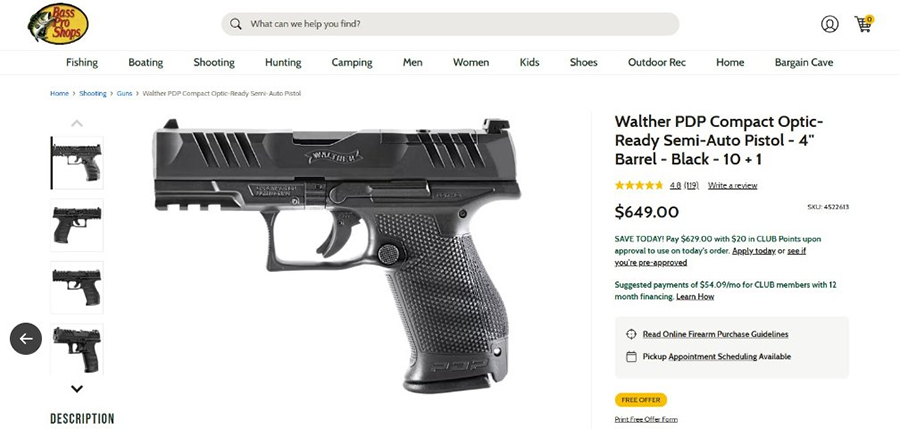
Suppose our aspiring gun owner settles on, for instance, the compact version of the Walther PDP that is included on California’s roster. Besides meeting the roster’s requirements, the California version will be less capable compared to those sold in most other states because the magazines it comes with will be limited to ten rounds. Despite being an inferior version, it will also cost more, because designing a handgun to meet California’s additional “feature” requirements adds expense.
Bass Pro Shops, a major retailer that sells firearms, demonstrates this well on their website. As of December 29, 2025, a standard compact Walther PDP sold for $529.98, but when the California-compliant version is selected on the same webpage, the price jumps to $649.00. So already, our aspiring gun owner is paying about $119 more than she would in Arizona, Nevada, and most other states.
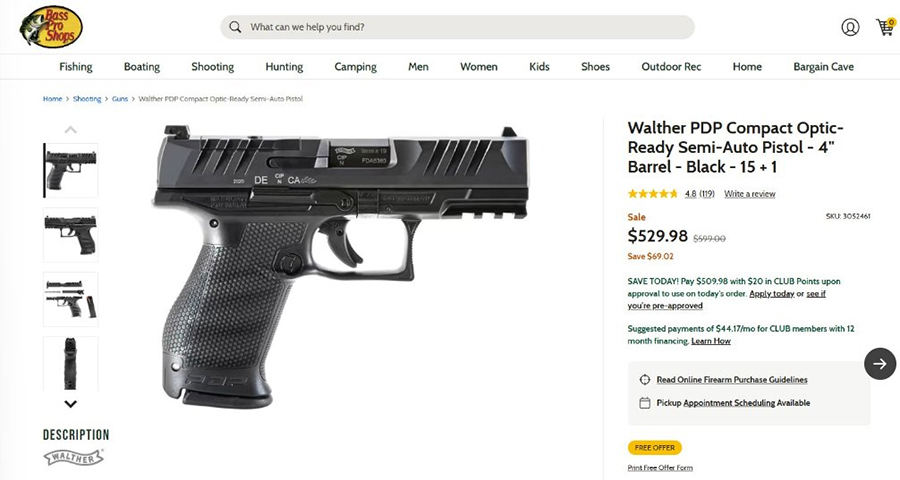
But the financial burdens are just beginning. For one, California requires a background check on every firearm purchase. Yet even though the state chooses to impose this burden on its citizens, it also piles on fees. California’s background check system requires a $31.19 Dealer Record of Sale fee, a $1 Firearms Safety Act Fee, and a $5 Safety and Enforcement fee. In total, for a background check that is free in other states, Californians must pay $37.19 every time they purchase firearms.
Additionally, in 2023, California enacted an 11% excise tax on firearms and ammunition. This tax applies in addition to standard sales tax, and adds another $71.39 to the price of our aspiring gun owner’s Walther PDP pistol. She will also have to pay it each time she subsequently purchases ammunition.
(Newsom, who now pretends to support the Second Amendment, called that excise tax a “sin tax.” That’s an odd thing to say for someone who allegedly respects the right to keep and bear arms.)
Finally, because it’s the first firearm she is purchasing, our aspiring gun owner must also obtain a Firearm Safety Certificate, which is acquired by passing a 30-question multiple choice test on firearms facts and safety rules. The card is good for five years. Whether such a requirement is sensible or not can be debated, but it adds yet another $25 in expense.
In total then, factoring in the price difference of the California-compliant version of the gun, the background check fee, the excise tax, and the price of the Firearms Safety Certificate, our aspiring gun owner will pay $252.58 more for her compact Walther PDP than she would in most other states thanks to California’s hostility to the Second Amendment. Considering that a better version of the same model costs about $530 in other states, that’s a nearly 50% premium just to exercise the same right in California.
If our aspiring gun owner practices enough and feels ready to begin carrying a firearm in public, the process of getting a California carry permit will cost her hundreds of dollars more and will include livescan fingerprinting, a police interview, a 16-hour training course, and sometimes even a psychological exam.
If she lives in Santa Clara County, one of the worst offenders, the total expense of obtaining a carry permit will rise to about $2,000. (Second Amendment Foundation has sued over this issue.) In other counties, the expense of getting a permit may be “only” around $500 to $600, but wait times can take over a year. The California Penal Code sets a 120-day time limit for processing permits, but Attorney General Rob Bonta has taken no action to enforce the law against the many counties and cities that blatantly violate that statutory time limit.
All this is ironic coming from a state which sued the City of Huntington Beach for implementing a simple voter ID requirement, calling it a racist effort to disenfranchise people of color. If requiring an ID to vote is racist, then what does that make California’s burdens on the Second Amendment?
Newsom’s California restricts everything Alex Pretti was doing
Newsom’s support for Alex Pretti’s Second Amendment rights is especially ironic considering that everything Alex Pretti was doing is illegal in California, or would be if Newsom had his way.
Alex Pretti carried a version of the SIG SAUER P320 that would be illegal for regular citizens to posses in California because it has a threaded barrel. California treats semiautomatic pistols with threaded barrels as banned “assault weapons.”
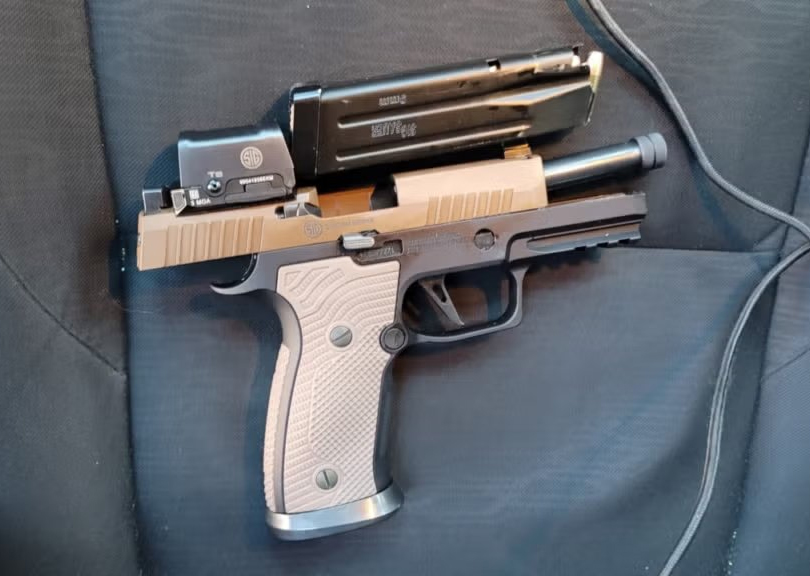
Pretti’s magazines are also presumably standard capacity P320 magazines, meaning they hold 17 rounds. Those too would be banned in California where magazines are limited to a maximum of ten rounds.
To the extent that Pretti was carrying at a “protest” (that is how the government has characterized what was happening at the time), then that too is against a law Newsom supported and signed which bans carry firearms at all public gatherings. Fortunately, that particular aspect of the law was struck down by the Ninth Circuit, at least at the preliminary injunction stage. The state continues to defend the law in court.
Aside from public gatherings, the same law also restricts carry at almost every public place besides streets and sidewalks. That includes parks and playgrounds, the wilderness of state parks, any place that serves alcohol, hospitals, public transportation, banks, museums, stadiums, and many more. The state even enacted a “vampire rule” which banned carry on all private property held open to the public unless the owner posts a sign saying otherwise, though the Supreme Court appears set to strike down such laws soon. Various aspects of Newsom’s law are preliminarily enjoined as the litigation proceeds, but most of it is still in effect.
All of these location restrictions are despite the fact that it has been definitively proven that Americans with carry permits almost never commit crimes. In fact, in Second Amendment Foundation’s litigation against Newsom’s so-called “sensitive places” law restricting carry, we put forward statistical evidence supporting this argument to make the point that California’s stated safety concerns regarding the right to carry were baseless. The California DOJ didn’t even try to rebut our evidence, effectively conceding the point. This led the district court to conclude that “[s]imply put, CCW permit holders are not the gun wielders legislators should fear.”
There is simply no rational reason for California to restrict carry so broadly, as it vets everyone who gets a carry permit and they don’t commit crimes. The motivation isn’t safety, it is animus. California hates the Second Amendment and everyone who exercises it. And that would have included Alex Pretti if he lived in the state.
Conclusion
This article only scratches the surface of what “common sense gun control” has meant in California. Just recently, California restricted most online shopping for firearm accessories, making it more difficult and costly to purchase them. It also recently enacted a barrel background check law.
The state also has an ammunition background check regime that costs $5 each time you purchase ammunition, and erroneously rejects one in ten people who attempt use it, as Second Amendment Foundation discussed in our amicus brief in the relevant case. For every prohibited person the background check law stops from buying ammunition, it wrongfully turns away over 400 law-abiding people. Newsom’s Attorney General is, naturally, defending the law in court.
And, of course, the state bans bans common rifles, common handguns, and suppressors (even if the prospective buyer is willing to register them federally). I am probably forgetting a variety of other restrictions, as there are just too many to recall.
Each of these measures have the strong support of the national gun control groups, all of which praise California effusively and give it top marks. They want California-style gun laws to go national.
In sum, the claim that California’s gun laws “prioritize regulating who can access firearms,” as Newsom’s press release claimed, is an abhorrent lie. California restricts every aspect of gun ownership, and would no doubt ban it entirely if the Supreme Court allowed it to do so. Because it can’t do that, it makes guns much costlier to obtain, costlier to carry, and restricts where you can carry them if you go through all the trouble and expense of getting a carry permit.
We can certainly have a debate about the efficacy of things like background checks or red flag laws. But the idea that those are the core policies of gun control activists is pure gaslighting. Rather, those are the popular Trojan horse policies they use to convince the public to put them into power. Once they have that power, they restrict guns for all law-abiding citizens as much as they possibly can.
Kostas Moros is Director of Legal Research and Education for the Second Amendment Foundation. This post was adapted by SNW from an article posted at X.
?
I was able to legally purchase a non-CA compliant (non roster) gun and have it approved for my California CCW because I made use of an exemption in the law. I’m not allowed to purchase it new, but I *am* allowed to buy it from a LEO who sold it to me because he was switching to a different gun for his own use. So Newsom and his Keystone Kops in Sacramento have declared that the particular gun I now possess is super duper dangerous for us plebes to own, but it’s okee-dokee for law enforcement to buy it first and then later sell it to me, because then some Elven magic happens and the evil-ness of the gun is washed clean, and it’s now safe for me to bear in public. You know…because Leftist logic and stuff.
Why are these infringements allowed?
Shall not infringe is pretty clear…