

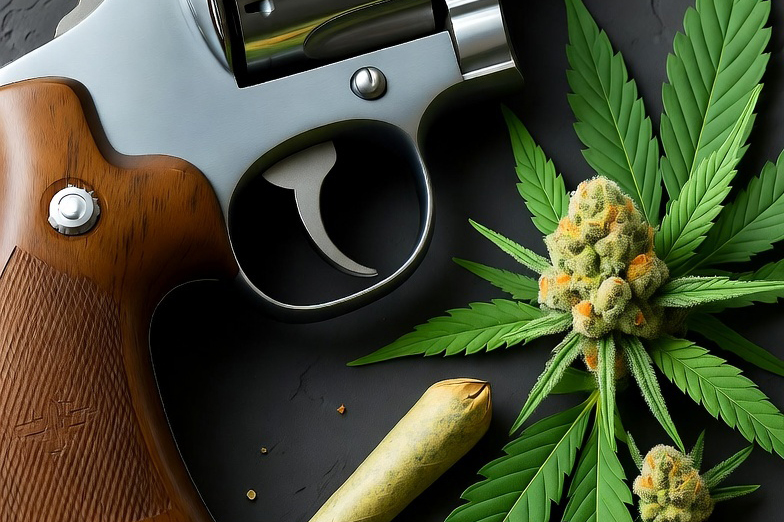
You may have heard that President Trump recently did what presidents have been threatening to do for the last decade or so. He reclassified marijuana from a Schedule I controlled substance to a Schedule III controlled substance. You can read what that means in detail here, but in short, Schedule I drugs are deemed by the federal government as having no accepted medical use with a high likelihood of abuse. Schedule III drugs have some medical uses and “moderate to low potential for physical and psychological dependence.”
We asked SNW contributor and attorney LKB what his opinion of the move is as far as gun owners and their rights might be. His analysis of any change that will result as a result of Trump’s order: not much.
Marijuana is still illegal under federal law unless you have the right permission slips. Just as possession/consumption of, say, Xanax without a prescription is illegal, but possession/consumption with a prescription is legal. Reclassification allows for the possibility of medical use of marijuana products.
While reclassification might make some medical uses of marijuana legal (and thus not disqualifying), it won’t apply to the vast majority of recreational users.
As the White House’s announcement says, the reclassification will allow for more research into the benefits of wacky tabacky use, but again, the change doesn’t legalize or decriminalize it at the federal level. And under federal law, it’s still illegal to purchase or possess a firearm if an individual is “an unlawful user of or addicted to any controlled substance (as defined in section 102 of the Controlled Substances Act).”
Marijuana is still very much a controlled substance under the CSA…it’s just been moved from one classification to another. And there’s nothing about that reclassification that would result in a change to ATF’s 4473 Fiearms Transaction Record form.

Completing the 4473 still requires you to attest that you’re not an unlawful user of or addicted to marijuana, among other controlled substances. The form also clearly warns you that weed is illegal under federal law, no matter what the laws in your state may be.
If you’re a marijuana user and respond ‘Yes’ to the question, your purchase will be denied. If you’re a user and respond ‘No,’ lying on a 4473 form is a felony (ask Hunter Biden about that), which is also a threat to your gun rights.
So, without a change to the law at the federal level — something that’s about as likely as me perfecting cold fusion — current and prospective gun owners are still in the same situation as they were before Trump’s executive order. Using cannabis puts your gun rights as risk now as much as it ever has.
Act accordingly.
Does Trump’s Reclassification of Cannabis Mean Anything to Gun Owners?
… PresidentTrump has signed an Executive Order to reclassify cannabis as a schedule III narcotic rather than a schedule I narcotic. But will any of that effect the Federal prohibition on cannabis users from possessing firearms? Washington Gun Law President, William Kirk, gives you the short answer which is NO. The reason being is that while cannabis has been reclassified, it has not been legalized. it remains an unlawful controlled substance and until Congress steps in, or ATF significantly changes how they do business, the dilemma for cannabis users in the United States will remain.
ht* tps://www.youtube.com/watch?v=19nQv4C9c-c
“Completing the 4473 still requires you to attest that you’re not an unlawful user of or addicted to marijuana,…”
First,thanks, LKB, and Dan for passing my question along to Mr. LkB.
Unless you are currently stoned or intoxicated at the time of filling out that 4473, it could be argued in good faith that the signer of that 4473 could have fully intended to never partake again, but but ‘fell off the wagon’, so to speak.
This is likely to be a ‘sticky-wicket’ that will haunt us for a very long while, yet…