I don’t often get involved in chat threads or the thread of comments on social media platforms. However, I got pulled into one comment thread recently in an invitation-only group of what are supposed to be like-minded individuals, graduates of a professional firearms training school.
It was a bit concerning to read the comments of those who had purportedly gone through the training of said school, and then espoused thoughts and opinions that were contrary to the school’s methodology. All fields of endeavor need to grow and improve with time. That said, there are also basic foundational principles that should be followed.
Of the many comments, one that struck me and caused me to offer greater consideration, was in reference to a graduate who stated that he no longer felt challenged. Consequently, he was seeking out other avenues. That led me to the topic of this review, as well as to formulate an easy to replicate set of skill drills.
Training vs. Practice
Before we move any further, let’s consider the language and how it’s used. Gun community members tend to interchange the words training and practice, using one to mean the other and vice versa.
In the arena of the martial application of firearms, training is a purposeful and deliberate activity that’s undertaken under the watchful eye of a subject matter expert…a coach, an instructor, or a mentor. Good training should be goal-oriented and move from the known to the unknown and the simple to the complex. We don’t train ourselves.
The basic purpose or goal of any quality training course is to teach you how and what to practice. Consider this. When a person takes guitar lessons, the teacher shows the student what to do, the student does it while the teacher watches, makes corrections, and then the student is sent home with the admonition to “practice at least a half hour a day.” If a person were to take guitar lessons, but only pick up the instrument once a week during the scheduled training session, it would take them much longer to achieve any proficiency or skill than if they practiced each day.
Quality firearms training provides you with the foundational building blocks, the how and what to practice. It’s up to the student to make time to go out on their own and replicate what they’ve been shown to the best of their ability until skill is developed.
Practice What’s Hard
Human nature being what it is, there’s a strong tendency for people to do what they are good at or feel comfortable doing. That’s particularly true when other people are watching. Perhaps this describes you.
If you have ever gone to the ubiquitous indoor range, you have seen the guy who runs a paper target out to five, maybe seven, yards. With a strong, two-handed grip, he slowly fires a magazine or cylinder worth of ammunition. Then he reels the target back in, takes it off the clips and admires it. “Not bad…not bad at all.”
Is there anything inherently wrong with the previous situation? No. Our anonymous shooter has demonstrated basic, fundamental marksmanship skill, and that’s great. However, after a while, doing that will no longer be challenging, the shooter might decide that in order to be challenged, he needs to find somewhere to play a shooting game and race against a shot timer.
In such a situation, this nameless shooter hasn’t yet truly challenged himself. If you can shoot a fist-sized group at five yards with both hands and are bored, I’d ask if you can do the same thing with only your dominant hand on the gun. Can you shoot a fist-sized group using only your support hand? If the answer is “no,” you haven’t really challenged yourself.
33, 33, and 33 Practice
Regarding the martial application of a pistol or handgun, I would recommend that for a truly challenging practice session, you divide your shooting in thirds. Of course, this should be after you have attended professional training and mastered the fundamentals of firearms handling and basic marksmanship.
When you’re on the practice range, force yourself to fire 33 percent of your shots with a two-handed grip, 33 percent with your dominant (strong) hand only, and 33 percent with your non-dominant or support hand only. You can fire that last one percent any way you want.
From studies of neuroscience and the building of our neuro-muscular pathways, we’ve learned that using the non-dominant hand actually helps to improve the performance of the dominant hand. Also, engaging in difficult or uncomfortable exercises — ie: shooting with your support hand only — improves brain health and cognitive function.
In layman’s terms, if you’re right-handed and you force yourself to shoot with your left hand only, eventually, not only will your performance with your left hand improve, your overall coordination will improve and your right-handed or two-handed shooting will get better.
The problem with humans is that they’re afraid of not looking good or cool, so they deliberately don’t shoot one-handed or off-handed because their shot groups aren’t as tight or they might miss completely. This mentality holds back their progress and they’ll never move beyond mediocrity.
Range Time
For my challenging range time, I decided to use the Birchwood Casey 8-inch steel gong or “headplate” target set-up. This target package is pretty slick. All you have to do is provide a 2×4.
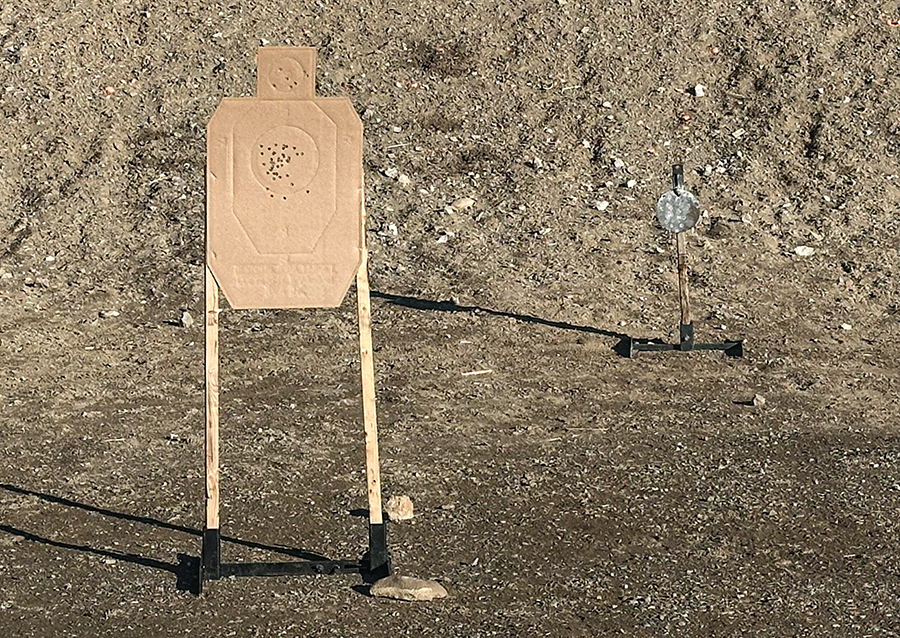
I set the BC steel target up and moved back to seven yards.
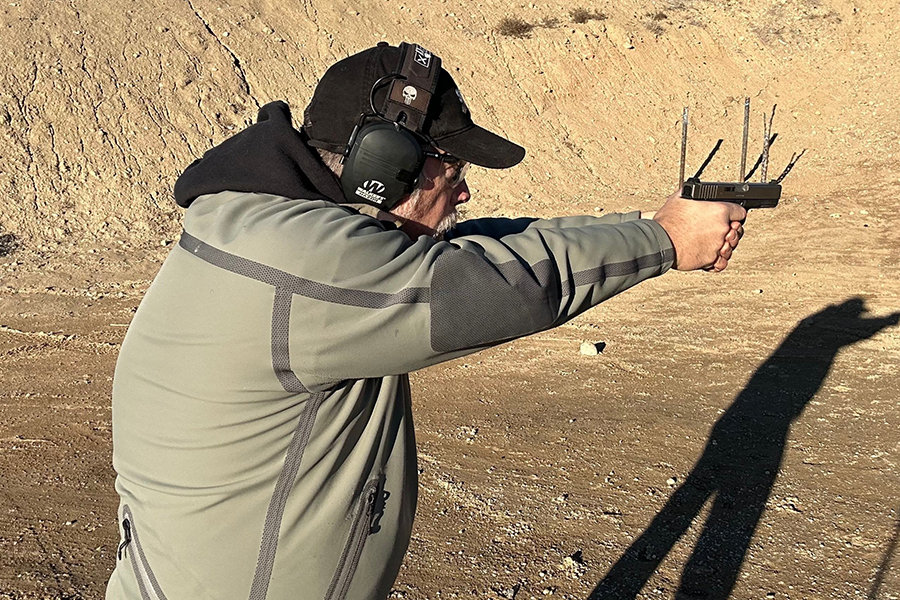
Using my EDC GLOCK 48 pistol, I put the first magazine through with two hands. Then I moved to single handed right and then single handed left.
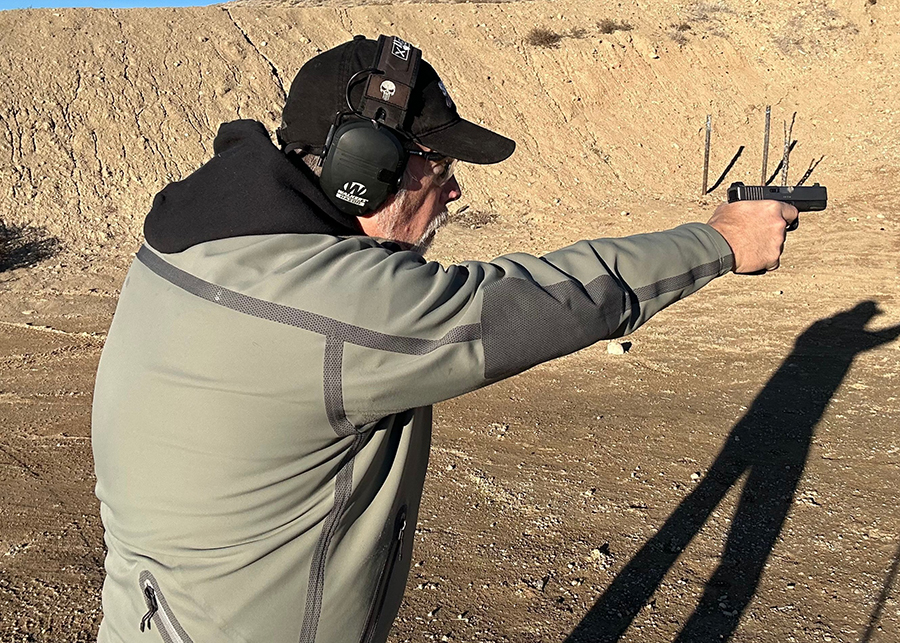
The great thing about steel plates is that they don’t lie. You either hit it and get a “clang” or you don’t and dirt kicks up behind it. Hopefully the training you took forced you to shoot not just with two hands, but with both right and left alone so you’re at least comfortable with the practice.
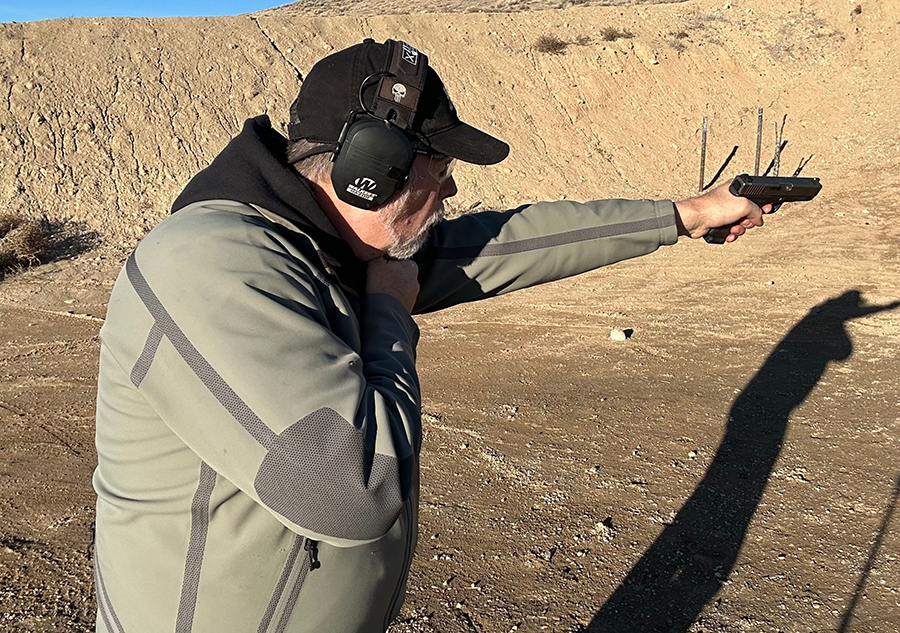
If you don’t have a steel target available, you can use cardboard or paper. My desire in using a relatively small steel plate is to add another level of challenge. An 8-inch plate is about the size of the preferred target zone on a humanoid silhouette and seems small when you move back beyond five yards or so.
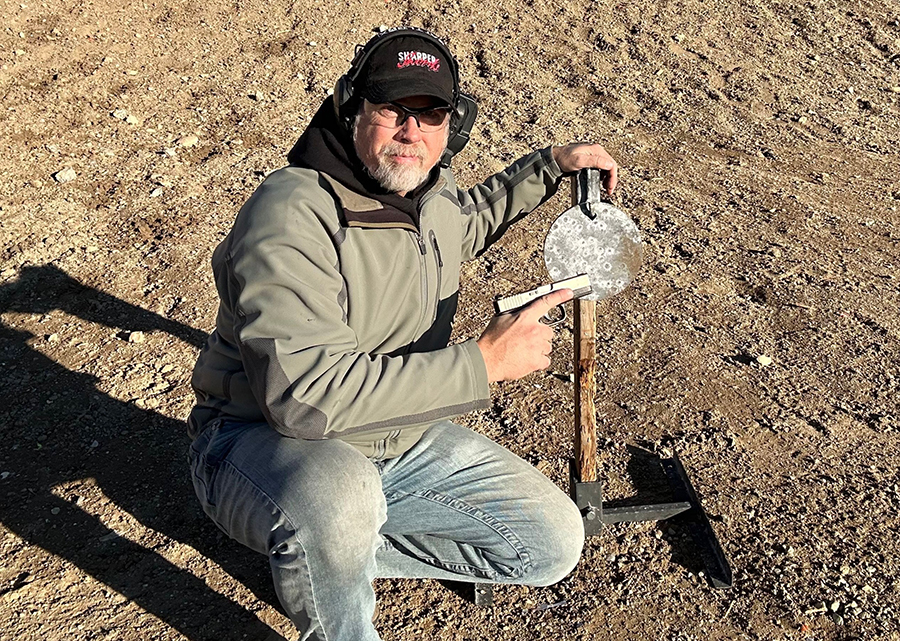
If you can keep all of your shots on steel, even when using only your support hand, you’re well on your way to realistic skill development. Also, even if you never have to use only your off hand in a martial fashion, that exercise alone will improve your physical coordination and improve your shooting overall.
Additionally, if you’re looking for skill maintenance drills that are easy to replicate regardless of the range, indoor or outdoor, I created the One Box Workout program. With the OBW, you can budget for a single box of fifty rounds of training ammunition, and get in all of the essential practice you need with a handgun.
Paul G. Markel is a combat decorated United States Marine veteran. He is also the founder of Student the Gun University and has been teaching Small Arms & Tactics to military personnel, police officers, and citizens for over three decades.