


One of the most negligent and/or reckless trends in American law enforcement has been replacing skills or abilities with technology. Case in point, replacing defensive tactics training — fighting — with technology, specifically the TASER.
Yes, I understand that management doesn’t want their officers physically fighting with subjects on the street. Regardless, the desire to keep officers from going hands-on does not jive with the reality that sometimes hands-on fighting is what must take place.
Before Christmas, the whole country got to see the video of a shoplifter in Canton, Ohio attempting to shoot a police officer. The store’s loss prevention officer and a Canton police officer had to go hands-on and fight because that was what was called for.
On the heels of the Canton incident, a friend of mine shared a video that was dated a bit, but showed two police officers attempting to subdue an unarmed man and failing miserably. The man ended up stealing the police cruiser and driving away. The video is the definition of pathetic.
Then there was one more video, again shared by a friend, where a grossly out of shape Sheriff’s deputy was attacked by a prisoner inside the sally port of a courthouse. The prisoner attacks the deputy and snatches the officer’s gun. The deputy in question struggles to fight and then after a very short time appears to just give up from exhaustion. Luckily, another deputy runs in just in time to shoot the armed prisoner.
Citizen Gun Carriers
I give the previous examples because they jibe with the tendency of American citizens who carry firearms to believe they can replace skill and ability with technology. Only in this case, the technology is a firearm.
Many moons ago, I first experienced this mentality when a middle aged man mocked my martial arts training by saying that he didn’t know karate but he knew “ching, ching” and he mimicked the action of racking the slide on a pistol. I would be shocked if most of you haven’t either heard, read, or done that yourself.
One of the most important lessons we can teach those who carry concealed is that they have an absolute responsibility to prevent the gun they’re carrying from falling into the hands of someone else. When I went through the police academy, our defensive tactics instructor made it very plain to us: “If a bad guy gets a hold of your gun, the first thing they are going to do is try to kill you with it.” That is not hyperbole, that is history.
Do you as an armed citizen need to be a black belt in the trendiest martial art? No, but you should be able to fend off a physical attack for thirty seconds. My friend and barbell training mentor, Matt Reynolds, put it to me this way; “Strength makes everything better.” Strength makes you a better shooter. Strength makes you better able to defend yourself in a physical altercation. Strength reduces the likelihood of injury.
“Strong people are harder to kill than weak people, and more useful in general.” – Mark Rippetoe
The 1 Million Pound Challenge
The calendar flipped last night and you now have the opportunity to challenge yourself and seek self-improvement. You might ask yourself where you want to be when January of 2027 arrives. Is your goal is to become a stronger person, because you’re mentally mature enough to understand that muscle is the organ of longevity and that strength truly makes everything better? If so, the next question is how you’ll meet that goal.
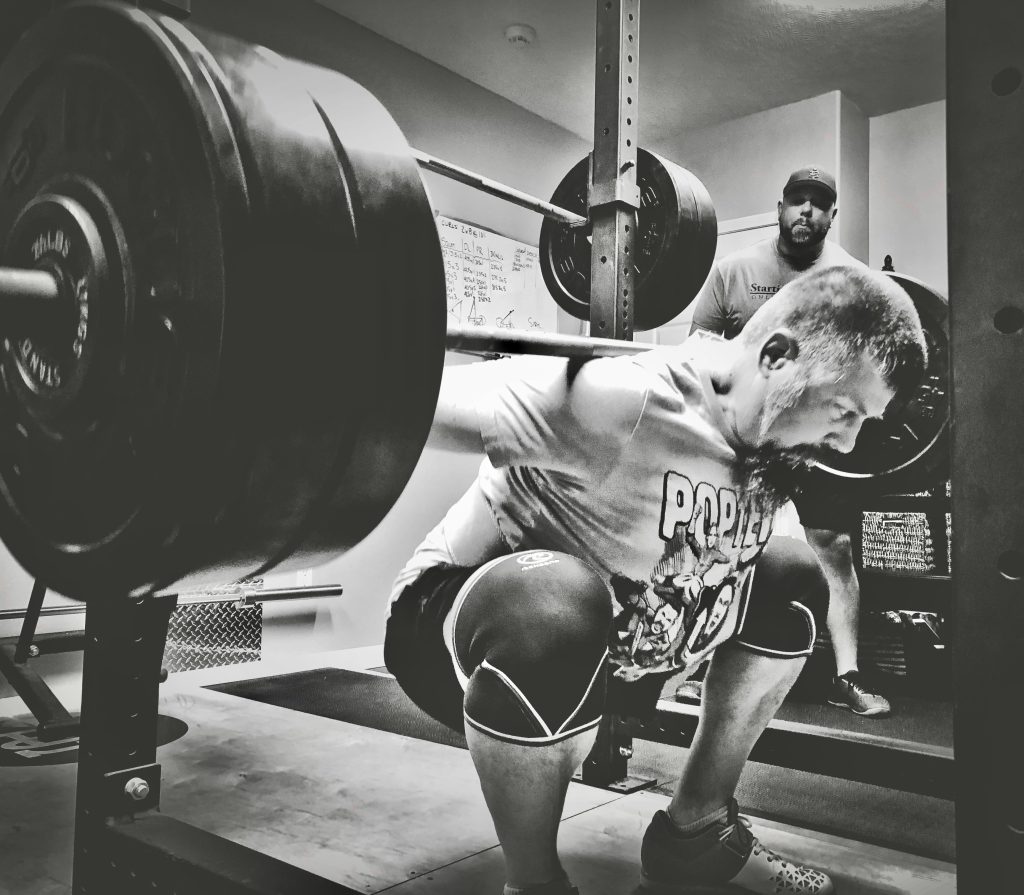
It’s no secret that I fully endorse barbell training for strength and that is, in large part, why cancer didn’t kill me a few years back. While I have only been involved in professional strength training for about nine years, I feel that I have some basis to offer advice.
Last spring I worked with my compatriot, Nicholas Orr on his book “A Pipe Hitter’s Guide to Strength and Wellness” and last fall an article appeared in these pages that discussed practical strength goals. With the coming of the new year, I’ve given some serious thought to the subject of strength and the importance of consistency.
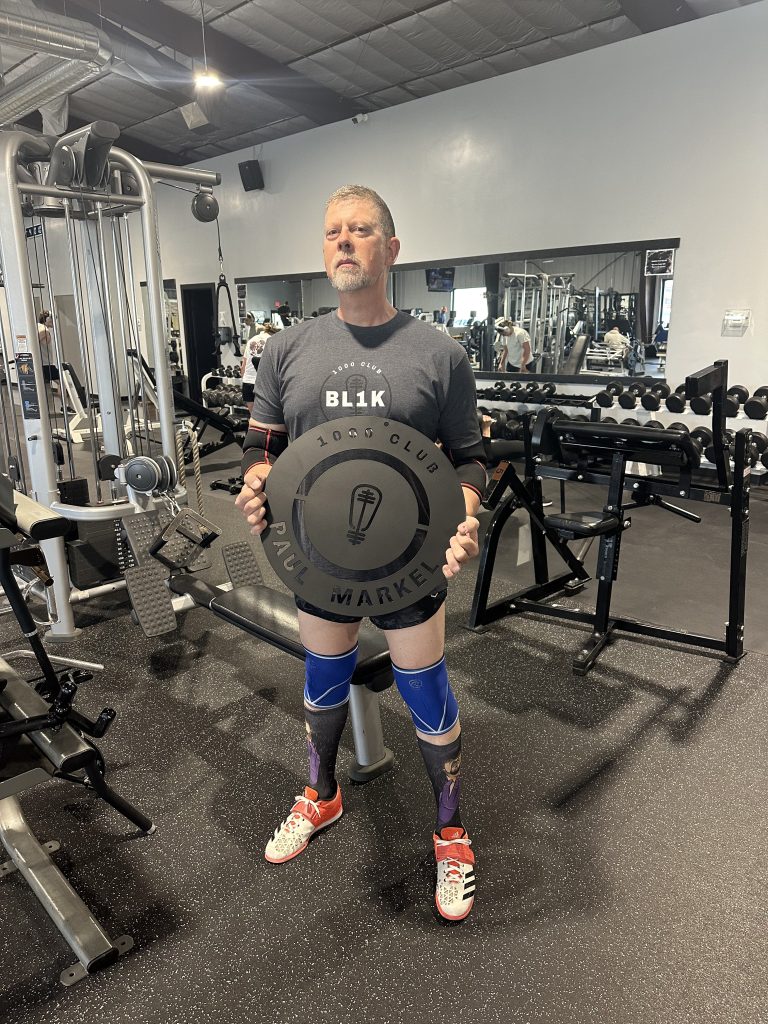
One of the ways that Barbell Logic Online Coaching encourages consistency in their members is by rewarding them with a 1K / 1000 session plaque and t-shirt. The goal is to successfully complete one thousand programmed workout sessions and log your progress. Last year I was able to achieve that goal.
Of the many pieces of advice Matt gave me, one of them that I have followed to the letter is to keep a notebook and a pencil in my gym bag and to record the workout weights and reps for every session. When you start strength training you’ll encounter the word “tonnage.” That’s the total weight moved for the programmed/assigned lifts (warm-up weight isn’t included in tonnage).
Your tonnage for a training session will vary based on the exercises or workouts. For instance, if you’re lifting heavy weight, close to your max, you will likely be doing low count repetitions. On the other hand, if you’re doing something like a closegrip bench press that’s relatively low weight, but high reps, your overall tonnage will increase.
I am on a training program that includes three sessions per week…Monday, Wednesday, and Friday. Each day is different, but I track my weight, reps, and total tonnage. One day it might be 6000 pounds, another day it might be 7500 or more. Before I sat down to write this, I went to the gym and squatted, closegrip benched, and then finished with the leg extension machine. Total tonnage was 10,400 pounds, but that doesn’t happen every time.
So here’s my challenge to you; hit 1 million pounds of tonnage in the next 365 days. I’m reminded of the old advice about how you eat an elephant…one bit at a time. Yes, one million pounds seems like an insurmountable task. If you tried to do it in a month you’d likely fail. However, with consistency, you can indeed achieve that goal in a year.
Let’s break down a three-session workout week. If you’re faithful and dedicate yourself to three training days each week, I usually spend 1 to 1.5 hours in the gym total. That’s only 4.5 hours max out of the 168 hours in a week. There are 52 weeks in a year and 52 times three is 156 training days. Take one million and divide it by 156 and you get an average of 6,410 pounds per session. While 6400 pounds might seem like a lot, it’s doable for most people. Maybe you’ll need to spread the 6400 over five different lifts. Let’s just say 6500 for an average. That is 19,500 per week.
As you can see from the number crunching, the key to success in the 1 Million Pound Challenge isn’t in trying to get it done a short amount of time, it’s to develop reliable consistency, to eat the elephant one bite at a time.
Sure, you’re going to miss some days due to travel or illness, etc., but the key is to consistently track your progress so as not to fall behind. If you have heavier tonnage days, that will help you keep on track toward one million when you invariably miss a day here or there. I suggest not only keeping track weekly, but also monthly. Your monthly average should be about 84,000 pounds. If you can keep that up, you’ll reach your one million pound goal.
The purpose is to develop a positive habit. We don’t go to the gym and engage in resistance training only when we’re motivated or in the mood. To the contrary, we go even when we are tired, busy, annoyed, etc. As we’ve previously discussed in other articles, doing what’s right, even when you don’t feel like it, not only strengthens your body, it strengthens your mind and improves brain health. The time to begin is right now.
Paul G. Markel is a combat decorated United States Marine veteran. He is also the founder of Student the Gun University and has been teaching Small Arms & Tactics to military personnel, police officers, and citizens for over three decades.
I’ll second Paul’s comments about the stronger you are, the harder you are to kill. Congrats also for that impressive accomplishment.
At the same time, thanks for the challenge Paul, but I’m going to respectfully decline. Not because I think it’s impossible, but because as someone nearly 60 years old, there aren’t many days I’m moving anything near my max weights. Why? Because I don’t heal like I’m 20 anymore. I’m doing very slow reps (8-12 for most) at very modest weight. Very slow as in 3-4 second eccentrics, with as close to perfect form as I can muster. Every single rep.
For the record, I’m currently 6′ and low 180s now with a 12.x% bodyfat per a SECA machine at my local gym. I’m 3 points from “platinum” in terms of lean muscle mass and low body fat. And there aren’t many folks in that Platinum realm. For my age I’m probably close to the top 5% in terms of body build and bodyfat – maybe close to the top 2%.
So yeah, for those who are younger, and especially those who tangle with bad guys for a living, I think this is a laudable goal. For us old farts, well, you and me are better off with lighter weight, better form and slower reps for each movement. Hire a personal trainer to help educate you on good form and technique. Just as I see bad form on indoor ranges when it comes to handling guns, I see similar poor form in gyms now that I know enough to be kinda dangerous when it comes to lifting stuff and putting it back down. Your man card doesn’t imbue you with the knowledge of how to lift with maximum safety and best effects for the effort you expend. If you’re the guy who races through your reps and whips stuff around, yes, I’m talking about you. Or the guy who puts on lots of plates to impress the girls and does only about 10% of the range of motion that’s required to build real muscle.
Consider starting out with a 100,000 pound challenge and then try to replicate it in fewer days for your next cycle while not “cheating” on form.
And if you’re brand new to the gym, go easy my friend. Do some simple compound movements AFTER some stretching. Get some competent help from trainers to reduce the likelihood of personal injury and strains. Be smart about it. You’ll see changes in 2-3 months and in six months you’ll really like what you see. Also look into TRT if you’re struggling to lose weight and gain muscle as an older guy.
If you’re going for good form instead of speed or max weight, make sure to take the time to squeeze the muscle being worked at peak contraction. Pause at the peak and squeeze for a full second.
I would suggest occasionally changing things up instead of only doing slow lifts. You can do this safely with light weight. Explosive light lifting trains the nervous system to generate force quickly, which transfers to daily tasks and general athleticism. It recruits fast twitch fibers without going heavy and is easy to do safely for older people with proper form and loading. Women should be lifting weights every week too; it’s not just for men.
Finally, do not neglect your cardio. I’ve seen big ripped dudes run out of breath after walking up a flight of stairs. At a minimum, aim to get your heart rate over 120 bpm for 20 minutes three times a week and work up from there.
Your VO2 max is a strong indicator of longevity. Good cardio also has practical benefits like chasing or running away from a bad guy or winning a struggle for a weapon. If you watch MMA fights, you’ll notice that in evenly matched bouts, the person with b-e-t-t-e-r* cardio usually wins.
I’ve been into fitness and nutrition for decades.
*I’m not allowed to type out this apparently horrible word on this site.
P.S. Guys, if you cared about this site, then you would at least try to improve the commenting system. Everyone complains about it, and nothing is ever done. Why would people seek out a site as frustrating as this one?
Spirit of Aloha crazy: Hawaii Uses [decrees from defunct kingdom of Hawaii, and post civil war – Jim Crow Era] Black Codes to Defend [‘vampire rule’] Carry Ban [at SCOTUS].
ht* tps://www.youtube.com/watch?v=TJbXPdWtSgE
It’s Not Just Minnesota. The Vast Majority Of Daycare Is A Scam.
“The Trump administration announced it is pausing all child-care payments to Minnesota in light of explosive revelations about Somali-saturated fraud rings siphoning billions from federal welfare programs. State officials in Ohio, where the second-largest Somali population resides in the United States, are begging for a federal fraud investigation there.
…
As shocking as the estimated $9 billion theft in Minnesota is, it rests upon an even deeper level of scammery. For if it is fraud to take taxpayer money for childcare while not providing it, isn’t it also fraud to take taxpayer money for early childhood development that actually damages early childhood development?
The truth is, ‘affordable childcare’ is itself a scam. The billions spent on daycare result in worse outcomes for society than if these programs never existed. Industry researchers have known and lied about this for decades. Yes, that makes them frauds, too, and their mark — is there any other mark on the planet? — the endlessly spigoted American taxpayers.
…
‘Affordable childcare’ has been a Democrat campaign demand much longer than the Clintons’ infamous ‘it takes a village’ efforts in the ’90s. The notoriously ineffective Head Start federal preschool program was a key part of Lyndon B. Johnson’s Great Society scam that, as Christopher Caldwell detailed so well, traded the rest of Americans’ constitutional ways of life for bankrupting welfare hush money.
From 1965, when it began, to 2020, Head Start has cost American taxpayers $240 billion, according to a Heritage Foundation report. The program sold as an educational boost for America’s poorest children has done nothing in 60 years to improve education outcomes for those children, according to federal evaluators. Yet it currently gets $9 billion in taxpayer funds per year. Pretty scammy!
…”
ht* tps://thefederalist.com/2026/01/01/its-not-just-minnesota-the-vast-majority-of-daycare-is-a-scam/
Without George Washington, America Wouldn’t Have A 250th Birthday.
ht* tps://thefederalist.com/2026/01/01/without-george-washington-america-wouldnt-have-a-250th-birthday/
There were many lies from the collective left wing in 2025, just about everything they say is a lie but among them, especially from the left wing media and democrat politicians, there were some whoppers: The Left’s Top 25 Lies Of 2025.
ht* tps://thefederalist.com/2025/12/29/the-lefts-top-25-lies-of-2025/
Good by New York City, you’ve fallen to communist rule and Islam. Mamdani starts shoving the hammer-n-sickle firmly up your butts: Mamdani’s Chilling Inaugural Remarks Are a Harbinger of Trouble to Come.
ht* tps://redstate.com/nick-arama/2026/01/01/mamdani-inaugural-remarks-n2197681
Stupid left winger idea does the FA part and discovers the FO part: A German Woman Reportedly Wanted to Livestream How Safe It Was to be Out on NYE. Here’s What Happened.
“I believe the phrase is called ‘suicidal empathy,’ and we saw that with this female livestreamer during New Year’s Eve in Germany. I don’t know what the point Kunshikitty was trying to make. Some alleged that she was doing this to show how safe Cologne was during this celebration.
Ten years ago, migrants committed a mass rape in the city, where almost 100 women were sexually assaulted by a horde of at least 1,000 men, mostly of North African or Arab descent. For Kunshikitty, her livestream ended with her being stoned by migrants. During the broadcast, she’s hit with a foreign object (via Breitbart):
…
Shortly before the clock struck midnight, Cologne-based Twitch streamer Kunshikitty, who has nearly a quarter of a million followers on the platform, was broadcasting live in a bright pink outfit. As she was walking through a crowd of what appeared to be mostly foreign background men, she was struck in the head with an unidentified object.
‘Ow, ow, I got hit by something. I got hit in the head with something,’ she said, according to the Bild newspaper.
Minutes later, she was struck again by what appeared to be a firecracker projectile, to which she replied: ‘I think if I were a two-meter-tall bouncer, they wouldn’t have done that.’ She later said that she plans on filing a complaint to the police.
…”
[Note: good luck with getting the police to really investigate this ‘Kunshikitty’. One of Mandanis policies came into play when he got sworn into office – that being to have police not investigate ‘immigrant’ crime.]
ht* tps://townhall.com/tipsheet/mattvespa/2026/01/02/a-german-woman-reportedly-wanted-to-livestream-how-safe-it-was-to-be-out-on-nye-heres-what-happened-n2668754
Left wing violence: Abigail Spanberger’s DEI chief praised mob for destroying American historical statues.
ht* tps://thepostmillennial.com/abigail-spanbergers-dei-chief-praised-mob-for-destroying-american-historical-statues?utm_campaign=64470
Trash commenting system = trash site. SNW is trash.