

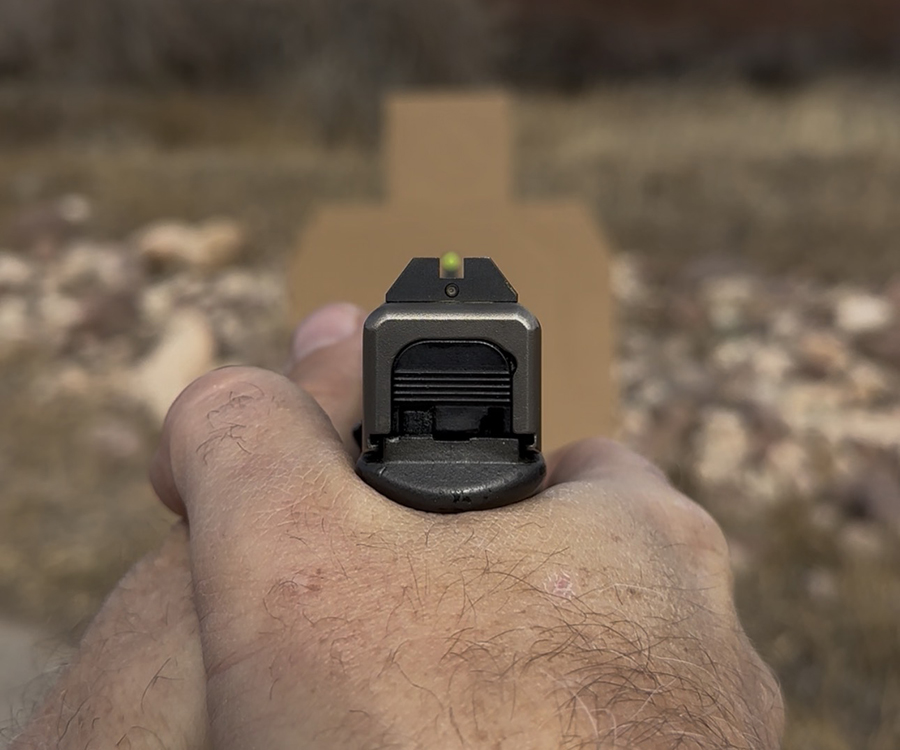
“Front sight, trigger press.” is a mantra spoken by firearms instructors and coaches for literally decades on shooting ranges from coast-to-coast. I have been both a student on the line while a coach walked past me and uttered those words as well as an instructor/coach walking behind my students repeating those words of encouragement.
There are numerous fundamentals when it comes to handgun marksmanship, but it cannot be denied that aligning a clear front sight on the target while deliberately pressing the trigger are the most important. If you can hold the gun still, indexing the front sight on the target and simultaneously press the trigger without disturbing the sight picture, it doesn’t matter how your feet are configured, what your grip looks like, or how much or how little contact your finger has with the trigger. All that is required to hit a target with a single shot is the first two. Recoil management and follow-up shots are a different subject.
And so, having said all of that. Which is the most important: a perfectly clear and in focus front sight or a smooth, deliberate trigger press? I can hear some of you yelling at your screens, “Both! Both are important!”
Eye-Opening Example
While working as a Small Arms & Tactics Instructor during GWoT, I was coaching this young man who was preparing for deployment to a combat zone. Watching the young man’s performance, I was disappointed to see shots hitting, not just low left, but all over the target. From the five yard distance, he should have been at least shooting fist-sized groups. He was not even coming close.
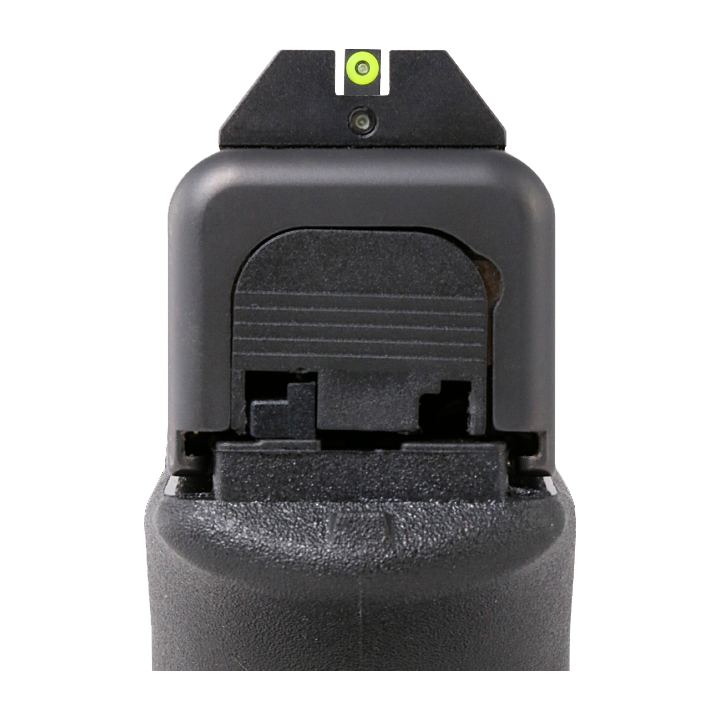
In the student’s hands was the M9 Beretta. “Slow down,” I advised him. “Can you see the front sight clearly?” He replied that he could. “Okay, now press the trigger slowly and deliberately to the rear. Let the gun surprise you as it goes off.” He fired the pistol and the shot went way low. We went through it again, slowly, and got the same result. Finally, after talking him through, step by step, what I was able to discover was that he was indeed finding the front sight and seeing it clearly focused in his vision. However, the moment his brain switched to the trigger pulling process, he completely lost focus of the front sight. He put all his mental focus on pressing the trigger and while he was doing so he disregarded the front sight! He stopped looking at it.
What did I learn that day? I learned that as a coach, saying the words “front sight, trigger press” did not guarantee that the shooter was going to do those things SIMULTANEOUSLY. From that moment forward, when explaining the importance of front sight focus and smooth, deliberate trigger press, I was sure to remind the students that both of those had to be done at the same time. Experienced shooters might laugh at that story, but having a student lose their focus while pressing the trigger was not all that uncommon.
Which is More Important? The Experiment
Many years ago, I was having one of my regular telephone calls with my friend and mentor, Walt Rauch. The subject was training new shooters, particularly handgun shooters. Walt said that his experience was that new shooters would naturally prioritize front sight focus over trigger press. As he said it, “We say to them, front sight focus, trigger press, and so, as beginners they assume that whatever we said first was the most important thing.”
My friend decided to conduct an experiment, over the next couple of months, he would recruit novice shooters to attend his basic pistol training classes. They had to be newbies, human blank slates without prior firearms training. Walt divided them into two groups; A and B with five students in each group.
For Group A, Walt went through all the fundamentals of handgun shooting; grip, stance, etc. with the exception of trigger press. Walt explained sight alignment and front sight focus. He went into great detail regarding the three different objects (front sight, rear sight, target) at three different distances and explained why clear focus on the front sight was so important. The one thing he did not do with Group A was discuss or focus on trigger press. All the students knew that the trigger was what made the gun go “bang”, so he left it at that.
As you likely have figured out, for Group B, Mr. Rauch taught them just as he taught Group A. However, for Group B, no discussion of sights or front sight focus was given. All that Group B was told about sights was to line up the front sight in the rear sight and point both at the target. What Group B was given, in addition to training on grip and stance, was specific and detailed instruction as to how to press the trigger smoothly and deliberately to the rear. Walt told me that he used the “Brass Drill” to help them understand smooth trigger press.
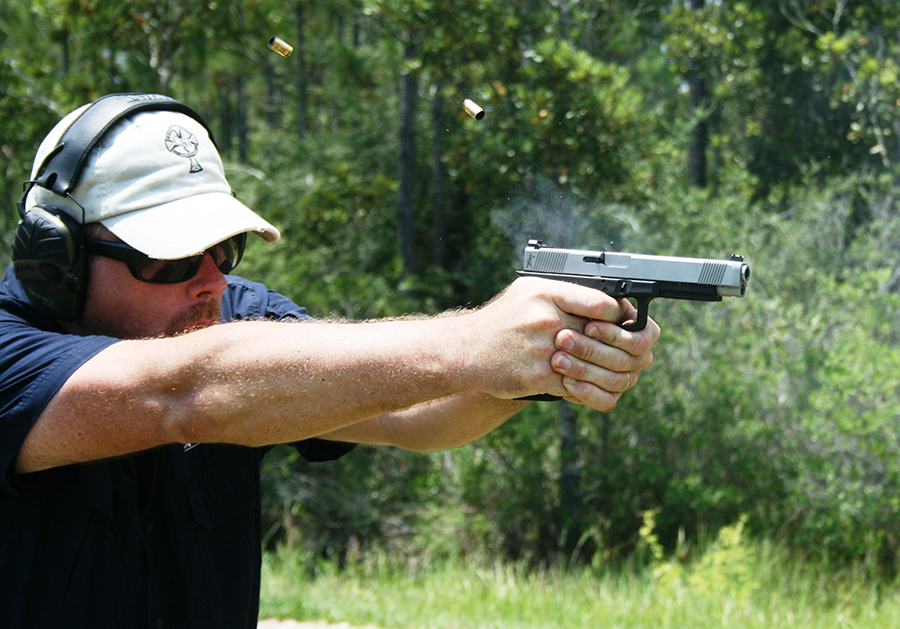
For the uninitiated, the Brass Drill is simply taking a piece of spent brass off of the ground, having the student hold an empty pistol straight out in a firing grip, then placing the brass gently in a position as close to the front sight as you can. If the student can press the trigger and drop the hammer/striker without having the brass fall off of the gun, they are on their way to a good trigger press. I have also done this drill with coins. Keeping a dime balanced on the rounded slide of an M1911A1 is quite the feat.
Test Results
Walt explained to me that all ten students got the same amount of instruction and range time. The only difference was Group A getting detailed front sight focus and no trigger press instruction and Group B having the opposite, trigger press but no sight focus discussion.
After both groups had the same number of training hours, I cannot recall the total, but it was a one day class, Walt had them step the 5-yard line and fire ten rounds at a target the size of a pie plate. Across the board, the students in Group B out performed those in Group A putting consistent shot groups on the targets. Walt related that, while the Group B shot patterns might not have been dead center, bullseye, they were far more consistently clustered than those of Group A.
GWoT Testing
The previous discussion about front sights and trigger press between my friend Walt and I took place in the late 1990s. More than ten years later, when I was teaching military students during GWoT, one part of their qualification process was a Night Qual. Using their stock M9 Beretta pistols, black sights, the students had to put five rounds into a OD green cardboard silhouette in the dark, from five yards out, using only ambient light; no flashlights. There were other night fire stages, but this one was the darkest.
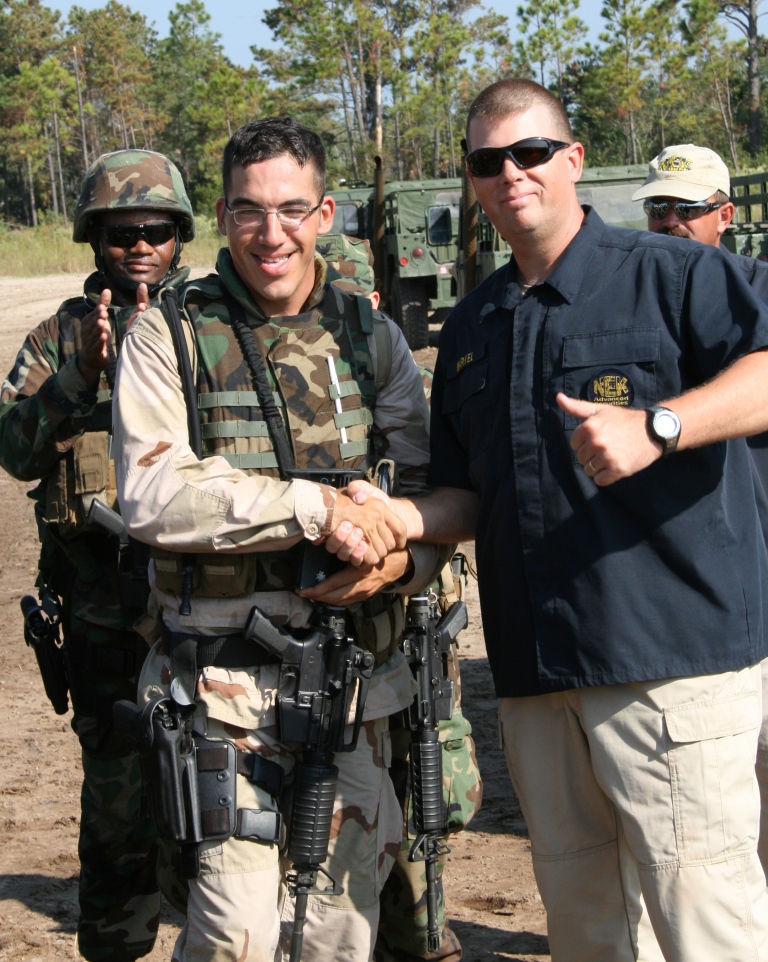
When we first began running this part of the Night Qual, students would complain that they could not see their sights, which made sense because they really could not. What we coaches would do was to ask them if they could make out the outline of the pistol slide. They would reply in the affirmative. To which we would then reply, “Okay. Hold the outline of the slide in the center of the silhouette target and take five perfect shots, focus on the trigger press.” By this time they were at the end of four full days of handgun training and had fired in excess of a thousand rounds.
For three years I was on that training team during GWoT. In that time we ran somewhere around 2000 students a year through the course. I can only recall a handful of students who did not pass the Night Qual after we told them how to do so without being able to see their sights.
Should we strive to see our front sight? Yes, of course. Does perfect sight focus fix a poor trigger press? No, it does not. Train and practice accordingly.
Paul G. Markel is a combat decorated United States Marine veteran. He is also the founder of Student the Gun University and has been teaching Small Arms & Tactics to military personnel, police officers, and citizens for over three decades.