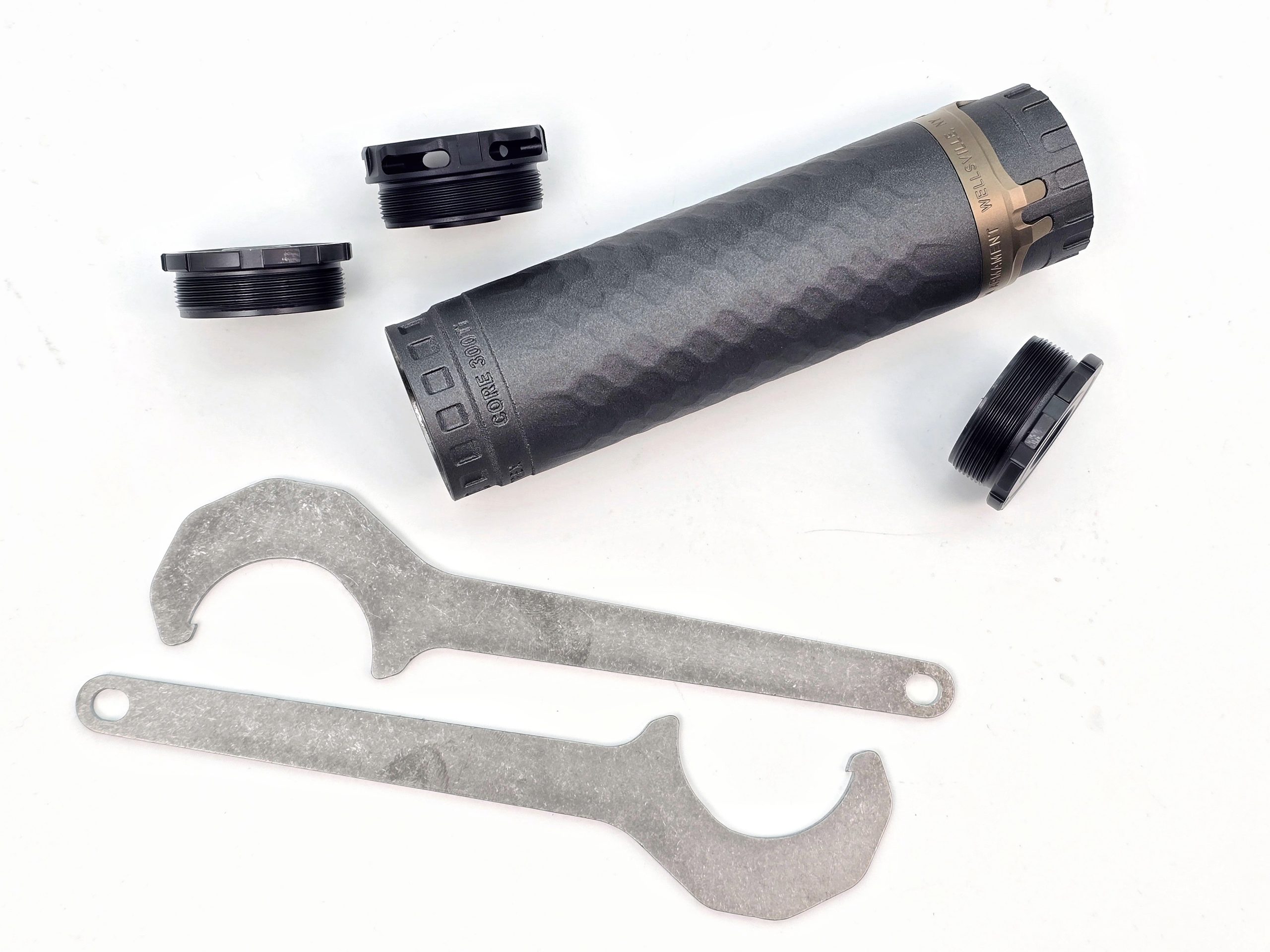
The way new suppressors are hitting the market, it’s no surprise we got our hands on one of the best suppressors ever made in this, The Year of Our Silencer 2026. This is the Precision Armament TiTrex in .30 caliber, and it’s pretty dang impressive.
3D-printed from Grade 5 titanium, the TiTrex is one of the smaller, lighter .30 cal cans on the market at just 6.2 inches long and weighing only 9.2 ounces including the mount and front cap (5.9 in and 7.2 oz for the body alone). Inch-for-inch, it just might be the quietest .30 cal suppressor available. Even when paired up against longer, fatter, heavier cans, it beats out nearly all of them.
That said, the number one piece of advice I give to soon-to-be new silencer owners is not to chase dB numbers. Everyone tries to buy the quietest can for their first suppressor or two, and then they realize that as long as it’s “hearing safe” — the standard for that is under 140 dB at the shooter’s ear — things like size, weight, suitability on particular firearms, and other features are much more important for every shooting scenario other than firing seated at a bench.
The thing is, the Precision Armament TiTrex delivers pretty darn hard on form factor and features, which has left me free to openly celebrate its standout sound suppression performance as well.
If you’ve been a reader of ours for a while (good grief, it was way back in late 2014) you may recall my muzzle brake shootouts where I measured how much recoil reduction over 100 different muzzle brakes (was it closer to 150?) were good for. Precision Armament won most of those tests, and a couple of ’em by a large margin. I also commented that their machining and finish were the best of the entire lot. They’re a very talented, dare I say OCD-level machine shop and they make my favorite non-suppressor-related muzzle device (the AFAB).
Fast-forward more years than I realized (or want to admit to myself) and the guys at Precision Armament contacted me about testing their first suppressor. I was happy to give it a shot.
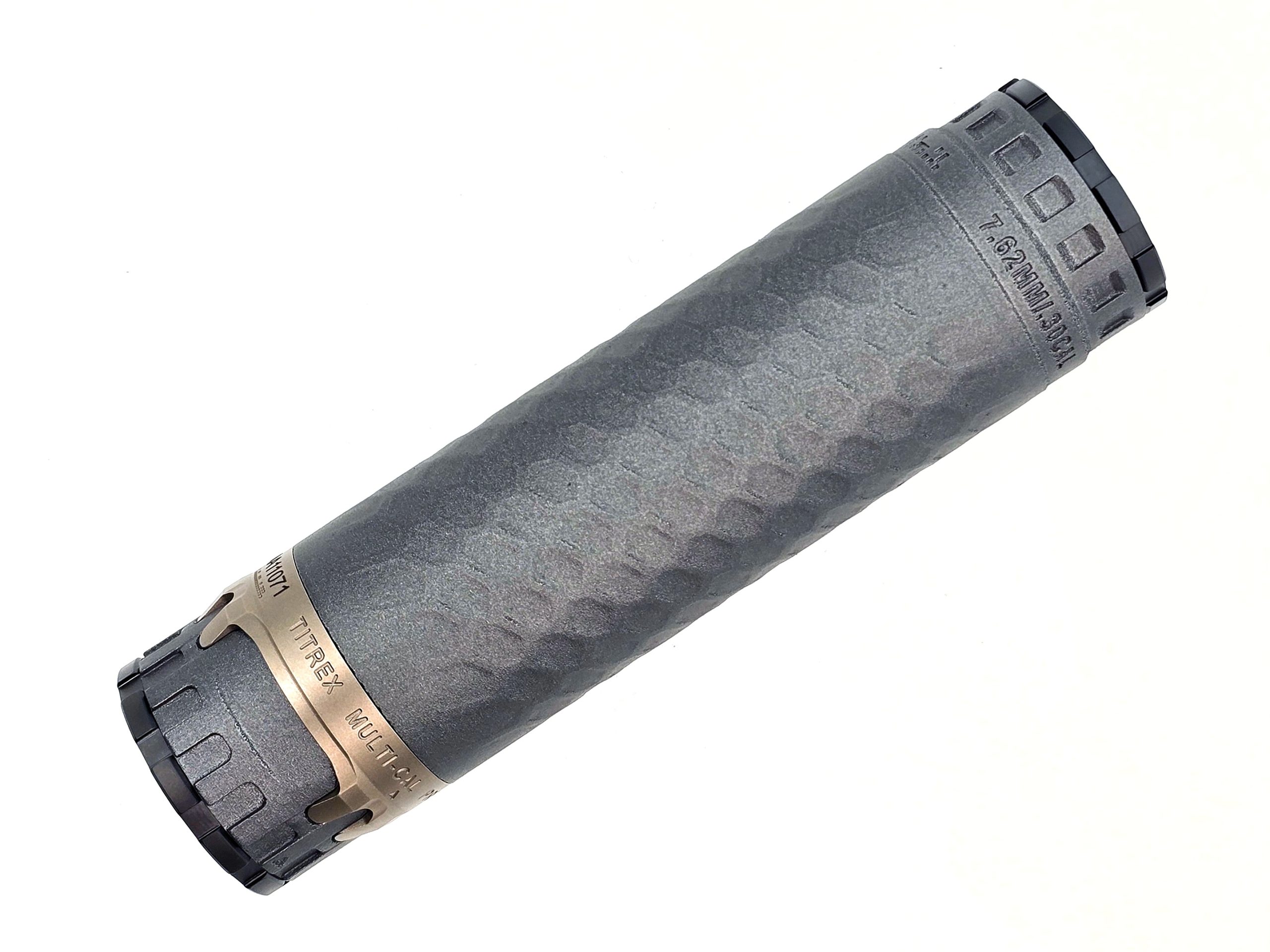
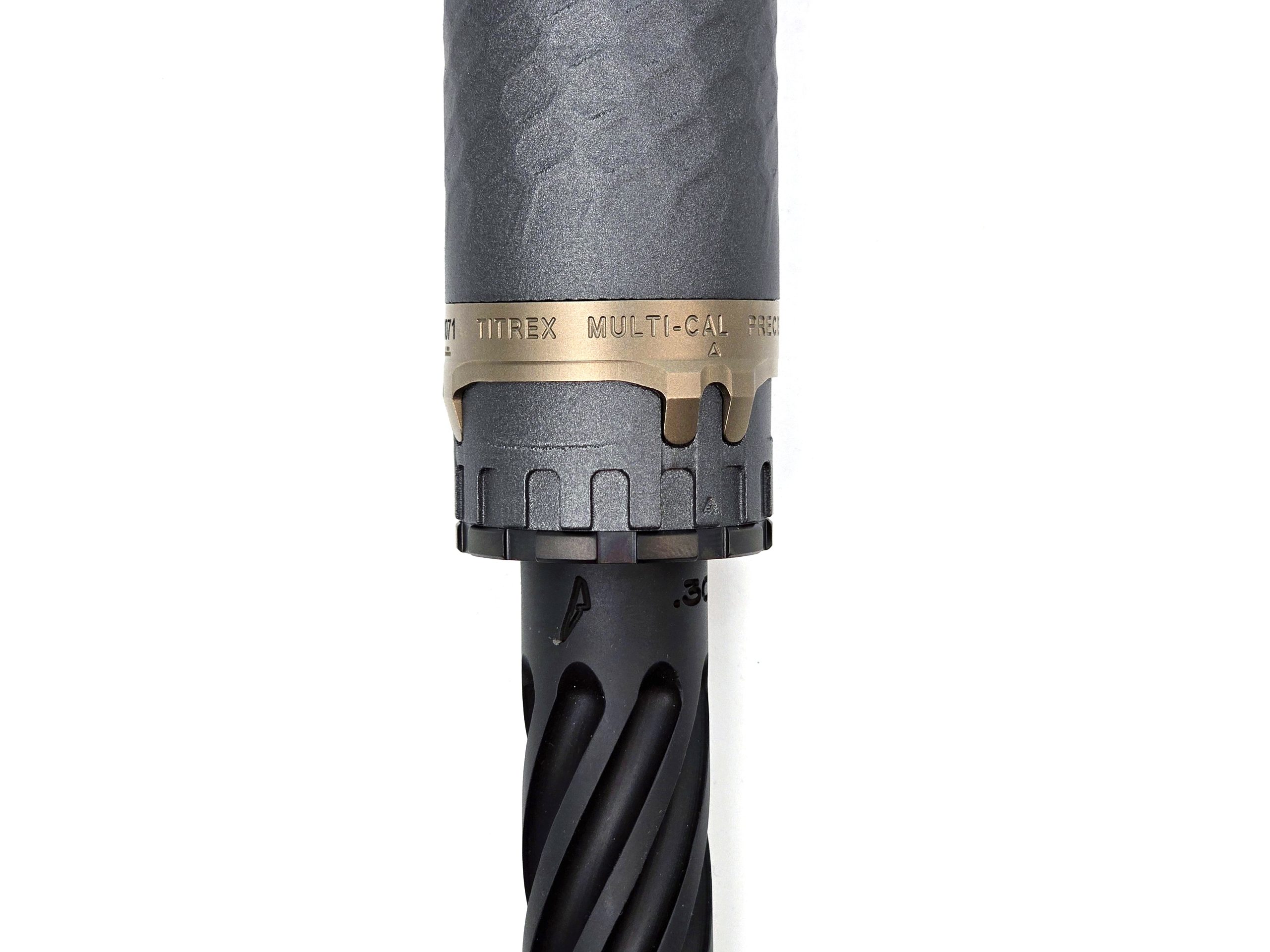
It showed up and first impressions were very good. I think the TiTrex has a super-premium look and feel to it with the heat-treated 17-4 stainless steel Xband in that lovely 17-4 H900 gold color and the X-CORE in Dark-Ti.
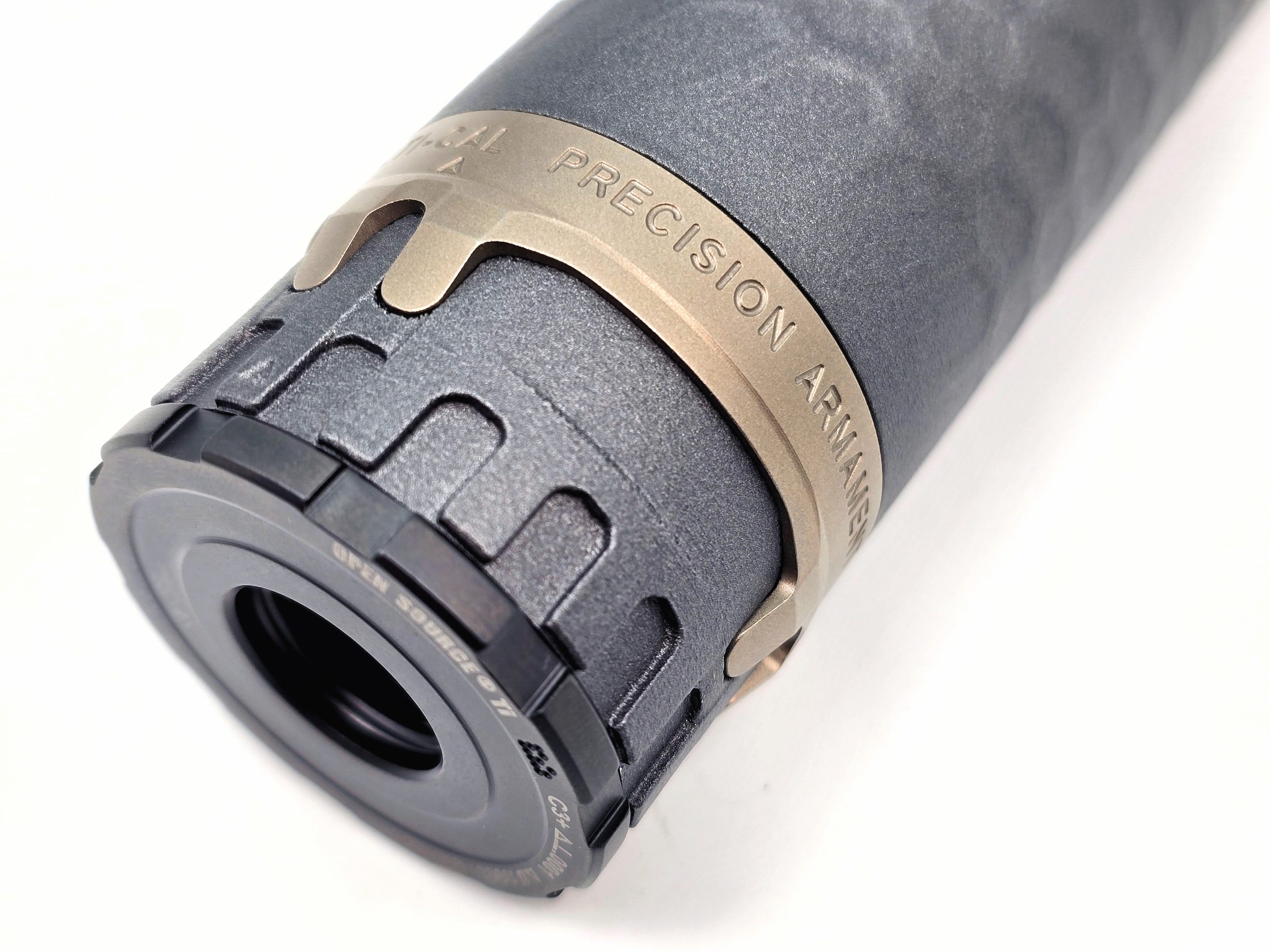
As I had come to expect from Precision Armament, the machining and engraving on the Xband was absolutely flawlessly executed, as was the machining and finish on the titanium mount and both front caps. Not only that, but the surface texture and features like wrench points and text on the TiTrex’s 3D printed body/core were cleaner and better executed than what I’ve come to expect from additive manufactured / DMLS (direct metal laser sintered) suppressors in general.
Still, I admit I wasn’t actually excited to shoot this thing. The TiTrex looked really nice, but the cutaway graphic on the box gave me the [incorrect] impression that they had printed a fairly standard baffle stack inside the core, so I thought I knew what to expect based on size and internal design. I let the thing sit on my desk for about two weeks before getting around to testing it. Boy was I was wrong!
Firing subsonic 308 Winchester through a 10-inch Black Collar Arms Pork Sword SBR, it was immediately apparent that this is a very quiet suppressor. Not only that, but there was no discernible first-round pop (the typical behavior of the first suppressed shot being louder than subsequent shots). We shot three other suppressors back-to-back on this setup and the TiTrex was easily the quietest, hands-down. Not even a question.
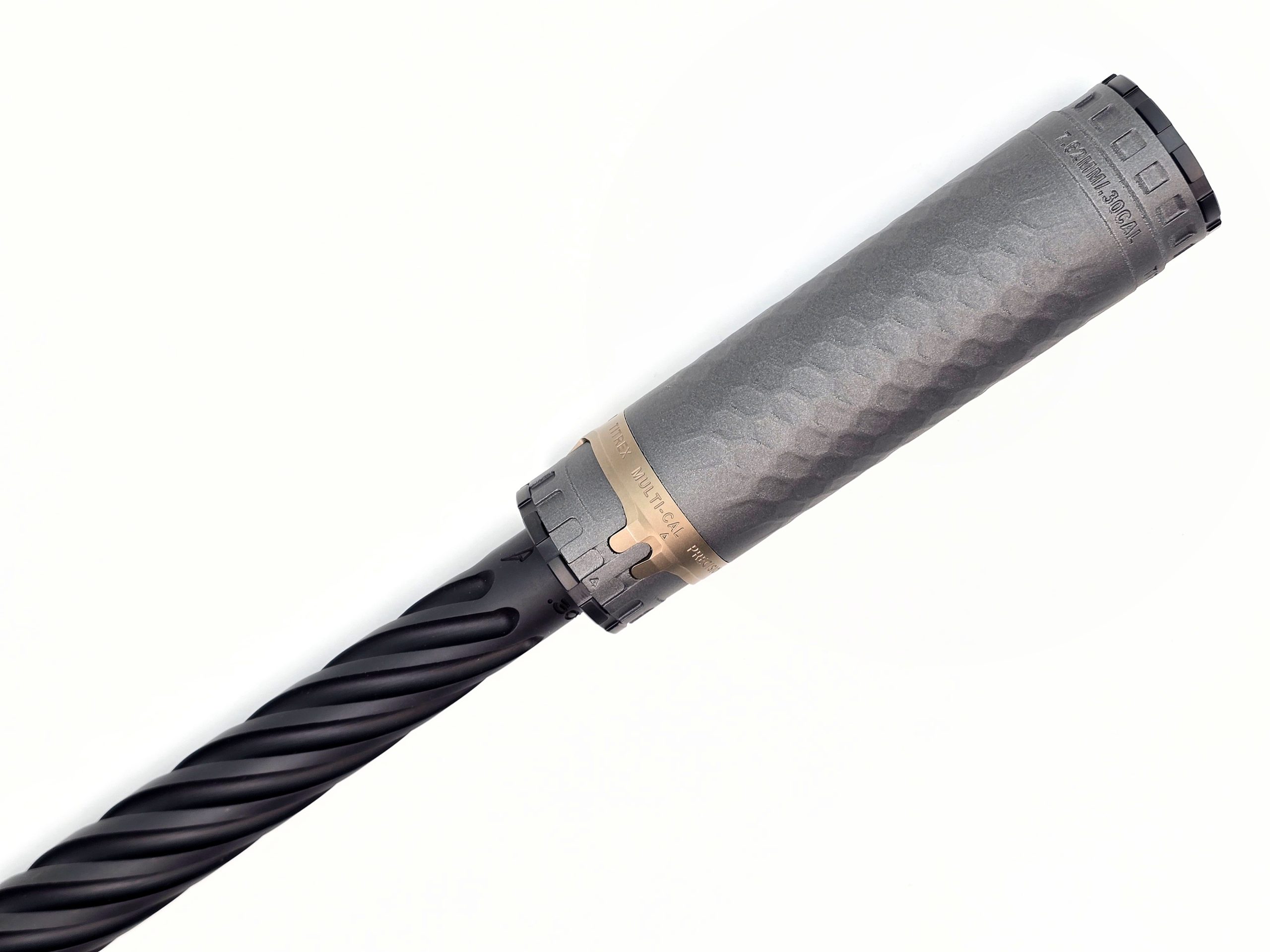
Dan and I then switched to full-power 308 Win from the same 10-inch barrel, which is certainly a harder workout for a suppressor than a “normal” 308 barrel length of 18-plus inches. Based on our human ear dynamometers, we guessed it slightly edged out one of the known (and larger) best-performing silencers on the market. And that was with the ultra compact K-Brake front cap installed, which Precision Armament says cuts down on recoil by 15 to 20 percent, but typically adds about 4 to 5 dB at the shooter’s ear compared to the flush-front cap, both of which ship with the TiTrex.
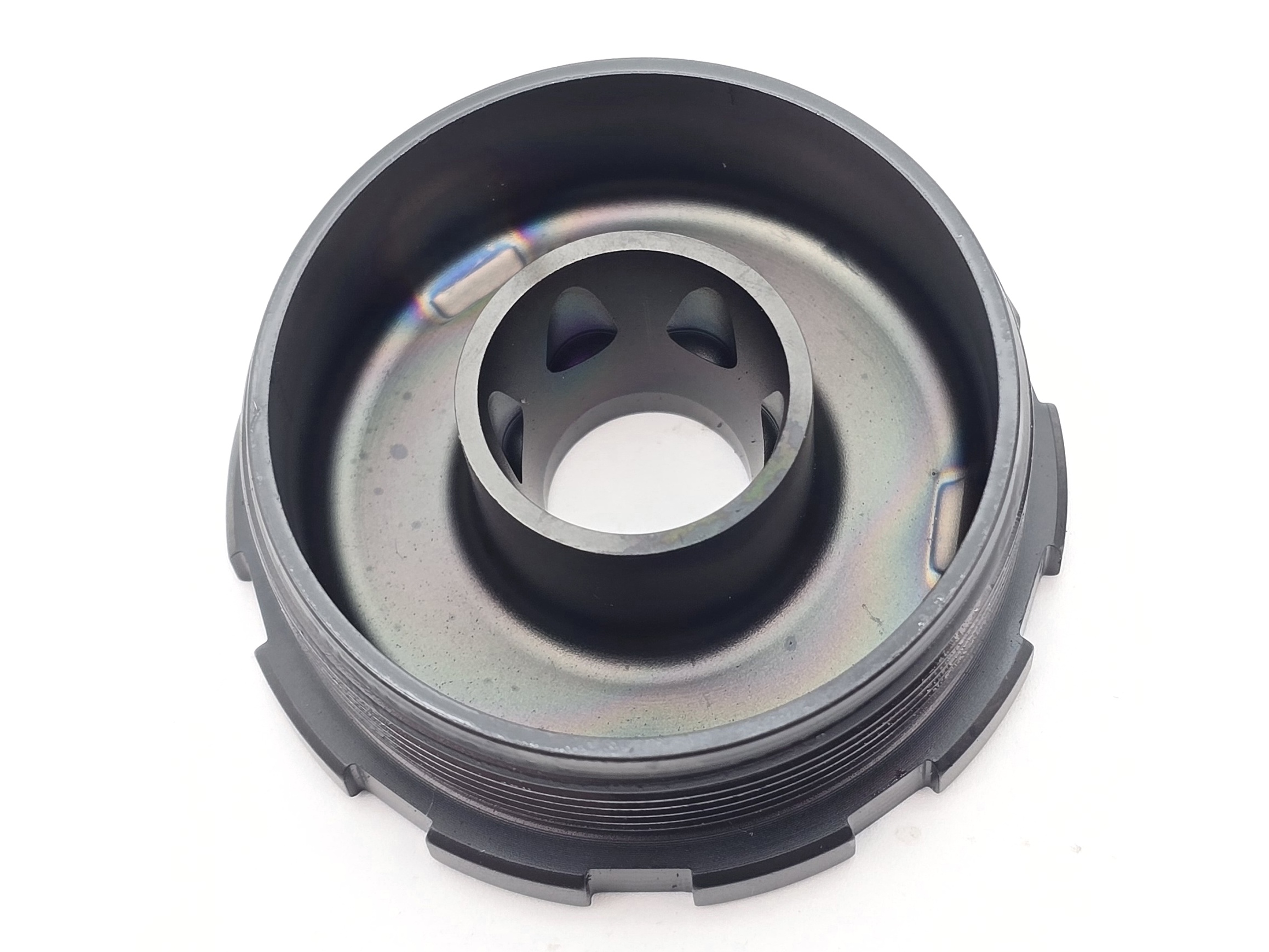
On a related note, an example of their über engineering R&D process (“nerdery”) can be found in the K-Brake white paper HERE as well as in the photo above. That’s the inside of the flush front cap. Precision Armament spent more time modeling and A/B testing iterations of it than most companies spend on their entire silencer design.
The precise shape of the bore in that front cap — how it transitions from wide to narrower to wider again, those little gumdrop-shaped cuts on the inside, the height of the cone, etc., is not random. They squeezed blood out of that stone and delivered legitimate, additional suppression performance from the design of that front cap bore alone.
On the drive out of the range that first day I called up the Precision Armament guys. “What the freakin’ heck have y’all done?” The TiTrex exceeded expectations enough to surprise me into mild profanity.
On our next range day with the TiTrex, we threw it on a 300 Blackout AR-15, a .223/5.56 AR-15, and a 7mm PRC bolt gun. Again the TiTrex’s lack of first-round pop was noticeable when compared to the other suppressors we shot that day, and it performed extremely well across the board.
Though this first X-CORE design from Precision Armament isn’t a high-flow / low backpressure-style suppressor, I had zero issues with gas even on the Stag Arms .223, which doesn’t have an adjustable gas block or any other suppressor-ready features. It was as smooth as always, and judging by the video (above) there wasn’t a large increase in gas coming out of the ejection port versus firing the gun without a suppressor. No gas or debris in my eyes, which is something that will happen on this rifle with some suppressor models.
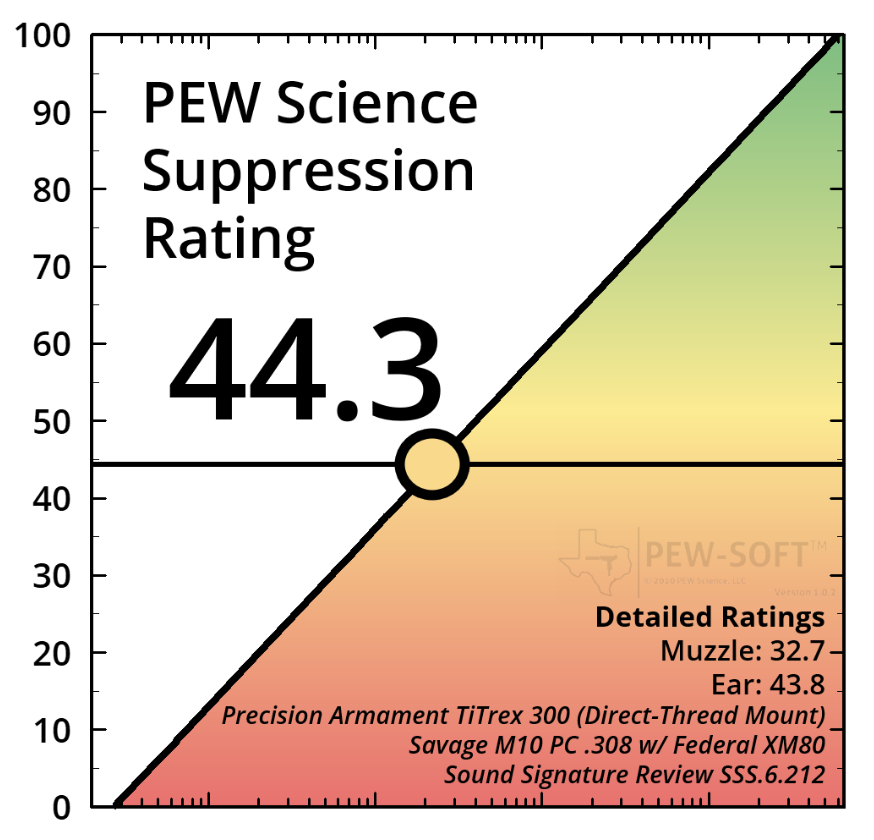
Shortly after our first range session with the TiTrex, Jay of PEW Science released his Sound Signature Review on it. Especially in the members-only PEW Science reports, there are many data points by which to compare suppressors, but the short version here is that Jay’s science corroborates (as it’s supposed to) Dan’s and my real-life, human ear experience with the TiTrex.
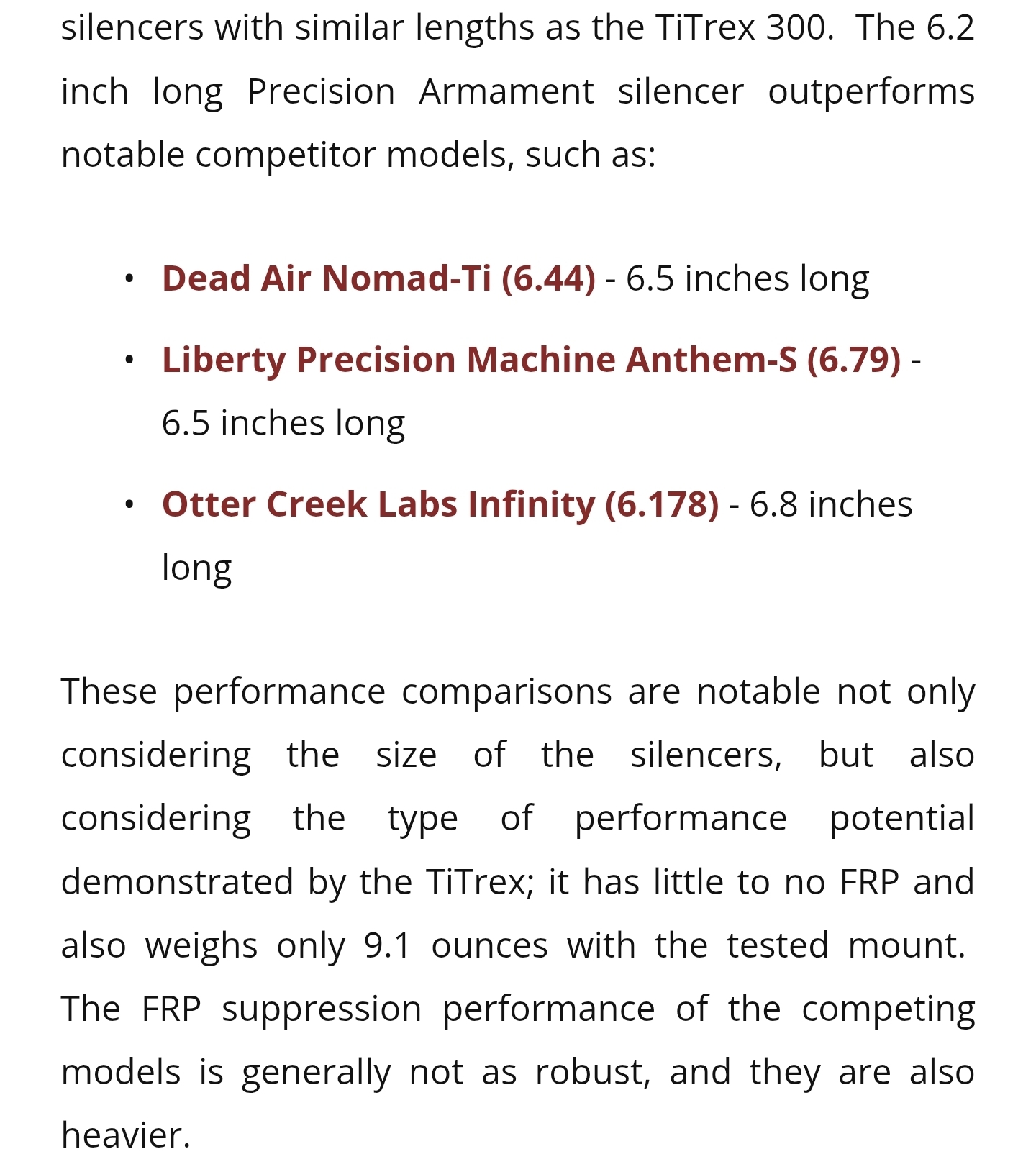
To summarize the results as aggressively as I can, the TiTrex beats nearly every other .30 cal suppressor ever tested on full power 308 Winchester in every metric minus a couple of ties and coming in 1 to 2 dB “louder” in one scenario than a suppressor that’s 25% longer and 34% heavier. Inch-for-inch and ounce-for-ounce it’s particularly dominant.
Here are a couple little tidbits from the PEW Science write-up:
I think we’ve established that it’s a good performer, eh? Let’s dive into its design and features, which will explain some of the lingo thrown about earlier . . .
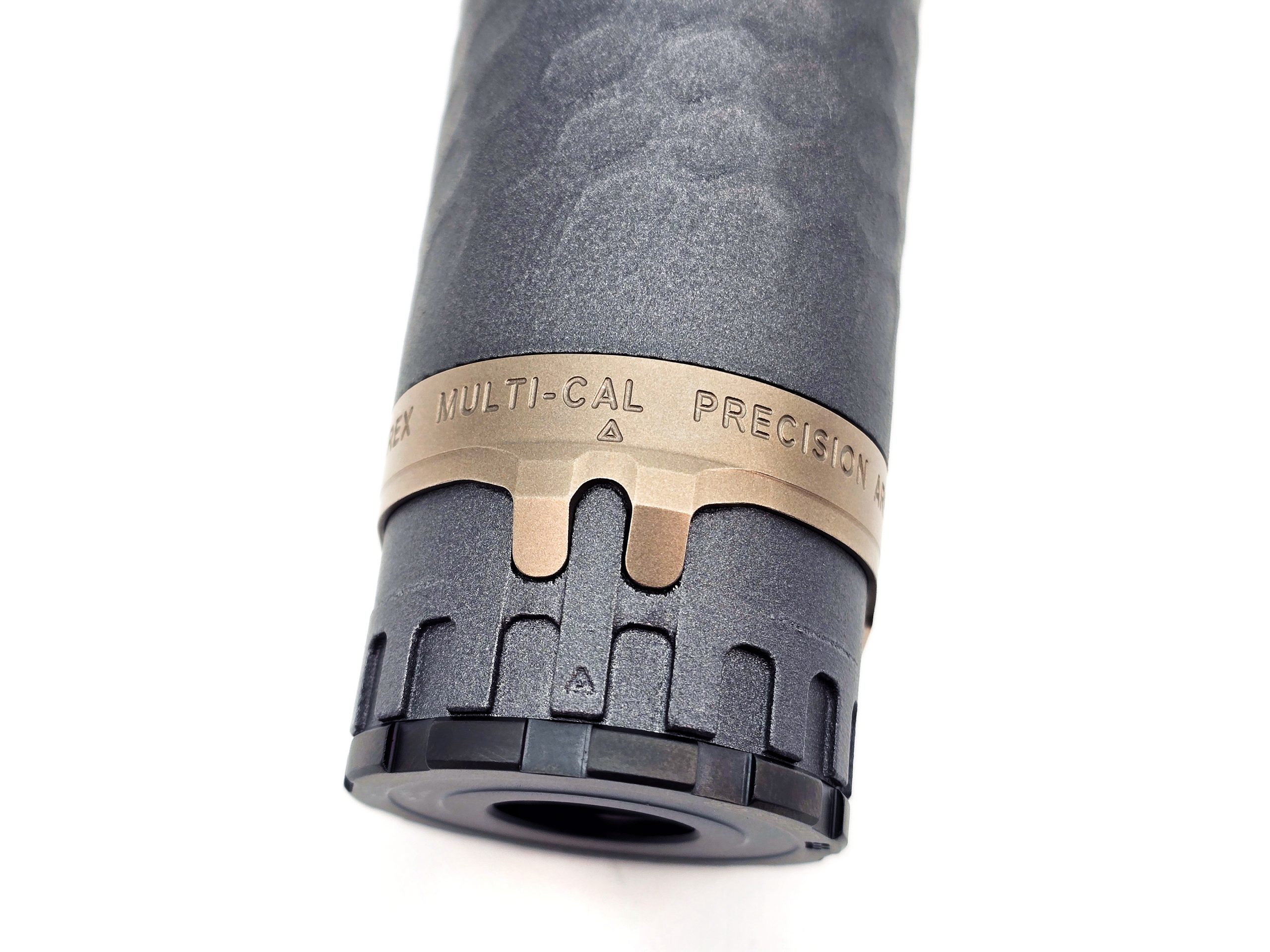
Xband: that good-looking 17-4 stainless steel ring around the base of the TiTrex is the serialized part of the silencer. It’s marked as Multi-Cal and it’s pressed onto the body where it clicks firmly into place. Precision Armament does this to achieve “endless upgradeability” and “unlimited repairability.” It basically future-proofs your TiTrex, as Precision Armament is able to remove the Xband and install it on a new core, whether that’s to replace a damaged core or to swap it for a new one of a different design, material, or caliber.
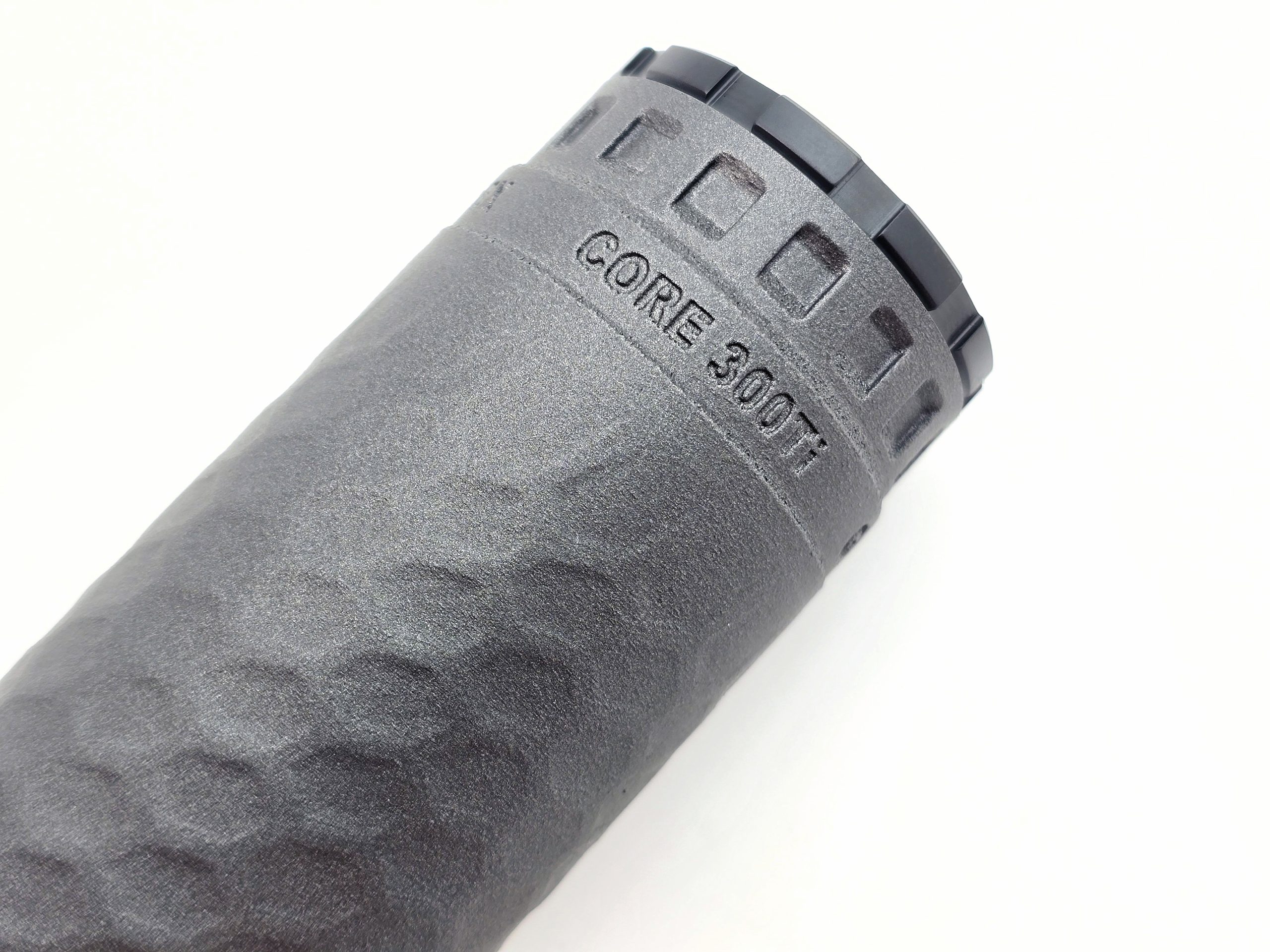
X-CORE: this is the body of the can…the exchangeable core of the TiTrex suppressor system. Model designation and other info is 3D printed into the body, because cores can be swapped should you decide you want to change calibers, materials, or designs.
For instance, Precision Armament already showed off X-COREs of similar design but in .36 cal, .260 cal, and others at SHOT Show and mentioned that they’ll be expanding the line fairly dramatically into Inconel and low backpressure models as well. The Xband + X-CORE setup means unlimited replacement capability, whether it’s replacement for repair reasons or just to get a new-and-improved design or to switch calibers, materials, and/or types.
NURBS: again, based on the cutaway graphic on the side of the box, I had mistakenly thought the baffles inside this .30 cal titanium X-CORE were of a standard cone design, but that wasn’t accurate. Precision Armament calls the design NURBS, for non-uniform reconvergent baffle stack, which they explained to me on that first phone call, but I blacked out a little from the engineer speak.
My takeaway is that each baffle is rotationally asymmetric and cannot be machined via traditional means (they must be additive manufactured). It was designed with some wild surface modeling software then refined through extensive testing until they optimized gas flow regulation, heat transfer, sound suppression (through a DOE-driven acoustic program), durability, point of impact shift reduction, etc. For example, Precision Armament fired an accuracy group, rotated the suppressor 45 degrees, fired an accuracy group, rotated, repeat, repeat on dozens of designs to dial in the secret to eliminating (or as close as possible) point of impact shift.
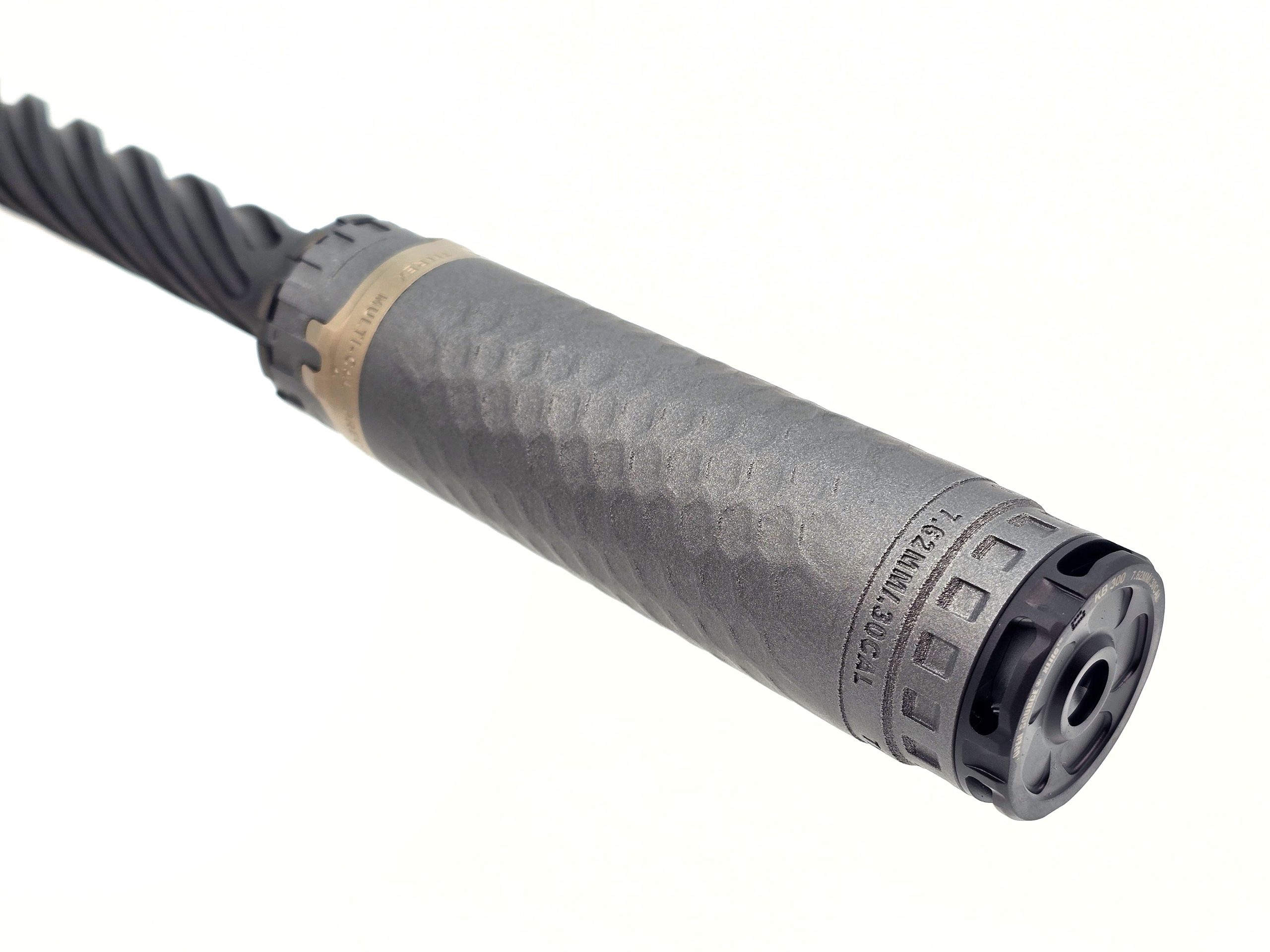
HUB and “open source” compatible: at its base, this X-CORE is HUB threaded for compatibility with any HUB/Bravo mount on the market. At the front, it’s designed for compatibility with SilencerCo Bravo-style front caps and accessories, which opens the owner up to a growing ecosystem of caps, brakes, and more. The TiTrex, at least in this .30 cal titanium flavor X-CORE version, ships with a titanium 5/8×24 direct thread mount and two front caps: a flush one and a K-Brake Ultracompact Brake version.
The TiTrex with .30 cal titanium X-CORE weighs just 7.2 ounces (9.2 with the included mount and front cap) yet is rated for use on up to 300 RUM with no barrel length restrictions. At SHOT Show we saw video of Precision Armament’s durability testing, including on a belt-fed machine gun, on a 10-inch 300 Remington Ultra Magnum SBR they built, and on a pressure test machine where they were able to intentionally take X-COREs to the point of failure so they could design precisely how and where they want a failure to occur in the core, should it happen in the field.
Needless to say at this point, Precision Armament really knocked it out of the park with the TiTrex. It isn’t just among the quietest (likely the quietest in many scenarios), but it’s also among the shortest, lightest, most thoroughly tested and well-thought-out, user-friendly (HUB + Bravo), and future-proof silencers ever made.
The Precision Armament TiTrex represents a leap forward in suppressor design — on multiple levels — and sets a new bar for 2026 and beyond.
More information can be found on the Precision Armament website, and the TiTrex is already available for shipment directly to your door from Capitol Armory HERE.
Precision Armament TiTrex .30 caliber Ti Specs:
| OD: | 1.65″ | |
| Length: | 5.9″ (Body), 6.2″ (w/ Mount & Front Cap) | |
| Weight: | 7.2oz (Body), 9.2oz (w/ Mount & Front Cap) | |
| X-CORE™ Material: | Titanium, Grade-5 Ti-6Al-4V | |
| Xband™ Material: | 17-4 SS w/ H900 heat treat | |
| Full Spec Sheet: | View PDF | |
| Installation Manual:
MSRP: |
View PDF
$1,199 |
|
I was amazed reading this article. I know very little about suppressors so this brought many answers to my questions! I will be a first time buyer of a can and this one looks perfect for my Ruger SFAR in 308 caliber. I realize though I still have much to learn about suppressors and will continue to grow on the subject in the near future. I was also amazed at the price being reasonable. I have had class three weapons in my collection and know about what it used to be like in the 90’s when I underwent the back ground check. Doing away with the $200 tax stamp made it much nicer and I understand the turnaround period of processing it isn’t anywhere as long which makes it a great deal.
Nevertheless I wanted to say I really appreciate your article and support reading you gave .
Many Thanks
Dave Boots