If you’ve spent any time shopping for suppressors, you’ve noticed the term “HUB compatible” popping up on suppressor listings, mount descriptions, and forum discussions. It’s one of those industry terms that’s thrown around that can feel confusing at first. Is HUB about the silencer or about the mount? Is it a specific mount style? A brand? Let’s clear this up!
HUB stands for Hybrid Universal Base, and it refers to a widely-adopted thread specification that has become the de facto standard for modular suppressor mounting.
The HUB designation traces back to SilencerCo’s Hybrid 46 suppressor, a .46 caliber can that launched in 2016 and quickly gained popularity for its versatility across an extremely wide range of calibers and firearms. When SilencerCo designed the Hybrid 46, they chose to cut 1-3/8×24 TPI thread into the mount end of the suppressor’s body. Also written as 1.375×24, this 1.375-inch diameter with 24 threads per inch thread pitch worked well for the diameter of the Hybrid 46 and nicely balances strength, installation speed, and security (coarse threads are strong and install fast, but are typically more likely to come loose, whereas fine threads are generally not as strong, require more rotations to install, but are more likely to stay tight).
Thanks to the Hybrid 46’s popularity and its ability to suppress a massive range of different firearms, there was large demand for different types of mounts to fit this suppressor. The aftermarket responded in spades, and mounts to fit the Hybrid 46 were soon available from dozens of different companies.
Fast forward a few years and, due to the huge variety of available silencer mounts with 1.375-24 threads, other suppressor manufacturers started making their silencers with that same thread size so their customers could tap into this existing mount ecosystem.
SilencerCo called the Hybrid 46 thread size “Bravo,” nomenclature they still use today along with some other mount manufacturers to designate mounts that are compatible with many of SilencerCo’s suppressors. Silencers from other companies, however, needed a different term (one not trademarked by SilencerCo) for this thread size and the industry standardized on “HUB,” or Hybrid Universal Base.
For the silencer consumer, what that means today is if you choose a silencer that’s “HUB compatible” it has this same 1.375×24 thread specification at its base and, therefore, it accepts any of the hundreds of HUB/Bravo-compatible mounts on the market.
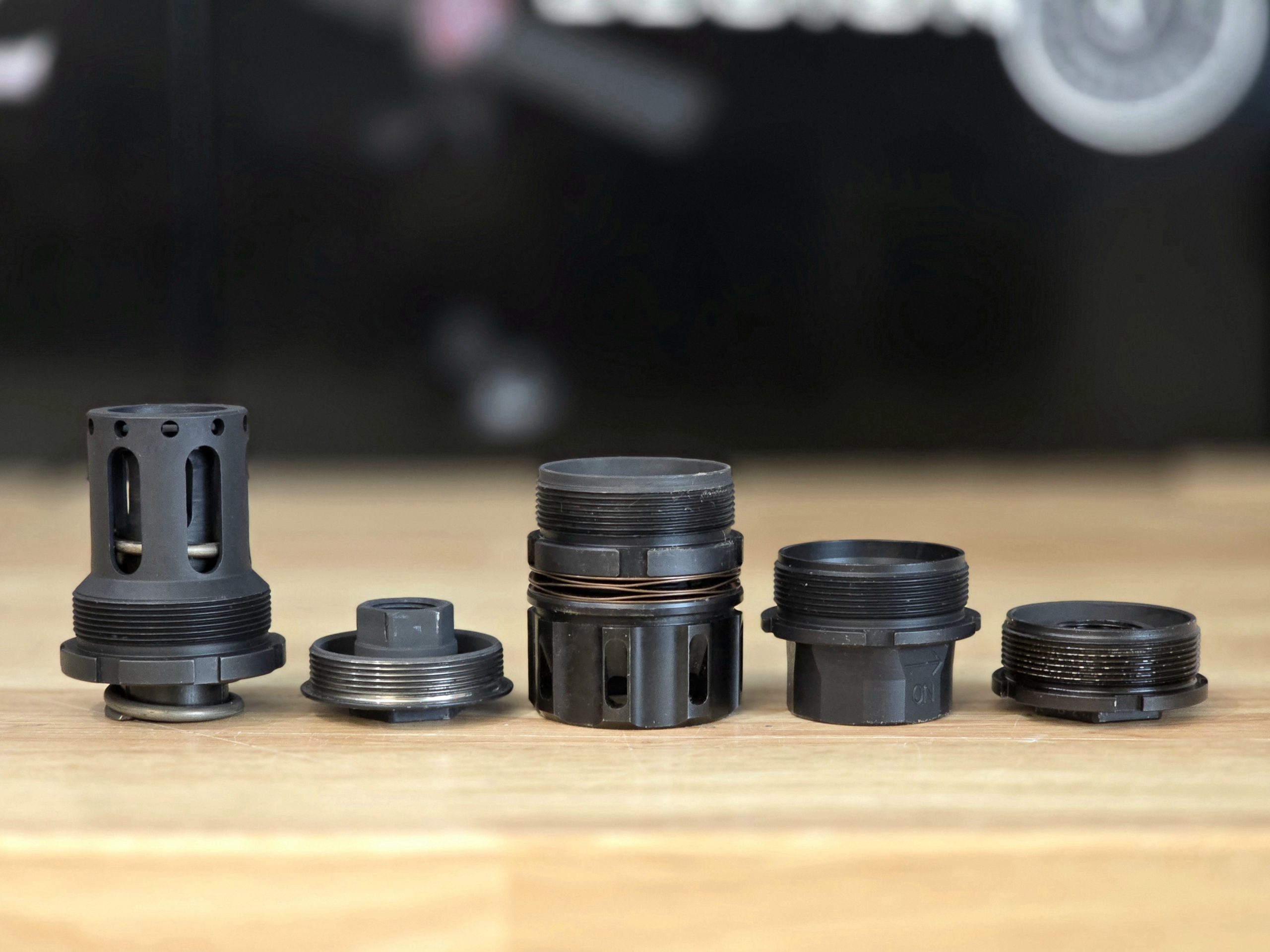
This means you can pair a HUB-threaded suppressor with:
– Direct-thread fixed mounts in every possible muzzle thread size (e.g., ½×28 for 9mm carbines and 5.56 rifles, 5/8×24 for .243+ caliber rifles, etc etc)
– Quick-detach (QD/QA) mounts for systems like KeyMo, ASR, Xeno, Plan B, three lug, and all the rest
– Pistol boosters (Nielsen devices) for semi-auto handguns
The obvious benefit is that this broad mounting ecosystem (e.g. dozens of HUB products available at Brownells) allows shooters to use one suppressor across multiple platforms — rifles, pistols, subguns, and even larger-bore firearms — by swapping the HUB mount at the base of the silencer.
Unlike silencers with a specific type of mount welded or machined into their base, a swappable mount is a huge cost and convenience win for getting the most out of a single can. The popularity of HUB-compatible mounts opens up a whole world of options across every style and manufacturer.
Perhaps less obvious, but no less valuable, the HUB ecosystem also allows the mounting of silencers from multiple brands to muzzle devices of a single brand or type. For example, if you’ve decided you prefer one particular mounting system like Dead Air’s Xeno and therefore you decide to install a Xeno muzzle device — flash hider or brake — on as many of your rifles as possible, you could install a Xeno-compatible HUB mount into the base of your SilencerCo Hybrid 46, your Precision Armament TiTrex .30 cal, and your Dead Air Lazarus 6 and quickly move any of those cans across all of those rifles…just make sure the silencer is rated for that rifle’s caliber.
There’s also a huge aftermarket of mounts and QA muzzle devices from companies that don’t even make silencers but just specialize in mounts. You could have silencers from six different brands all mounting with mounts and muzzle devices from a seventh brand.
A Word of Caution: Quality Matters
While the HUB standard opens up a lot of flexibility, it also introduces a potential risk if you cut corners. A poorly made or misaligned mount can cause the suppressor to sit out-of-line with the bore of the barrel, increasing the chance of a baffle strike (where the bullet contacts the inside of the silencer). Baffle strikes can damage or destroy a suppressor, ruin your accuracy, or even create a dangerous situation.
Many silencer manufacturers provide generous warranties that cover repairs from baffle strikes, but if you’ve used a wonky mount your chances of having to pay out of pocket go way up.
For both suppressor-side and firearm-side mounts and muzzle devices, stick with reputable manufacturers who are known for precision machining. We recommend double-checking for concentricity with an alignment rod when combining a mount, muzzle device, and/or firearm for the first time.
The Bottom Line
HUB isn’t a mount or a brand, it’s a thread size standard (1-3/8×24) in the base of the silencer that has become the industry’s preferred interface for the mount that connects silencer to firearm. By choosing a HUB-threaded can and pairing it with quality HUB-compatible mounts, you gain access to one of the most versatile suppressor ecosystems available today.
If one uses pro-gun websites and blogs to decide with what to equip their firearms – lately – there seems to be only two things in the whole wide world one absolutely needs, without a doubt or you are doomed, and that’s a suppressor and an IR laser/illuminator.
Then of course after that: You need nods to see the IR laser/illuminator then a helmet to put the nods on and of course to balance things out so you don’t look silly you need a plate carrier and battle belt – then a cover for your suppressor then the subsonic ammo for the suppressor and a mount for the suppressor then the best batteries for the IR laser/illuminator.
Then you need endless hours on the same web sites and blogs posting in comments about your nods and helmet and plate carrier and battle belt and suppressor and subsonic ammo and your suppressor cover and the suppressor mount and the best barrel length on the rifle for suppressor use and, for the masochist in you, how to best conceal carry your suppressed pistol and then if you should have a locked container in your car for your ‘helmet with nods and plate carrier and battle belt’ just in case the lights go out in the grocery store and you need to deploy in the vegetable section with your suppressed pistol or suppressed rifle and IR laser/illuminator.
So ya thought you had a handle on it all, and then along comes HUB.
And to think, you got into guns because as a kid you liked to go plinking with your .22 and nail a rabbit every now and then while hunting – and you just wanted something for home and personal defense. Life used to be simple until your read that darn pro-gun web site or blog.
I don’t have an IR laser or a helmet or helmet nods or even a suppressor cover. I have shot quite a few rabbits with a 22LR in the last few months, though. I think you’re gonna be just fine here, Booger.
you do know it was satire/joke right?