

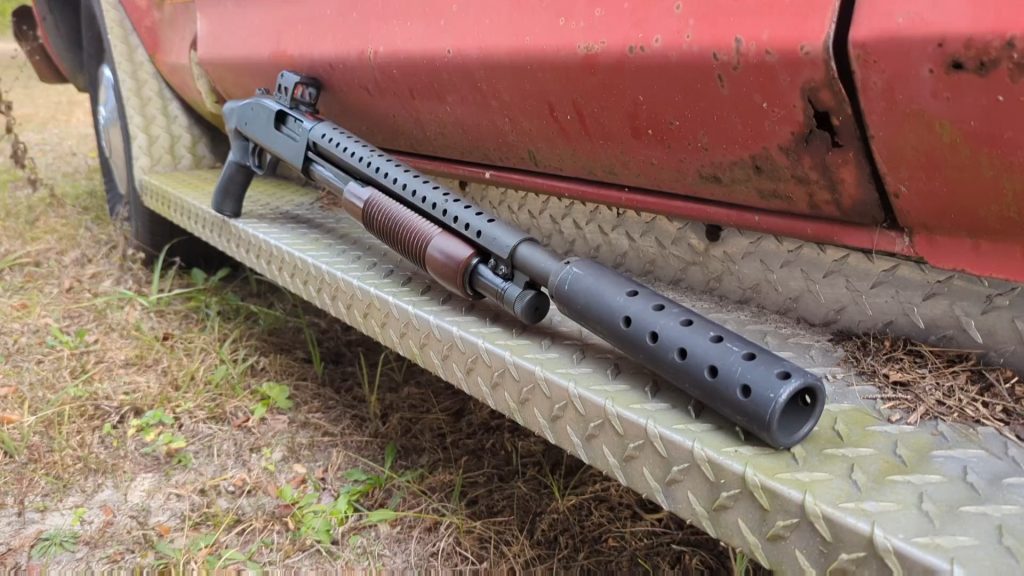
Mossberg, in the early 2000s, was a creative company. Being creative in the firearms world doesn’t always mean you’re putting out a great product. A lot of people made fun of the ZMB 464, but look how many tactical lever guns are out there now? Mossberg’s stock standard 500 series saw a lot of weirdness. Especially the pistol grip models. Like the Rolling Thunder.
We had the Chainsaw model with the hip firing approved chainsaw grip. We had the Roadblocker with a tank-style muzzle device, and the subject of today’s presentation, the Rolling Thunder. The Rolling Thunder is a variant of the Mossberg 500 with a pistol grip and a 23-inch heavy-walled barrel with a permanently attached muzzle device.

The 23-inch barrel length comes from the combined length of the muzzle device and barrel. The muzzle device is listed as a barrel stabilizer. A barrel stabilizer is a real thing, but it’s most commonly seen on rifles. In particular, they seem popular on Mini 14s to improve accuracy. They are not traditionally machined aluminium blocks affixed to the end of the barrel.
The barrel has four rows of ports, two rows of six, and two rows of five, totaling 22 round ports. Two rows are angled directly upward, and two more are angled slightly upward to the side. It’s certainly odd and appears to be better described as a compensator than a barrel stabilizer.
They Call It Heavy Metal
The heavy-walled barrel is also an oddity. Heavy-walled barrels on Mossberg 590A1s are common. Heavy-walled barrels in a Mossberg 500 configuration aren’t common, and I don’t know of any other 500s with a heavy-walled barrel.

That thick boi barrel has a heat shield for total tactical drip. The Rolling Thunder has a bead sight, but while shooting, it yeeted itself from the gun. It also traditionally came with a rail for lights and such on the bottom of the stabilizer. However, mine has had this rail removed.
The original press release is online, and it brags about the gun’s compact length, which, with a pistol grip is true. It’s short, but also 4.5 inches longer than a standard 18.5-inch barrel.

This isn’t an official Rolling Thunder model. I purchased the barrel on eBay, installed it in a Mossberg 500, and made a close approximation with an ATI pistol grip. The original Rolling Thunder had a hard plastic pistol grip and a polymer pump with a hand strap. My gun is equipped with the Williams Gunsight Low Reflex Sight.
The Rolling Thunder 500
The star of the whole show is the barrel, so I won’t spend much on the Mossberg 500 design. The high points are that it’s a pump-action, with dual action bars, a five-round magazine tube, it’s drilled and tapped for optics, and uses an aluminum receiver. It’s one of the most proven designs out there, but does the Rolling Thunder barrel and muzzle device actually work?
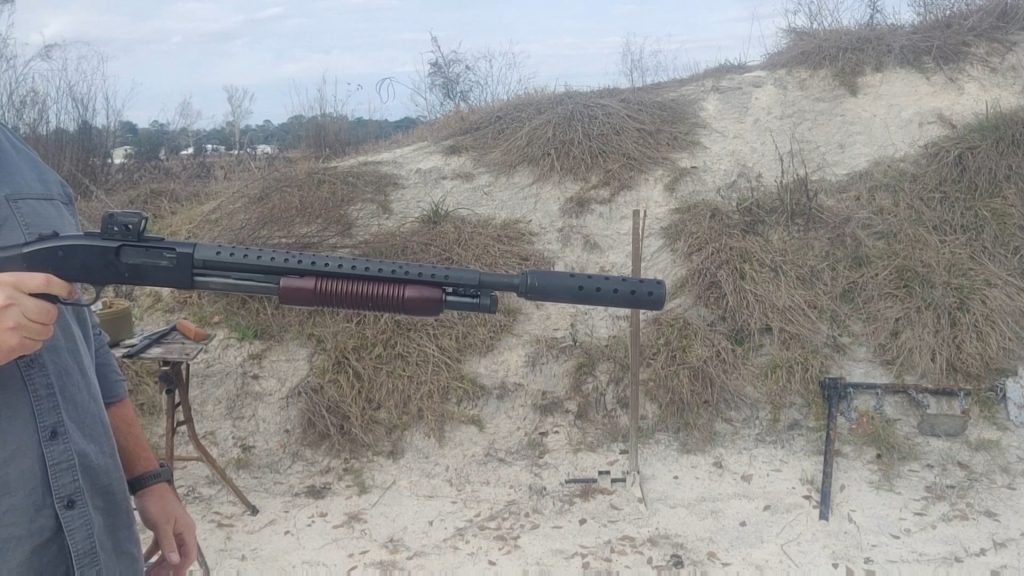
I grabbed a stock standard Mossberg 500 18.5-inch barrel to swap around to see if the massive muzzle device makes much of a difference. I wanted to test its ability to defeat muzzle rise and increase control.
Pistol grip only shotguns with this style of grip aren’t known for their ease of use. The Shockwave style has been the better option for years now, but these vertical grips hang around and generally kind of suck. They suck extra hard on a Mossberg with a tang safety.
The presence of a compensator or barrel stabilizer to reduce muzzle rise would be a valuable addition to a PGO gun, but does it work?
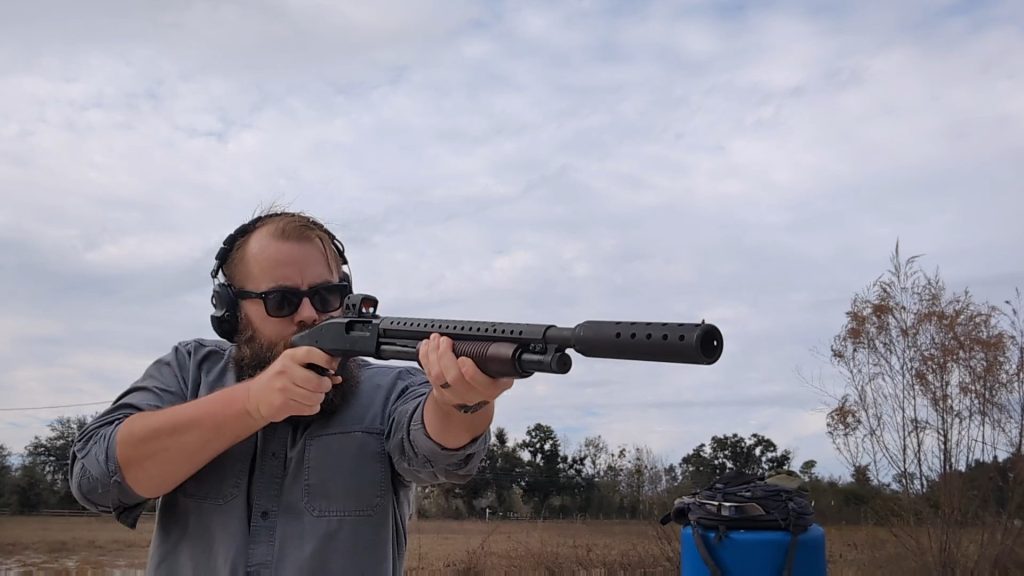
To find out, I ran some fairly basic tests. The first was load a 3-inch magnum load of 000 buckshot and see if muzzle rise is reduced. Shoot a load through each barrel and observe. I did not engage in any push-pull, or recoil mitigation. I just kind of held on, not too tight, but enough to support the gun.
The results made me laugh and grin as the gun exploded upward and out of my support hand. Without a doubt, the Rolling Thunder barrel didn’t go nearly as high as the stock barrel. Is that the effect of the compensator? Or the fact that the barrel has a giant weight at the end?
The Weight Matters
The Rolling Thunder barrel weighs more than double the standard barrel. It’s 3.09 pounds, and the standard 18.5-inch barrel weighs 1.13 pounds. The Rolling Thunder is ridiculously front-heavy and unbalanced to the point that the standard model feels remarkably light compared to the Rolling Thunder.
The next test was simply two shots fired at 15 yards as fast as possible with a standard buckshot load. I repeated the test three times with each barrel. There was no notable difference. It was a series of 1.15 to 1.05-second times with no barrel offering a true winner.
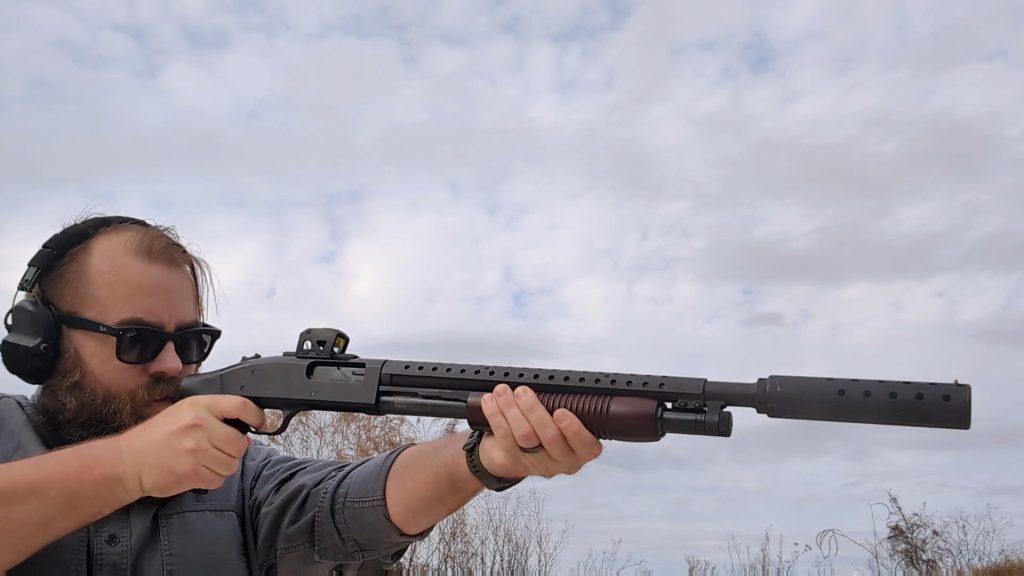
I then ran a variety of loads, including a one-handed shot with a full-powered load of buckshot. The Rolling Thunder did a much better job of not jumping violently than the standard barrel. Is it the comps or the weight? It’s a bit of both for sure.
Traditionally, you port a shotgun’s barrel right around the sight. This works because the gas is behind the wad and the shot you’re firing. The barrel ends right before the ports start, but the compensator has a wider diameter than the barrel, and therefore gas can push past the buckshot and wad instead of perfectly directly it upward.
I think this creates a less effective compensator overall. For fun, I strapped some painter’s tape over the ports and fired a round of full-powered buckshot, turning the shotgun and tape into a deadly confetti cannon. The ports are certainly doing something.
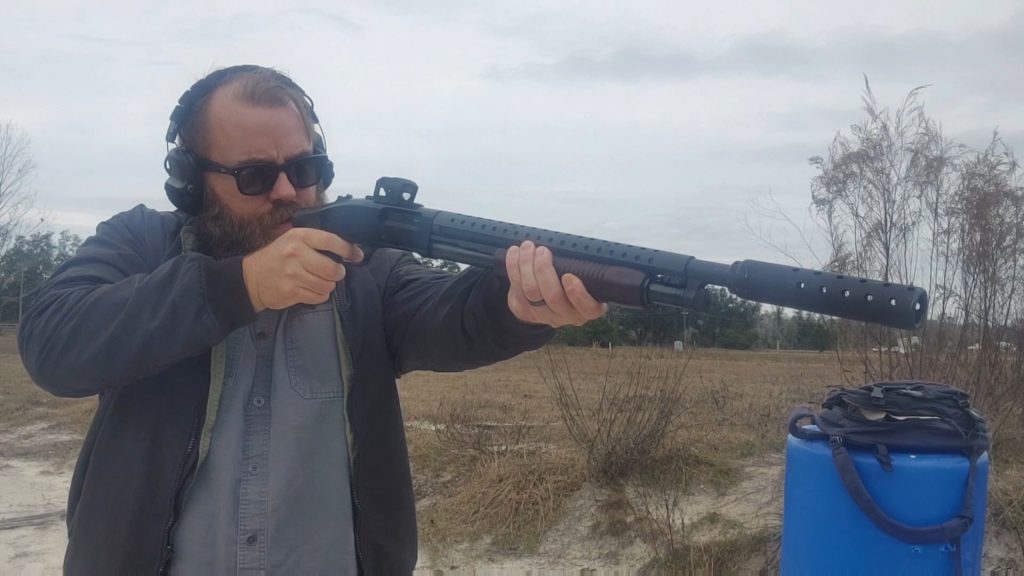
In continued testing, I wanted to pattern the gun at ten yards with both barrels. The rolling thunder barrels seem to throw slightly wider patterns with both standard buckshot and Federal FliteControl.
Going Loud
Past comparing the two barrels, I just shot the thing. Lots of double-taps and full magazine dumps. I didn’t know enough of a performance difference between the two to really think the giant stabilizer is worth the weight and length.
I’d rather add length to the rear of the gun via a stock than the front of a gun in the form of a compensator. That would make the gun much easier to control. The Rolling Thunder with pistol grip is 33.5 inches overall, and a stock-equipped Mossberg 500 with an 18.5-inch barrel is 39.5 inches.
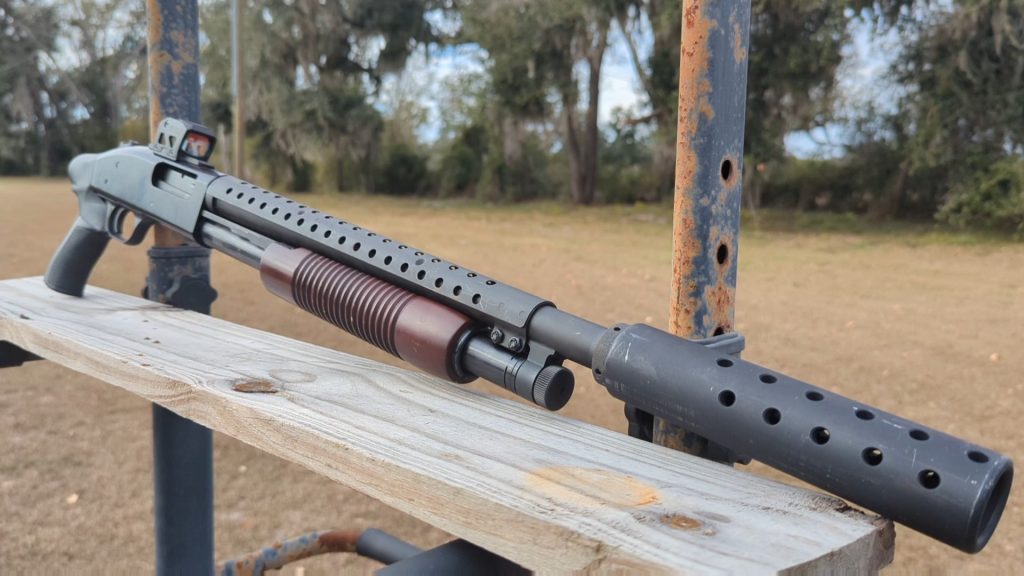
I’d much rather have the extra six inches a stock offers. Heck, it could be five and some change extra inches with a 12.5-inch LOP stock.
It doesn’t seem like Mossberg produced many of these Rolling Thunder models, and it’s easy to see why. It’s just kind of silly. It looks neat, and I guess it could safely breach doors, but there are already better breacher barrels out there. It’s just kind of silly…
Rolling thunder barrel
Chainsaw handle
Raptor grip
Trifecta of coolness,
or something
Add a bayonet to it. Just to keep with the theme of it.
that things neat.
what a lump.
single action bar and steel receiver is my preference.
can i cut it down from 18″ to 16.1″?
“can i cut it down from 18″ to 16.1″?”
Probably.
Mossy just needs to produce a silenced 500 now and be done with it…