

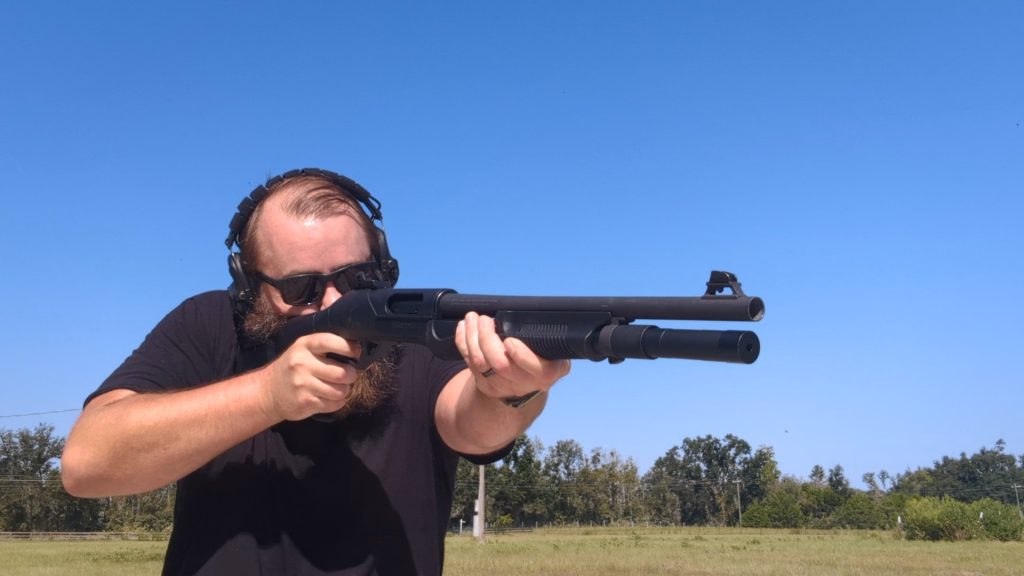
In the modern world of firearms, there seems to be little reason to choose a shotgun over other platforms. The handgun is compact, simple to conceal and easily kept at hand. The rifle provides superior ballistics in a semi-auto platform with various lengths and designs that are almost always shorter and lighter than a shotgun.
We can discuss its hefty recoil, the lower capacity, and other shortfalls people commonly associate with shotguns. Those points are all generally true, and it’s easy to see why shotguns are often overlooked in favor of semi-auto rifles and handguns. Despite all this, I still choose the shotgun for personal defense and there’s a Mossberg 940 Pro Tactical near my bed.
Why I Choose the Shotgun
I have several reasons for that. I live in a rural environment. If you look at the side saddle on my gun, you’ll see two rounds of No. 4 buckshot, a round of birdshot, and two slugs. I doubt I’ll ever be the victim of a home invasion in which I’ll need to launch seven rounds from my shotgun. If I thought that was a realistic possibility, I’d pack it entirely with FLITECONTROL buckshot.
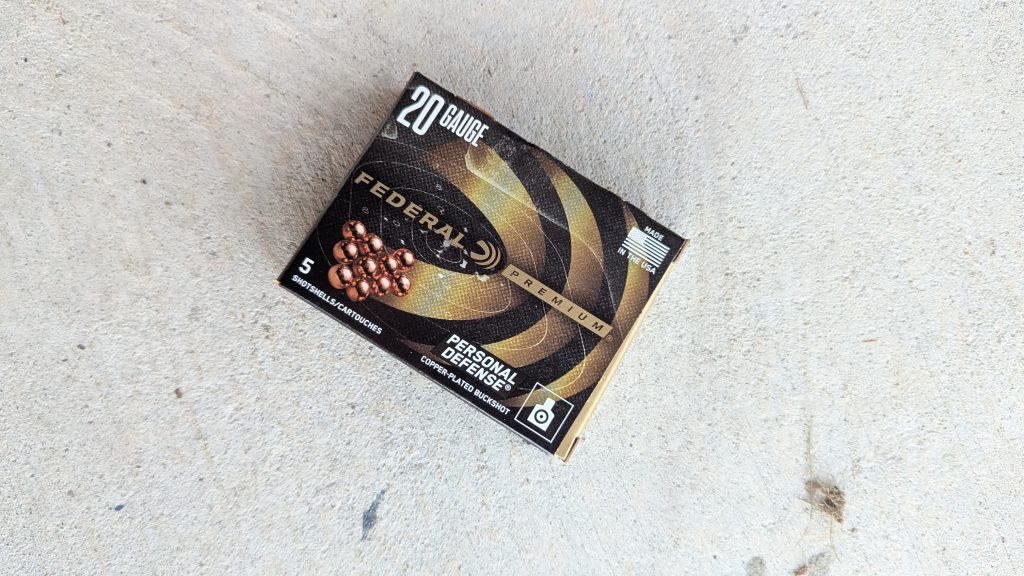
I keep that extra ammo in the saddle to deal with animals. Hogs and coyotes are common around here and it’s neighborly to dispatch them when you see one. Slugs work for them at a distance, and No. 4 works great on running ‘yotes. The birdshot is good “snake medicine.” While I let most snakes do their snake things, the chance of a venomous snake encountering my kids or animals remains, so a round of birdshot deals with them very effectively.
The shotgun is a great multi-tool for several different defensive aspects outside of the two-legged variety, so that’s one reason I choose it. The main reason, though, is that in a home defense scenario, I want to fire as few shots as possible. The shotgun historically works really well for close-range use and remains the battle-axe of modern firearms.
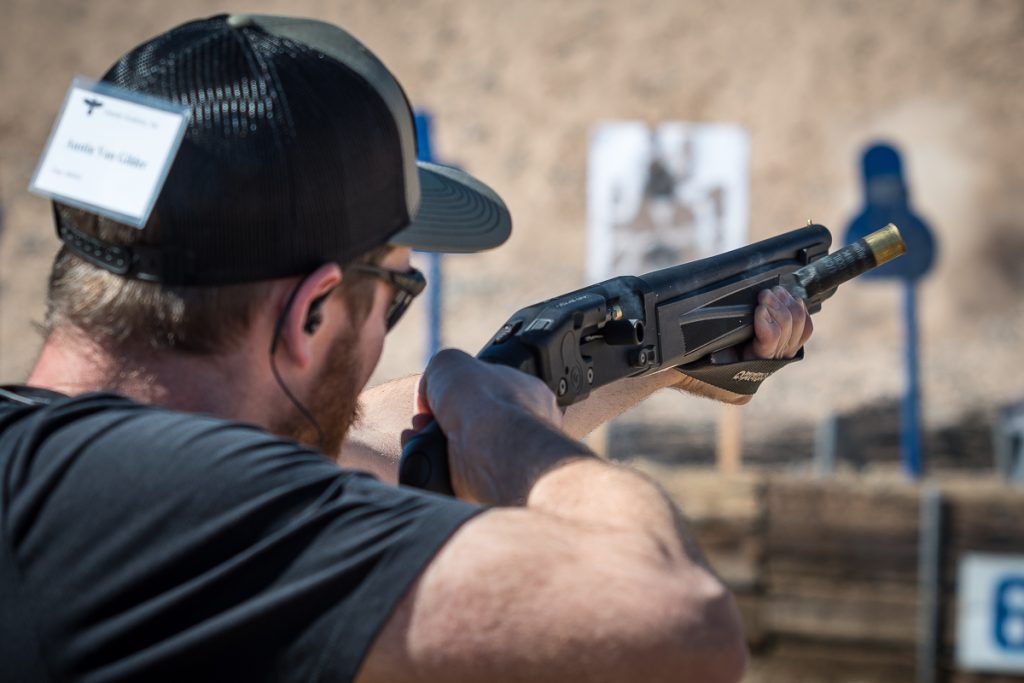
If you hit what you’re aiming at, it’s highly likely to be effective. If you miss, you miss hard and have to take more time to recover and react. That’s a tradeoff that can be balanced out through proper shotgun and ammo selection, along with an accessory or two.
The Power of Buckshot
The benefit of buckshot over other options is its tendency to stop threats quickly and decisively, even with slightly imperfect shot placement. You get about an inch or two of “play” with a shotgun at close ranges, less than most people thing, but not insignificant. The brutality of the impact of multiple pellets tends to inflict tremendous damage, rendering an attacker unable to continue their assault. Well-placed rifle rounds can have the same effect, but they rely on more precise placement than buckshot.
Buck allows you to place multiple projectiles into a target and increases your likelihood of stopping a threat with one shot. With those multiple projectiles, you have multiple chances of a vital organ being hit, potentially more than once. A chest shot can turn the sternum itself into fragmentation that further wounds the attacker.
Tim Chandler, an instructor with Justified Defensive Concepts and a worthy contender for a spot on the tactical shotgun Mount Rushmore, explains it best. I’m not quoting him directly, but he has explained more than once why OO buckshot is such an effective fight-stopping tool.
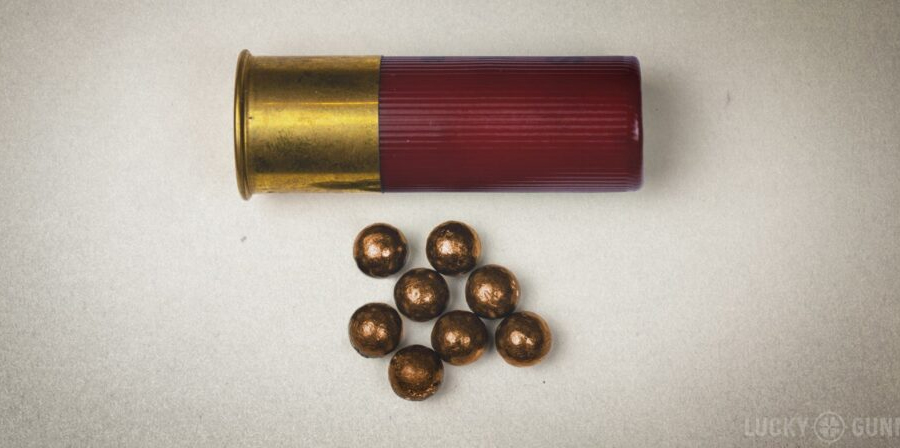
A round of buck holds between eight and nine .31 or .32 caliber pellets. When fired, these rounds hit virtually simultaneously. The pellets are so close together at home defense distances that they have what Tim refers to as a synergistic effect on tissue on impact.
The Synergistic Effect
This synergistic effect allows for multiple wound cavities. With buckshot, the elastic response of flesh between the pellets declines to the point of becoming nearly inelastic.
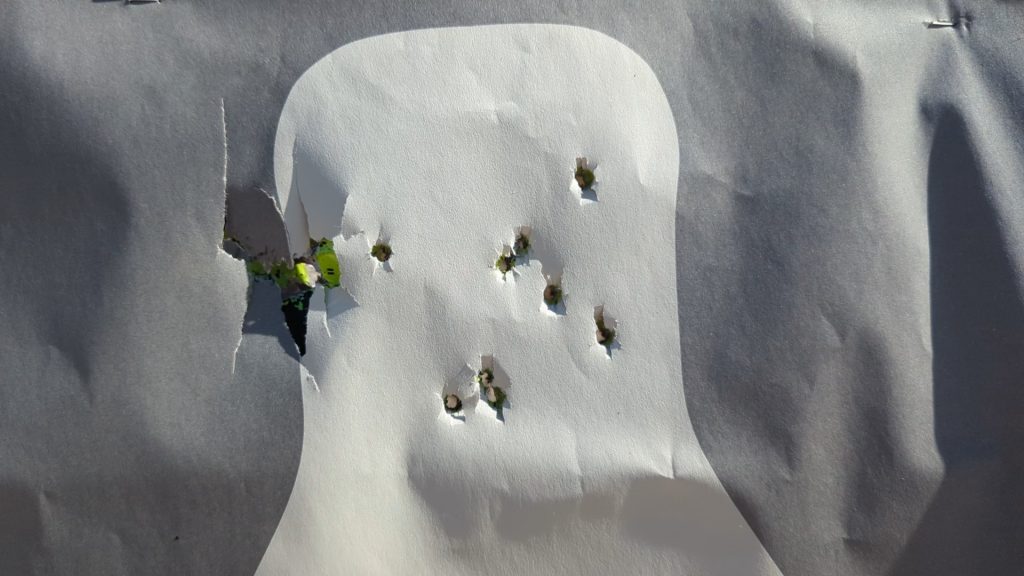
Those eight to nine wound cavities in close proximity push and pull at each other. This allows the pellets to pulverize and tear tissue at a much higher rate than a single projectile.
Expert Validation
Don’t just take my word or Tim’s word for it. Dr. Gary K. Roberts discusses a similar effect. While his research often focuses on rifle round fragmentation, one specific line sticks out as applied to the shotgun:
The multiply perforated tissue loses its elasticity and is unable to absorb stretching that would ordinarily be tolerated by intact tissue.
This is a major reason why FLITECONTROL works so well. The pellets stick closer together, helping to inflict that kind of extreme damage and the inelastic tissue effect.
Pellets and Payloads
Shotgun pellets don’t reach rifle velocities and don’t yaw or fragment in most cases. As a result, a single pellet creates a wound much like a pistol cartridge without the benefit of expansion offered by a jacketed hollow point. Because eight to nine pellets are hitting at once, we get a much more beneficial result.
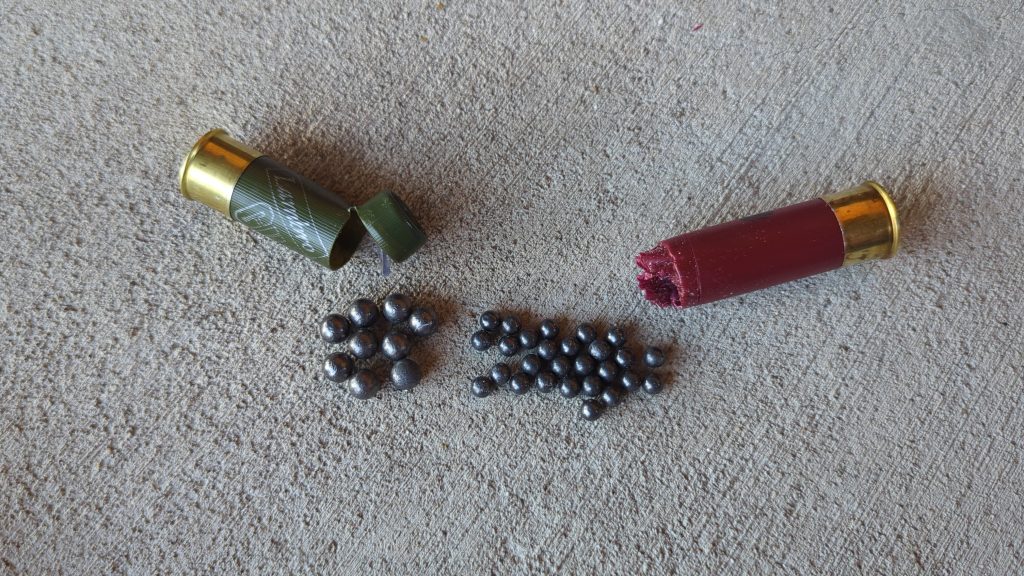
Scanning through papers written for medical professionals, shotgun pellets also tend to stay in the torso. The exceptions are typically thin individuals, headshots, or hits to the limbs. As they hit the body, they lose speed rapidly and start to migrate in different directions. Deformation of the pellets may occur, especially with unplated shot. That prevents over-penetration in most cases.
Defining Your Goals
Again, my goal is to take as few shots as possible in a home defense encounter, and I want a gun I can also use for defensive purposes beyond two-legged vermin. Your goals might be different, and you might favor the strengths of other firearms over the shotgun. That’s fine. You do you. I’m not touting the shotgun as the solution to every problem. It’s just the right solution for mine.
For our home defense shotguns, we use the Benelli M4 Tactical semi-auto shotgun.
.40,
Remington 970 kitted with a 6-shot side saddle and a light. Double-aught buck.
Trouble is, I have to keep it in the closet because my wife does not like it exposed. So, a Glock 17 and a Glock 43 in an open drawer on the nightstand. And a gazillion watt flashlight. Also a pencil for doing the John Wick thing.
A few years ago, I took a four-day Tactical Shotgun course that taught me more about a shottie’s potential within just the first half alone than all my lifetime prior to the class. Amazing stuff. 23 students at the beginning, and only 7 of us remaining at the morning of Day 4 due to how grueling it was (and punishing on your body when you had reached 500 shells fired, yikes). Only three of us passed the skills testing to earn the graduation certificate, me being the third, and I *barely* passed. Though…I hafta say the other two had semi-autos and I was the only one with a pump, so I privately like to think I put in the most effort.
Anyhoo, the main instructor (of the three total) was a Marine who had been in two tours in Iraq and was the breacher for a multi-soldier stack as they cleared houses. His primary weapon was a SBS equipped for punching through doors. In fact, one of the drills he taught us was how to blow the hinges off a door and quickly “slice the pie” of the room upon entry. Very enlightening and made us aware of small details we previously hadn’t considered that would make a life-or-death difference in a real situation. (In my first attempt at that drill, I quickly and successfully cleared 90% of the room but was “terminated” by the instructor who just happened to be standing in that 10% I didn’t check.)
He told us there are some very practical reasons for a CQB rifle depending upon the mission or loadout, but his favorite has always been the tactical shotgun, and he said if he had only a single long weapon, it would be the shottie.
After completing that course, I understand now why he said that. A long range rifle, a shottie, and a sidearm will do anything you need.
Haz,
Impressive!!
Pretty sure I would not have lasted the 4 days. Short attention span. 🙂
If external factors constrain you to only one firearm, then a shotgun is probably the best overall choice.
If you can afford multiple firearms, I have to believe that a semi-auto rifle in just about any centerfire caliber will be a superior choice for home defense. Nevertheless, a shotgun (especially chambered in 20 gauge) would be a close second. A handgun would be the least desirable choice because they are more difficult to shoot accurately and they are seriously lacking in true physical stopping power. (Handguns may do fairly well in terms of Psychological stopping power–unfortunately there is no way of knowing if any given home invader will respond Psychologically to your presentation of your handgun.)
If you have even a moderate interest in firearms–especially if you are interested in recreational target shooting, hunting, and self-defense–multiple firearms are the way to go. A rimfire rifle for plinking, dispatching pests, and small game hunting is super handy. A handgun for “everyday carry” is a fair choice for self-defense. A shotgun is great for dispatching pests, small game hunting, bird hunting, and even big game hunting at close ranges, not to mention recreational skeet and trap shooting. Finally, a centerfire caliber rifle is excellent for recreational target shooting, hunting out to a few hundred yards, and (with respect to semi-auto platforms with 16-inch barrels) home defense. Last but not least, if you are a serious recreational target shooter, a pistol-caliber carbine chambered in 9mm Luger is an outstanding choice. Note that a pistol caliber carbine is a decent choice for home defense as well.