

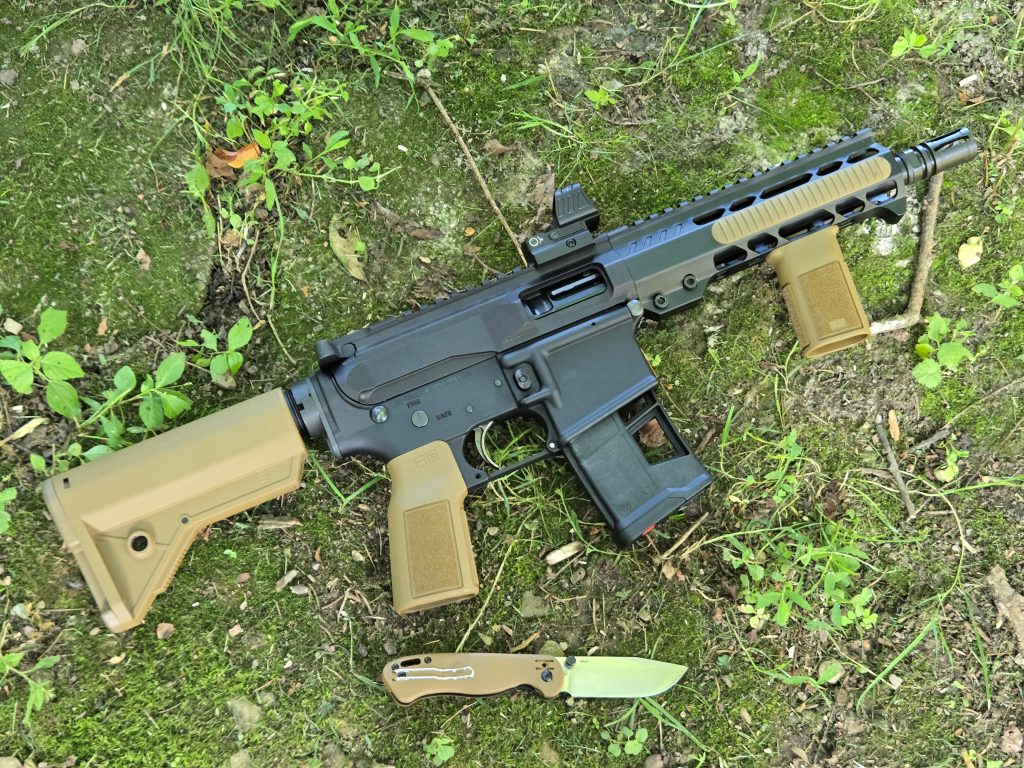
Okay, I know the first question everyone is going to ask…why? That’s a fair question with a simple answer. Because Hitman Industries makes .380 ACP barrels for AR’s, and it was weird enough that I wanted to try it.
Hitman Industries
I talked to the folks from Hitman Industries in the Supplier’s Showcase at the beginning of the week at SHOT in January. Their barrels and features looked good and the prices were pretty reasonable. After the show I checked out their website and they had a couple barrels I’ve been looking for. I picked up a .50 Beowulf that had a much better feed ramp than my current barrel. The .50 has been a pain of a project to get running reliably, but their barrel is pretty nice. Someday when the darn thing runs I’ll write that up.
The other thing I wanted was a .400 Legend AR barrel. After shooting the .400 at SHOT in 2024 I wanted to try one, but the barrels had been pretty scarce. Hitman had a couple of models in the lengths I was interested in. That’s another project I’m still working on, one that I’ll hopefully finish up soon. You’ll see that here on SNW when it happens.
Meanwhile, I happened to see that they had listed .380 ACP barrels for AR’s. They had 8.5-inch barrels, and 10.5-inch barrels. The regular price was $95.00, which wasn’t bad, but they were on sale for $76.00, which was even better. I messaged Hitman to ask what bolt, lowers, and mags they were using with the .380 barrels. They said they used GLOCK mag lowers, 9mm GLOCK mags, and a 9mm PCC bolt carrier group. Huh. I had all of that stuff on hand already.
The thing is, .380 ACP is pretty unusual in anything other than a small frame semi-auto pistol, although it has seen some subgun use like in the old MAC-11’s and CZ VZ-83’s. Hi-Point makes a .380 ACP carbine, too. I was curious how it would work out of an AR and what the velocity would look like in a longer barrel. I ordered a barrel and an A2 style flash hider and started looking to see what other parts I had or would need.
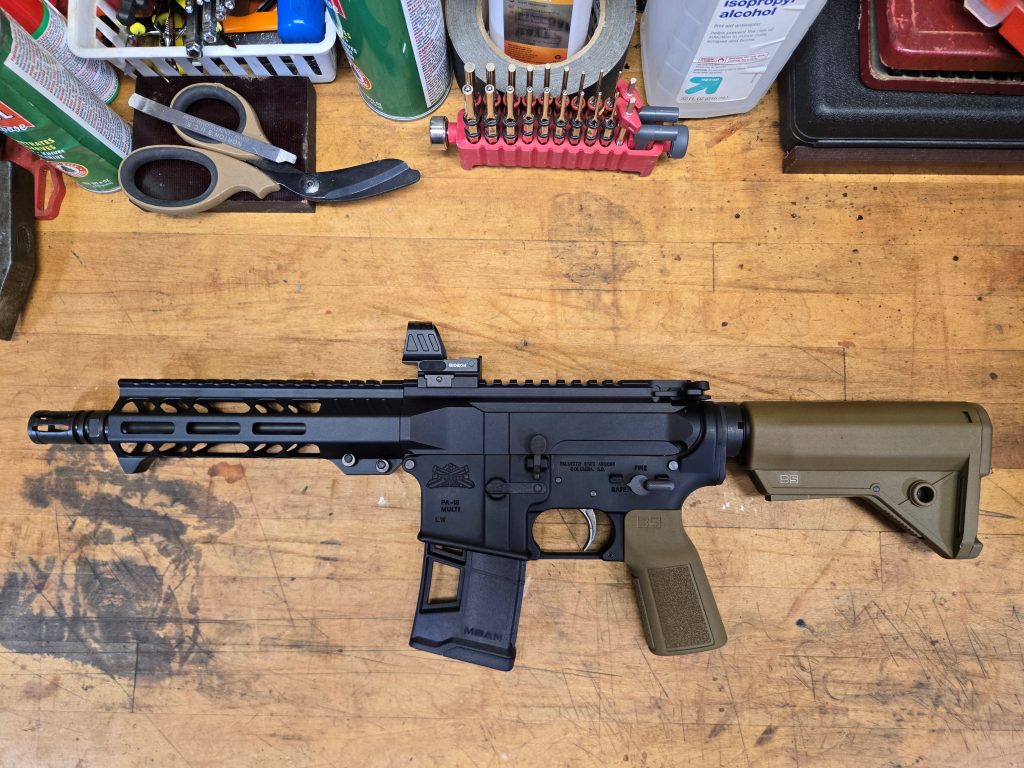
The Hobbit PDW
I considered just using my Spike’s Tactical 9mm SBR lower and building a new upper to swap out. I decided I’d give that a try, but I wanted to do a dedicated build as well. I didn’t want to SBR a .380 AR before I knew if it would even work, but I had a basic Palmetto State Armory lower that was already SBR’d and between projects at the moment.
The only issue was that it was a rifle lower, not a GLOCK magazine-compatible lower. I’d worked with the Mean Arms Endomag and Exomags before though, and they’re a great solution for running 9mm in a rifle caliber lower.
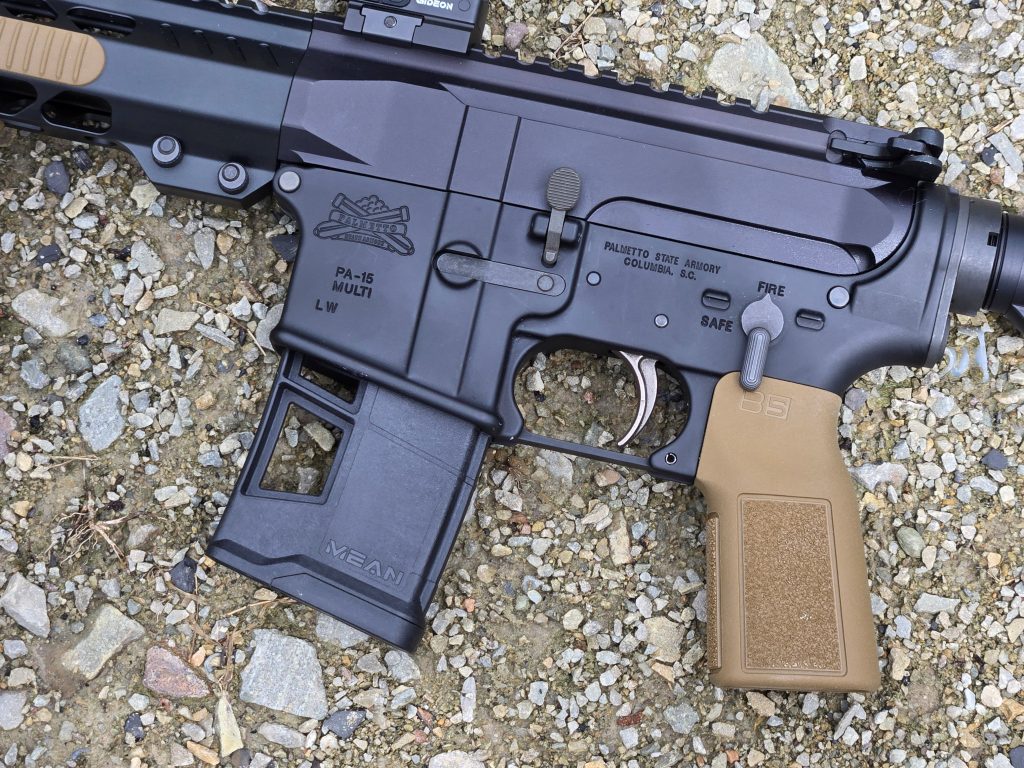
The Endomag is a drop-in conversion kit for Gen 2 or later Magpul PMAGs that convert them to feed 9mm. The Exomag is a dedicated magazine that’s the same dimensions as a 5.56mm magazine, but feeds 9mm. The actual mag portion is about the size of a typical 9mm subgun or PCC mag, but it has a skeletonized portion that takes up the space of a conventional AR mag. That allows it to lock in and feed in a rifle lower. It also lets you use rifle magazine pouches. So if you’re running a 5.56mm or .300 Blackout AR, you can swap out uppers to 9mm, use Exomags, and keep the rest of your gear the same. Or in this case, swap out to .380 ACP.
I already had 30-round Endomags and some 40-rounders, but that seemed like overkill for the .380, so I ordered some compact 20-round mags. You can get the mags either with or without a built-in ejector, depending on what type or lower you’re running. Since I was planning on using a rifle lower I picked the mags with ejector. The 20-round magazines were $25 each, or three for $66, so I ordered three.
B5 Systems Compact K Series Kit
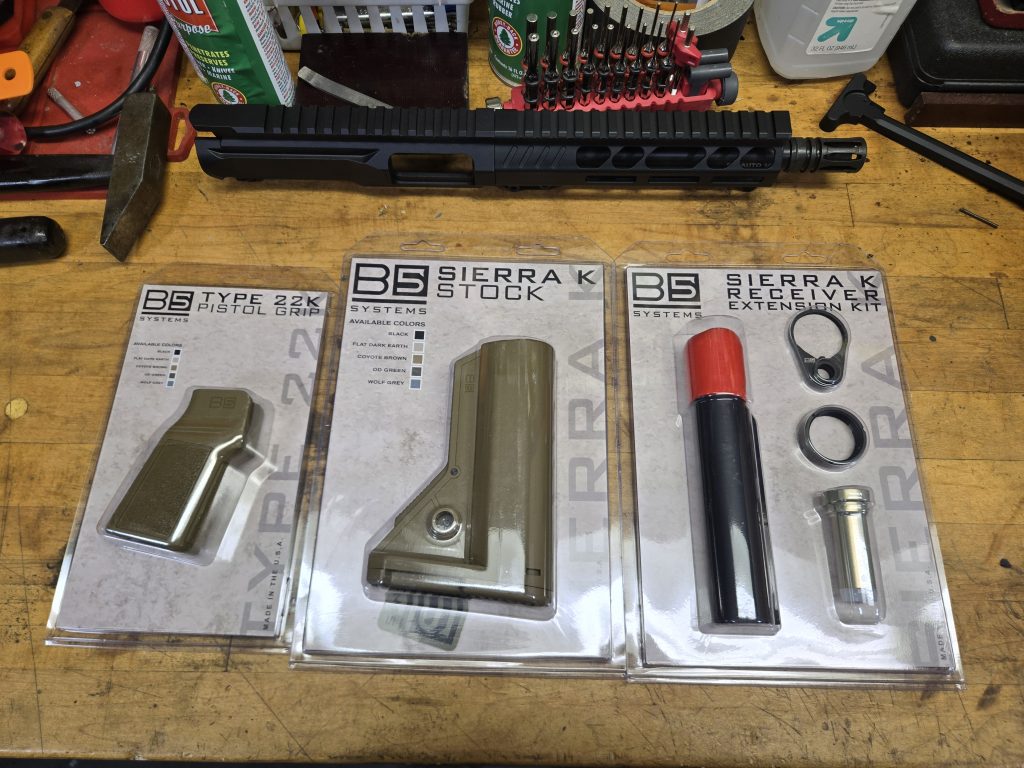
Right about the time I was assembling parts for the .380 build, B5 Systems dropped a new line of compact hardware for the AR platform. It consists of the P-GRIP 22K, the Sierra K Receiver Extension Kit, and the Sierra K Buttstock. This is basically a shortened PDW pistol grip, a shorter buffer tube with a short heavy buffer (3.5 oz), an extra power recoil spring, a castle nut, and a quick disconnect end plate.
The Sierra K Buttstock is similar to the B5 Bravo stock, but it’s a little shorter, not quite as tall, and a bit lighter. The buffer and stock combo and short grip are perfect for a PDW project. I had chopped the old A1 grips on a couple of my retro builds like my Colt 608 clone, and I actually like the short grip on a compact gun.
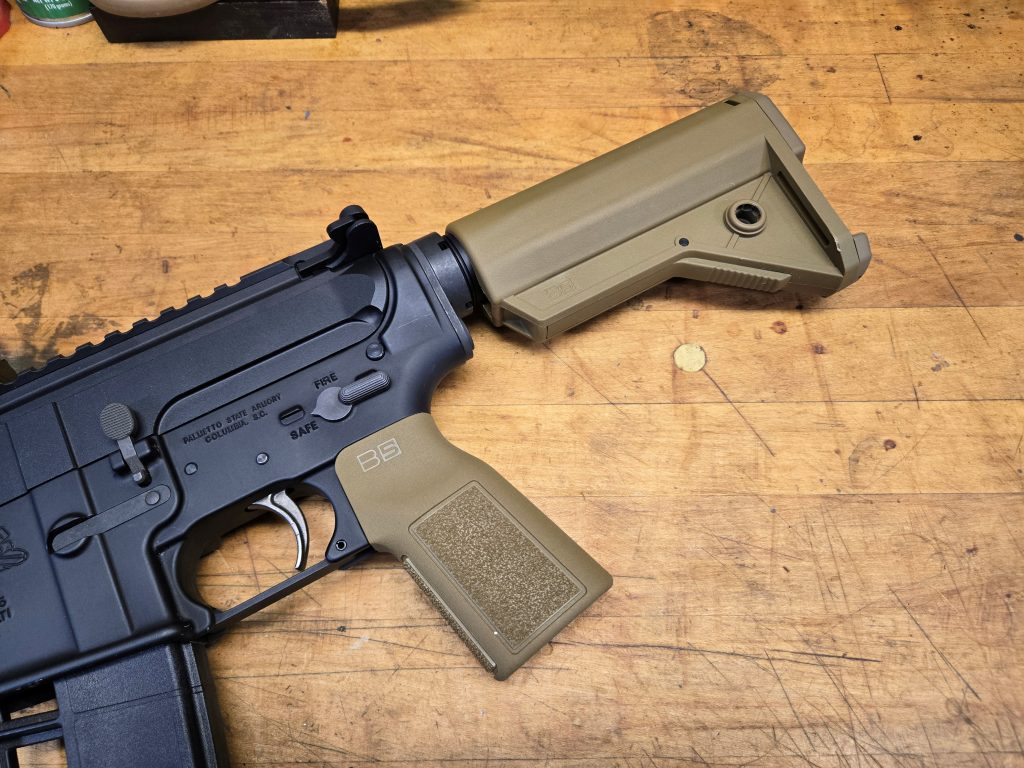
In addition to the grip, stock, and buffer tube, I also grabbed a B5 vertical grip and a set of B5 polymer rail covers. Their rail covers are my current favorites. They’re a soft polymer and really comfortable. They also just pop into the M-LOK rail slots so they’re easy to install. The vertical grip was $20 and the M-LOK covers were $18 for a set of four. Just for something different, I went with Coyote brown on all of the B5 hardware.
Upper Components
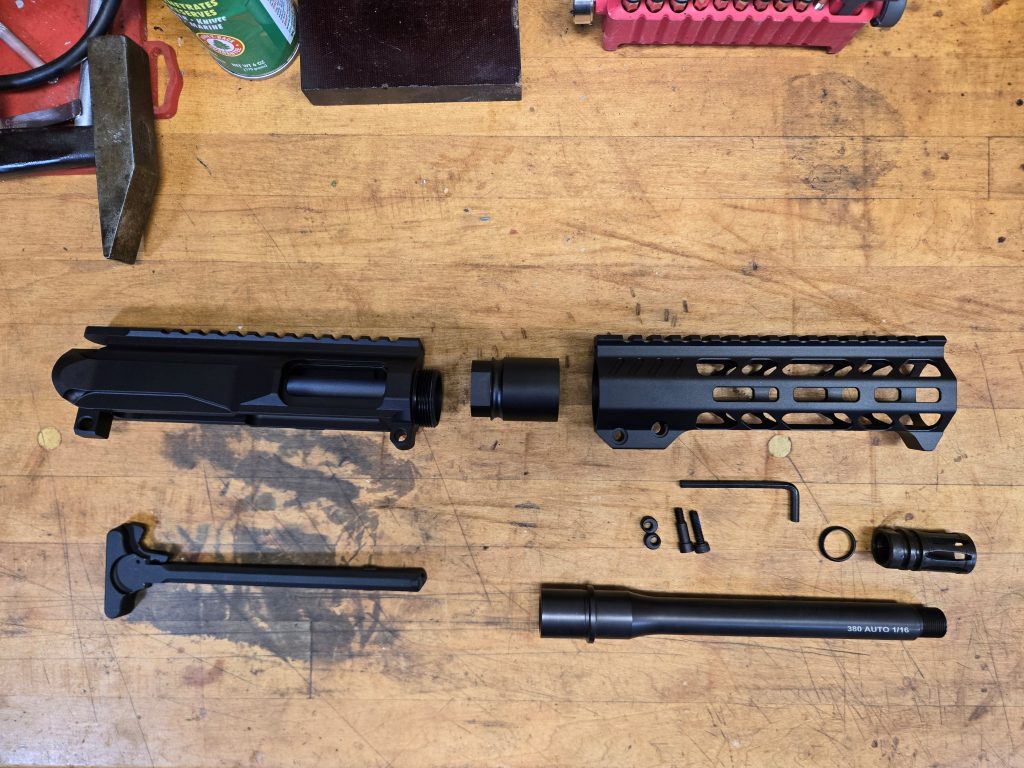
For my upper I used a KM Tactical PCC Billet upper, which I’ve used on a bunch of .22 and PCC builds. They’re simple, streamlined, cheap and they work. They’re only $48.00. I picked up a KM Tactical 7 inch M-LOK handguard while I was at it for $42.98. For a bolt I got a Faxon Gen 2 9mm PCC Blowback Full-Mass Bolt Carrier. They’re $165, but I had a coupon from accumulated points from prior purchases that knocked that price down a bit. I just used a stock GI charging handle from my parts box.
Mounting the barrel was pretty straightforward. I noted that the Hitman barrel didn’t have an index pin, which at first struck me as odd. After thinking about it though, the barrel chamber is symmetrical with no defined feed ramp portion like you’d see on a rifle barrel, so it really doesn’t make any difference. Or at least I didn’t see how it would, but I guess I’d find out once I hit the range.
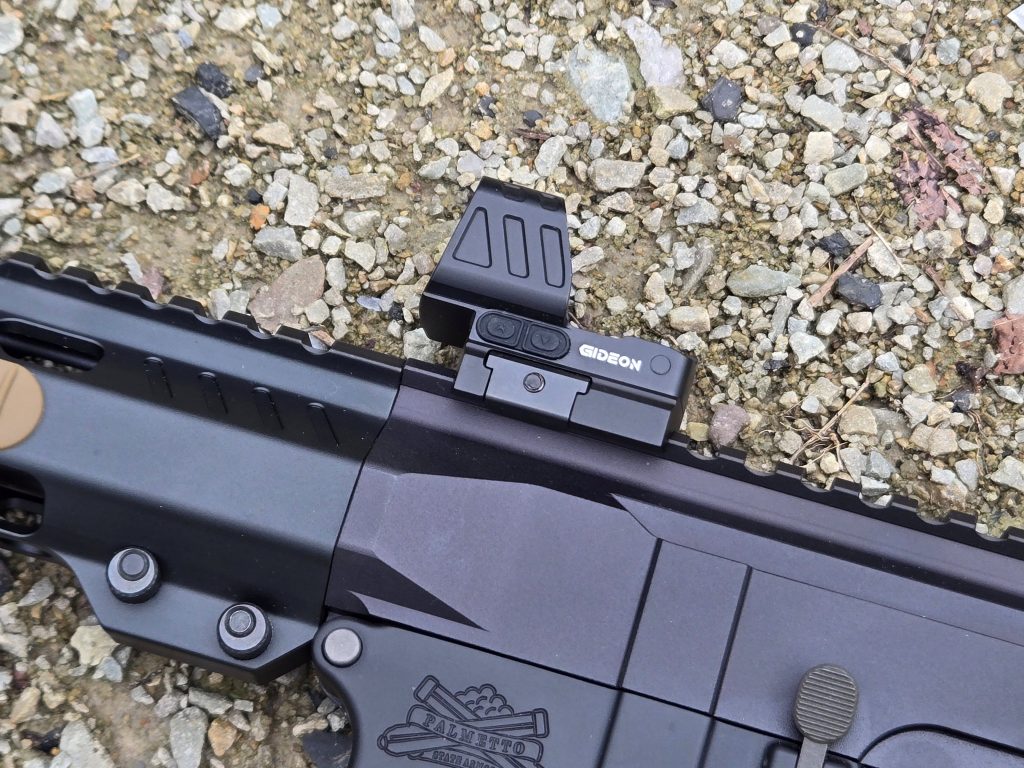
Once I had the stubby carbine put together I mounted a Gideon Optics Judge XL red dot to the upper receiver. It’s a large aperture reflex sight. While it’s a big handgun sight, on a PCC like the Hobbit PDW it’s compact while still offering an excellent field of view.
It has ten brightness settings and a 6 MOA dot. The Judge XL runs on a single CR-1632 Lithium-Ion battery and has a 10,000-hour battery life. Coupled with the auto shut-off and a shake-awake feature, that should be good for years of use.
When you do finally need to swap batteries it’s easy to do with a side-mounted battery door. MSRP on the Judge XL is $269.99, although they’re currently listed at $219.99 on Gideon’s website. I have a few Gideon optics I’ve been testing lately and they’ve all been solid.
The finished build is just 23 1/8 inches long with the stock closed and weights 5.1 pounds with the optic installed. Not the smallest AR ever made, but it’s pretty compact.
At the Range
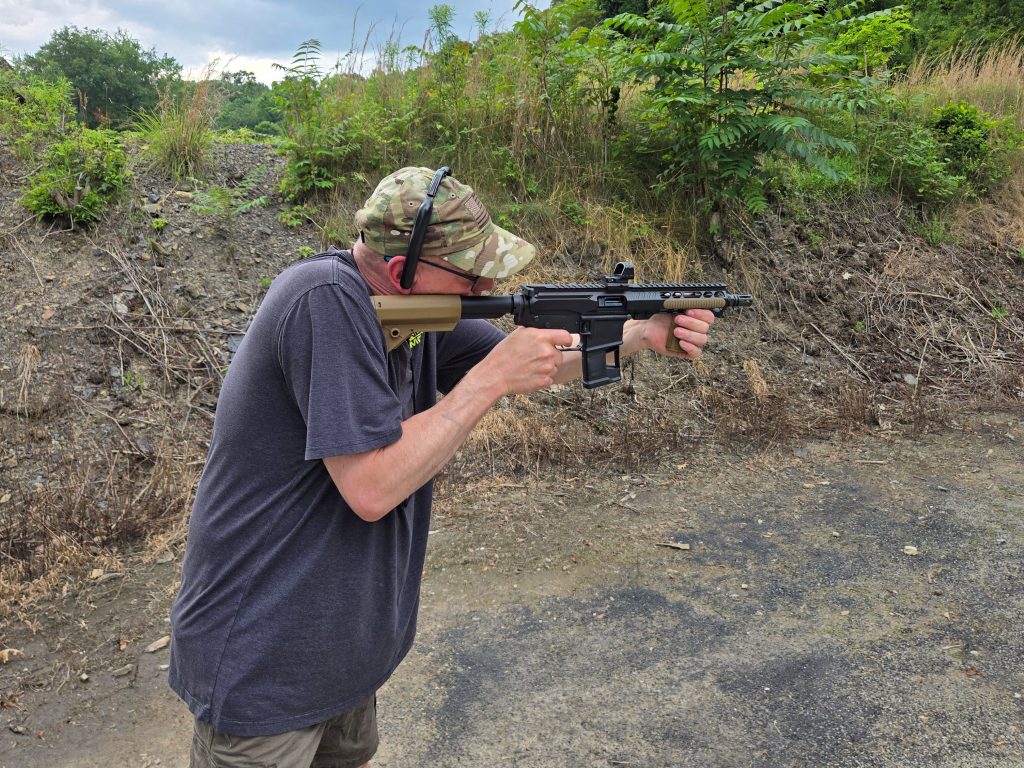
Once I had everything assembled I headed to the range. I honestly wasn’t sure how, or even if, this thing would run. It was essentially a .380 ACP using all 9mm components except for the barrel. I was preparing myself for feed and cycling issues. I was therefore pleasantly surprised when the Hobbit PDW ran extremely well.
I used Speer Lawman 95gr FMJ loads. These are the same ones I use for my off-duty qualification with my Ruger LCP Max. I loaded up an Exomag with the FMJ .380 rounds. They loaded easily, but obviously were a touch short in the mag, 9x17mm versus 9x19mm. I tried to make sure I pushed the rounds all the way back as I loaded them.
I tossed on some ear pro and headed up to the line. I popped my Exomag in place and let the bolt fly forward. The first round fed and chambered without a problem, so that was promising. I then proceeded to blast 20 rounds downrange with no hiccups. I was honestly a little surprised.
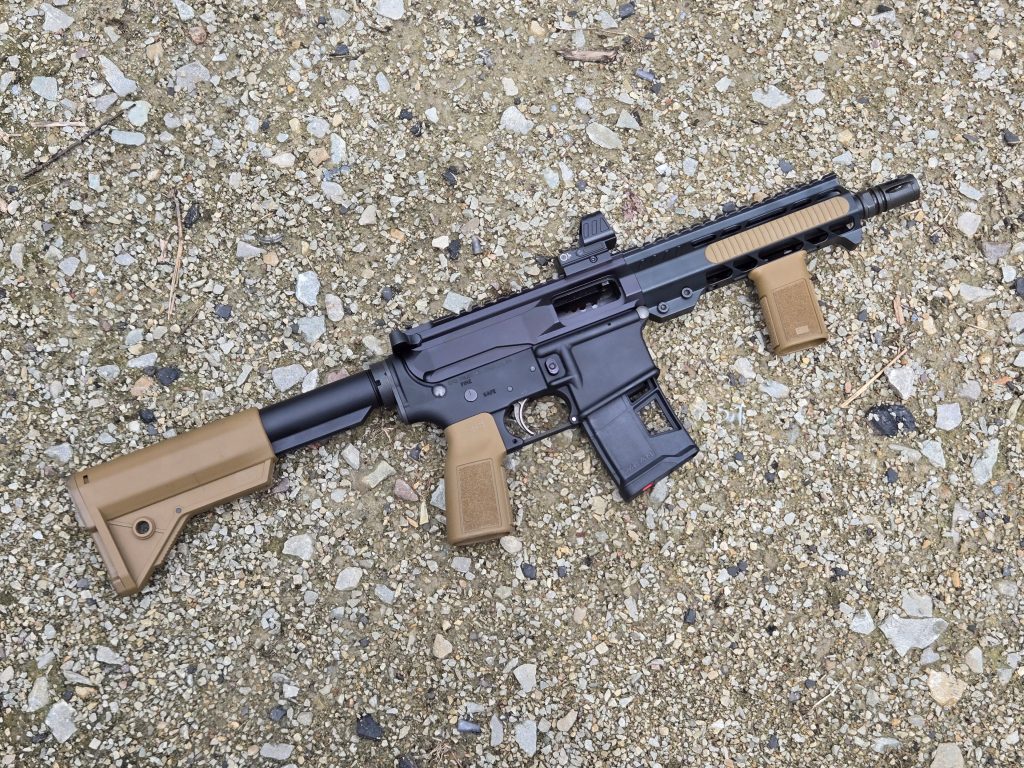
Recoil was extremely mild. Blowback 9mm PCC’s actually have a fair bit of recoil due to the mass and speed of the bolt coming back as they cycle. I don’t find it unpleasant, but it’s there.
The .380 ACP had noticeably less recoil and hardly any muzzle climb. You could tell you were shooting something with more oomph than a .22, but it didn’t feel like much more. I was just shooting pop cans and iced tea jugs at 25 yards. I made a very minor sight correction on the Gideon Judge XL and then proceeded to send cans and jugs flying with the next couple of mags. Success!
I went back out to the range about a week later, this time armed with some PPU .380 ACP, and brass-cased Blazer .380 ACP. Both were 95gr FMJ loads. I recently picked up a Garmin Xero C1 Pro Chronograph and decided to try it out with the Hobbit.
I first did a 5-round string of the PPU through my Ruger LCP Max with its 2.8-inch barrel. I had an average velocity of 846fps and muzzle energy of 151 foot-pounds. The same load from the 8.5-inch Hitman Industries barrel clocked in at an average of 1083fps and muzzle energy of 247 foot pounds.
That’s a pretty significant increase, in the ballpark with many .38 Special loads from of a 4-inch service revolver. Maybe not a powerhouse, but pretty respectable. A lot of police departments thought that level of energy was sufficient through much of the 20th century at any rate.
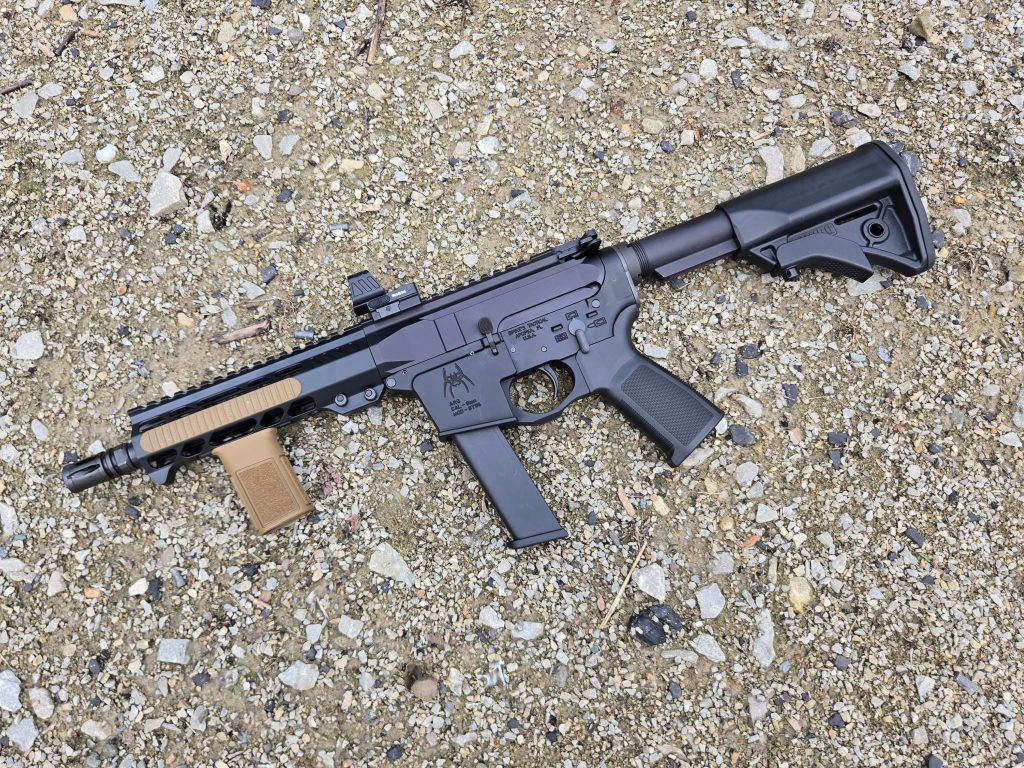
On this second session I shot the PPU and Blazer .380 using the original build with Exomags, and I also brought along my Spikes Tactical lower that uses GLOCK mags. It has a similar short buffer tube although I was running a heavier buffer in this one.
While the .380 worked fine in the Exomags, it seemed to fit a bit better in the GLOCK mags. There was less play when I loaded them. Function was 100% with the Spikes lower using the GLOCK mags, although it would not lock the bolt to the rear on the last shot while the PSA lower with B5 buffer system and Exomags did.
I’m wondering if the heavier buffer in the Spikes lower kept the .380 from blowing the bolt back far enough or hard enough to engage the last round hold open. If I manually racked the bolt, it would hold open when empty. I’ll try it again with a lighter buffer and see if that is the issue.
Overall function was quite good. One hundred percent with the GLOCK mags and Spikes lower, as noted. With the PSA lower and Exomags, I had a couple of jams throughout both range sessions. Nothing catastrophic and they were cleared easily and quickly, but they did occur.
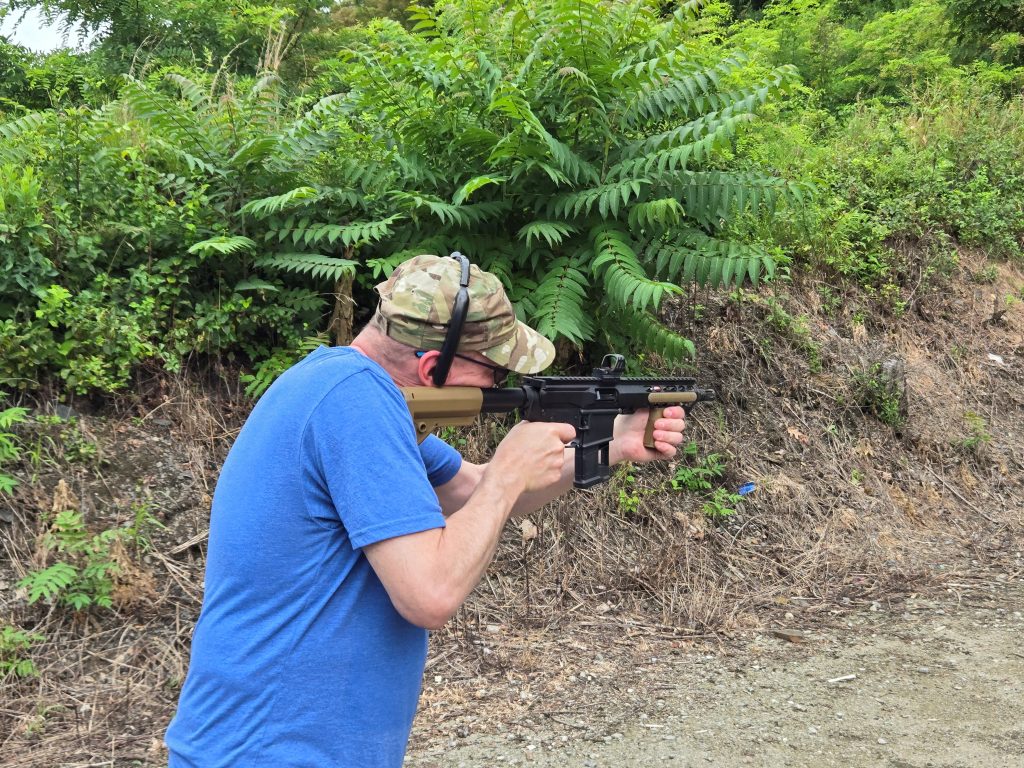
I didn’t formally test the accuracy of the build, but I was able to easily toss pop cans around on the range at 25 yards. The big window on the Gideon Judge XL made it easy to track the cans as they bounced and follow them with the dot, sending them flying again as soon as the slowed down enough to engage. Again, recoil was pleasant and rapid fire was fun and controllable.
So What’s It Good For?
Okay, so the gun works pretty well and is easy to shoot. So what’s it good for? Well, assuming I ran some hollowpoint defensive loads through it and confirmed it’s reliable with one or the other of the lowers and magazine combos, it could make for a very short, very handy and easy to shoot house or car gun. The extra barrel length gives .380 some half-decent muzzle energy that would be nicely complimented by modern hollow point design.
But honestly, why would I? Either lower will run a 9mm upper that will do the same job even better with only a bit more recoil and muzzle climb. Not enough to be a factor for most any shooter.
In reality, the Hobbit PDW was just an exercise in building something because I could, and to see what it would do. It’s a neat gun and fun to shoot, but I think its primary role is going to be as a range toy to take out when I want something a bit more than a .22 but that’s still mild to shoot.
The B5 K buffer, stock, and grip setup is pretty nice though, so I do plan on building another upper for that lower that’s a little more potent than 9mm short. I just need to see what catches my eye next. KAK Industries makes a 7.62x25mm AR barrel I haven’t tried yet so….
Why not? Guns can be just for fun. We don’t have to spend every minute preparing for the end of the world.
Sure we do. Add a suppressor, and it becomes a great zombie dispatcher.
I use a wire wrapped base ball bat for zombies.
Does it take a FRT?
Well first, I agree with JWM.
Second, this left me a bit perplexed…
“ It was essentially a .380 ACP using all 9mm components except for the barrel.”
Why don’t es it need a .380 barrel ?
A .380, 9mm, .38s&w, and .357 mag are almost exactly the same diameter.
I have in fact loaded and successfully shot .380 in 9mm semi-auto pistols. They don’t cycle properly because of guide rod spring rates, but they were accurate nonetheless. Yes, I know … “don’t do that… you’re a fool…”. I’m intelligent enough to have researched it first, and basically I just wanted to know that, in a SHTF scenario, could I use a .380 in a 9mm pistol if there was no other ammo.
The answer is yes. But you have to manually charge it after every round.
So there ya go…
Just Sayin (OG),
My somewhat educated guess as to why you should not just load .380 ACP into a pistol caliber carbine chambered in 9mm Luger is due to the dimensions (length specifically) of the chamber and the 2mm difference in the length of the casing between .380 ACP and 9mm Luger.
A chamber for 9mm Luger is just barely long enough for 9mm Luger cartridges which make a sort-of tight seal as the chamber transitions into the bore of the barrel. That maximizes both accuracy and muzzle velocity. (The less distance that a bullet has to “jump” out of the chamber into the barrel translates to better alignment of the bullet’s axis with the barrel’s bore axis and hence better accuracy. Similarly, the less distance that a bullet has to “jump” out of the chamber into the barrel also translates to trapping more gases and increasing muzzle velocity.)
There could also be significant trouble with extraction. The extractor for a 9mm Luger chamber reaches just far enough past the rim of a fully seated 9mm Luger casing in the chamber to grab it and yank it. Since a .380 ACP casing is 2mm shorter than a 9mm Luger casing, that .380 ACP casing could move forward in the chamber and the extractor may not reach forward far enough to grab the rim of the shorter .380 ACP casing.
Another potential problem is primer strikes. The firing pin for 9mm Luger cartridges only moves forward far enough to ignite the primer when a 9mm Luger cartridge is fully seated in the chamber with the primer-end of the casing extending backwards some defined distance. However, .380 ACP cartridges are shorter and may seat fully forward in the chamber which means the firing ping may not strike the primer at all since the .380 ACP casing is 2mm shorter.
All of this simply illustrates how caliber designations define more than just bullet diameter–they also define cartridge lengths and casing profiles (e.g. straight-wall versus bottle-neck casings).
Just Sayin (OG),
My somewhat educated guess as to why you should not just load .380 ACP into a pistol caliber carbine chambered in 9mm Luger is due to the dimensions (length specifically) of the chamber and the 2mm difference in the length of the casing between .380 ACP and 9mm Luger.
A chamber for 9mm Luger is just barely long enough for 9mm Luger cartridges which make a sort-of tight seal as the chamber transitions into the bore of the barrel. That maximizes both accuracy and muzzle velocity. (The less distance that a bullet has to “jump” out of the chamber into the barrel translates to better alignment of the bullet’s axis with the barrel’s bore axis and hence better accuracy. Similarly, the less distance that a bullet has to “jump” out of the chamber into the barrel also translates to trapping more gases and increasing muzzle velocity.)
There could also be significant trouble with extraction. The extractor for a 9mm Luger chamber reaches just far enough past the rim of a fully seated 9mm Luger casing in the chamber to grab it and yank it. Since a .380 ACP casing is 2mm shorter than a 9mm Luger casing, that .380 ACP casing could move forward in the chamber and the extractor may not reach forward far enough to grab the rim of the shorter .380 ACP casing.
Another potential problem is primer strikes. The firing pin for 9mm Luger cartridges only moves forward far enough to ignite the primer when a 9mm Luger cartridge is fully seated in the chamber with the primer-end of the casing extending backwards some defined distance. However, .380 ACP cartridges are shorter and may seat fully forward in the chamber which means the firing ping may not strike the primer at all since the .380 ACP casing is 2mm shorter.
All of this simply illustrates how caliber designations define more than just bullet diameter–they also define cartridge lengths and casing profiles (e.g. straight-wall versus bottle-neck casings).
Just Sayin (OG),
I replied to your comment and explained why it is probably a bad idea to try and shoot .380 ACP out of firearms chambered for 9mm Luger.
Unsurprisingly, this site immediately made that comment vanish for absolutely no good reason whatsoever–as it does so often.
Just Saying (OG),
Short version (because comments with more than 10 words or more than one comment every 30 minutes apparently are automatically hidden/deleted):
The shorter casing of .380 ACP (compared to 9mm Luger) means reduced muzzle velocity and accuracy as well as a much higher probability of failed extraction and light (or no) primer strikes.
I want it!
Give it to me now.
Be a great house gun.
Mainly would be fun.
Seems like I remember B&T we gonna offer braced 380 pistol for 11-1200 bucks.
Never saw one – but would have considered it even if too pricey.
In terms of building something for fun, wonderful!
Being pragmatic: why not just build your pistol caliber carbine chambered in 9mm Luger which exhibits barely noticeable extra recoil, produces increased muzzle velocity, and costs less (for ammunition)?
Only reason l can see is if its run unsuppressed it would do less hearing damage if used in the home for self defence.
What barrel did you use?