Let’s face it, the amount of aftermarket accessories for firearms seems to grow daily. I’ve been the recipient of social media ads where the manufacturers of these gadgets seem to have created a solution to a non-existent problem. You might say, an answer in search of a question. Given this situation, it can be a daunting challenge for the neophyte or the uninitiated to determine what they really need to have and what they don’t, particularly when it comes to attending a professional training course.
Having just returned home from teaching our Martial Application of the Rifle (R201) course at the ProGun Vegas range in Boulder City, Nevada, I thought now would be a good time to address need vs. don’t, at least gear wise.
What is a Fighting Rifle Class?
Step one is to consider just what a “fighting” or “martial” rifle training class is all about. For our part, at Student of the Gun University, we have precision rifle courses and martial or fighting rifle courses. Naturally, the precision course is more about slow-fire, long distance shooting. A “martial” class is as the word defines; fighting, tactical, or mortal combat. In such a course, the rifle is used as a ballistic power tool to stop deadly threats. Targets will generally be in the 3 to 25 yard range. Imagine the distances that you might need to stop a deadly threat in and around your home.
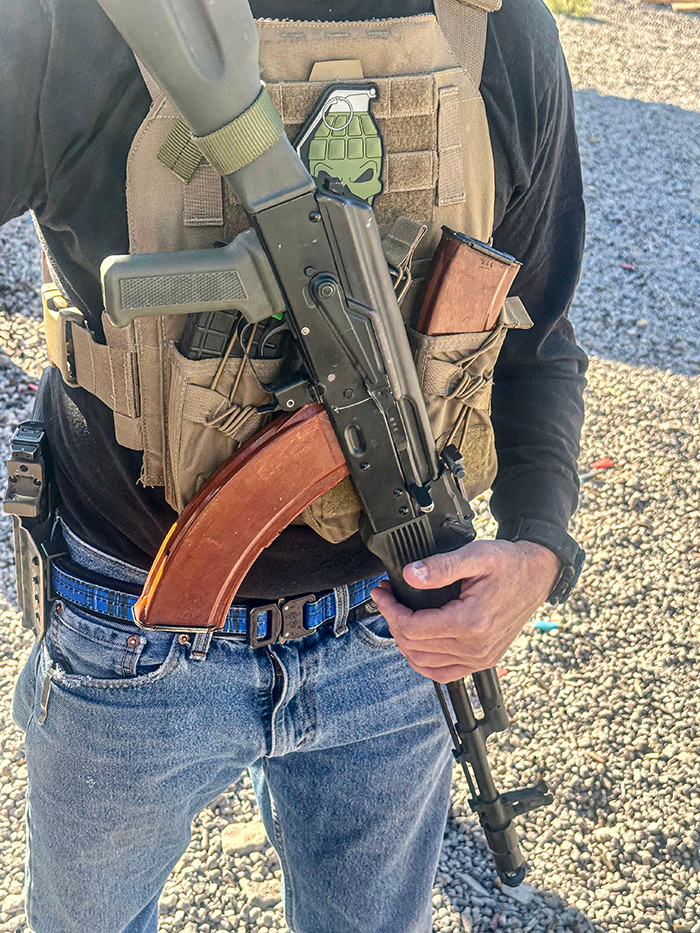
As such, you’ll need some type of self-loading rifle or carbine such as ARs, AKs, etc. Long barreled, heavy guns are not what we are looking for here. Although we rarely if ever see them, you could bring some type of bullpup, an M1 carbine in .30 Carbine, or even a Mini-14 if you like.
The gun choice is relatively easy. Somewhere between two to three out of every 10 adult American males own an AR-15 style rifle now. Then there are all the other makes and models of magazine-fed, rifle-caliber carbines. Let’s face it, the first thing men, or women, do when they are thinking of taking a training class is decide which gun they are going to take.
When it comes to your rifle, whether its AR, AK, or other, most of them are ready to go out of the box and perfectly suited for a fighting rifle or martial course. It is the accessorizing process where folks tend to lose focus. We have had students successfully take the R201, two-day class with bone-stock ARs and AKs.
Accessories for Your Rifle
Given the fact that the aforementioned style training does not involve long distance shooting, a magnified optic, even an LPVO that can be turned down to 1x or 1.5x is not needed. If it came down to spending $500 to $1000 on an LPVO or $500 to $1000 on ammunition, I’d buy the ammo for sure.
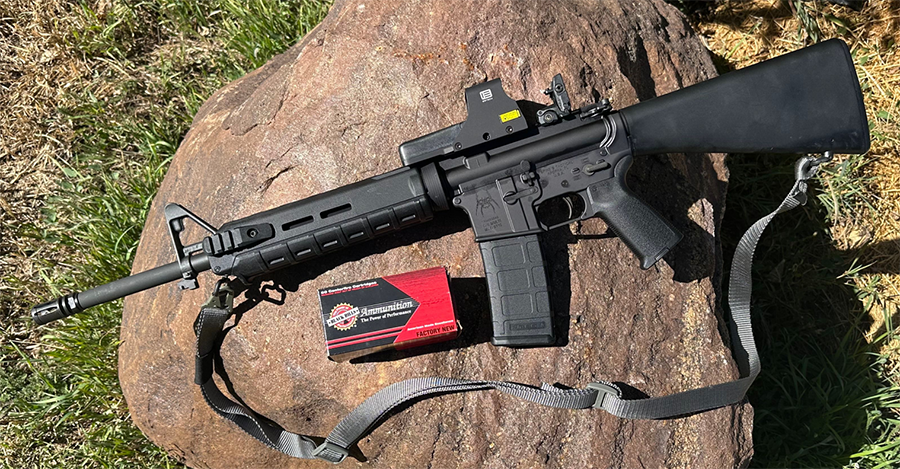
Can a 1:1 red/green dot optic enhance the experience? Yes, it can. Depending on where your vision is at this point in your life, an illuminated reticle optic, such as EOTech HWS 512 or XPS can greatly aid you during the training course.
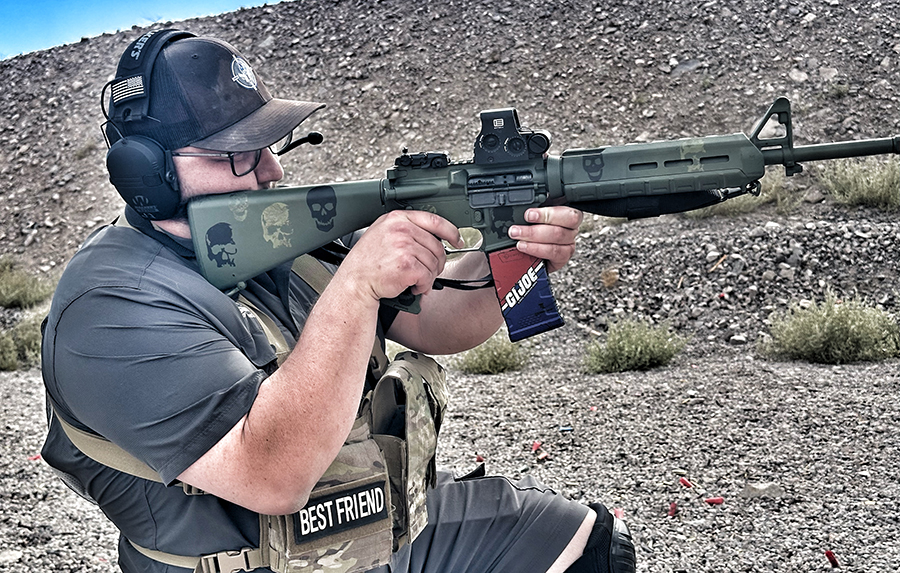
However, before you break the bank on an optic, I would be sure that I had six magazines for said rifle/carbine (you can live with three, but that’s the minimum), a two-point nylon sling, and a case of training ammunition. Some type of pouch or pouches to carry spare magazines will also make the experience more enjoyable.
PPE and Foul Weather Gear
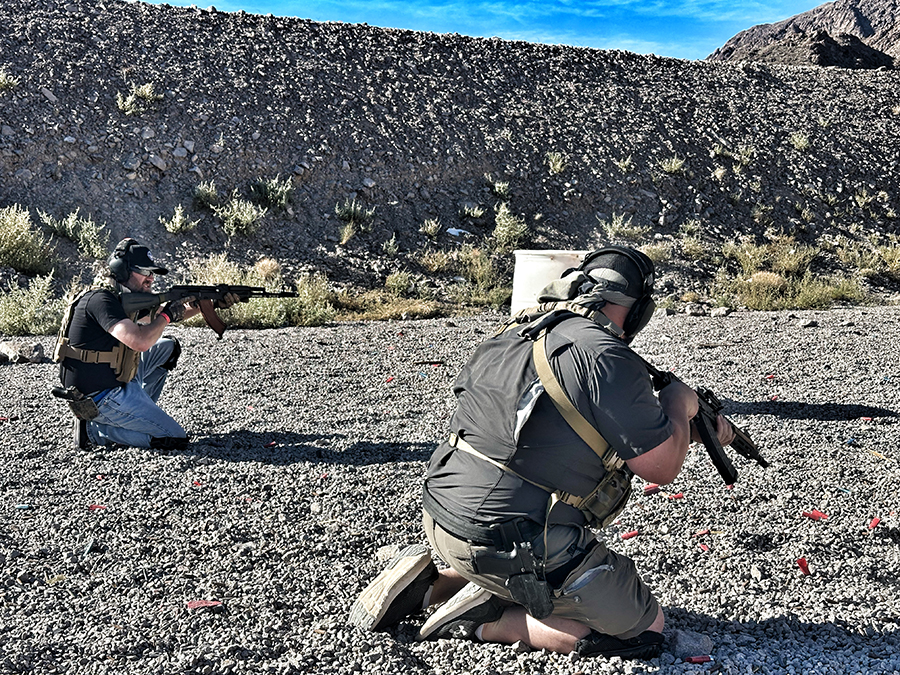
Also, another solid piece of advice is to be sure that you have your personal protective equipment and foul weather gear taken care of before you spend money on Gucci add-ons for your gun. DO NOT buy aftermarket stocks or triggers or rail systems unless you have a quality rain jacket, a good pair of boots, knee pads, electronic hearing protection (muffs are best) and shatter-proof eyewear. Also, we train outdoors and cannot predict the weather. A fleece watchcap and well as a fleece jacket, to go under the rain jacket, plus a good pair of gloves that you can shoot with should be on your priority list.
Ammunition
We are assuming that you’re planning to attend training because you want to be a serious shooter. Serious shooters order their ammunition by the case, not the box. Yes, ammo prices vary. As this piece is written, the cost for FMJ (non-expanding) training ammunition is as low as it has been in a decade. Remanufactured ammunition loaded with once-fired brass can be a good option. However, before you bring “reman” to a class, test it out in your rifle and be sure that it’s reliable.
Naturally, you should read the gear list for the training session to be sure that you’re bringing the appropriate amount of ammunition to the course. Martial-type courses tend to be higher round count classes than slow-fire, precision courses, as you would expect. Each school is different so don’t just assume.
What NOT to Do
While we like to focus on the positives or the “do’s”, there are some “don’ts” that will save you money and frustration. While it’s tempting to want to be the guy who has the coolest looking rifle in class, I would absolutely advise against stripping off the original furniture and replacing it with aftermarket Gucci stuff. Ditto for the trigger. Before you decide that your rifle needs a different trigger, actually go to an intensive two-day training course and run the gun. If you decide after the class that you still need a new bangswitch, then okay.
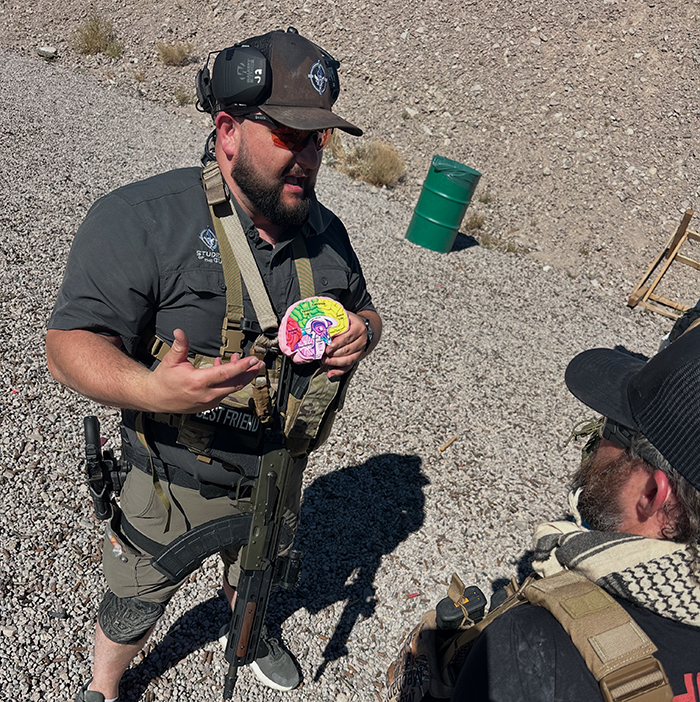
My good friend Jay “Nighttmare” Gibson, of Tactical Response fame, likes to refer to superfluous accessories and add-ons as “doobers.” As he related to me many years ago, “It’s amazing how many doobers that were bolted onto the rifle the morning of day one are missing on the morning of day two.”
Speaking of bolted-on or screwed-on accessories. If any optic rail or accessory is held onto the gun with threads, be sure to take the time to A) clean the threads with alcohol to remove any oil and B) apply some type of threadlock compound more than 24 hours before the class. Threads without threadlocker will eventually come loose, as often as not in the middle of a shooting drill.
Before the Class
As mentioned, you need to actually read the gear list and the instructions that the school has taken the time to provide. For instance, if there’s going to be lowlight shooting, you need some kind of flashlight. Take their advice, they do this for a living.
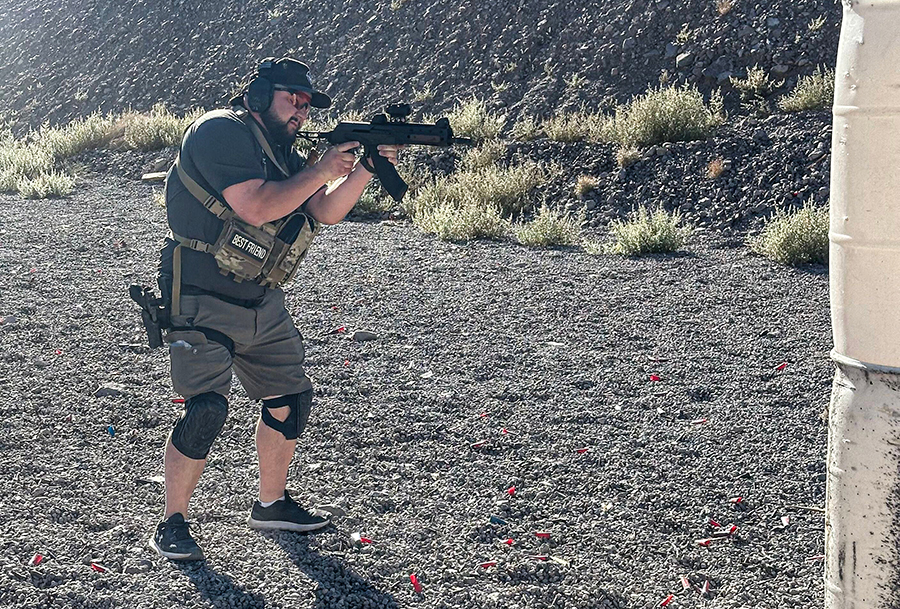
To be completely honest, our students at SOTGU, rarely have an issue being unprepared or caught off guard because we prep them with our Home Study/Distance Learning material prior to our in-person residency classes. As a matter of fact, we offer the option of just enrolling in the Home Study first and then picking live training at a later date. We have had this program for a couple of years now and it’s been extremely well-received by our students.
Parting Shots
If you already have your home defense carbine/rifle decked out with your favorite optics and accessories, cool. I’m not telling you to strip it all off and go with a naked gun. What we’re hoping to minimize here is hesitancy on the part of new students and the mistake of buying stuff that you don’t truly need.
The most important thing that you can bring to a class is your brain. Show up with an open mind, park your ego, and enjoy the experience.
Paul G. Markel is the founder of Student the Gun University and has been teaching Small Arms & Tactics to military personnel, police officers, and citizens for over three decades. He is the author of numerous books and is a combat decorated United States Marine veteran.
I think outside of the box. So I ask what if my fighting rifle is a ruger 1022? Or a 22 lever gun? Or a single shot 22?
The Chechens were very effective against the Russians as city snipers. Using 22lr rifles.
Because a 22lr report is a lot less than a 5.56. And a 22 suppressed can’t be heard.
As far as fighting goes. I don’t need to fight them head-on. If you harass them enough they will eventually leave the area.
But you will spend a great deal of money for this Class and the required long guns.
The so called “experts” don’t want to teach you how to fight with revolvers and small caliber long guns.
You go to war with what you have. Not what you wish you had.
“As far as fighting goes. I don’t need to fight them head-on.”
I encountered an ANTIFA-wanna-be once who, in a threatening/aggressive manner, confronted me and asked loudly if I was willing to die to defend my beliefs in being conservative.
My answer was: “I don’t need to be willing to die to defend my beliefs. I just need to be willing to let you die for your beliefs, and I’ll be happy to help out with that.”
confrontation over, he and cohorts immediately left the area without another word.
Big(smile)
General Patton was very correct!!!
Chris T in KY,
You make a very good point about combat in general. If you expect to be part of a squad going door-to-door in Fallujah, you certainly want rifle combat training and a semi-automatic rifle chambered in an intermediate or full-house centerfire caliber. If you want the ability to effectively send an occupation force packing, then you probably need a totally different approach, such as you mentioned. Choose wisely.
For reference a potentially superior choice to a compact rifle chambered in .22 LR is a carbine or a so-called “short barreled rifle” chambered in .300 AAC Blackout–loaded with sub-sonic ammunition and sporting a suppressor at the muzzle. THAT is about as stealthy as you can get and yet it has VASTLY SUPERIOR terminal performance compared to .22 LR. That platform will have any occupying force praying for a hasty exit from your community.
Waddle to the sound of the guns.