

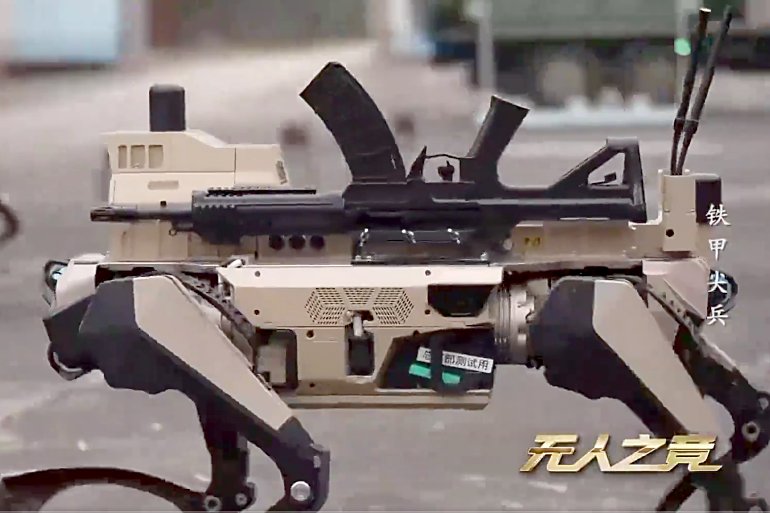
China’s showing off a new combat robot mutt they call a “wolf.” America’s gun owners who have seen the videos no doubt pondered the obvious question: What caliber would solve that problem should any of us be lucky enough to live where a shipping container of these so-called “super-soldiers” are set loose?
Just like those flashy Temu-grade Chinese air defenses that flopped so spectacularly in Venezuela and Iran, Beijing’s latest combat wolves are likely all hat and no cattle. There’s a reason Harbor Freight hasn’t sent a manned rocket into orbit: junk looks great in promo videos, but real life won’t allow people to add some airbrushing or CGI to remedy the shortcomings.
Sure, these quadruped “wolf packs” strut around with machine guns, grenade launchers, micro-missiles, and allegedly obstacle-clearing mobility. They appear to have a “collective brain” for swarming coordination. The salesmen have their scripts ready: Robots supposedly clear streets in minutes, humans chill in the rear, and attrition shifts to drone-vs-bot playdates with lower body counts. The magic elixir for urban combat!
First footage just dropped: China’s robot wolves have been put through a simulated street battle.
You might remember their debut at China’s V-Day parade last year. It seems that they are no longer a showpiece.Here’s what’s new:
• Heavier loadouts: can be equipped with… pic.twitter.com/TUFtPTJ93a— Sinical (@Sinical_C) March 27, 2026
After watching the video, these mutts look impressive on flat ground. Throw in some brush, tall grass, woodlands or even scattered junk and they probably won’t fare so well.
Plenty can go wrong, things your overly optimistic CCP salesman won’t talk about. Real-life cities are nightmares of stairs, potholes, rain, rubble and civilians. The article admits the killer flaw: can these $74,000 JD.com specials actually discriminate between friend and foe or recognize that Aunt Ling Ling isn’t a combatant? And what happens when the battery craps out after an hour or two? Does the robot wolf expect someone to turn the crank to recharge it?
Chinese soldiers undertake military drills with robot troops leading the breach
Terminator is today. pic.twitter.com/hfMlezuY7c
— Chay Bowes (@BowesChay) April 1, 2026
Low-tech solutions hit hard, especially with a little Yankee ingenuity. Birdshot may blind sensors. Translation, a one-dollar shotgun shell just neutered a $70-something thousand dollar piece of whizbang technology. Similarly-priced rifle rounds will bedevil joints. Fancy lithium batteries don’t like to get punctured, even gently, much less violently with bullets. Assuming a punctured battery doesn’t go into a thermal runaway and turn the cyber soldier into a four-legged Tiki torch, it could become expensive lawn art. Not only that, but good-ol’ boys will then be able to salvage the rifle or grenade launcher off the dead electro-pooch and have a nice war trophy and to build their weapon stash for their next encounter.
Even a fire extinguisher would likely blind them temporarily. Molotov cocktails could deliver flaming electronic meltdowns. Acid bombs eat away at seals and joints. Firehoses might send them tumbling. From rooftops, drop a masonry block on them to give them a headache or break their backs. Physics laughs at Chinese “indigenous design.”
Channel those smart US Marines from the viral clip: cardboard box, silly walk, or tree impersonation. The swarm glitches — “New urban species?” — while you stroll up with a sticky bomb. Jamming, EMPs, duct-tape trips, or trash-bag snares finish the job.
Battlefields are gloriously messy, attritional, and human. Robot dogs will probably be useful in some situations, but they’ll also be pricey, glitchy targets for grunts and civilians alike.
So send your robot dogs, China. We’ll turn them into scrap metal and statues until we figure out how to reprogram them to push a lawn mower for us. Woof.
ZeroHedge has the CCP propaganda:
Four years of hyperdevelopment, battlefield testing, and deployment of FPVs, ground robots, AI-enabled kill chains, and soon humanoid robots have permanently altered the course of the modern battlefield, as war technologies once viewed as 2030s-era weapons are being pulled forward into the present day and are now proliferating across battlefields stretching from the Eastern European theater to the Gulf theater, as Eurasia appears to be at war.
The latest reminder is that, regardless of the battlefield across Eurasia, there will increasingly be large swaths of land, miles deep, effectively forming a new kind of no-man’s-land controlled by FPVs and ground robots operating with AI kill chains. In Ukraine, that no-go zone stretches 15 miles wide and already means a quick death for any biological soldier, with FPVs able to detect, track, and strike.
A new form of attritional warfare is emerging in which FPVs and robots are cheap and disposable, while soldiers are mainly exposed only when they have to hold, clear, or occupy terrain.
China occasionally likes to flex its dual-use robotic ground systems, with the latest footage showing quadruped machines that act as “robot wolves” with machine guns mounted on top, being trained for street battles.