

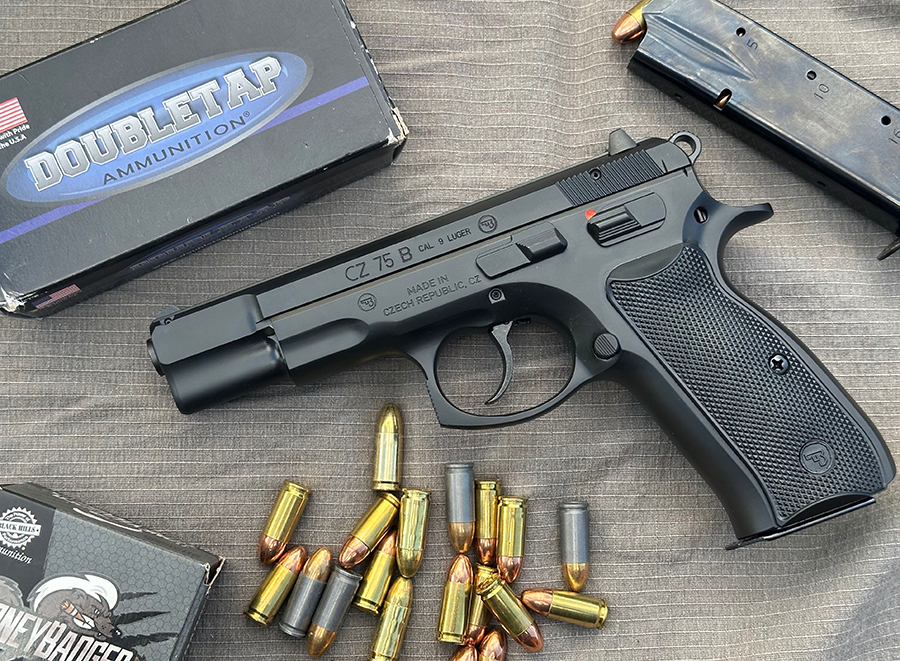
Back before every firearms maker in the world was producing their own version of a GLOCK 17, pistols had distinct and unique profiles. You could identify the various handguns of the Cold War by their silhouette alone. One of the most distinctive silhouettes was that of the CZ 75.
CZ 75
Originally produced in Czechoslovakia and released to the world in 1975, the CZ 75 was one of a number of post-WWII handguns to be manufactured with a Double Action/Single Action trigger mechanism. As we previously discussed during our review of the VZ-58 rifle, the Czechs were unique amongst Warsaw Pact members in that they did not just license and copy whichever guns happened to be coming out of the Soviet Union. Another distinction was that while members of the Warsaw Pact, Czechoslovakia was never a member of the Union of Soviet Socialist Republics.
The truth is that the CZ 75 pistol was more on par with the pistols being made in Europe than those in the Soviet Union at that time. The Italian double-action Beretta Model 92 shares a 1975 birthdate. The DA SIG SAUER P 226 did not arrive on the scene until nearly ten years later. Of course, in the United States, Smith & Wesson had the Model 39 DA/SA pistol which the US Navy Seals used for some time in Vietnam. From a historical standpoint, the most successful DA/SA pistol up to that point was the original Walther P38 and it was that handgun which laid the groundwork for others to follow.
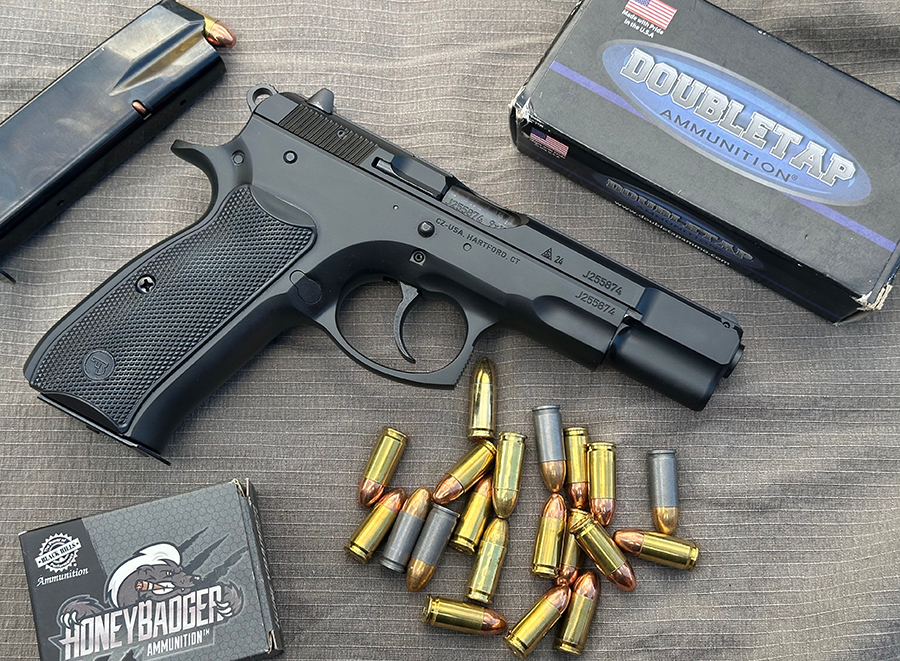
Quite the robust pistol, the CZ 75 was constructed of a forged steel receiver and slide with black polymer grips. Unique to most pistols being manufactured at the time, the slide of the CZ 75 is recessed into the rails on the frame, not the other way around as most all modern semi-automatic handguns are constructed. This feature is credited with giving the “75” reliable accuracy as well as function. The frame on this pistol is also referred to as a “short rail” frame.
Controls on the CZ 75 include the curved trigger, an exposed hammer which has come in both spur and rounded configuration. Speaking of the hammer, the pistol has a “hammer notch” safety a la M1911 and there is an internal firing pin block.
On the left side of the frame you will find a manual safety lever in the normal location for the right thumb to activate and a slide lock lever in front of it. The magazine release button is found to the rear of the triggerguard on the left side. The manual safety can only be engaged when the pistol is cocked in the single-action mode. If the hammer is all the way down or in the notch safety position, the manual safety lever cannot be engaged.
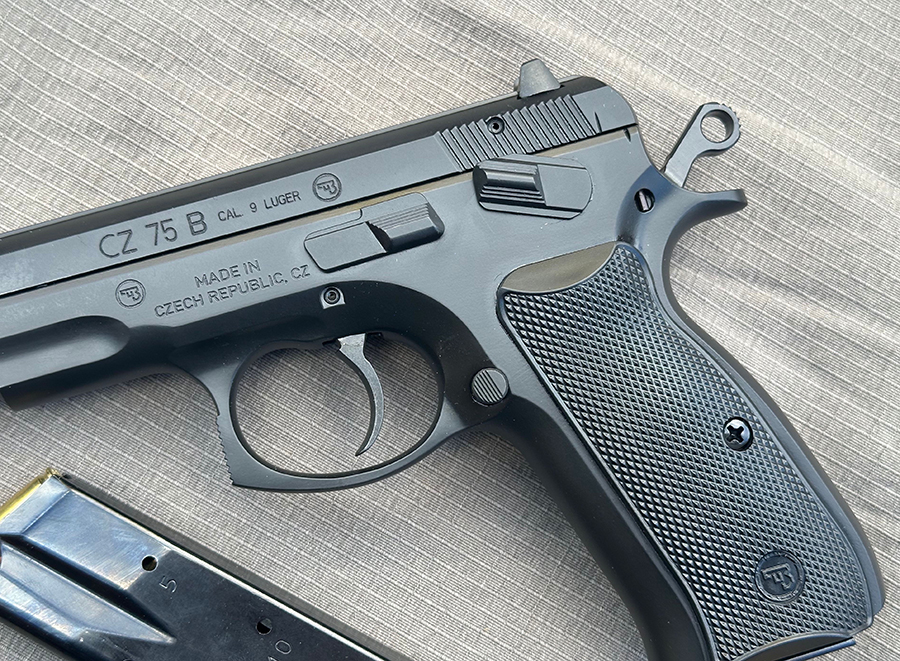
The design of the frame has been aptly described as “ergonomic” and “shooter friendly” and it certainly is both of those. Over the years, many clones of the CZ 75 have been made replicating the grip angle and design.
Interestingly, unlike the Beretta, SIG, and Smith & Wesson DA/SA pistols mentioned earlier, the CZ 75 does not have a decocking lever. When a round is chambered, the hammer is set in single action mode and the user can simply engage the manual safety lever and carry the pistol as you would an M1911A1 or a Browning P35 Hi-Power. The only way to lower the hammer to the “notch safety” is to pitch it between the thumb and forefinger of the non-shooting hand and very slowly and carefully press the trigger to release it. Naturally, this is not a technique for neophytes and should be done while exercising the most extreme amount of caution. A better way is to simply practice chambering a round and engaging the manual safety.
Although I can’t say for certain what was going on in the minds of the Czech engineers fifty years ago, I can say that at that time, the common practice for soldiers was to carry their handguns with the hammers down on an empty chamber and a loaded magazine inserted. When I entered the United States Marine Corps in 1987, that method of carry was still the official practice for the M1911A1 and it did not change until units were issued their Beretta M9 pistols. Were I a betting man, I would venture to say that in 1975, soldiers in the Army of Czechoslovakia were not allowed to chamber around round in their pistols until they intended to fire them, ala, chamber-empty carry.
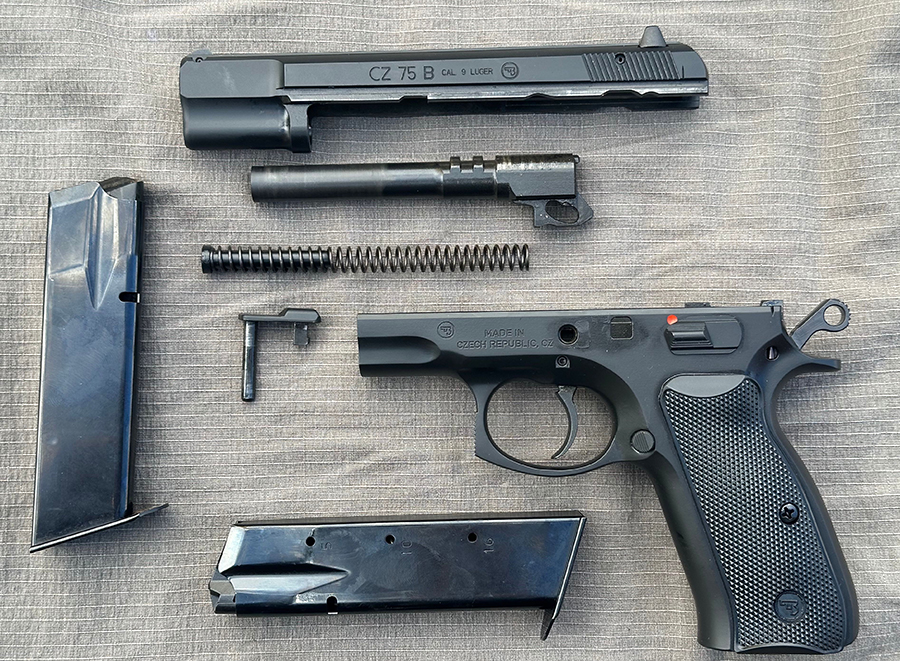
Chambering the 9x19mm cartridge, the CZ 75 used a staggered or dual column 16-round magazine. This gave the pistol three more rounds than the P35 and one more round than the M9 and the P226. The choice to use a 9x19mm round was rather rebellious as the Soviet Union was using both the 7.62x25mm and the 9x18mm Makarov cartridges at that time AND the 9x19mm was also the 9mm NATO, the choice of the western enemy. The Czech engineers did produce a CZ 83 in 9x18mm Makarov, as well as a .380 ACP version of that same gun.
CZ 75 B Range Time
The pistol that I had on hand for this review was a newly manufactured CZ 75 B. The “B” or “Bravo” model indicates the use of a firing pin block safety. While this particular pistol is a modern version, it shares the same profile and functionality as the originals.
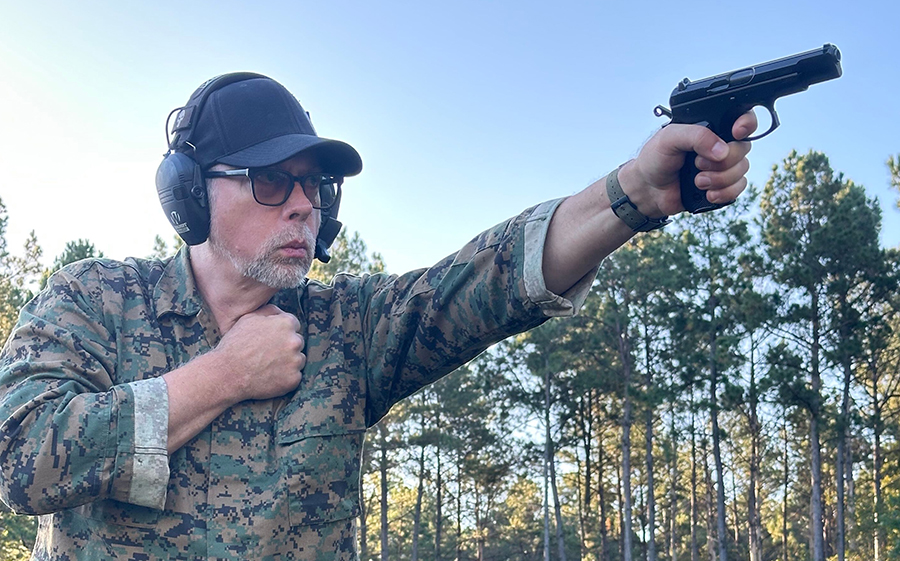
For range testing I used the standard 115 grain FMJ ammunition in both steel and brass cased configuration. The brass cased ammo came from DoubleTap. Additionally, I used Black Hills 124g JHP and 100g Honeybadger +P. Before writing this review, I put around 200 rounds of the aforementioned ammunition through the pistol. Right out of the box the pistol ran without issue, no break-in period needed. The double-action trigger press is certainly manageable and not at all too heavy. The single action trigger was crisp and smooth.
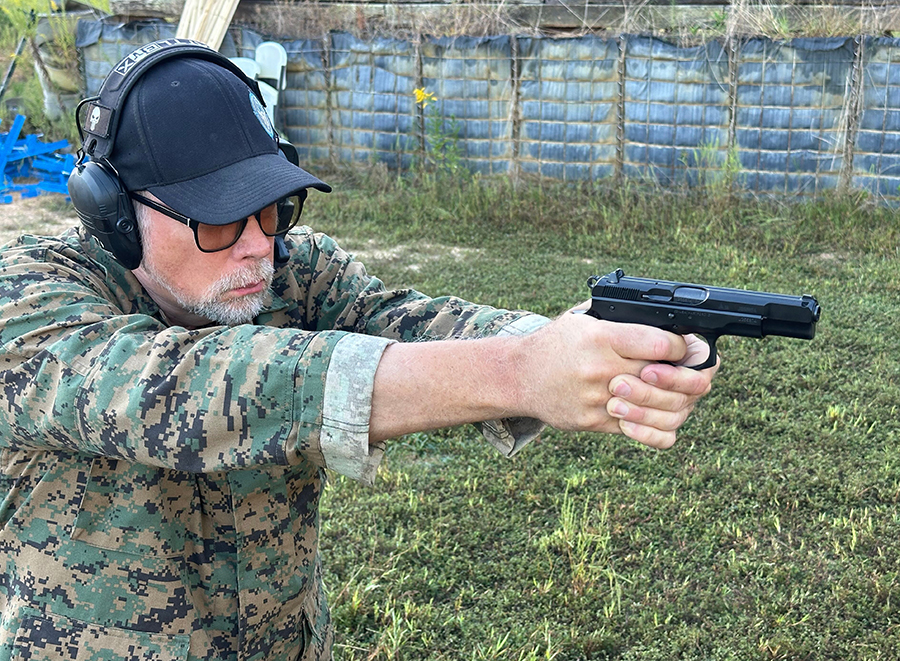
I would describe the front and rear sights as “Milspec”. They are made of steel and should be tough enough for field use. As with many duty pistols, the front sight is a bit short for my taste. I found that rounds were impacting about 2 inches above point of aim from ten yards. Will the average shooting under “combat” conditions be hampered by this? My oldest son, Jarrad, and I ran the pistol against steel silhouette targets from 15, 20, 25, and 30 yards and found that ringing the steel was not a problem at all.
As you would expect from a duty pistol, the CZ 75 disassembles for cleaning without tools. Using pressure from your left hand, ease the slide back ever so slightly and line up the two notches on the left side of the pistol, then push the slide stop out from the right side. With the slide stop removed, the slide comes off of the frame and the recoil spring and barrel can be removed for cleaning. Reassemble in the reverse fashion.
Parting Shots
As far as Cold War pistols are concerned, the CZ 75 was robust and reliable as well as accurate. While the design may seem dated when compared to 21st century handguns, the CZ 75 and the myriad clones that it inspired are still being used to this day. The CZ 75 has been used by militaries and law enforcement agencies in Europe, Asia, Africa, North and South America.
Specifications: CZ 75
Caliber: 9x19mm
Action: DA/SA
Sights: Fixed Steel
Capacity: 16+1
Furniture: Black polymer grips
Barrel Length: 4.6 in.
Overall Length: 8.1 in.
Weight (empty): 35.2 oz.
Price: $660.99
Paul G. Markel is a combat decorated United States Marine veteran. He is also the founder of Student the Gun University and has been teaching Small Arms & Tactics to military personnel, police officers, and citizens for over three decades.
The CZ-75 family are underrated guns with great ergonomics and great accuracy. They’re not the easiest guns to work on but you can get mostly drop-in parts from Cajun Gun Works to really make it shine. A Cajunized P-01 is on my want list.
works.
with sweatshirts coming out i’ll start hefting the compact.
my full size has the omega trigger. it’s… different. simpler. interesting that even though they adopted it for 75 use (it was developed for the polymer frames) the 75 in this review still uses the original (well, the “b”) design.
the aluminum framed version of the compact is probably the one to get. and there is an individual here that causes me rami envy.
my friends p10 with optic mounted is an improved glock and works well.
still, csx e…