
Just last week, I heard the same words that I’ve heard so many times before, “You’re a gun guy, right?” That question is normal followed by, “What do you think about…?” In this case, the “what do you think about” question was completed with “a good gun for home defense.”
Officially, I have been training in the martial application of firearms for 39 years and a few months, so I guess it’s just time to say “40 years.” As you might imagine, my opinions on such matters are deeply rooted in four decades of experience training with and carrying firearms as a US Marine infantryman, a police officer, a bodyguard, and as a small arms and tactics instructor. I put all of that out there to say that my thoughts and opinions, or my answers to the previous type of questions, have changed over the decades.
Thirty-plus years ago, I would have advised neophyte gun owners to purchase a stainless or brushed nickel (stainless guns held better trade-in value than blued steel) six-shot double action revolver and learn how to use it. Back then, .38 Special ammunition was plentiful and the least expensive gun food going, at least for centerfire handguns.
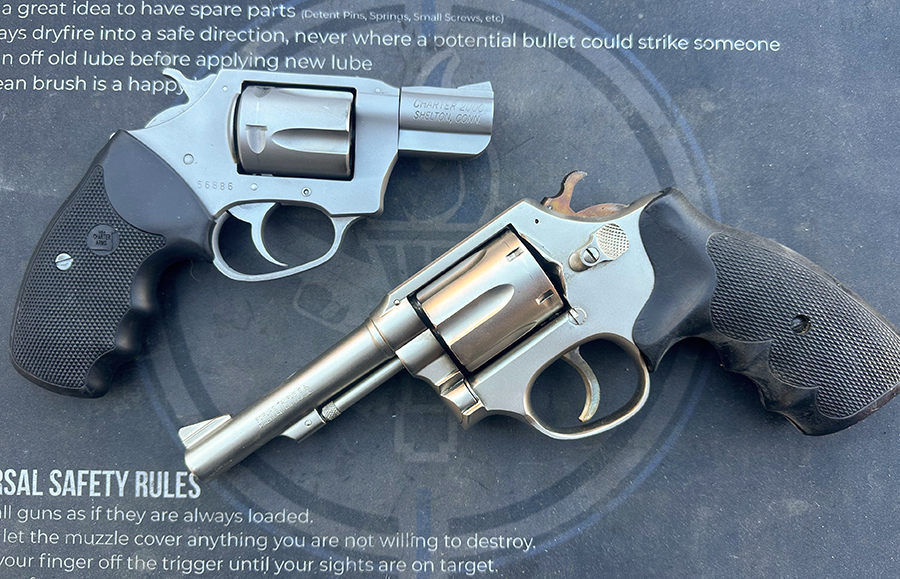
Of course, back then I was relying heavily on the advice that I’d been given by my mentors. Such a gun was the first “home defense gun” that my wife and I kept loaded and secured in a place where we both knew where it was. For my part, I carried and used semi-auto pistols, but I thought the DA wheelgun was a good fit for my bride who had far less experience.
She and I went with that plan for years, but I noticed that when it was time for our annual couples trip to the range, for her to shoot the home defense gun, she always needed a couple of cylinders worth of ammunition to get the rounds in the center of the silhouette target. Like many significant others, she only shot guns when she was with me. Shooting wasn’t a passion for her.
During one of these sessions, after shooting the revolver I had her shoot my GLOCK 17 with a nice, bright tritium front sight. She put the entire first magazine into the middle of the silhouette target. For our next session, many months later, I had her shoot the G17 cold — no warmup — and once more, she put all the rounds in the middle of the silhouette at five yards.
That was well over a decade ago, maybe closer to two decades, but I learned something. Despite the age-old advice about how “A double-action revolver is a good beginner’s gun because the operation is simple and it’s easy for new shooters to understand,” in reality, the DA revolver was only good for people who actually trained and practice often. For the once-a-year shooter, the long DA trigger and the movement of the cylinder was NOT a good fit for someone who didn’t enjoy shooting, but did so out of a sense of duty.
Cylinders vs Slides
I still hear men say, “Well, I got a revolver for my wife because she can’t rack the slide on the pistol I bought her.” When I ask which pistol he purchased for her, invariably, the answer is some type of compact or sub-compact. Of course it’s harder for an inexperienced person to work the slide on a small autopistol. The springs are extra heavy to make up for the lack of mass in the slide and there’s just less to hold onto. The pocket .380 pistols are some of the worst offenders in this regard.
When it comes to the small guns, sure they “fit” in the wife’s hand, but they have snappy and often painful felt recoil. The wife doesn’t enjoy the shooting experience and won’t willingly do so unless prodded.
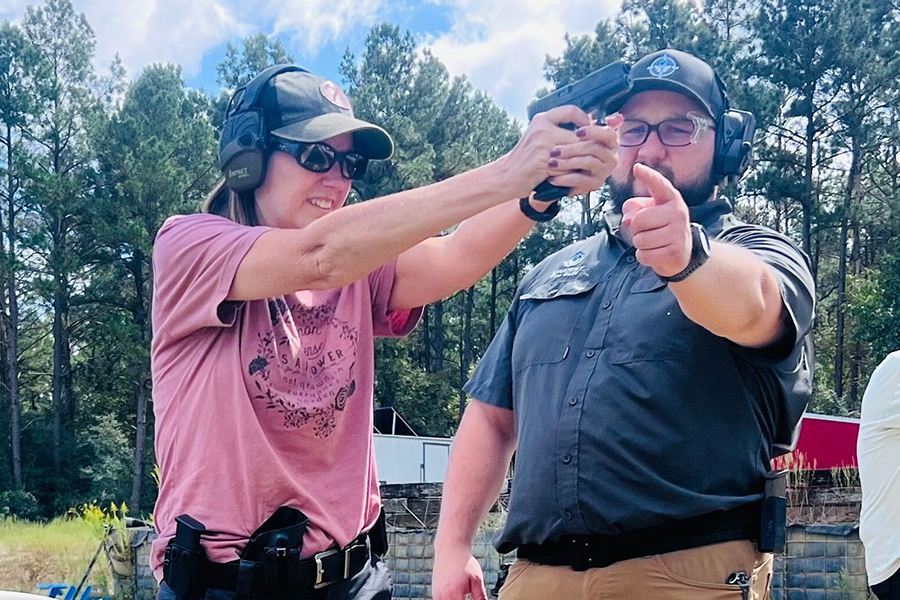
A full-sized pistol, such as the aforementioned G17 for the superb Canik METE SFT, will offer the neophyte shooter plenty to hang onto from both a grip and a slide racking standpoint. At Student of the Gun University, we have neophyte female shooters in just about every P201 pistol course we teach. Most are wives, but many are teenage or adult daughters.
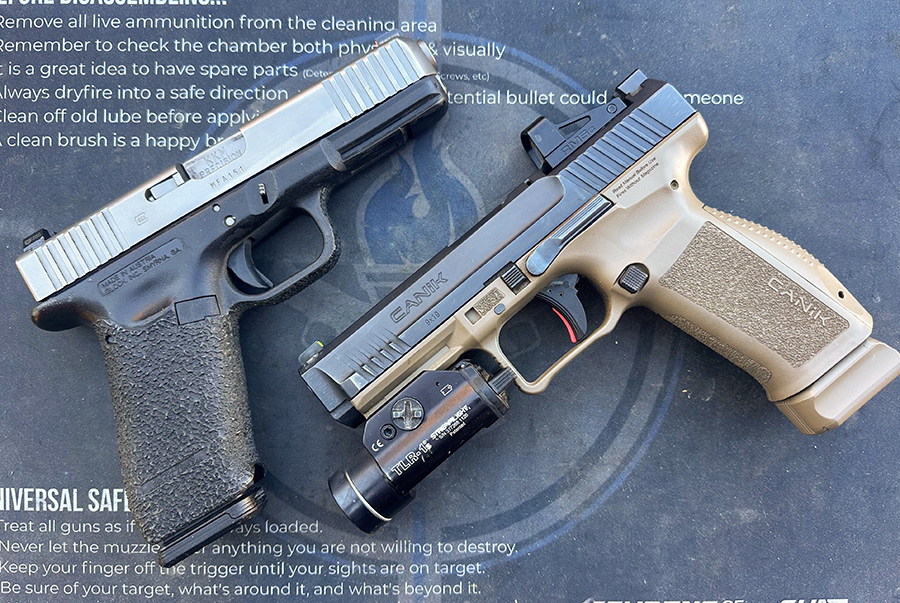
The husbands and fathers that come to our classes are pretty savvy and they don’t buy compact snub-nosed or J-frame revolvers for the ladies in their lives. Our experience is that the most favored pistol is the compact GLOCK 43. That would seem like a good choice and it can be, but the learning curve and the struggle to pull on the dual-captivated recoil spring while gripping the small slide can be tremendously challenging.
I would say that to a person, when we encounter a neophyte woman, or man in some cases, who struggles to operate their subcompact semi-auto pistol, when we take them aside and let them shoot a full-sized gun, such as the Canik METE SFT or, in Jarrad’s case, his GLOCK G45, their performance improves immediately.
Can new shooters learn to shoot and successfully run a subcompact pistol? Sure they can, but they’ll need a lot of hours to be able to do it. And humans being humans, if the experience of struggling with a subcompact pistol is unpleasant, they’re not likely to want to put in those hours.
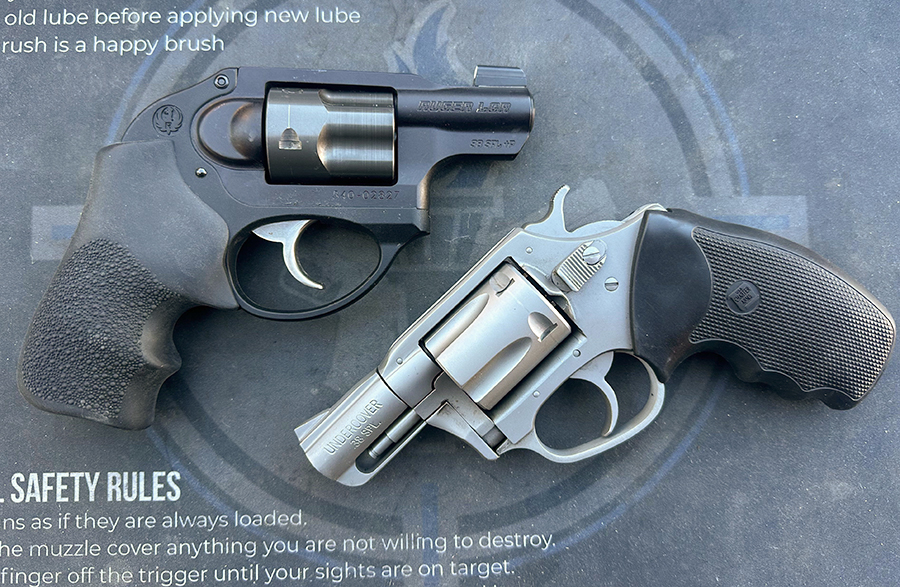
Going back to the discussion of DA revolvers, whether compact five-shot models or even the full-sized six-shot guns, the DA triggers tend to be long and heavy, sometimes topping 10 plus pounds of pull weight. NO, telling them to just “cock the hammer” is not a solution. This isn’t 1873. There’s a reason we stopped using single action only revolvers as self-defense guns. To be fair to the revolver crowd, the Ruger LCR is, in my opinion, the best compact revolver as the trigger is actually manageable and the rubber grips give the shooter something to hold onto.
Give the New Shooter a Full-Sized Pistol
For some reason, when it comes to wives and daughters, husbands and fathers don’t think they can handle a full-sized pistol. Folks, the circumference of the grip on a GLOCK 19 and a GLOCK 17 is identical. The felt recoil on the G17 is going to be less that a G19 and far less than the G43 or G48. Working the slide on a full-sized pistol is going to be easier. It’s just simple mechanics and science. Back in the old days of GWoT, when I was training the military, I had female shooters, some with small hands, who learned to master the M9 Beretta and that’s a large pistol.
In the Canik line, I love their subcompact MC9 pistol and I think it’s just about the perfect EDC gun. Nonetheless, for a new or neophyte shooter, running such a gun is going to be a struggle until they put in the hours and get some genuine skill and confidence. After all, aren’t skill and confidence more important than convenience or compact size?
I just heard someone say, “But they need to train with what they’re going to carry.” Sure, you train with what you’re going to carry when you’ve developed the skill and ability. Forcing a person to struggle against a heavy recoil spring while holding a subcompact pistol isn’t going to inspire them to do that more often. Quite the opposite is often true. They learn to dislike shooting because of the struggles and failures on the range. Wouldn’t it be a better idea to first set them up for success and then, after they’ve been successful with a full-sized pistol, move them on to a more concealable EDC gun?
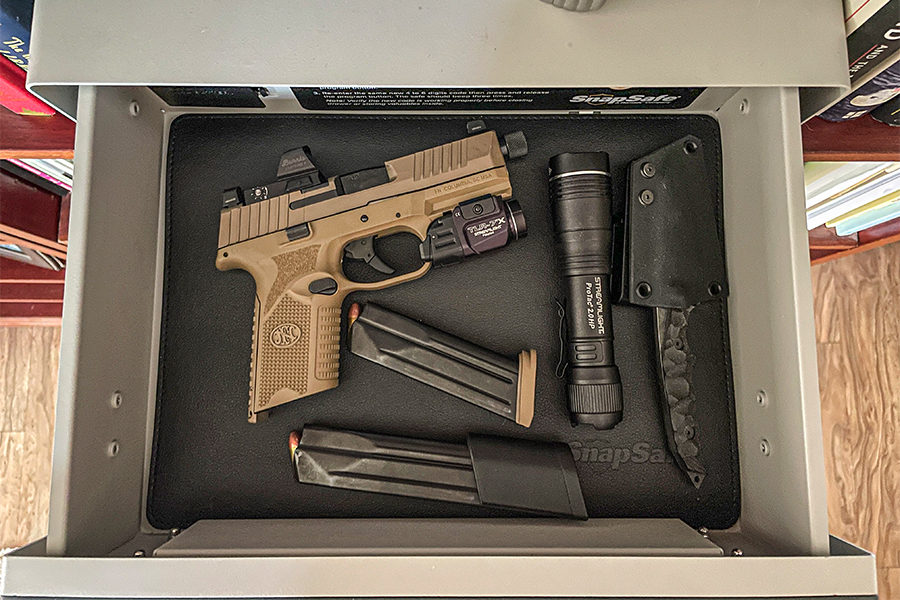
Also, let’s go back to the original question about home defense guns. There’s absolutely no reason to be using compact or subcompact handguns as home defense guns. You aren’t carrying it or trying to conceal it, so opting for small guns has no discernible benefit.
Parting Shots
Should the worst situation materialize and a non-shooter, someone who isn’t passionate about shooting, is forced to use a gun to protect their lives, there will be no warmup shots. The first rounds out of the gun have to be on target or something terrible and unthinkable could happen to them. Guns aren’t good luck charms that ward off evil. If you have someone in your life who isn’t into shooting, but does so out of a sense of duty, you owe it to them to help them develop genuine confidence and skill. Using a full-sized auto-pistol might be the best way to do just that.
Paul G. Markel is the founder of Student the Gun University and has been teaching Small Arms & Tactics to military personnel, police officers, and citizens for over three decades. He is the author of numerous books and is a combat decorated United States Marine veteran.
Hmm, no mention of the EZ line of compacts from S&W? Sure, there’s still more recoil to manage.. And that’s why…..
IMNSHO, new shooters should be handed a 22lr, not a 9mm or 380. The goal for new shooters isn’t “what gun is best for you”. It’s “let’s get you focusing on the fundamentals of shooting – grip, sight alignment, breath control and trigger press”. Otherwise, bad habits will develop, and it doesn’t matter if it’s a full-size or a compact at that point.
The NRA Basic Pistol Marksmanship Qual with a 22lr is a fantastic mechanism for new shooters to grow the fundamentals rapidly without extensive ammo costs, etc.
FWIW: The Smith & Wesson shield EZ’s slide has small wings on the rear that makes racking the slide much easier. And, the magazines have pull down buttons that makes loading the slides much easier too. For me the grip safety is a plus also.
Should have read: pull down buttons makes loading the “magazines” much easier.
.300Blackout,
I agree. My lady (not a gun owner or enthusiast) decided she needed to understand my hobby (that took me to the range, regularly, for several hours at a time), so she agreed to go shooting with me. My “standard” self-defense pistols, at the time, were a Kimber 1911 and a Beretta M9. But, since she’d never shot a pistol, before, I felt either would be ‘too much’ to start her with.either of those . . . so I took my Ruger MkIII “Hunter” model, with the 6.88″ barrel (and my other two). The first time she shot the Ruger, the noise (even with the nearly 7″ barrel) and the (minimal) recoil, shocked her. I tried to image how she’d have reacted to the Kimber or the Beretta, and thank God I wasn’t stupid enough to start her with one of those.
Anyway, after her first shocked reaction, she went back at it, and after a single magazine, realized that the noise (especially with cans) and the recoil were entirely manageable. By the end of the second magazine, she was placing every shot in the target zone (not many bullseyes, but all of them ‘in the paint’). After giving her a chance to go through four magazines on the Ruger, I let her try the Beretta. As before, the first shot was a shock, but her experience with the Ruger let her know it was manageable. She went through four magazines on the Beretta, another two on the Ruger, and decided she was able to do this.
(Side note: Her last magazine on the Beretta, and her last two on the Ruger? Nothing outside the 8-ring. I started calling her ‘Annie Oakley’). For exactly the reasons you mentioned, started a noob on a decent .22 is a smart opening move.
Choosing the right gun for a new/non shooter is easy: full size .44 Magnum with 8-inch barrel! Just kidding of course.
I have watched countless people struggle to rack semi-auto pistols of all sizes: micro-compact, sub-compact, compact, and full-size. I also watched all of them rack the slide WITH EASE once I showed them proper technique.
Now that I have established that virtually everyone (short of people with severe physical maladies) can learn the easy technique to rack slides, I will argue that a new/non shooter should purchase whatever size of handgun (a) fits their hand comfortably and (b) is not so small/light that recoil is so unpleasant that they don’t want to shoot for proficiency.
And, since I am on the topic of proper technique, once you teach someone how to properly grip and hold a handgun, they can handle recoil. I watched a women shoot a Smith and Wesson M&P 40 pistol with 4-inch barrel, which ended with her eyes closed and her hands up in the air nearly over her head. I then showed her proper grip and hold–including that she must use a LOT of strength (not quite to the point of shaking). Her next shot was accurate and her overall presentation was beautiful, ending with her eyes open and pistol still pointing at the target rather than the pistol pointing up in the air with her hands over her head as she was previously doing.
In my previous post, I mentioned that there is a proper technique when it comes to racking the slide on a handgun. I will try to describe the most important points.
1) Using your “strong” hand, hold the pistol CLOSE to your body and LOW, typically below your belly button. Make sure your strong hand’s palm is facing toward your body and the barrel is pointing at the ground in front of your feet.
2) Using your “off” hand, “pinch” the slide between your finger tips and your palm.
3) Hold your “off” hand in place and push your “strong” hand (which is holding the grip of your pistol) down toward your feet.
4) As soon as your “strong” hand has pushed your pistol down toward your feet and the slide is fully rearward, LET GO of the slide with your “off” hand.
The reason that people struggle to rack slides is because they fail one or more aspects of the technique that I outlined above. Pinching the slide with your thumb and fingers is the most common error. Holding the pistol up high at chest level with their “strong” hand wrist bent in a way that drastically weakens their grip is another common error. Last but not least, people often try (and fail) to move the slide backwards with their “off” hand rather than moving the pistol forward with their “strong” hand which means keeping their “off” hand in place.
Like I said, I have taught this and it works. The very first time, I saw a woman struggling at a gun store counter and I let her and her husband flounder for a bit. Then I demonstrated the above technique and helped her replicate it. She racked the slide easily. I repeated the same with an elderly gentlemen who said that arthritis and poor muscle strength blocked him from racking the slide on a pistol–until I helped him implement my technique above.
Learn it. Do it. Teach it.
LOVE my G17. The extra mass in the slide makes a real difference. I’ll consider it next time I take someone to the range. Second shot always on-target, because the muzzle didn’t flip toward the moon. Did the Dicken Challenge (a.k.a. “Indiana Mall Hero”). 40 yard silhouette, unsupported – 8/10. Very well-behaved pistol.
Sadly, I can only carry it concealed during winter; the grip makes a rather large print.
Yesterday, I expended significant effort to type a fairly short comment which carefully explained how to “properly” rack the slide on a semi-auto pistol. I believe that comment is incredibly useful to countless people.
Sadly, it comes as no surprise that this site refuses to display that comment. Given the amount of effort that it took to explain that technique clearly AND concisely, I will not be typing it again.
As has become all too commonplace, this site is somehow convinced that it must hide all of my comments, no matter how short and polite they are. Since this site cannot be bothered to display wonderful content, I cannot be bothered to provide any.
Test comment.
Testing the words this site.
Nice article. Changing with experience, modifying a behavior because reality, are signs of intelligence, not “flip-floping”, or “caving” to popularity.
Considering the mechanics of small guns vs. larger guns, as regards likelihood of a new person to actually learn to shoot well is a welcomed adjustment to opinions about “best” first guns.