

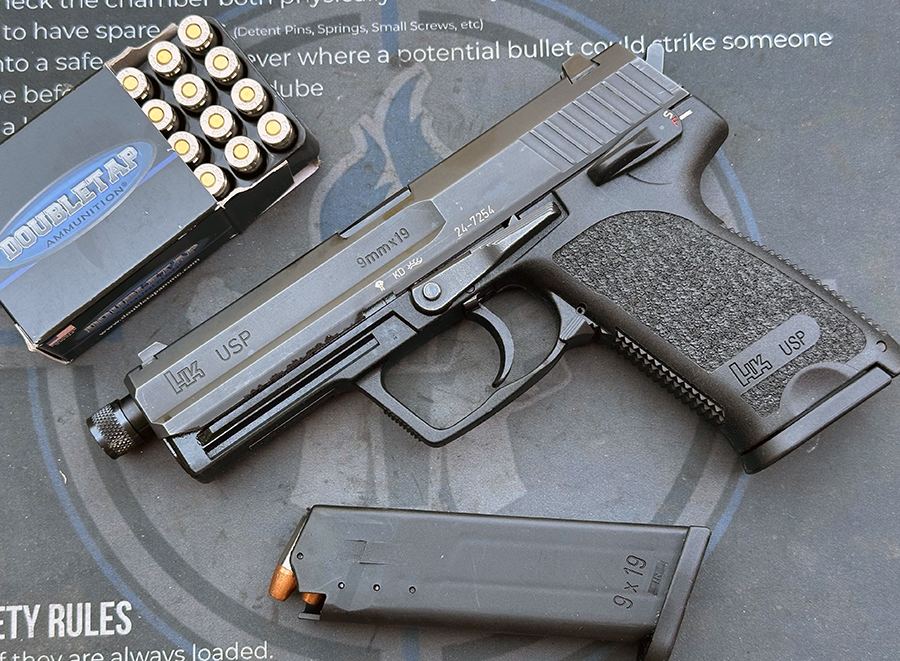
“Time keeps on slippin’ slippin’ slippin’ into the future.” So said Steve Miller and rightfully so. Despite the fact that I’m pushing up on six decades here on planet Earth, in my mind, certain events seem as though they happened yesterday. Case in point. I recall having lunch with an acquaintance in the professional security business when the topic of the new Heckler & Koch Universal Service Pistol came up.
That lunch happened during the summer of 1993. At the time, if you were one of the cool guys in the gun carrying world, you carried the HK P7 “squeeze-cocker.” Back then I was relatively young, newly married and did not have that kind of bread, man. A friend of mine, a bachelor, did have that kind of money and let me shoot his P7M8 in 9x19mm. To quote Ferris Buehler, “It’s so choice. If you have the means, I highly recommend picking one up.”
I mention the P7 because in the early 1990s it was pure sex from HK; sleek, steel, sweet trigger press, fantastically accurate, the whole package. And then, HK released a polymer framed, double-action pistol that looked like the polar opposite of the P7. True HK fans were befuddled. Some were quite vocal about their disapproval.
HK USP History
In the interest of clarity, in 1993 we were still under the spell of the then new .40 S&W cartridge, at least younger shooters and cops were. The older, more seasoned gun guys had little to no use for that cartridge from the start. I have two witnesses who were present when the late, great Col. Jeff Cooper was asked for his thoughts on the brand new .40 S&W round. True to form, the Colonel responded with a one word answer; “Why?” Why indeed. Sadly, Jeff passed before the gun world woke up to their mistake, but he knew.
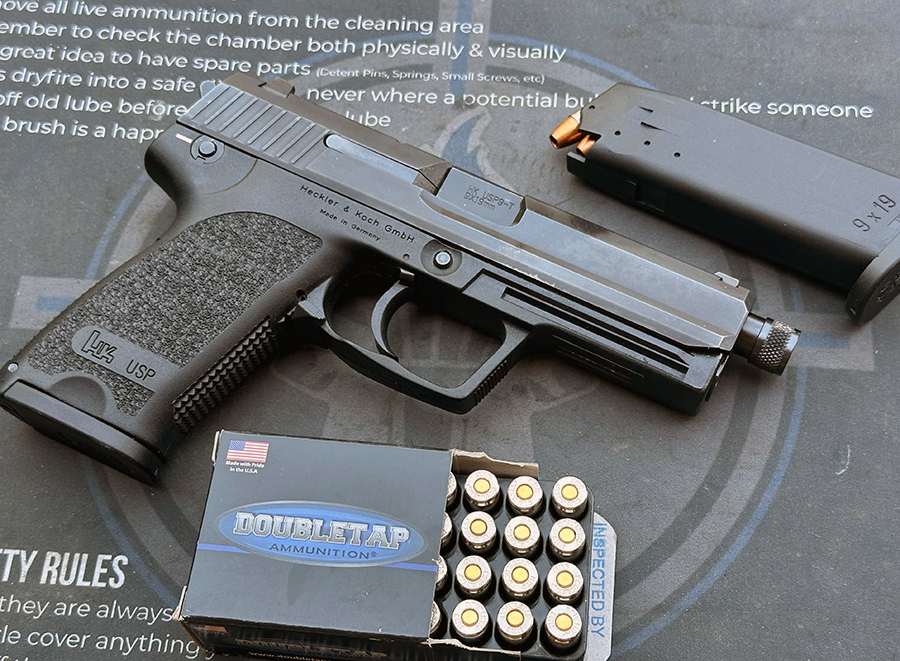
The first HK Universal Service Pistol was released in the United States, the #1 Handgun Market in the World, in .40 S&W. It was not until 1995 that the USP 9mm was introduced to the gun buying public, making the unit that I have in my hot little hands about 30 years old.
Heckler & Koch knew two things, the naive Americans wanted the .40, but NATO and the Europeans were married to the 9x19mm round. Other models were available in .45 ACP and in .357 SIG (compact). Don’t forget the monster-sized .45 ACP in the Mk23 configuration. The Mk23 SOCOM was a .45 ACP unit with all the Gucci features to include laser aiming module and a silencer. A good friend of mine was in the US Navy Seal Teams when these rolled out. I once asked him about the Mk23. “Oh, they were a lot of fun to take to the range.” he commented and continued, “but they were so big we never carried them in the field. We carried our SIGs.”
Why the HK USP 9mm?
In the early 1990’s, HK had the P7 M8 and M13 pistols (single column and staggered column mags), the pride of that German company, guns that were not only sexy, but insanely accurate and highly sought after, coveted might be a good term. And so, why go a completely different direction and make a “blocky-looking” pistol with a plastic frame and a long DA trigger?
A good portion of the blame can be laid at a doorstep in neighboring Austria. The GLOCK 17 won the Austrian Army trials and was beginning to make serious waves in Europe and the United States. GLOCKs were not the king as they seem today, but they were making noise. For example, when I attended the Police Academy in 1992, of the 25 or so cadets in my class, a grand total of one had a G17, the rest were S&W DA revolvers and a smattering of various autos. Being the weirdo I was, I had a Springfield M1911A1. But that’s a story for another day.
The engineers at HK were reading the tea leaves and they knew that polymer framed guns were the future. They also knew that most cops were not “shooters” or “gun aficionados” and that LE agencies were leaning toward Double-Action auto pistols for their future purchases. From an economic standpoint, a new HK USP was priced about ½ that of a new HK P7 model. A police agency or a military unit could buy twice as many USPs for the money.
HK USP 9mm Specifics
When you look at the DA autoloaders of the time, the German engineers went a slightly different direction. A DA pistol needs some kind of decocker/manual safety. The SIG P226 has the side-mounted de-cocking lever. Smith & Wesson and Beretta famously put their controls up on the slide. (In my ever so humble opinion, one of the worst places for them). The USP’s manual safety/decocking lever was more akin to the M1911A1 manual safety. On my USP, this control is located where the righthand thumb can operate it, it is not ambidextrous. To de-cock the USP 9mm, you push down on the lever.
While the USP 9mm can be carried in the DA, trigger-cocking mode, you can also load it and then simply flip the safety lever up for a first shot SA trigger press. For those schooled in the art of the M1911A1, this might be a perfect set up.
As for other controls, the USP 9mm has an ambidextrous mag release located at the rear of the trigger guard and a slide lock on the right side, that is it. Both function exactly as designed. The magazine release, while not a button, was not difficult to master and was nearly impossible to accidentally bump during shooting.
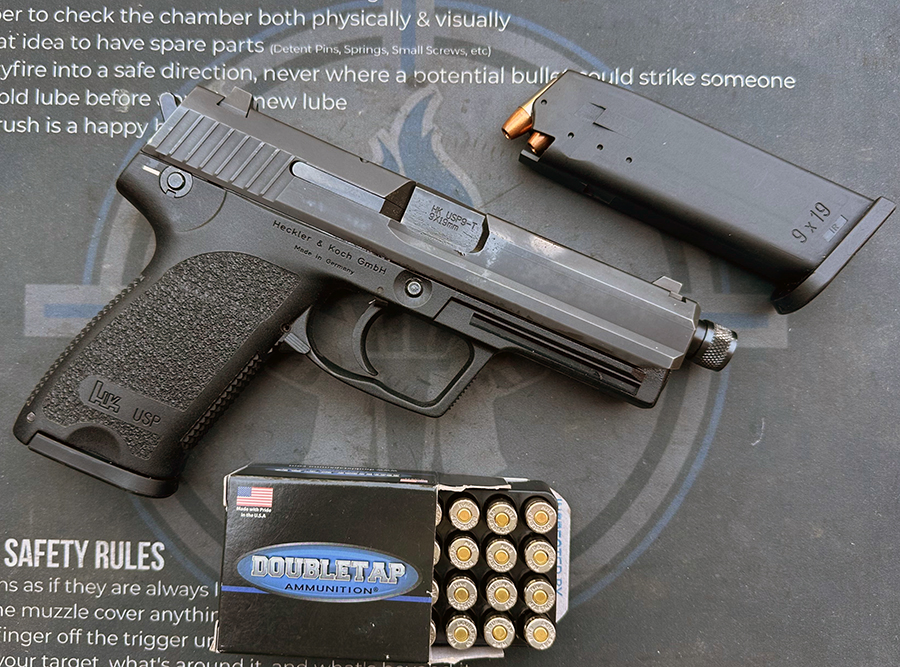
The HK USP 9mm magazines are drop-free style unlike the original G17 magazines which did not drop-free by design. Speaking of which, the standard capacity for the 9mm USP is 15 in the mag plus 1 in the chamber.
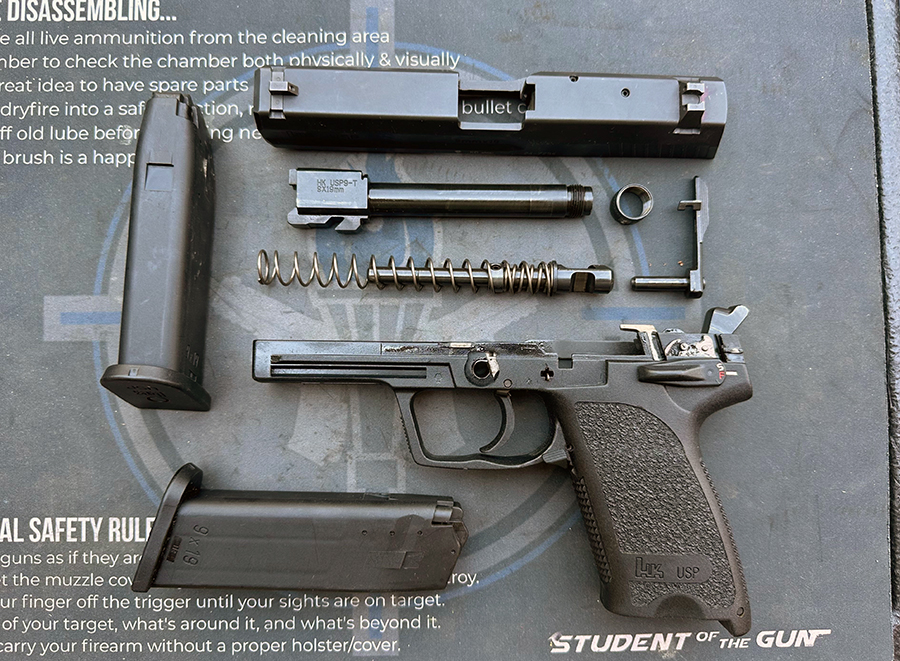
A corrosion resistant finish was applied to the slide, barrel and steel parts. The polymer frame and magazines are naturally rust-proof. Standard barrel length for the USP 9mm was 4.3 inches. Several years ago, I installed an HK USP-T threaded barrel to allow the use of a suppressor. The sights are three white dot Patridge-style and the external extractor claw is more than up to the task of ripping out fired cases.
Back in the early days when gun makers were toying with the idea of putting lights and/or laser modules on pistols, HK put their own unique mounting rails on the frames. The Gen 3 GLOCKs used a “Weaver/Picatinny” style on their guns and essentially won the accessory rail design contest. Newer HK polymer framed pistols use the Weaver/Picatinny accessory rail. If you want to put a light on a true USP, there are websites with dedicated USP mount lights or you can purchase adapters and use the standard weapon-light design.
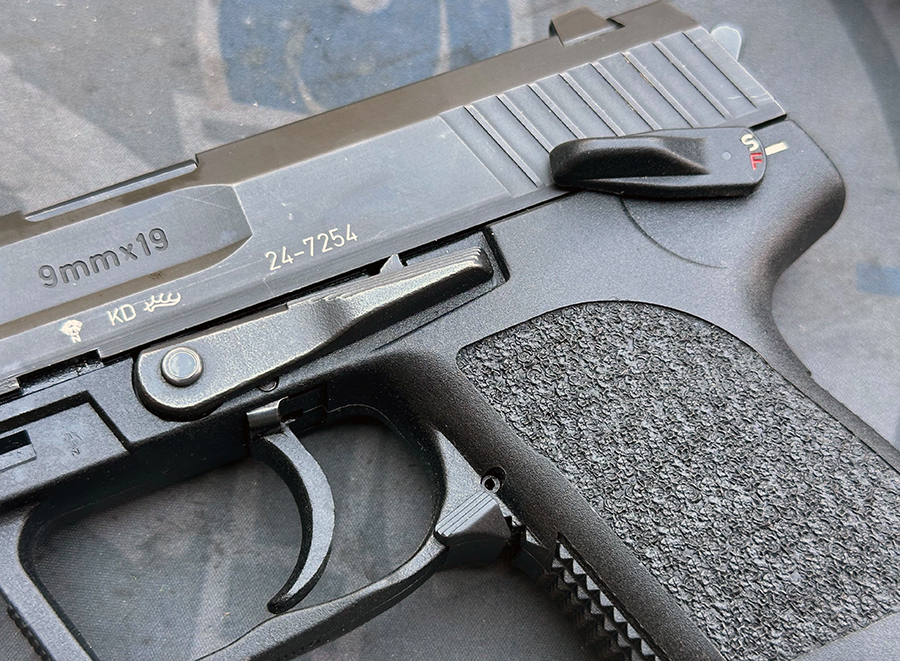
How about the trigger? Well, if you were a fan of the P7, you likely hated the long DA trigger press of the USP. To be fair, the DA press is long, but certainly not unmanageable. Also, when compared to the MILSPEC DA triggers on the M9 Beretta, the HK USP version was a dream. The SA trigger press was not as sweet as the P7, but still respectable.
Speaking of triggers, it has been 30 years since the USP 9mm was released. I have not been able to find a single incident of that pistol having an “uncommanded discharge” in the holster, so there’s that.
Range Time
This review was not my first outing with the USP 9, but I did have a bunch of new 9x19mm ammunition that I wanted to try out in the gun. From the Double Tap ammunition website, I ordered their 124g. FMJ-RN Match, the 115g DT Lead Free SC-HP, the 124g DT Lead Free SC-HP, the 77g Lead Free SC-HP. That load is a real screamer at 1600 FPS! Finally, I ordered some 145g 9mm “Snakeshot Defense.”
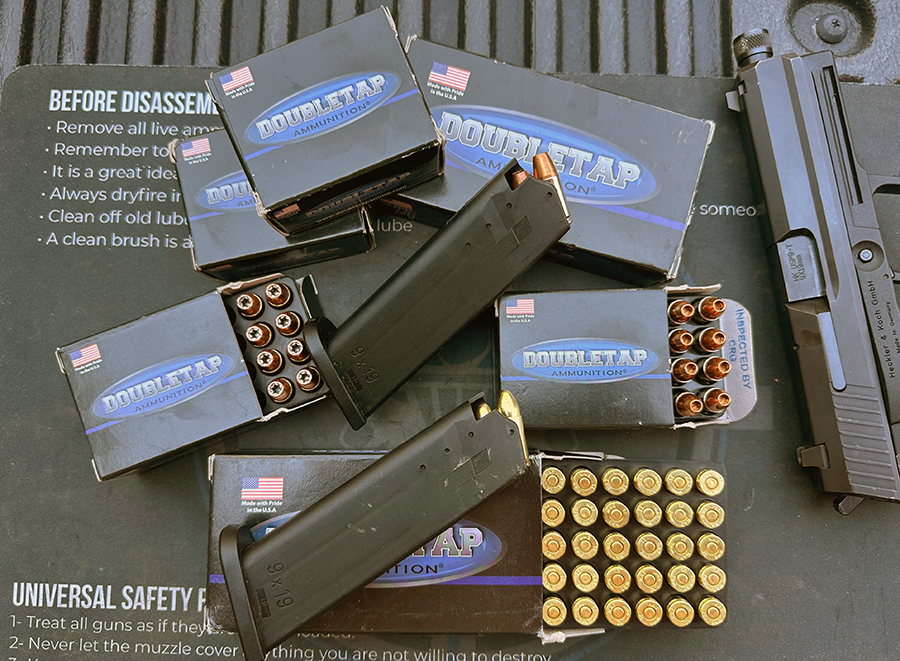
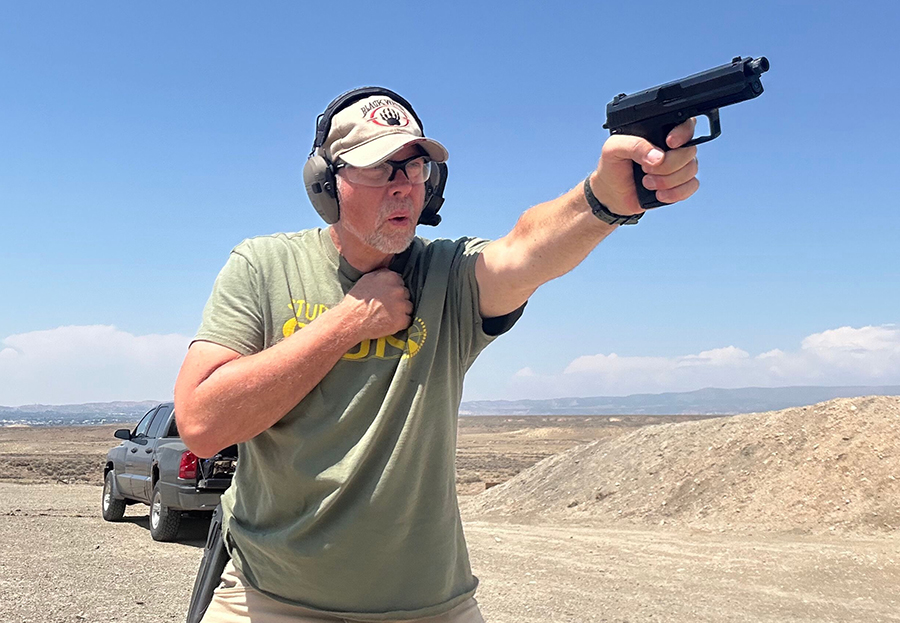
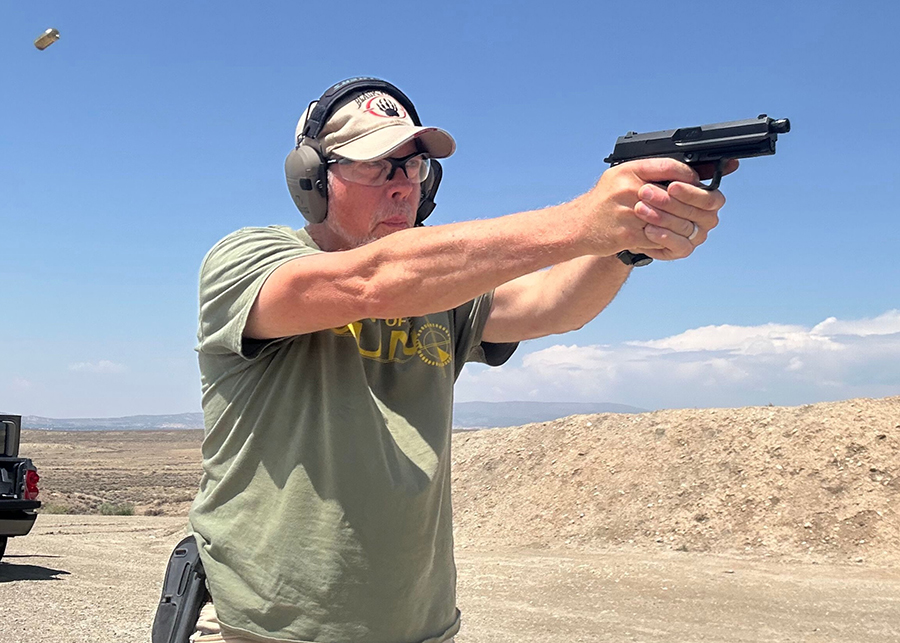
Naturally, I did the majority of my shooting with the 124g FMJ ammunition. However, I did mix up all the other loads to ensure that the pistol would feed them reliably. I split my range time up roughly in thirds firing about ⅓ with two hands, ⅓ strong hand only and ⅓ with my support hand. Shocker! The HK USP 9 ran hundreds of rounds of various bullet weights, velocities, and projectile designs with 100 percent reliability. The iron sights were right on from the factory and hits on a steel half-silhouette from 25 yards were not a problem at all, point of aim / point of impact.
Parting Thoughts
While you might view the USP 9mm as a dinosaur, and many readers were in diapers or elementary school when it came out, I would certainly not feel at all handicapped were I required to use that pistol exclusively. Though it has been rumored that HK actually stands for “Hates Kustomers”, if you can get your hands on a true USP, you won’t likely be disappointed.
Specifications: HK USP 9mm Pistol
- Caliber: 9x19mm NATO
- Action: DA/SA
- Capacity: 15 + 1
- Barrel Length: 4.3 inches
- Overall Length: 7.6 inches
- Weight (empty): 26.4 ounces
- Current MSRP: $1259 for the USP 9mm V1, about $1030 retail
Paul G. Markel is a combat decorated United States Marine veteran. He is also the founder of Student the Gun University and has been teaching Small Arms & Tactics to military personnel, police officers, and citizens for over three decades.
all the mags are loaded correctly. no fun.
How does this pistol compare to the HK VP9?