

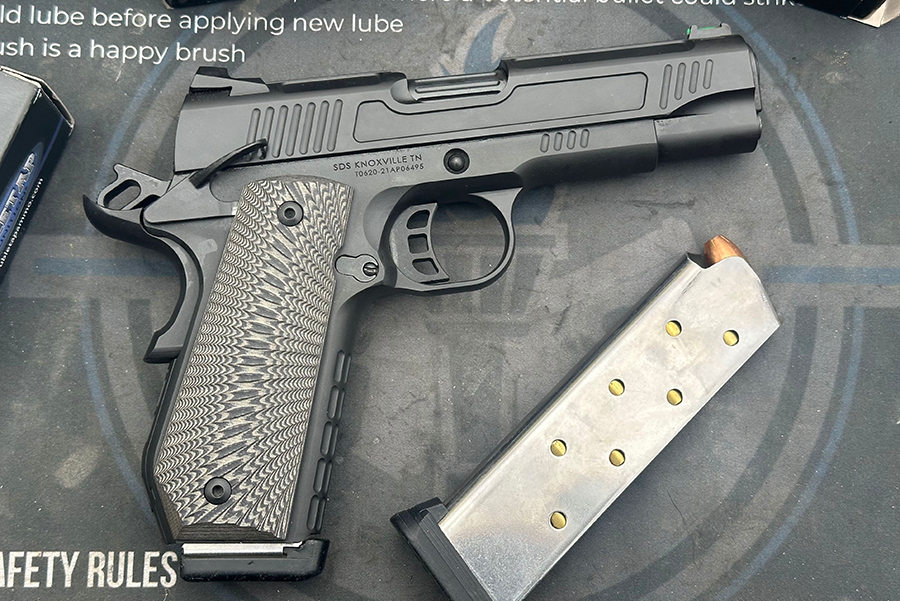
My recent article about “Fun with .45s” inspired a few members of the audience to ask questions about carrying some type the M1911A1 or simply a 1911 for EDC/concealed carry. As someone who has carried a 1911 .45 ACP pistol in both duty capacity and plainclothes, I feel as though I have sufficient experience in the matter.
For this discussion, I went to my gun safe to retrieve what I think is a good example of a 1911 pistol that was designed for concealed carry. The pistol in question is the “Bantam” model from SDS Arms and I’ve had it for a few years now. While this specific model is no longer listed in their catalog, they have similar versions.
Big and Heavy
When carried on a duty belt while in uniform, the M1911A1 doesn’t seem so large or heavy (empty weight for standard model is 35.5 ounces). However, when you decide to conceal such a pistol on your body, the 2.5 pounds of steel, brass, copper and lead can be less than comfortable to tote.
Long ago, gun makers — Colt Firearms in particular — started to produce 1911-style pistols that were a bit easier to carry concealed. To reduce their weight and overall size, the slides and barrels were shortened. A “commander” style 1911 has a 4.25 inch barrel but has a standard frame length. The “officer’s” model shrank even more with a 3.5 inch barrel and a chopped down frame that reduced the round count by one.
After Colt did it, numerous other manufacturers started making 1911s with aluminum frames to reduce overall weight. The Bantam featured here has an aluminum frame, 4.25 inch barrel and weighs 28 ounces as compared to 35.5 ounces for an all-steel, full-sized M1911A1. For comparison, the GLOCK 48 has a factory weight of 18.48 ounces.
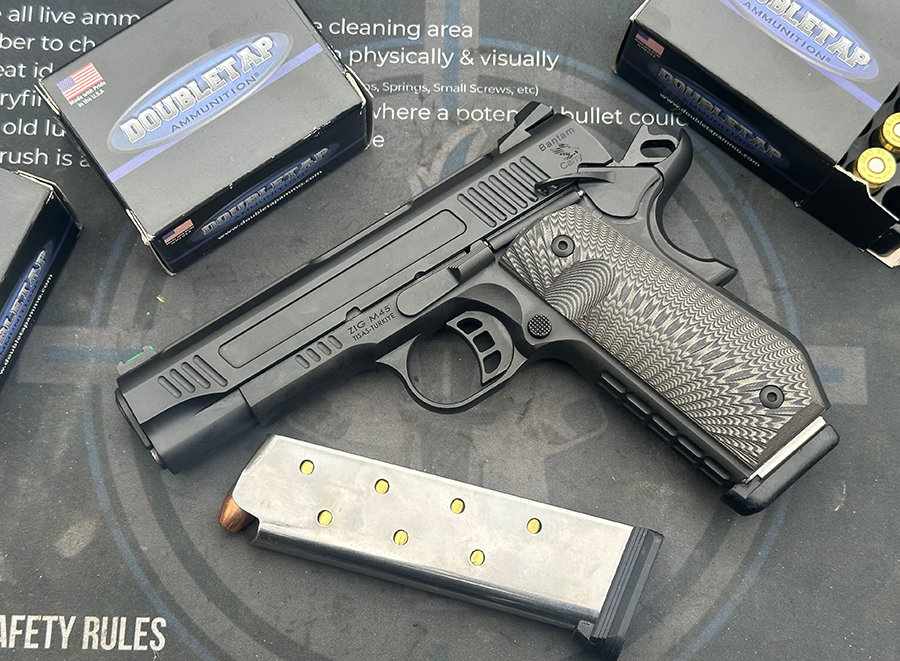
Is it possible to carry an all-steel, full-length M1911A1 pistol concealed? Sure it is, I used to do it. However, I can tell you that shaving seven ounces or so off the total weight does indeed make a noticeable difference when you’re talking about carrying a gun all day long.
Finicky Eaters
Like it or not, the reality of the 1911 is that they have a tendency to be picky about ammo. I’ve been shooting these guns for 39 years now and I can tell you for certain that when it comes to reliable function, you have to test out the ammunition you plan to carry. Too many inexperienced gun owners erroneously believe that just because the gun says “.45ACP” on the barrel, that means every box of ammo with the same marking will run reliably in it.
Base level reliability testing for every 1911 pistol begins with factory-new 230 grain full metal jacket ball ammunition, not Uncle Jim’s basement reloads. Unless the manufacturer states otherwise, the recoil impulse from that load is how the guns are tested in the factory. Also, the factory sights are designed around that load as well. Is there a noticeable difference between where the 230 grain ball impacts and where s 200 grain JHP bullet impacts? If you fire the guns from a Ransom Rest, yes. In the hands of the average shooter at seven yards, not really.
Regardless, let’s not get away from reliability as that’s the most important feature for a self-defense gun and that’s why we carry concealed. After you’re satisfied that your pistol is reliable with 230 grain ball, then you should pick some type of controlled expansion, tissue destroying load from your favorite maker. For this review I used standard ball ammo and four different loads from DoubleTap Ammo.
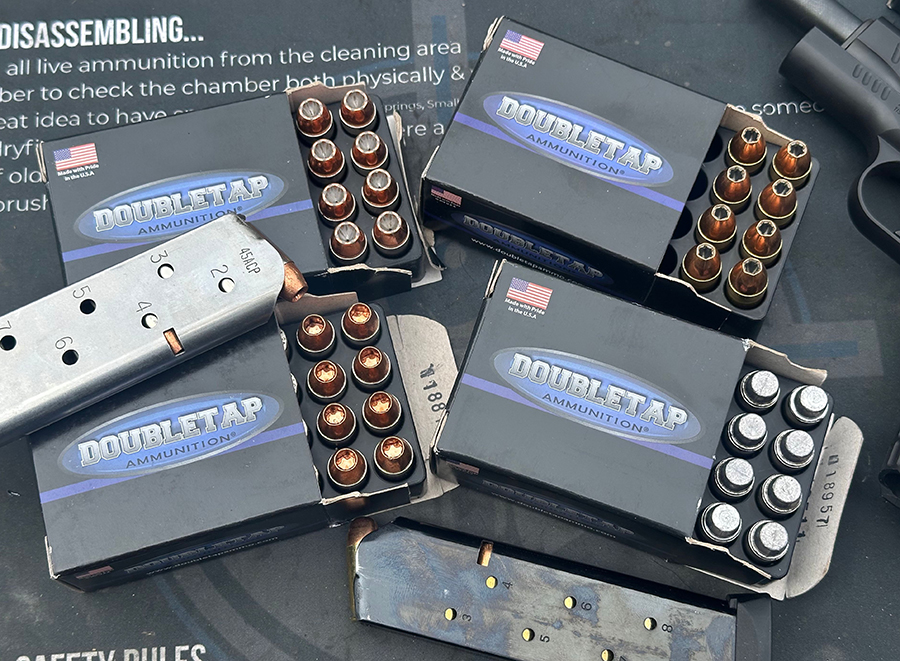
Present from Doubletap were .45 ACP loads; 200 grain Bonded Defense (JHP), 160 grain DT Lead Free 100% Copper hollow-point, 255 grain Hardcast Solid Lead +P and a DT specialty 245 grain Snakeshot Defense. All the loads ran well in the SDS Bantam with the 255 grain Hardcast +P providing the biggest “ouch” factor.
Keep it Clean
The redundant reliability of the modern breed of polymer-framed 9mm pistols has truly spoiled the American shooter. I know guys who clean their handgun biannually, if that often. If you want your 1911 pistol to run, you need to do so far more often than that. Also, the 1911 is a different kind of creature than your plastic fantastic blaster. Browell’s has some excellent “how to” videos regarding disassembly and cleaning of the 1911 pistol.
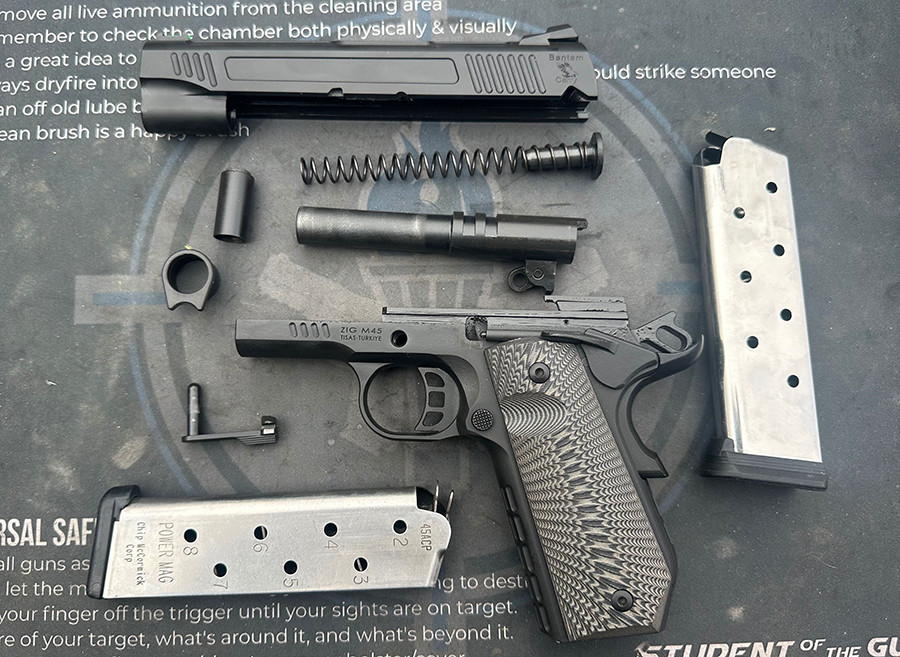
A dry gun, where the lube has baked off and carbon has baked on, is one of the biggest reasons why your 1911 will start hiccuping and having stoppages. If you don’t like to clean guns, don’t buy a 1911 or don’t plan on shooting it.
Running the Machine
Thirty years ago, most gun people understood the basic functioning of the single-action M1911A1 pistol. Today that has all changed. I would say that only between 1 and 2 percent of the students who arrive at our Martial Application of the Pistol course bring a single-action pistol.
Yes, most of the controls on a semi-automatic pistol function in a similar fashion. However, allow me to focus on two aspects of the single-action 1911 that merit close consideration. First, learning and practicing to work the manual safety lever is a must. If most of your experience has been with a striker-fired gun sans safety lever, you need to dedicate serious range time to this aspect of operation. Remember, EDC means you are carry a gun for that “Oh Sh*t” moment when your life is being threatened. During the adrenaline dump, your body will perform as you have trained it to. If it takes conscious thought for you to remember to take the safety off, you are practically guaranteed to forget to do so in a fight.
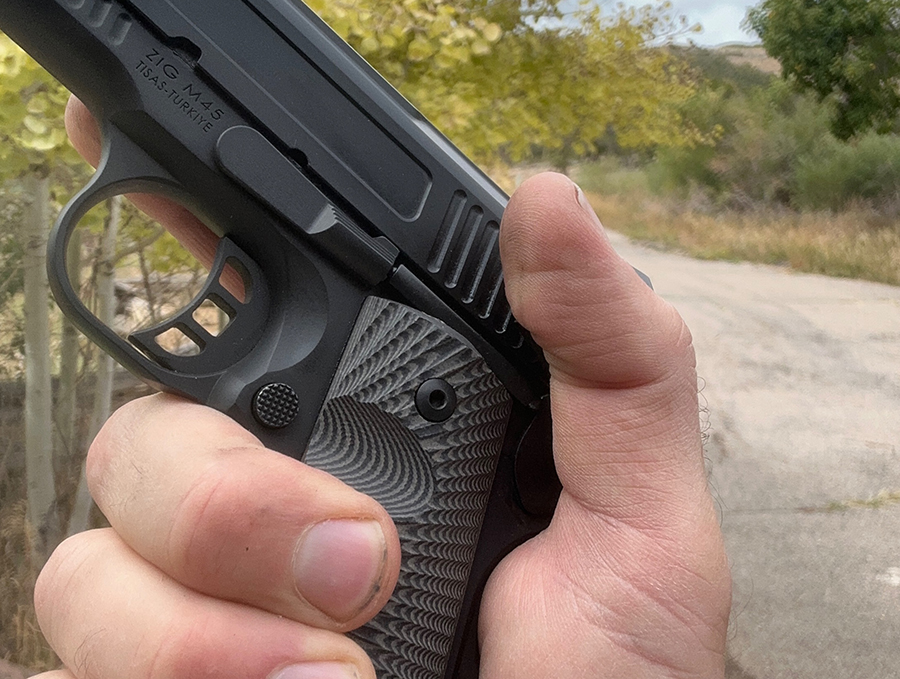
Back in the old days before the internet and mobile phones, I carried an M1911A1. The first time I ever had to pull it out and point it at a human, it was as if my brain screamed “Threat!” and the next thing I knew there was a pistol in my hand and the safety was off. I can only credit that to the fact that before that moment in time, I had likely performed a thousand drawstrokes and disengaged the safety a thousand times. It was probably much more, but you get the point.
If the 1911 design is new to you, you need to practice not only drawing and disengaging the safety, you need to also practice reengaging it every time you put the gun back in the holster. I’m going to say that at least 500 correct presentations are needed for that skill to be mastered and to become a subconscious action that you will perform under high stress.
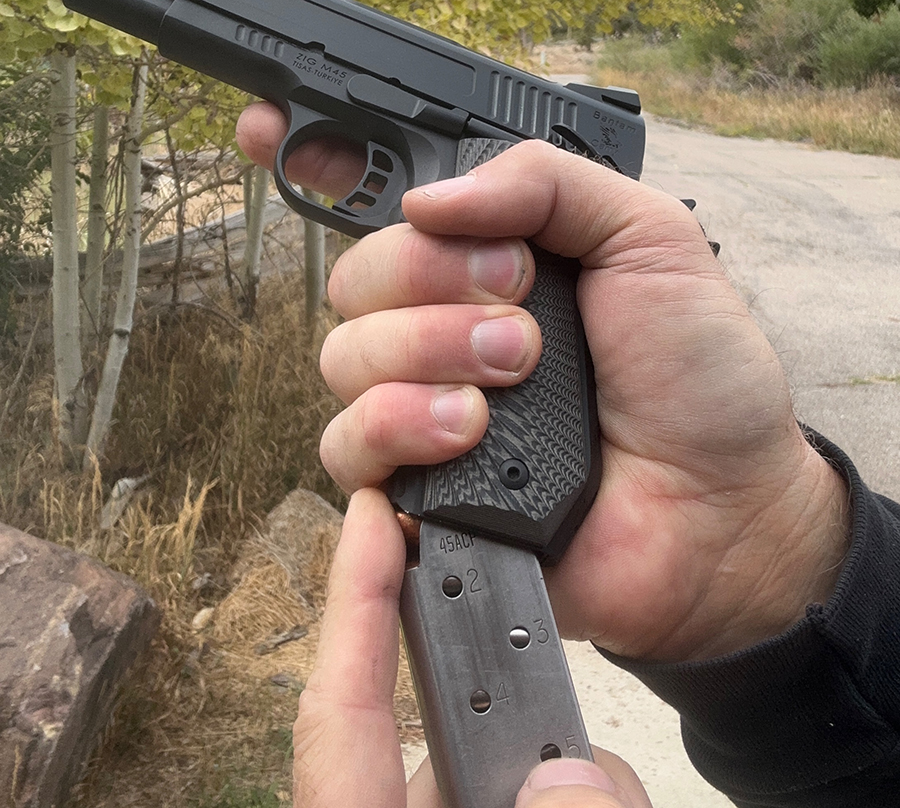
Additionally, when it comes to loading the thin, single-stack magazines into the pistol, you will quickly realise that the hole in the 1911 frame is smaller than you are used to. There are two basic tricks to get your 1911 loaded quickly and reliably. First, stage your magazines with the bullets pointed inboard so that when you retrieve them, the tip of your index finger touches the tip of the round. Then “put the flat on the flat”. That is, put the flat portion of the back of the magazine on the flat portion of the magazine well and insert firmly. I can recall my dearly departed friend, Ed Head, standing on the firing line at Gunsite giving that advice. “Put the flat on the flat.” I can hear him saying. “Insert it firmly with your palm. You don’t need to spank it.”
Parting Shots
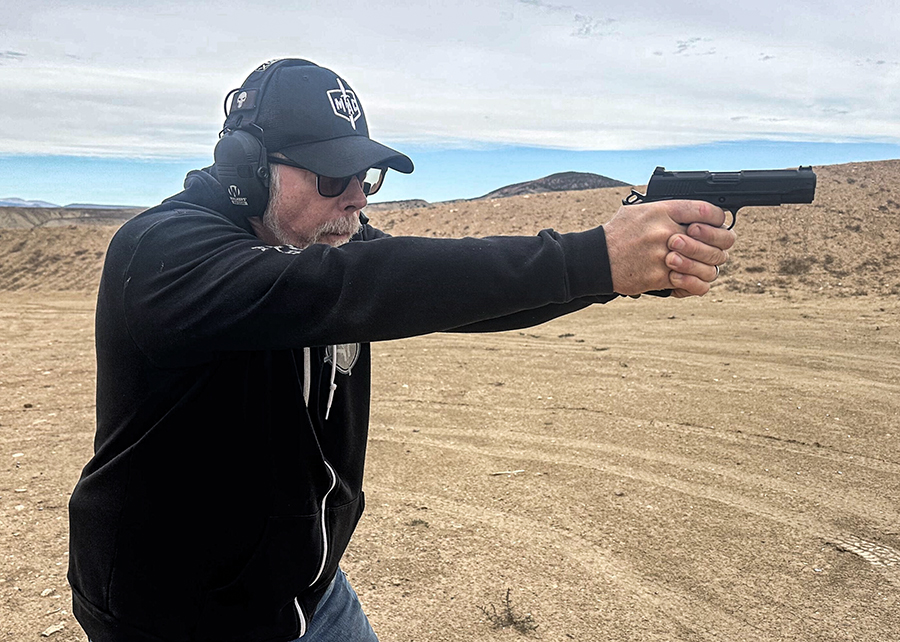
Is the 1911 still a viable EDC pistol? Sure it is. However, it’s not some kind of magic talisman that wards off evil just because you attached it to your body. If you are serious about defending innocent life and not just “playing at self-defense” as my friend Sheriff Jim Wilson likes to say, you need to put in the time and effort. For my part, I’d love to see your smiling face in one of our upcoming classes. Until then, remember, your responsibility to be ready for the fight never ends.
Paul G. Markel is the founder of Student the Gun University and has been teaching Small Arms & Tactics to military personnel, police officers, and citizens for over three decades. He is the author of numerous books and is a combat decorated United States Marine veteran.
Weight is everything when you carry a gun. Concealed or not. I carried a rifle and a sidearm while in the Army. It was my duty. So I put with all in inconveniences. And made the best of it.
You don’t have to do this as a civilian. If you’re gonna buy a gun with intention of carrying it, then you really need to consider the size and weight. And you need to consider the type of job you have, as well as the type of clothing you already have.
A 1911 is very difficult to conceal because of its size. If you are wearing office business attire? I don’t think a 1911 is going to work out for you. A business woman wearing a dress is going to have a difficult time concealing a 1911.
And the “gun community” does not spend a lot of time addressing the issues of female gun owners when it comes to what they’re going to wear to conceal their weapon.
And females are the largest subgroup of new gun buyers. A self employed person can carry whatever they want.
And most gun owners are not self employed. If you are self employed you can carry whatever you want.
“Is the 1911 Really Still a Viable Choice for Everyday Carry in 2025”
No, not with 7 round mags.
We have moved from the ‘common criminal’ one or two perpetrators thing. Today its becoming frequent for 3, 4, 5, heck 15-20 attackers at once. Haw fast can you reload when the attackers are right there in arms reach and closing? How effective will six rounds in a revolver be if there are more than 6 attackers closing or a 7 round .45 mag be if there are more then t attackers closing that are dedicated and will not stop unless you stop them cold, when you account for any misses or wounding that does not stop and motions when those attackers are closing and suddenly you need to reload when they are right there at arms reach? Ya think they are going to go “Oh, ok, you reload, we’ll wait’? How about the thousands of screaming mentally ill leftist cult fanatics on line that have in their imaginations tagged ‘you’ (as in any ‘conservative’), as their enemy and want to roam in mobs looking for targets of their irrational mental illness fanatical hatred willing to die for their imagined cause, ya think they are gonna stop every time you need to reload that six shot revolver or that 7 round mag .45?
You need to be able to sustain fire with a minimum of reload interruptions – at very close range that’s not going to give you time to reload a six shot revolver or a 7 round mag for a .45 .
Seems like after last week everybody should be carrying a PDW in .300 and 8 mags of supers.
A 7 or 9 capacity for a semi-automatic handgun. That weighs over 32 oz in the 21st century, as a carry gun. I think is obsolete.
And what about a 5 or 6 shot revolver?
Most don’t weigh 32 oz. In fact my SW Model 36 from the 1960s is less than 20 oz.
I have a 1911 with an aluminum frame that makes it easier to carry if need be.
Stupid places, stupid times, stupid things, stupid people. I avoid these things like the plague. I also practice situational awareness. If I’m driving, I have an out. Even if it is over a curb. I carry a Commander sized 1911 every day, two spare mags.
I have carried a Hi-Power. I may do so again. Also with two spare mags. I may, or may not carry a S&W 586 with two moonclips in moon pouches from Jeffrey’s Custom Leather.
There may, or may not be a PCC with three 32 round mags in the car, accessible from the drivers seat. Illegal in a lot of jurisdictions. I don’t give the LEO’s a reason to give me a second look.
A good belt, not some cheap Wally World special, and a quality holster. I use Milt Sparks and TT Gunleather. I’m closer to 70 than I am 60. I don’t mind the weight.
Mind over matter. If you don’t mind, it don’t matter.