

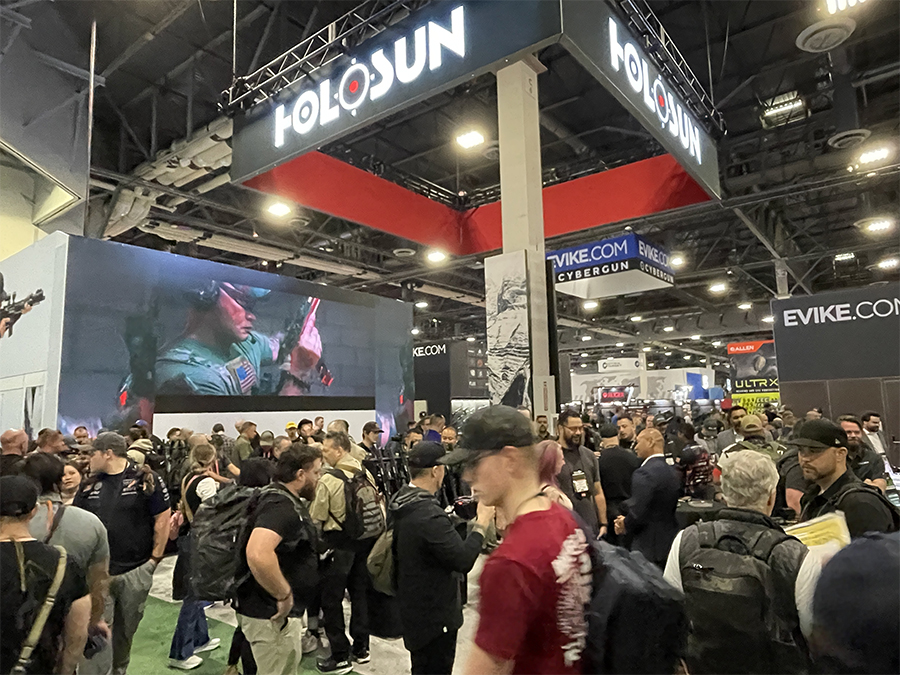
With SHOT Show days away, there’s a considerable amount of interest regarding anything and everything related to the business. From legislative and regulatory shifts to emerging technologies and changing demographics in the shooting community, everyone’s seeking insight.
The goal is simple: make buying decisions at SHOT more factually based and less, to use a Vegas term, a crap shoot.
This week, the National Association of Sporting Goods Wholesalers held another insightful industry leadership roundtables. This one addressed questions most on the minds of manufacturers, distributors, and retailers.
Joining NASGW President Kenyon Gleason were Ruger President and CEO Todd Seifert, Mark Emonet, President and CEO of Lipsey’s and Phillip Milks, the Senior VP of Regulatory Services at Orchid Advisors. Orchid’s co-founder and CEO Jon Rydberg moderated the discussion.
The trio covered the waterfront for the business of making and selling firearms while staying compliant with everything from the crazy-quilt of state regulations to the myriad of ATF, ITAR/EAR and other national and international alphabet organizations.
The goal was simple, to help provide insight, if not outright clarity, into what channel partners need to prepare for to work efficiently going forward. This is, after all, a time where virtually everything from trade embargoes to changing demographics and AI are impacting the marketplace.
So, where’s 2026 headed?
“My crystal ball’s pretty murky,” said Ruger’s Seyfert, “but we know consumer spending drew back in Q4 of 2025. Where we’re focusing as a manufacturer is how do we give consumers with some discretionary income reasons to spend something in our space.”
“The key to that,” he continued, “is to bring them things they want to buy. That means new products, so we all need to be looking to what energizes them.”
From a distributor viewpoint, Mark Emonet of Lipsey’s was more encouraging. “We’re pretty busy right now,” he explained. “Retailers don’t want to bring in a lot of product in December, but now they’re looking to restock. We’re concentrating on getting retailers more excited about new products.”
“We’ve learned a lot in the past five years,” Emonet continued. “We are still ahead of where we were pre-COVID. But we have to be smart about what we bring in as far as inventory and be cautious not to get heavy in slow-moving products.”
Seyfert agreed. “The more information we share as an industry around signals from consumers, the better we all are,” he said. “I know we’re protective of our information, but we can share information anonymously via organizations like NASGW. The better the information, the better we can get ahead of what consumers want.”
So what about suppressors?
“Most in the industry are aware of the changes in the NFA space,” Orchid legal expert Phil Milks said, “but the ‘One Big Beautiful Bill’ passed last year effectively removed the transfer and making tax on suppressors, AOWs and SBRs. The tax on machine guns remains, and the National Firearms Act of 1934 remains in place. All the paperwork, waiting and delays remains. Thankfully ATF has gotten better, but January 1 sent them a surge of more than 51,000 Form 4s, so they’re seeing increased demand on processing. We expect that to go forward in the first quarter.”
“We’re seeing more players in the space and an uptick in suppressors,” says Emonet, “so we’re aware that our people are going to need to know more about suppressors.”
“The demand’s there,” Seyfert said. “There was a surge in Q4 and we expect, honestly, a bit of a Wild West scenario early on in ’26. Our goal at Ruger is to make certain that the consumer has the threaded barrels and suppressors to meet the demand.”
And the push to repeal the NFA? “Always the pessimist, never the optimist,” said Milks. “I’m not very optimistic about that happening. The majorities in Congress are so razor-thin that I’m not thinking it will happen.”
The panel also touched on mergers and acquisitions. Consolidation, it seems, is always a concern.
“My view of M&A in 2026,” says Seyfert, “is that selling would be tough for companies that aren’t in trouble or where owners don’t just want out. Earnings were suppressed in the last couple of years, so the multiples aren’t what they would have been two years ago based on earnings.”
“We did one acquisition last year,” he continued, “but I don’t see many consolidations because of those reduced multiples in ’26.”
“I don’t see any consolidation,” Emonet said.” There may be some distributors who just close up. We’ll just absorb their market share, but I want manufacturers to help keep everyone going.”
What about retailers and margin protections in a growing online marketplace?
“If we, the manufacturers, do our job,’ Seyfert said, “offer dealers innovative products and give consumers a reason to buy something that’s not on the lower demand tier, it helps everyone in the process.”
“Innovation and consumer demand,” summarized Rydberg,” drives the bus.”
New consumers, according to Emonet, are where there are new opportunities, especially for ranges. “Ranges are drawing people in. The new customer wants to go and shoot what they buy.”
And what about California after their new laws went into effect? A nightmare that began with requirements making selling accessories into California difficult enough to essentially be impossible. From shipping and delivery requirements, California has created enough new rules and restrictions to make risk assessment virtually impossible. And tougher rules will make it even more difficult going into effect next July.
This one’s far more complicated than anyone can address at this point. As always, nebulous standards and deliberately vague descriptions are written into the new legislation, essentially to remove the protections of the Protection in Lawful Commerce in Firearms Act from virtually any questionable transaction. Liability wouldn’t just extend to the seller, but would cover distributors in any drop-ship situation as well.
In other words, California has essentially stopped anything other than face-to-face sales there. We’ll do more on the California laws in the months ahead.
So what’s going to “drive the bus” in 2026? The short answer is innovation. And that sets the stage for interesting new products in Las Vegas.
We’ll keep you posted.
Speaking of the state of the 2A business, there’s a for-real Trans SOT-FFL named Caylee Pendergrass who has announced her (his?) intention to manufacture and sell a modular, fully-serviceable Titanium .22lr suppressor she-(he) calls the ‘Peas-n-Quiet. See it here :
https://www.youtube.com/watch?v=rPvqPykYk4Q
Caylee claims the price will be $200. I wish Caylee all the luck in getting her-(his?) CNC suppressor factory running at full blast, because at that price the orders will be flooding in.
Oh, I also hope to see LKB’s prediction of a fifty-dollar disposable .22lr can come to fruition, as well…
Where did my comment go???