


IWA isn’t the only event being held this week in Nuremberg. The Plenary Session of the World Forum on Shooting Activities began the week’s events with a session that covered everything from the EU’s proposed lead ban to an overview on the Olympic shooting sports at the Los Angeles 2028 games.
European rules and regulations regarding everything from pocket knives to pneumatic rifles are a dizzying array of contradictions. Walking around Nuremberg earlier this week, I saw people wearing belt knives in areas where the circle-slash signs clearly banned firearms, knives, canes, cudgels and just about anything else perceived to be potentially dangerous. The German police, equipped with pistols and PDWs, didn’t seem to be bothered much by the blatant violations of the bans.
The explanations of the rules for the shooting sports in Europe and the LA 2028 games didn’t do much to clear up any confusion as to what might be permitted or verboten. If you don’t already understand the myriad Olympic rules, a gathering of people intimately familiar with them won’t do much to provide any real clarity.
But our real reason for attending the Plenary Session wasn’t to try to wade through the rules and regulations or listen to the panel discussions about them. Coming to Nuremberg early for IWA gave the Wires an opportunity to join in recognition of the recipients of the 2026 Vito Genco Shooting Ambassador Award.

This year, Franco Gussalli Beretta and Pietro Gussalli Beretta were the recipients. It seems appropriate to recognize the Berettas and Fabbrica d’Armi Pietro Beretta as this is the company’s 500th anniversary. It may be difficult for most of us to imagine any company that’s been around 500 years. In those five centuries, weapons have evolved from swords to today’s high-tech firearms and accessories. It’s actually pretty mind-blowing.
But Beretta has consistently remained in business, producing products through all 500 years from their headquarters in Gardone Val Trompia, Brescia, Italy. During major conflicts like WWI and WWII, manufacturing relocated from their factories to caves in the mountains.

When visiting the otherwise peaceful town, there’s not much doubt the residents are proud of their oldest business. And the feeling is mutual. During his remarks, Beretta thanked the WFSA on behalf of the “Beretta…the family, our workers, and our company.”
While we’re familiar with the ongoing arguments regarding lead in ammunition and fishing tackle in the United States, there’s a pitched battle going on right now to head off EU efforts to essentially regulate lead out of ammo and, by extension, the shooting sports. That would put many firearms and ammunition companies essentially out of business.
It’s yet another familiar battle for Tony Bernardo, the new WFSA president and executive director of the Canadian Shooting Sports Association. “For the past 30 years,” Bernardo told attendees, “our opponents have tried to destroy us. We’ve worked together- despite being all around the world- to protect our interests.”
“But,” he cautioned, “our rights to firearms hangs by a thread all over the world. You can’t take firearms and divide them in to categories of acceptable and unacceptable. We have to keep working together to preserve all our collective rights.”
A new tool is being added to the kit in order to help with that defense. Attendees were briefed on a database designed to document the businesses challenges faced by companies today.
According to a worldwide survey of 115 companies across 33 countries and five continents, more than 70% of respondents said they had experienced suppliers refusing service or closing accounts based on “ESG and reputational risk policies,” not the legality of the industry’s products. Further, 45% documented transit delays or disruptions with shipments impounded or returned at the border without warning. Even more telling, 47% documented accounts being closed and platforms being restricted based solely on a single word: firearm.
The new documentation tool is designed to quantify the illegal policies and provide companies with the ability to fight back using fact-based narrative to counteract the anti-gun rhetoric and practices. The creation of this International Regulatory Comparison allows companies to create bias and stability scores for “bias potential, policy stability and enforcement.”
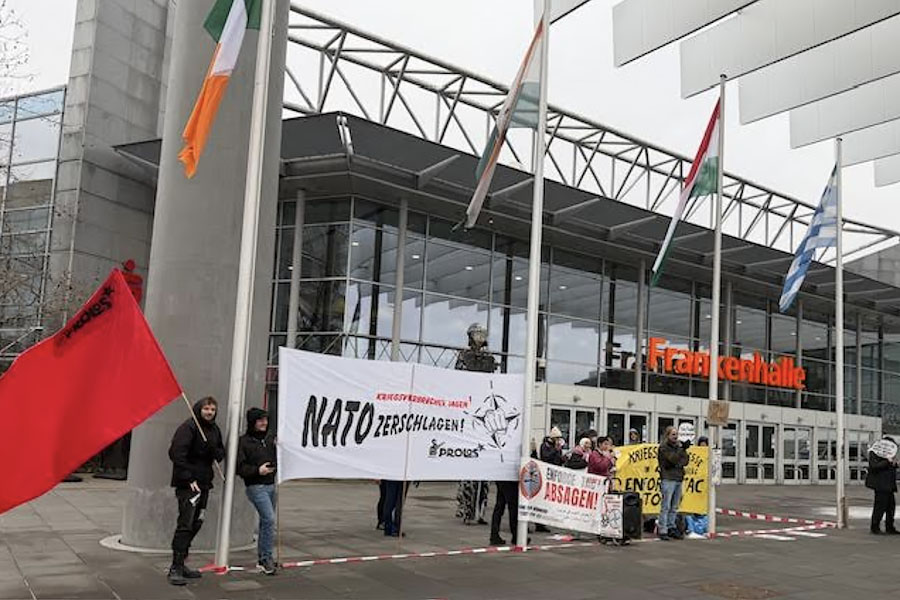
The fact that some groups want guns banned entirely was brought home as we headed back to our hotel. Outside the exhibit hall, a small crowd of protesters were demonstrating – loudly – against NATO, gun companies and the Enforce Tac exhibitions that will be featured prominently when IWA kicks off tomorrow.
As always, we’ll keep you posted.
“Even more telling, 47% documented accounts being closed and platforms being restricted based solely on a single word: firearm.”
Rename them to PAD (Projectile Assistance Device) instead of ‘gun’ and ‘firearm’
Instead of ‘firearm’ use ‘Projectile Assistance Device’ (PAD)
Instead of ‘gun’ use ‘PAD’
or maybe ‘PADarms’ in place of ‘firearms’ or ‘PADarm’ in place of ‘firearm’
Instead of ‘shoot’ or shooting’ or ‘shot’ use ‘Projectile Assistance’ or ‘Projectile Assisted’ (or just ‘PA’) [for example, “…and the bad guy was PA’d.” or “I PA’d a deer.”]
Think of it this way… we could have web sites with names like (instead of ‘shooting news weekly’) ‘Projectile Assistance Weekly’ or (instead of ‘The Truth About Guns’) ‘The Truth About PADs’
😁
It would drive the anti-gunners nuts.