


For those who have been living in a cave for the last few years, there’s a nationwide debate and some serious controversy regarding the SIG SAUER P320 and whether or not even holstered pistols can and do go off in an “uncommanded” fashion.
The truth is that I never heard the term “uncommanded discharge” used until P320 pistols became the center of attention for making loud noises when the owner didn’t want or expect them to. To be completely up front, I have tested, used, and carried SIG products for at least 25 years or so. I proudly own a P226 9mm that was made in West Germany and that gun is still a tremendously accurate and reliable firearm.
I have trained at the SIG Academy several times, though admittedly not in the last decade. When the P250 SIG pistols came out, I ran thousands of rounds through two different pistols and I really liked that gun. I know…all of this sounds like there is a big BUT coming. I will instead simply use the term ‘nonetheless’ or ‘however’….
What Happened to the P250?
For those of you who are just now paying attention to this huge kerfuffle, you might now even know that there was a SIG P250. Introduced in November 2007 and highlighted at SHOT Show 2008, the P250 was SIG’s first mass produced handgun with a removable fire control unit. The P250 “2Sum” combo package came with a full-sized pistol slide/frame set and a compact pistol slide/frame set along with corresponding magazines, and one FCU. The end user could easily swap the FCU between the full-sized and compact setups.
During the early 2000’s, SIG worked hard on the double action only trigger that they called the DAK. I used guns with these triggers and they were good, but not great. The standard DA/SA, such as found on the P226 was superior, in my opinion, but the guns were perfectly serviceable and reliable.

The P250’s FCU was a DAO design, but folks, it was one of the best DAO triggers that I had ever encountered. The P250 was hammer-fired — not striker-fired — and it had a built-in firing pin block. No external safety levers or de-cocking levers were used.
As I said, over a period of a couple years, starting in 2007, I ran thousands of rounds through two sets of P250 pistols. Keeping with the SIG tradition — at the time — of “hell and back reliability” I found no flaws in the P250 design. The trigger, despite being DAO, was smooth and the guns were tremendously accurate as was the standard for SIG handguns at the time.
The end user could also change the magazine release button in the P250 from right hand configuration to left hand on their own kitchen table or workbench. The pistols had an accessory rail and could be easily disassembled for maintenance and cleaning. In short, it was a great gun. So what happened?
The American Trigger Obsession
Going back to the old days when GLOCK pistols were new, people — primarily 1911 shooters — made snide comments about trigger feel and design. Yes, polymer-framed, striker-fired handguns are “assembled” from bins of parts. They aren’t “built” by master gunsmiths. When the trigger components on a G17, for instance, are put together, there isn’t a trained gunsmith with a jeweler’s cloth and set of files meticulously fitting all the parts together.

The original GLOCK triggers were a bit rough or stiff when you took them out of their black tactical Tupperware boxes, but you know what? The more you fired them, the better the trigger began to feel. The trigger parts and firing components meshed together and smoothed out with use.
But there was the problem. You had to actually train and practice with your guns. You had to shoot them, not just talk about them.
When I first encountered the Smith & Wesson M&P9, the striker-fired trigger was aptly described as “mushy” with no real discernible reset. Guess what? After 500 to 1000 rounds, the M&P trigger broke in nicely and a crisp reset could be felt. The trigger broke in and worked just fine.
Ah, but Americans, being Americans, wanted a quick fix. The aftermarket trigger business exploded with “matchgrade” “drop-in” triggers that promised to “fix” the “problem” with factory triggers. This wasn’t rally all that new. Americans have been screwing with and screwing up M1911A1 triggers on their workbenches since I was in short pants.
Rather than take their newly acquired pistol to a training class and learn how to really run it, Americans instead attempted to purchase their way around a well-trained trigger finger…by buying new triggers. They told themselves, “This gun would be more accurate if it had a new trigger.” Bullsh*t.

People who talk about guns, as opposed to people who shoot guns, convinced themselves that the trigger safeties, found on 99 percent of striker-fired pistols, negatively affected their “accuracy” or the trigger press.
But what about the older DA/SA guns, the ones with a longer, heavier DA pull for the first shot and a shorter, lighter SA pull for successive shots? Again, rather than taking the time to master the tool, Americans tried to shortcut the process and buy their way around training and practice. Were some of the DA/SA guns tough to master at first? Sure. But it wasn’t impossible, it just required effort.
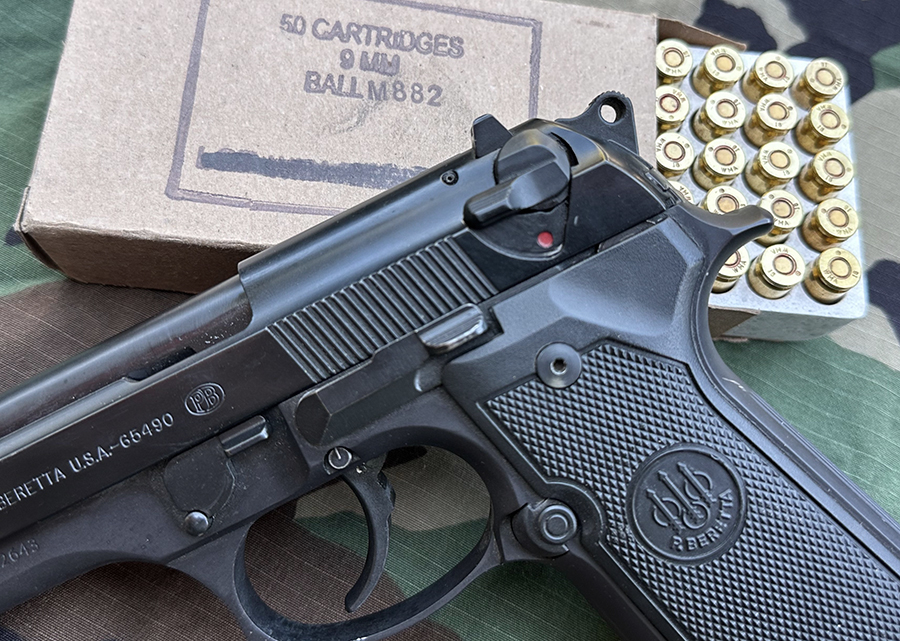
During the era of the M9 Beretta service pistol, my training command put through thousands and thousands of military students who were “handicapped” by the heavy DA trigger pull of the M9. You know what? In every class we had, some shooters fired “Expert” with the M9 and only rarely did any of the students fail. I have a friend, one who I see in the mirror every time I shave, who broke the range record using a stock M9 that he drew from the armory that morning.
The Lack of a Doober
Polymer-framed, striker-fired pistols in our modern era are no longer rare, they’re the rule. Every major gun maker has one, if not several models in their catalog. That being the case, how is it that the striker-fired P320 is getting all this heat for “uncommanded discharges” when GLOCK, FN, Smith & Wesson, Beretta, H&K, and the other striker-fired guns aren’t? The answer might be simple. The SIG P320 does not have the “trigger doober” that all the other guns have.

Why is that? Great question. I was reading an article today about the P320 and how the lack of a trigger safety, the blade doober, contributed to a more smooth, precise and pleasing trigger press. Did SIG, in an effort to address the American obsession with the trigger pull, leave out that part in order to please people who talk about guns but don’t have the time or inclination to shoot them to the point of mastery?
It’s not just the American shooting consumer who constantly tries to purchase their way around training. That malady is rampant in both law enforcement and the US military. You see, training cops and soldiers requires purposeful and dedicated time and effort. Money has to be spent for training hours and ammunition.
Was the P250 supplanted by the P320 because the DAO/hammer-fired trigger wasn’t “good enough”? Did SIG fall into the trap trying to make such a good trigger that the reliability and redundant safety, provided by the blade doober, became an afterthought?
Could the addition of a doober fix all the issues that the P320 has allegedly had with uncommanded discharges?
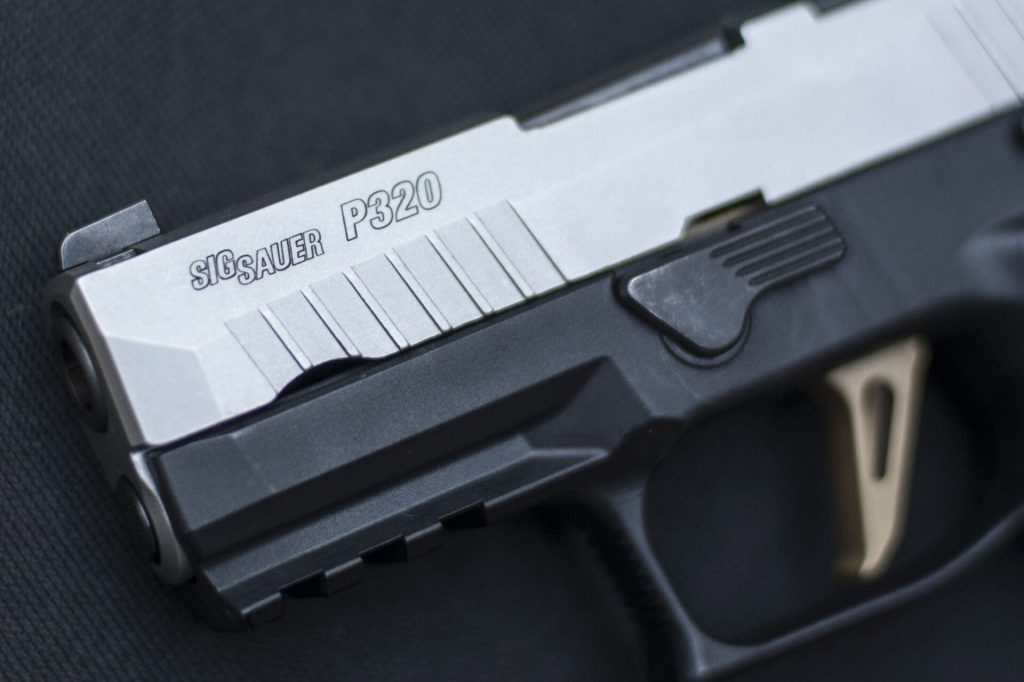
If that’s the solution, it might be as easy as pushing a camel through the eye of a needle. That would require a redesign, a massive recall and an admission that the P320 FCU wasn’t a perfect design. Are the folks in New Hampshire willing to go down that road and incur that expense? Only time will tell.
Regardless, as long as stock P320 pistols remain out there, it’s highly unlikely that the issue of the “holster bang” is going to go away. Love SIG or hate them, the American trigger obsession could be largely to blame for what is going to be an ugly and expensive future for SIG SAUER.
Paul G. Markel is the founder of Student the Gun University and has been teaching Small Arms & Tactics to military personnel, police officers, and citizens for over three decades. He is the author of numerous books and is a combat decorated United States Marine veteran.
Set up: I spent 13 yrs as an expert witness for Florida DOH. Those state lawyers really educated me as to what is an accident , and what is negligence (or malpractice in the health field).
I’m also an NRA instructor & RSO.
I am not a FUDD, not even close; more of a 2A absolutist.
So this:
“uncommanded discharge”
First off I think that term is a made up, Orwellian BS term to deflect responsibility.
Most firearms accidents are NDs, not accidents.
And yes, I have two NDs in my rear view mirror. Thusly, “I am learnt!” It steeled me to believe that safety is a journey, never a destination.
The moment you think, “I’m safe. I know what I’m doing.”, thats when the fecal matter hits the whirling blades.
No assumptions!
One is none, two is one; check, then double check.
Remember decades ago the Remington 700 series rifle that were “just going off”?
Turns out it was a very mixed bag. 1- Peeps were storing them loaded, 2- some rifles did discharge when knocked over.
None could be proven to “just go off”.
I have a Gen1 320 X5 w/ thousands of rounds fired; no issues. Also have an early P320 Legion; maybe 1000 fired.
I will be keeping both.
“The moment you think, “I’m safe. I know what I’m doing.”, thats when the fecal matter hits the whirling blades.”
That’s literally what kills the most pilots in the 100-200 total time in hours range…
Buying gear whatever it is.
Will never replace training. Spend you money to pay for a class. Instead of an optic or a mounted flashlight.
Buying more gear is not paying for an increase in skill level.
Besides the recoil forces can actually loosen this equipment. And it will eventually fall off your gun. Or just stop working.
Wrong question.
The right question is whether SIG may have missed the boat in not doing a major redesign for their “voluntary upgrade” of first generation P320’s. Instead, they just reduced the mass of the trigger.
The correct question is:
Why did the “gun community” go along and accept Sig Sauer only issuing a voluntary recall, for a gun that was proven to not be drop safe?
This reminds me of the many people making excuses for Remington. The so-called “gun experts.”
Another question.
Will Sig Sauer still be in business in the next two years?
And will the company be sold?
“Why did the “gun community” go along and accept Sig Sauer only issuing a voluntary recall, for a gun that was proven to not be drop safe?”
“Drop Safe” is a fraught expression, like foolproof. No thing is ever truly drop safe or foolproof. You can always drop from a greater height, and impact at an even less likely contact angle, to achieve a drop test ‘failure’. But what height, and what angle, represents the worst possible condition to be expected in the field? Dropping from a plane or helicopter at altitude? Contacting on the trigger?
The P.320 33° drop test discharge only occurred at a specific angle, when fitted with triggers beyond a certain mass. It even passed California standards, as introduced.
Was a recall necessary? This would be a value judgement. Note here that most automobile recalls are wildly undersubscribed. On average, about 69% of passenger vehicles ordered recalled are repaired during the three year period following the ‘madatory’ recall. So how is a voluntary recall to be distinguished from a standard or mandatory recall?
Great article.
Seem to recall Ruger brought out the SR9 minus a “doober” (love that word).
Before they got going good – they had a recall. I think this stymied the SR9s momentum. It really is a nice gun.
But the “doober” or “dingus” is needed for drop safety.
Since the bulk of striker-fired guns are mostly cocked, the trigger can complete its travel rearward if pistol is dropped on its butt.
The “doober” (being spring-loaded)prevents the trigger from heading home if it lands butt-down.
Maybe Sig figured out how to alter physics. I do remember seeing LOTS of videos of Sig firing when rapped with a mallet.
Looks like that will continue to haunt Sig for a while.
After adding that, they still made some incremental changes to the SR9 over the years, I got one of the later ones. It’s a great gun.
MASSIVE BREAKING NEWS: NEW TRUMP EXECUTIVE ORDER ENDS ANTI-GUN $$$ EFFORTS
President Trump has signed an executive order attempting to end the practice of debanking businesses such as gun companies. Mark Smith Four Boxes Diner discusses.
https://www.youtube.com/watch?v=Fsu3t96hZfY
Stop off-topic spamming, a-hole…
Aside from the whiff of “elitism” – not everyone has the means or resources to train at the level implied – but that’s neither here nor there as far as the main point of this article. Sig may very well have brought a gun to market that’s not as good as it could’ve been in order to accommodate what customers felt they wanted.
And they wouldn’t be the first company to do so – GM built a revolutionary (for Detroit) compact car that some may have heard of called the Corvair, air-cooled, rear mounted engine, independent suspension, superb space utilization, economical, good performance considering the relatively modest horsepower. But they knew how much American drivers valued ride softness over handling so rather than provide the Corvair with a sufficiently firm suspension to keep driver’s out of trouble they built the Corvair with fairly soft springs and depended on lower than typical for American car front tire pressure to ‘fix’ the oversteer issue. So then American drivers proceeded to put their shiny new cars of the future into spins after setting the tires to the “standard” 32PSI. We were subjected to decades of Ralph Nader’s sneering face after he made himself famous over the supposed Unsafe at Any Speed Corvair. And GM redesigned the Corvair from simple swing axles to true IRS and added a front anti-sway bar but the damage was done. Guess Sig should have done to industrial archeology along with market studies before deleting the doober.
I’m old enough to have qualified with two of the USAF’s recent handguns – the lovely S&W M15 .38Spcl revolver and the Beretta M9 and in neither case did the DA trigger pull cause much consternation. At the time I fired the S&W at the range I’d never even handled a SA pistol of any kind so outside of thumb-cocking the .38 (or my old H&R .22) DA triggers were what I considered “normal”. Shooting the M9 was quite the eye opener for me – all those rounds right there in the gun! My first shots tended to be a bit of a flyer but close enough, the transition to SA did make hitting the sweet spot on the target easier. And even though I have smallish hands I rather liked the M9 though it is a hefty critter that needs a good holster setup to carry around. Ironically, by the time I needed to actually use an M9, my mobility position no longer required that qualification so I ended up carrying a rifle on that deployment when a pistol would’ve made the job much easier to do.
No. Ron Cohen ruined it by deciding to take a “premium” brand and chasing minimum viable product without altering price. Exactly the same way he ruined Kimber.
“chasing minimum viable product without altering price“
Welcome to capitalism!