

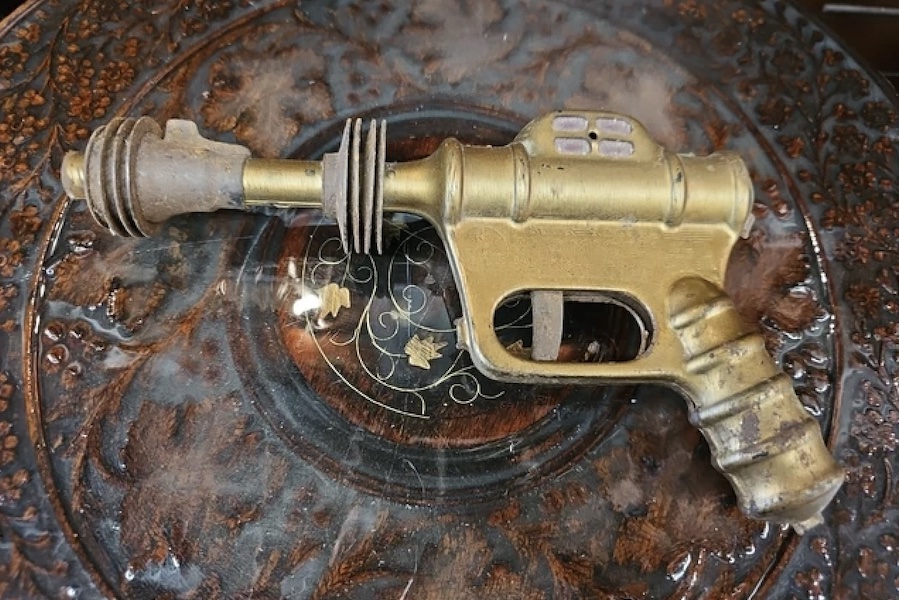
What about the main technical problem with firing a gun in self-defense: guns are hard to shoot.
The common answer is that if you find a gun hard to shoot, it’s because you haven’t trained enough. You need to go to the range, learn proper grip and trigger control, learn to use a red dot, learn good presentation, manage recoil better, etc. And that’s all true. Once you do all that, it’s pretty easy to shoot well. But that’s the point. “This is easy if only <unrealistic condition that most people will never satisfy” means the thing is not easy. Most people are never going to put in that much training time, so guns are going to stay mysterious for most people.
Most gun training only exists because we have to cope with the fact that it’s hard to learn to shoot well. That’s not a people problem or a discipline problem, it’s a technology problem. This isn’t to say trainers aren’t essential. Trainers are doing life-saving work, because guns will always be an essential tool when all else fails, and it’s important for people to know how to use them. But the ceiling on the population size of that well-trained cadre is always going to be pretty low. That’s just the nature of expertise. In every subject, there will always be more laypeople than experts. There will always be more people who can start a Tesla than a Model T.
Guns are necessary, but while we iterate on the Model T and make it better, we should also be pushing the industry forward and trying to invent Teslas. That’s the only way that self-defense will truly go mainstream.
Suppressors are a good early example. They’re basically magic. Less noise, less recoil, less flash, zero downsides ballistically. Other than some increased dirtiness (which is being innovated away in newer designs), they’re a strict improvement over unsuppressed guns.
We want to see more along the same lines. Strict improvements. Fire-by-wire, better sighting systems, civilian defensive drones. Battery tech has been going crazy the past few years. Mid-tier drones have an energy density around 150 watt-hours per kilogram. The DJI Mavic 4 Pro, at the top end of consumer drones, has an energy density (including the battery management system, housing, wiring, etc.) around 287 watt-hours per kilogram.
Consider an electromagnetic gun with a 1.5 kilogram battery pack that has an energy density of 225 watt-hours per kilogram. That’s 1,215,000 joules in the battery pack, which is the equivalent to the muzzle energy of ~700 rounds of 5.56x45mm. There are going to be some internal losses, so assume only 25% of the battery energy is converted to kinetic energy of the projectiles. (For comparison, 70-90% of the battery energy in an electric vehicle is converted to kinetic energy.)
-
- Electromagnetic gun shooting 175 rounds equivalent to 5.56x45mm
- Weight of battery pack: 1.5 kg (enough for a theoretical 700 rounds, but we’re assuming 75% of the energy is lost in the operation of the gun)
- Weight of projectiles: 55 grains x 175 rounds = 0.62 kg
- Total weight of energy + projectiles = 2.12 kg or 4.66 lbs
- AR-15 shooting 175 rounds of 5.56x45mm
- Weight of battery pack: 0
- Weight of cartridges: 176 grains x 175 rounds = 2 kg
- Total weight of energy + projectiles = 2 kg or 4.4 lbs
- Electromagnetic gun shooting 175 rounds equivalent to 5.56x45mm
— Open Source Defense in Guns suck
Debunking Gavin Newsom Lies About Guns On Shawn Ryan’s Podcast.
(Colion) : “…Gavin claims he “respects” the Second Amendment, but everything he says and does tells a different story.
In this video, I break down Newsom’s comments line by line—and expose how he spins stats, manipulates language, and hides behind emotional buzzwords to push gun control while pretending to be pro-2A.
From misleading homicide data, to cherry-picked polling, to his shady history trying to ban handguns outright, Gavin plays the game like a pro politician—but I’m not letting it slide. We dig into real crime numbers, real context, and real lies.
If you care about the Second Amendment and the truth, watch this video all the way through. Then share it with someone who still believes “common sense gun safety” means safety. …”
https://www.youtube.com/watch?v=DP2pZDealxk
I’ve trained plenary of kids and newbs in shooting.
It is not hard to shoot well.
Most people have more difficulty shooting rounds with heavier recoil and muzzle blast.
Stay with what can be controlled and all is good.
This is why we see the increased popularity of 22 LR, 22 Mag, 32 Long, 32 Mag, and 32 ACP. Less recoil – less to manage to shoot well.
Are they more effective for defense? only in that they are easier to hit with.
If you translate that to larger, more effective calibers – just make them big and heavy. 357 in an X frame S&W would probably recoil like a 22.
But the weight would make it tough to carry for many. Just as adding a suppressor increases length. So maybe a wash.
There is a lot to be said for a relatively light handgun in a mid bore caliber. That’s why we ended up with 38 special and 9mm.
Most people can’t shoot because the buy a Glock and are intimidated by muzzle blast and the recoil that keep them from getting pinpoint hits like call of duty.
Maybe if people started with a 22 and learned trigger control and sight management – moving to a heavier caliber would be easier.
“It is not hard to shoot well. ”
You are correct, its not hard to shoot well.
But ‘shooting well’ and “firing a gun in self-defense” under stress response are not the same thing 99.9% of the time. Contrary to Hollywood movies and range-heros and ‘tacticool looking guys in youtube videos’ – for most, even the most well trained a lot of times, “firing a gun in self-defense” under stress response, no matter how well they shoot, is not smooth-cool-looking ‘John Wick easy’ personified as it can look on the range.
Ehhhh. Cars are easy to drive, because we’re used to them and operate them every day. But when you first learned (trained) on how to operate a car, was it easy?
I really wanted to stop reading this ..but found the extremely high evel of stupidity, oddly entertaining.
Sounds good for a single pulse. Seems it is the obtaining of 20 – 30 pulses in interval of less than one second that is the barrier.