

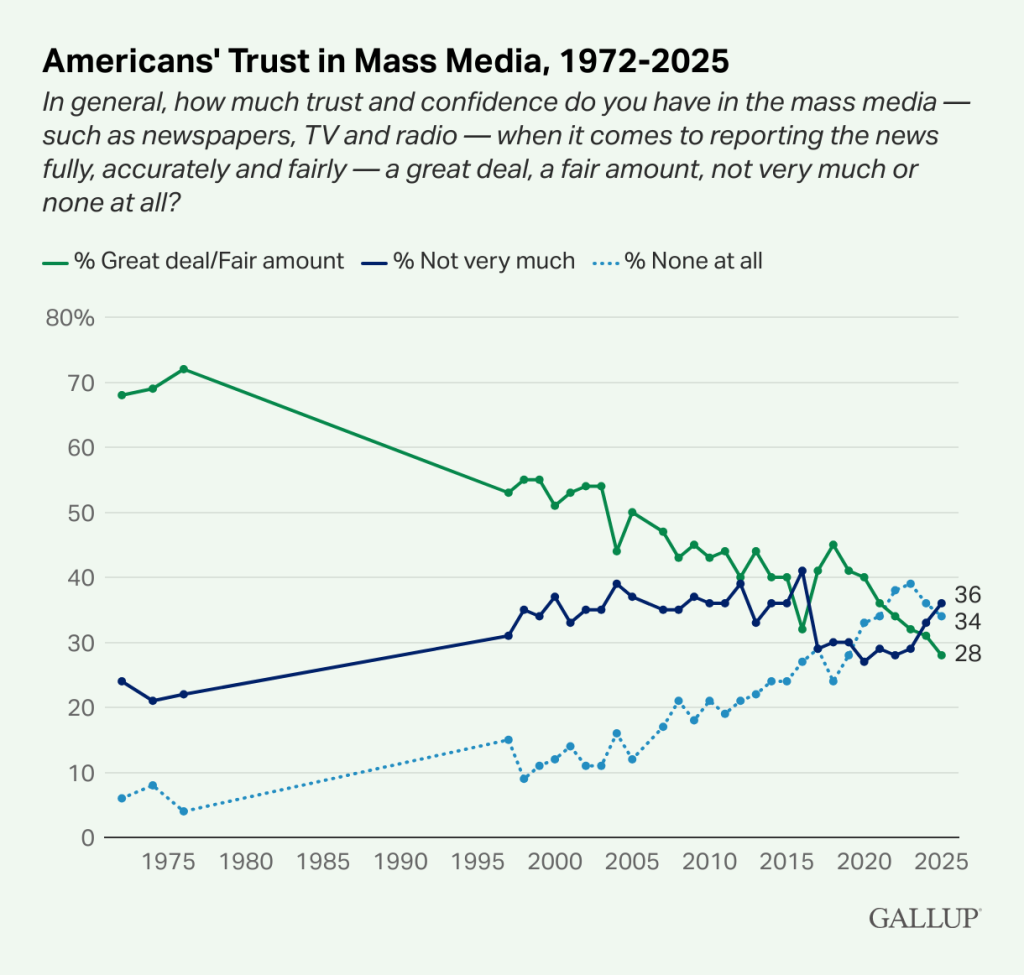
A few weeks ago, an alert discussed the Gallup organization’s polling that tracks historic changes in the public’s perception of mass media (newspapers, TV, and radio). Since 1972, Gallup has been asking Americans about their “trust and confidence” in mass media and how it reports the news. Its most recent polling revealed that overall trust and confidence in mass media has fallen to a new low, as only 28% of respondents felt a “great deal” or “fair amount” of trust in mass media to report the news fully, accurately and fairly. The vast majority of respondents (70%) said they had either “not very much” confidence or “none at all.”
Gallup’s survey didn’t include anyone under the age of 18, but a new study on those aged 13 to 18 years old indicates that today’s teens may be the most brutally — and deservedly — distrustful of all when it comes to the press.
The study, “Biased,”“Boring” and “Bad”, was published last month by the News Literacy Project, a “nonpartisan education nonprofit that works with teachers, school districts, states and community partners” to ensure that students receive news literacy instruction by the time they graduate from high school.
The study’s title pretty much says it all. The teens surveyed about their views of journalists and news organizations were even more distrustful than what the Gallup polling revealed of their elders. Asked for a word that best describes today’s news media, 84% responded with negatives like “biased,” “fake,” “sucks,” “crazy,” “false,” “scary,” and just “bad.” Only 9% responded using a positive word.
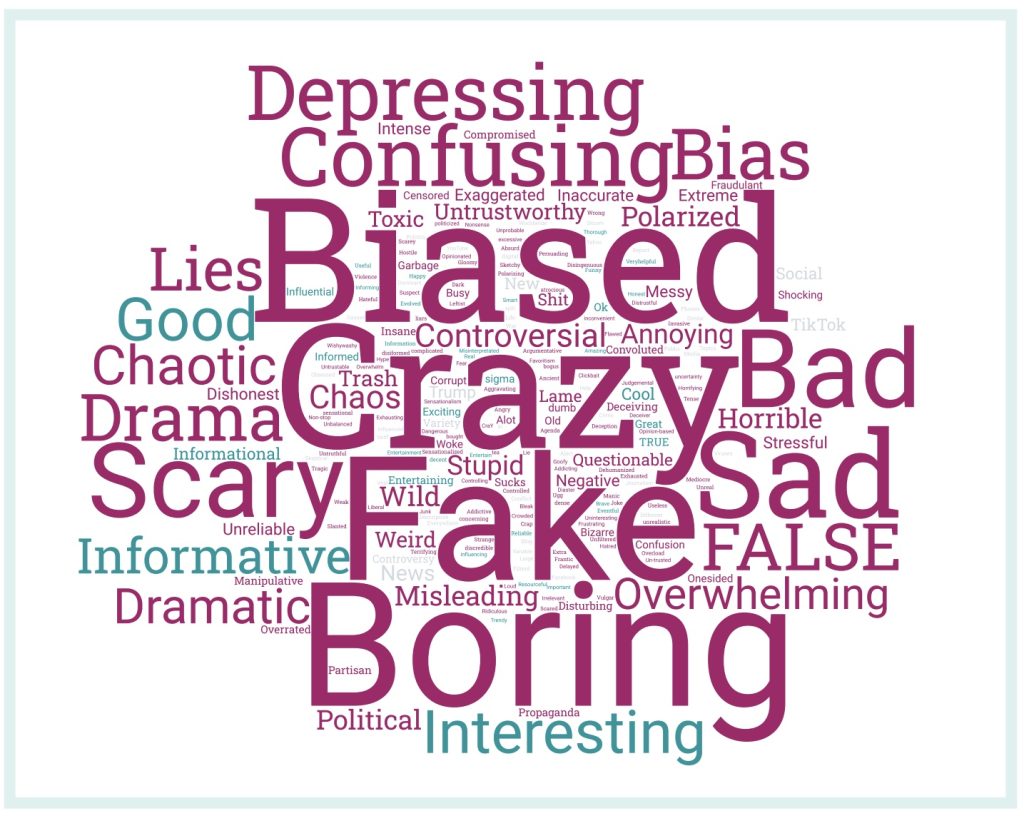
When asked what journalists do well, more than a third of the responses likewise focused on the negative, with answers like “telling lies,” “reporting fake news,” “overexaggerating,” “spreading misinformation” and “gaslighting.”
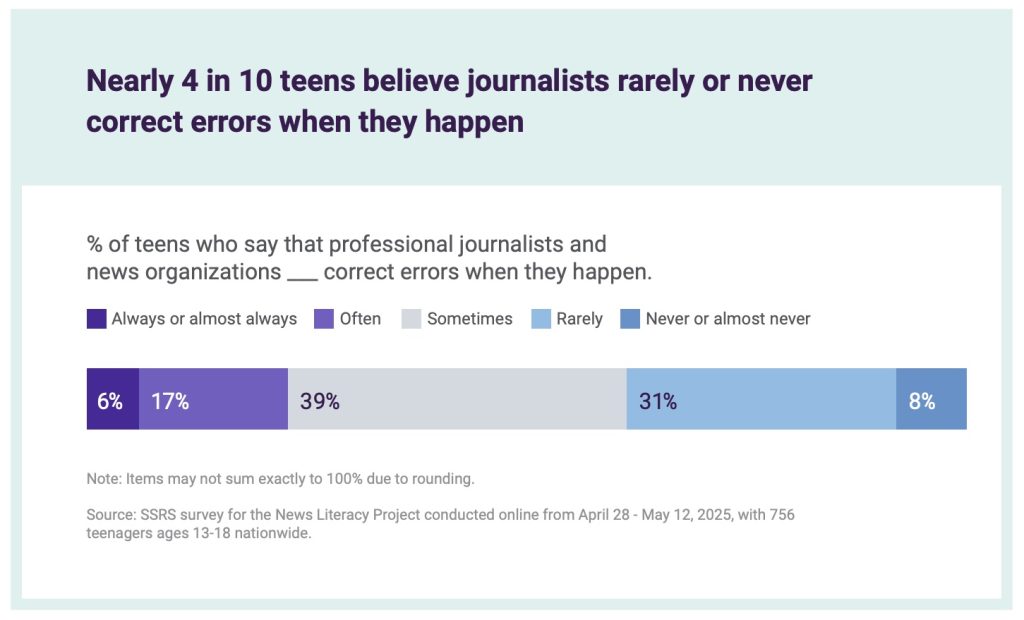
Most teens, the study found, “do not believe that standards-based journalism practices are the norm these days.” Only 30% of the adolescents thought journalists confirmed facts before reporting them; fully half believed that members of the press made up details, like quotes, for their stories. Only six percent responded that journalists “always or almost always” corrected errors when they occurred in their reporting, and six in 10 believe journalists frequently take photos and videos out of context.
Particularly revealing were the responses about “watchdog reporting” – investigative reporting to expose wrongdoing by powerful people and organizations. The percentage of teens who felt professional journalists and news organizations always/almost always or often cover such stories that help protect the public’s interests was just 30%.
The study speculates that one factor for this “shockingly bleak” perspective could be that teens lack “news literacy,” with social media sources – even those that offer opinions or gossip – now being viewed as journalism by adolescents.
Another, more plausible, reason could be that they are more savvier than earlier generations at spotting bias and other problems with what passes as “hard” news (what the study calls journalism that “presents all relevant facts, context and information available at the time in as impartial or unbiased a manner as possible”), because gate-kept news is no longer dominant.
The coverage leading up to the 2024 election, for example, demonstrated how mainstream media by and large perpetuated or failed to challenge the narrative that then-President Joe Biden was cognitively unimpaired, even as voters plainly saw increasing signs of “gaffes” and disorientation. One notorious example of this press pitch-hitting was in March 2024, when Joe Scarborough, the longtime host of MSNBC’s news program Morning Joe, responded to the report of former Special Counsel Robert Hur (that Biden showed significant memory lapses and retention issues) with an excessive and emphatic denial:
As I’ve said here on the show over the past couple of weeks, I’ve spent a good bit of time with Joe Biden … But I undersold him when I said he was cogent. He’s far beyond cogent. In fact, I think he’s better than he’s ever been: intellectually, analytically… Start your tape right now because I’m about to tell you the truth, and eff you if you can’t handle the truth. This version of Biden, intellectually, analytically, is the best Biden ever. Not a close second, and I’ve known him for years… If it weren’t the truth, I wouldn’t say it.
It wasn’t until more than a year later, by which time Biden’s cognitive issues had cost him his place as the Democratic presidential candidate, that Scarborough admitted this “truth” was wrong.
The same type of slanted reporting appears in most media coverage of guns, responsible gun owners, and the Second Amendment. As our prior alert observed, “mainstream media reporting on firearms is driven by an anti-gun agenda and is rife with political bias, inaccuracy, ignorance, and sensationalism,” and cites several examples. When Charlie Kirk was assassinated with a rifle at long range during a political debate on a college campus, an MSNBC contributor quickly (and baselessly) speculated that Kirk may have been killed by “a supporter shooting their gun off in celebration.’”
The Trace claims to be a team of journalists who “use the power of journalism to improve public understanding, increase accountability, and identify solutions that can lead to safer homes and communities for all Americans,” but it actually functions as the media mouthpiece for Michael Bloomberg and his Everytown gun control entity. The Trace published a piece in October claiming that “support of the NRA is linked to support of political violence” and which begins with the words,”[l]ast month, a gunman opened fire on an Immigration and Customs Enforcement facility in Dallas, killing two people and wounding another, before he fatally shot himself.” The piece, though, offers zero evidence that the Dallas shooter supported the NRA or indeed, had any connection at all to the organization (which remains the case today).
Given the manipulation in the current “information environment,” teenagers’ jaundiced perceptions are less of a misjudgment and more of a predictable and justified reaction to the mainstream media talking down to them (and the American public in general) as if they were gullible morons. Parsing the facts from the modern media’s chaff is a valuable skill for any age, and it certainly doesn’t hurt to start with a dose of distrust.
Why Did Gun Crime DOUBLE After the UK Banned Guns?
(Colion): “A 15-year-old boy in the UK was shot and stabbed to death in broad daylight…
in a country that supposedly “doesn’t have gun violence.”
So I went down the rabbit hole — and what I found completely destroys the fantasy that the UK is some gun-free utopia.
In this video, I break down the viral footage, the BBC reports, the government stats, and the research the gun-control crowd never wants to talk about:
• Gun crime in the UK more than doubled after the 1997 handgun ban
• The Guardian admitted that criminal handgun use went up 40% after they outlawed them
• The BBC itself reported a 14-year-old shooting and stabbing a classmate
• Modern medical care reduces homicides — not violence
• And yes… shootings still happen. They just don’t talk about them.
When you combine under-reported violence, government-controlled media, and criminals who don’t care about bans, you get a country where teens are still being murdered — just with fewer people allowed to defend themselves.
Gun bans don’t stop criminals.
They stop victims from fighting back.”
ht* tps://www.youtube.com/watch?v=j1si6B7sXCg
Don’t Walk, Run! Productions: [Dem] Congresswoman Says ICE Pepper-Sprayed Her Face!! [note: AKA, a democrat politician lied again]
ht* tps://www.youtube.com/watch?v=U88tqq_W94g
DOJ Lawsuits Against Gun Control Policies Especially Protect The Weak.
ht* tps://thefederalist.com/2025/12/08/doj-lawsuits-against-gun-control-policies-especially-protect-the-weak/
Only Thing Democrats Hate More Than America Is You.
ht* tps://townhall.com/columnists/derekhunter/2025/12/09/only-thing-democrats-hate-more-than-america-is-you-n2667569
You remember seeing that comedy routine with the clown car? You know, the one where all these clowns are in a really small car : Truck Driver Found With 23 Illegal Aliens Hidden in His Sleeper Cab.
ht* tps://twitchy.com/brettt/2025/12/08/truck-driver-found-with-23-illegals-hidden-in-his-sleeper-cab-n2422608
I blame 4chan leaking to normie social media. Love to see it.