

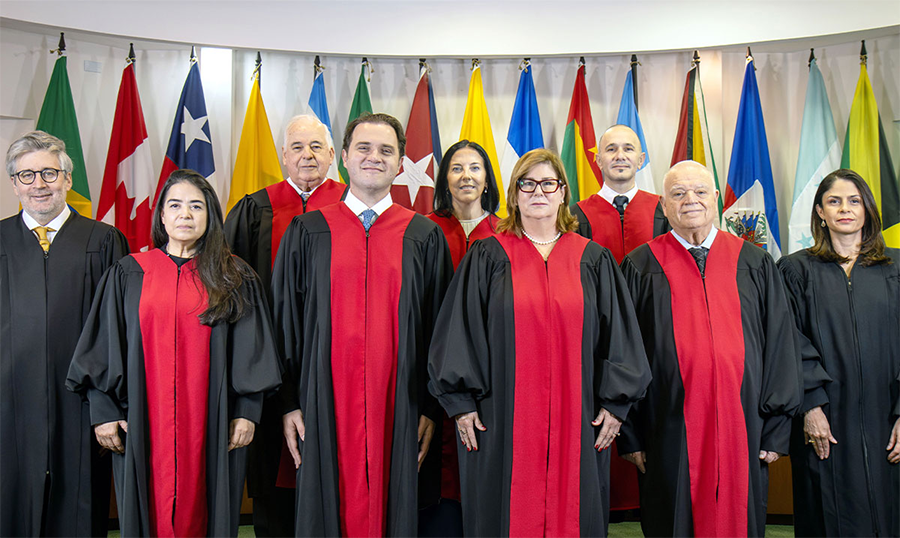
Mexico’s hope to appropriate a human rights court to bolster its chances in frivolous lawsuits against U.S. firearm manufacturers and retailers is disappearing like a vapor in breeze.
The Inter-American Court of Human Rights published an advisory opinion at the request of Mexico’s government. NSSF filed an amicus brief with the IACHR arguing that Mexico was attempting to improperly influence sovereign U.S. courts by co-opting an international human rights court that has no jurisdiction on pending decisions. Predictably, the IACHR leaned into the opinion anyway.
But if this was the boost for which Mexico was searching in its pending lawsuits, authorities there will be disappointed. They got platform shoes, not a platform with which they can walk in when they press their claims.
There are a couple reasons for that. First, U.S. courts are sovereign. Courts in the United States answer to the U.S. Constitution, from which all U.S. law stems. Second, the U.S. Supreme Court already dismissed one of their flagship and erroneous claims that U.S. firearm manufacturers are somehow responsible for the criminal violence and harms caused by narco-terrorists in Mexico. Lastly, there are growing and continuing reports of widespread corruption and arms smuggling within Mexico.
What the IACHR Said
The IACHR wrote in its opinion that companies have an obligation to supervise distribution of firearms to avoid “human rights violations,” but it didn’t name specific companies. In fact, it didn’t list U.S. firearm manufacturers at all. The IACHR also held that governments must guarantee effective judicial remedies for violations of human rights but, despite Mexico’s demand that the IACHR reject laws like the Protection of Lawful Commerce in Arms Act, the IACHR did not even criticize, much less reject, these sensible procedural protections for the firearms industry.
The most egregious portion of the opinion noted that the IACHR takes pains to observe that human rights obligations are “transnational.” That means that companies in one country should be responsible for human rights violations that occur further down the chain. That can’t be interpreted as anything other than a swipe at U.S. companies. However, here again, no companies are named.
The IACHR’s opinion will obviously have no bearing on the U.S. Supreme Court’s decision in Smith & Wesson Brands, Inc., et al. v. Estados Unidos Mexicanos. In that case the Court held that the PLCAA bars Mexico’s claims that firearm manufacturers “aided and abetted” illegal firearms trafficking to narco-terrorist drug cartels in Mexico. NSSF filed an amicus brief supporting U.S. firearm manufacturers in that case. The Supreme Court rejected Mexico’s theory of liability in a 9-0 decision written by Justice Elena Kagan. It explained that the lawsuit is barred by the PLCAA because “Mexico’s complaint does not plausibly allege that the defendant gun manufacturers aided and abetted gun dealers’ unlawful sales of firearms to Mexican traffickers.”
Lawyers for Mexico alleged that U.S. firearm manufacturers sold guns to “rogue gun dealers,” “declined to suitably regulate dealers’ practices” and firearm “design and marketing choices” spurred narco-terrorists to demand those illegally trafficked firearms.
Those theories were resoundingly rejected. The fact is that firearm manufacturing, distribution and sales are highly-regulated by the Bureau of Alcohol, Tobacco, Firearms and Explosives. Every firearm sold at retail is transferred only after a Form 4473 is completed and signed and the transferee approved through the FBI’s National Instant Criminal Background Check System.
And the Supreme Court appears to have already addressed this theory by the IACHR that companies are responsible for the alleged and even criminal misuse of their products to violate human rights. The Court, in its decision, explained that federal aiding-and-abetting law is premised on the centuries-old standard that a person is not responsible for a crime he did not personally commit unless he deliberately “helps another to complete its commission.” In other words, an aider and abettor must “participate in” the crime “as something that he wishes to bring about” and “seek by his action to make it succeed.” More recently, the Court explained in a case brought against social media companies that aiding and abetting claims do not meet this standard if a plaintiff alleges that a company has mere knowledge that “some bad actors” are taking “advantage” of its products for criminal purposes.
Still, it is likely to be used in Mexico’s lawsuit against several firearm retailers in Arizona. That case, Estados Unidos Mexicanos v. Diamondback Shooting Sports, Inc., is pending. Mexico’s President Claudia Sheinbaum, just days after the Supreme Court’s rejection of Mexico’s firearm manufacturers’ lawsuit, said she’s eyeing this case to attempt to force gun control through judicial avenues. Mexico alleges in their complaint that the firearm retailers, “systematically participate in trafficking military-style weapons and ammunition to drug cartels in Mexico by supplying gun traffickers.” It further argues that the firearm retailers “know or should know that their reckless and unlawful business practices — including straw sales, and bulk and repeat sales of military-style weapons — supply dangerous criminals in Mexico and the U.S.”
The 800-Pound Cartel in the Room
None of this addresses the ongoing issues and concerns of rampant corruption by narco-terrorist cartels in Mexico’s government. Just last week, it was reported that Cartel Jalisco New Generation illegally obtained firearms, tactical gear and body armor from Mexico’s Navy. That revelation was revealed by a cartel hitman to authorities in April 2025 that he personally picked up firearms for the drug cartel.
These aren’t passing allegations made by a disaffected and rival cartel. The informant is a protected witness of Mexico’s Attorney General’s Office. The information revealed that firearms and gear were often coming straight from Mexico’s Navy warehouses.
There is example after example of the highest ranks of Mexico’s government being tied closely with narco-terrorist drug cartels. Mexico’s then-President Andrés Manuel López Obrador is credibly accused of taking bribes from narco-terrorist drug cartels for his own election and then using a soft approach toward the cartels. Mexican government corruption was embodied through President Obrador’s “hugs, not bullets” campaign. That effort was labeled a failure by the Council on Foreign Relations.
Mexico’s current president, President Sheinbaum, is President Obrador’s hand-picked successor. Until Mexico’s government takes its own systemic corruption seriously, there is little hope for Mexican citizens.
Data Doesn’t Lie, but Gun Control Advocates Do
Critics pointing to the United States as the source for Mexico’s scourge of narco-terrorist criminal violence do so with skewed data. David Hogg, gun control activist and booted co-vice chair of the Democratic National Committee (DNC), blamed “90% of the guns used by the cartel…” on America. He didn’t get the number from thin air. He got it from former President Barack Obama when he made the erroneous claim in 2009. However, that’s cherry picking the data.
The data comes from a Government Accountability Office (GAO) report that stated, “it is impossible to know how many firearms are illegally smuggled into Mexico in a given year, [but] about 87 percent of firearms seized by Mexican authorities and traced in the last 5 years originated in the United States.”
Seized and traced are the operative words here. Mexico doesn’t submit every firearm it seizes for tracing and not all guns that are seized are traceable. And it does not trace firearms it knows it owned but were stolen from its armories.
The GAO Report recognized that “the eTrace data [used in the report] only represents data from gun trace requests submitted from seizures in Mexico and not all the guns seized,” and “[i]n 2008, of the almost 30,000 firearms that the Mexican Attorney General’s office said were seized, only around 7,200, or approximately a quarter were submitted to ATF for tracing.”
Of the 7,200 guns submitted for tracing, only about 4,000 could be traced by ATF. Of those 4,000 guns, some 3,480 (or 87 percent) were shown to have come from the United States. Those 3,480 guns equal less than half of the 7,000 firearms submitted by the Mexican government to the ATF for tracing, and less than 12 percent of the total firearms seized in Mexico in 2008.
That critical information actually flips the false narrative on its head. Almost 90 percent of the guns seized in Mexico in 2008 were not traced back to the United States.
Further, in April 2024, the ATF released Volume Three of the National Firearms Commerce and Trafficking Assessment. The report focused specifically on 9,700 ATF firearm trafficking investigations over a five-year period between 2017 and 2021.
The ATF’s own report found just 136 cases of illegal firearm trafficking tied to a federal firearms licensee (FFL) over the five-year period — just 1.6 percent of all 9,700 cases. With 134,516 FFLs at the end of 2021, that equates to just 0.1 percent of all FFLs being implicated in allegedly illegal firearm trafficking.
Mexico’s attempt to sway U.S. courts with an opinion from IACHR runs into the problems that, unfortunately, have plagued Mexico. NSSF is sympathetic to the victims in Mexico who have suffered under the criminal violence wrought by narco-terrorist drug cartels. However, until Mexico addresses corruption and crime on their side of the border, this won’t be resolved.
The problem isn’t from U.S. firearm manufacturers or retailers. Mexico must address rampant crime and corruption on their side of the border.
Larry Keane is SVP for Government and Public Affairs, Assistant Secretary and General Counsel of the National Shooting Sports Foundation.
“What the IACHR Said”
Actually though, no one really cares about what the IACHR will say or decide except for the ones that ascribe to it a legal jurisdiction and/or authority it does not actually have as some sort of means to crow about it.
The IACHR does not actually have an actual legal jurisdiction and/or authority. Its decisions need to be accepted by the member states, and ,member states agree to do so by common agreement as signatories but they can also choose not to abide by IACHR decisions with no legal consequences what so ever because they are sovereign states and the IACHR can not override or interfere in that sovereignty and the IACHR does not actually have a legal jurisdiction and/or authority over a sovereign state state. Thus the IACHR does not actually have an actual legal jurisdiction and/or authority, and its decisions are not actually legally biding.
Plus, the IACHR can not interfere in the sovereignty of a country – it can not counter or over-ride a countries courts nor infringe or affect any rights a country constitution provides for its citizens nor can it affect the operation of a company operating in a country. It most certainly can not, and does not, have any legal jurisdiction and/or authority within the United States nor over U.S. citizens or companies nor can it over-ride decisions of courts in the United States, and such as the IACHR is actually forbidden from affecting legal or constitutional matters in the U.S. by virtue of the U.S. Constitution structure and intent. So in reality, the IACHR ‘decision/opinion’ here is nothing more than just another persons opinion and has no legal weight what so ever.
Left wing violence, again: Update – Active Shooter at Michigan Synagogue and School, Assailant Reportedly Dead.
”
…
Bill Melugin
@BillMelugin_
BREAKING: I’m told by law enforcement source that the suspected shooter at the Michigan synagogue was armed with a rifle, rammed a vehicle into the building and was killed in shootout w/ armed security. I’m told vehicle caught on fire and the suspect’s body is burned. No ID yet.
…”
ht* tps://pjmedia.com/catherinesalgado/2026/03/12/active-shooter-at-michigan-synagogue-and-school-n4950571
Note for above – no one known injured at this time except for a member of the security team that was hit by the vehicle and the shooter who is now dead.
The thing the anti-gun keep telling us does not exist – Good guys with guns win again.
Left wing violence, again: The Old Dominion University Shooter Has Been ID’d and It Looks Like Islamic Terrorism.
”
…
Now we reportedly have the identity of the shooter: Mohamed Jalloh. This is the same Mohamed Jalloh who was previously convicted of supporting ISIL.
…
Jalloh was arrested in 2016, according to a press release from the Department of Justice, ‘attempting to provide material support to the Islamic State of Iraq and the Levant (ISIL). According to the complaint, Jalloh is alleged to have attempted to provide services by assisting in the procurement of weapons to be used in what he believed was going to be an attack on U.S. soil committed in the name of ISIL. In addition, the complaint alleges that Jalloh attempted to provide material support to ISIL by providing money to assist in the facilitation of individuals seeking to join ISIL.’
…
🚨 BREAKING: The shooter at Old Dominion University in Norfolk, VA today is reportedly Mohamed Jalloh, a former Army National Guardsman arrested in 2016 for providing material support to ISIS
…
Jalloh is a naturalized citizen from Sierra Leone, and he reportedly traveled overseas several times in attempts to join ISIL. He was released in 2024 under the Biden administration.
…”
ht* tps://townhall.com/tipsheet/amy-curtis/2026/03/12/old-dominion-shooter-n2672755
“Mohamed Jalloh, a former Army National Guardsman arrested in 2016 for providing material support to ISIS”
Jalloh and those committing such acts should be UN-naturalized, arrested and de-ported swiftly.
He made it clear as to where his alleg-iance stood. Yet, the left lose sleep because a POTG may have magazines that hold more than 10 rounds all the while showing no concern for Jalloh and those like him residing in our country.
The Fits They’ll Throw When They Lose a Gun Case.
We have talked about this case already, but the news just keeps on coming. Last week, the DC Court of Appeals struck down their magazine ban. This has not sent the District into total disaray and complete chaos, or so it would seem if you read the newest pleading filed by the District. Washington Gun Law President, William Kirk, goes over that filing so that you can witness for yourself one of the greatest legal tantrums in modern 2A litigation history.
ht* tps://www.youtube.com/watch?v=fhYT8y5GrP8
Another booger plug up.
Perhaps to simplify things for our Mexican friends, the USofA should just embargo all arms trade with that country, both directly, and end-product.