

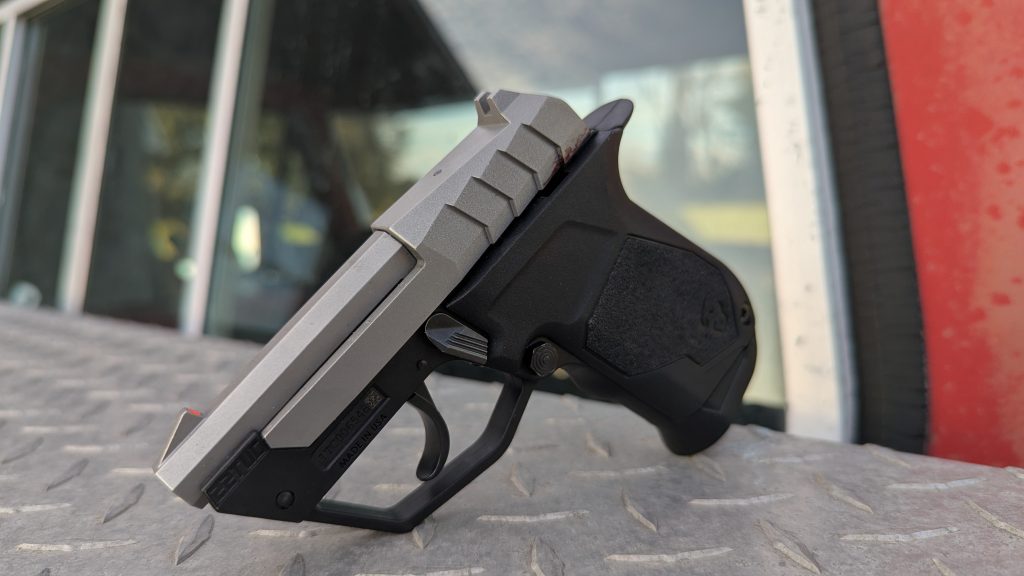
I love tip-up (tilt) barrel guns. Beretta more or less owns the tip-up market with their .32 ACP and .22LR options. Girsan has a .380 pistol that’s surprisingly nice. Taurus had long produced quasi-clones of the Beretta guns with a few of their own small changes in the form of the PT22 and PT25. To build on the PT lineup, Taurus released the 22 TUC.
The 22 TUC: What’s New
The Taurus 22 TUC keeps some of the PT22 DNA, but wisely made a few changes to make the new design a bit more current. It’s easy to describe the 22 TUC as a Beretta 20X or 21A clone, but that’s not exactly accurate either. While they borrow the tip-up DNA, there are some notable changes.
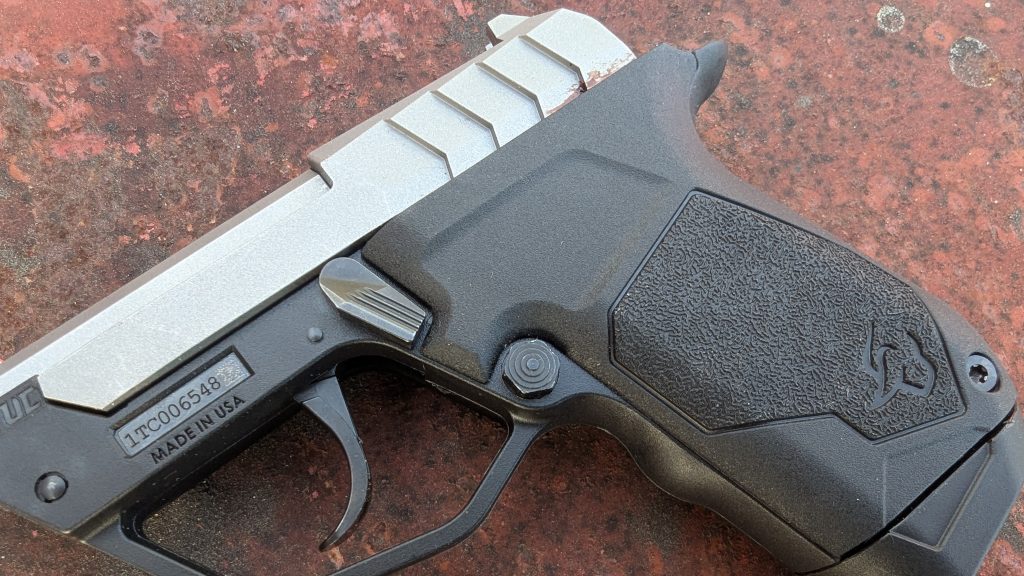
The 22 TUC comes in stainless and black. It has a polymer frame rather than metal, with G10 grips. That lightens the gun and makes it notably cheaper. The 22 TUC also does away with a DA/SA design and instead uses a simpler double-action-only system. As much as the DA/SA guns of the Beretta series charm me, the DAO design makes more sense.
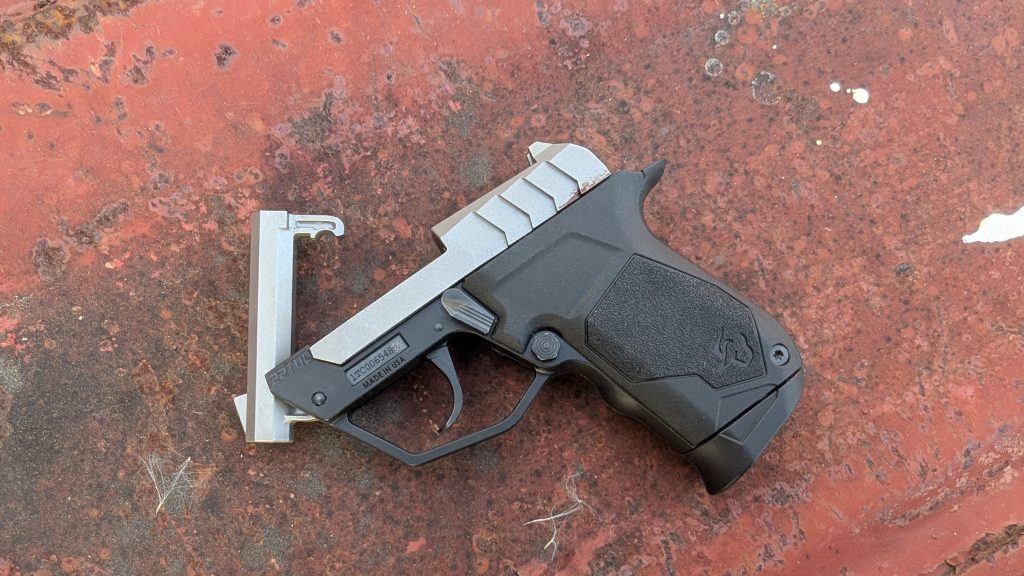
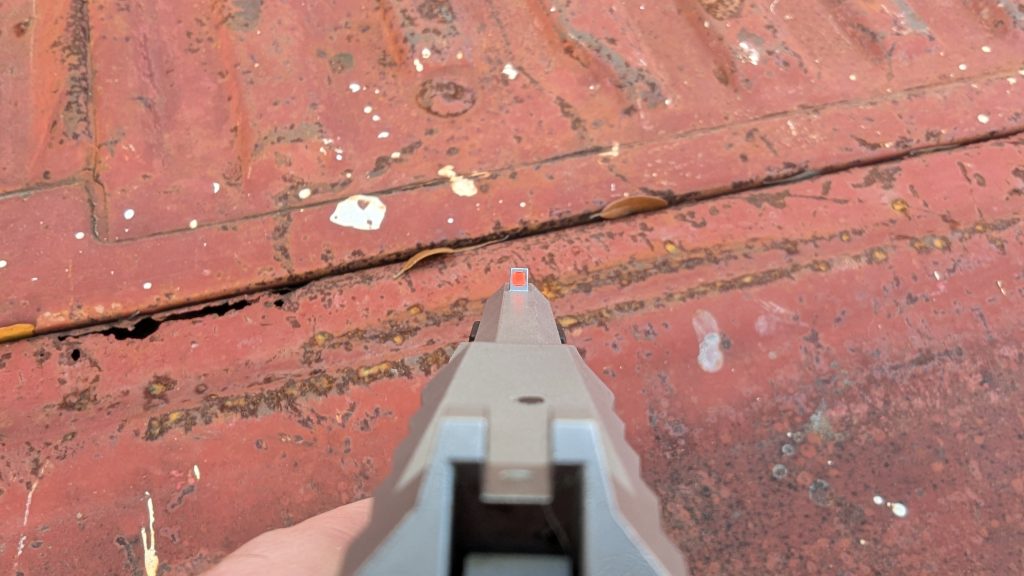
The PT22 series technically had sights. I say technically because they were so small as to be virtually useless. The 22 TUC comes with a much larger set of sights that are built into the slide and barrel. They’re fixed sights, but larger, easy to see, and ultimately easier to use.
The 22 TUC weighs 10 ounces unloaded, measures 5 inches overall, and has a barrel length of 2.5 inches. The gun is 1 inch wide and 4.35 inches tall. Overall it’s small, pocketable, and simple.
Tip-Up Benefits and Follies
The gun relies on a straight blowback system, which is the norm with .22LR semi-auto pistols. On this gun, there’s no ejector or extractor. The blowback action takes care of that for you.
The benefit of the tip-up barrel is that you can load and clear the chamber without having to work the slide. That allows folks with reduced hand strength to load and ready the gun. Even for those with adequate hand strength, racking that small slide isn’t easy.

The downside of tip-up barrels is that if the gun malfunctions, you’re up a creek without a paddle. Every malfunction can easily be a complicated malfunction. Double-feed? You have to drop the magazine, work the slide, and likely tilt the barrel.

Failure to fire? Well, you can re-strike, but if that doesn’t work, you’ll have to tip up the barrel and free the dud cartridge, then reload. The lack of an extractor and ejector complicates things. Kind of funny how a simplified design can create other complications, but life is a series of trade-offs.
The 22 TUC In The Hand
The 22 TUC has a fairly standard layout. The magazine release is where you expect it to be. The magazine holds nine rounds of .22LR, and with one in the chamber, you’ve got 10 rounds total. The grip is aggressively textured and is long enough to fill my entire (large) hand, thanks to the pinky extension on the magazine.

The mags are made of metal and drop free when you press the release, for the most part. Your pinky will pin it in if you don’t move it like you’re drinking tea. The magazine release is fairly large and easy to reach as it sticks out a reasonable distance from the frame. You don’t have to shift your hand to press it.
The gun comes with just a single magazine. Loading the magazine was easy, and below the follower sits a slot and hole. If a shooter chooses the .22 TUC due to lower hand strength, they can use a small rod or an Allen key to press the follower down to make loading mags easier.

The tip-up lever is huge and easy to reach with the firing hand thumb. Press it forward and it springs upward fast and hard. It’s quite aggressive and I appreciate that. I’d hate to have to fish the barrel up when I need to clear a malfunction.
At the Range
As a man with big hands who chokes up as high as possible on handguns, I learned quickly that’s not the move with the 22 TUC. The beavertail encourages a high grip, but not too high. Get too high and the slide takes a chunk of flesh with it. Choke up to the beavertail, but not against the beavertail and you’ll be fine.

The 22 TUC has a long, heavy double-action trigger pull, but it’s surprisingly smooth. The pull remains consistent until you reach the point where it breaks and the gun fires. There’s no manual safety and with a trigger like this, you don’t need one.
The big sights on this gun are outstanding. The front sight features a high-visibility orange dot that makes it easy to find and align on target. At seven, ten, and 15 yards, I can keep all ten shots inside an 8-inch circle. At 25 yards, with slow fire, I can hit an IPSC-sized target with all ten rounds. Not all A-zone shots, but plenty hit the high chest area.
I tried my hand at a ten-inch gong at 25 yards and didn’t have the same success. On the first mag I went four out of 10. On the second I went six out of ten. Not bad for a micro-seized DAO gun by any means.
Recoil? That’s not a worry here. You can unleash rounds and your sights won’t leave the target. In the first few magazines, I went fast and failed to let the trigger fully reset each time. I started to make it a habit to slap the front of the trigger guard with my trigger finger. Since the trigger goes so far forward and the trigger guard is small, my finger isn’t leaving the trigger to smack the trigger guard.

What About Reliability?
Small .22LR semi-autos can be finicky. Any Beretta 21A owner will tell you that. I took the 22 TUC out with 100 rounds of CCI Mini-Mag, Aguila Super Extra, Federal Ammunition, CCI Blazer, and Remington Golden Bullet ammo.

The Remington Golden Bullet gave me two malfunctions in 100 rounds. Both were failures to fully eject. The Blazer gave me a failure to fire, which was solved by a second trigger pull. Another failure to fire might have been due to my failure to let the trigger fully reset. The Automatch, CCI, and Aguila ran without a problem.
Those are the only notable failures. You need to ensure the rear portion of the barrel and chamber remain clean. I’ve found that with tip-up guns, especially rimfires, this ensures reliable function and smooth extraction. If it gets too dirty, you’ll run into problems.
Tucking In
I’m an advocate for deep concealment guns and think with a little forethought and proper round selection, the meek .22LR will get ‘er done. I like Federal Punch and that seems to get good results out of a short barrel. The 22 TUC is one of the few, modern, pocket .22s still around and I’ve become a fan.
It’s very tempting to get this gun. I own the old school beretta 21A in 22LR. From the 1980s.
The lower position of the release mag button is an Achilles heel of the beretta design. Even the early 92 gun in 9mm has this problem.
And we were warned about accidentally releasing the magazine. When we unholstered our sidearm, when I was stationed at Fort Bragg. In the late 1990s. And it’s one of the reasons why I would never, recommend to anybody getting the early 92 gun.
My earlier Bobcat has this same problem. But I really like having the DA/SA action. I think having a pocket gun in single action. After the first shot, makes it very accurate. Despite having not the greatest sites. And having shot hundreds of rounds thru it.
The Bobcat was my primary carry gun 10 years ago. And I trained with it all the time. In class I learned to put all 8 rounds into my 35 yard target.
Travis, Is that dried blood on the left side rear above the grip? (in the pics)