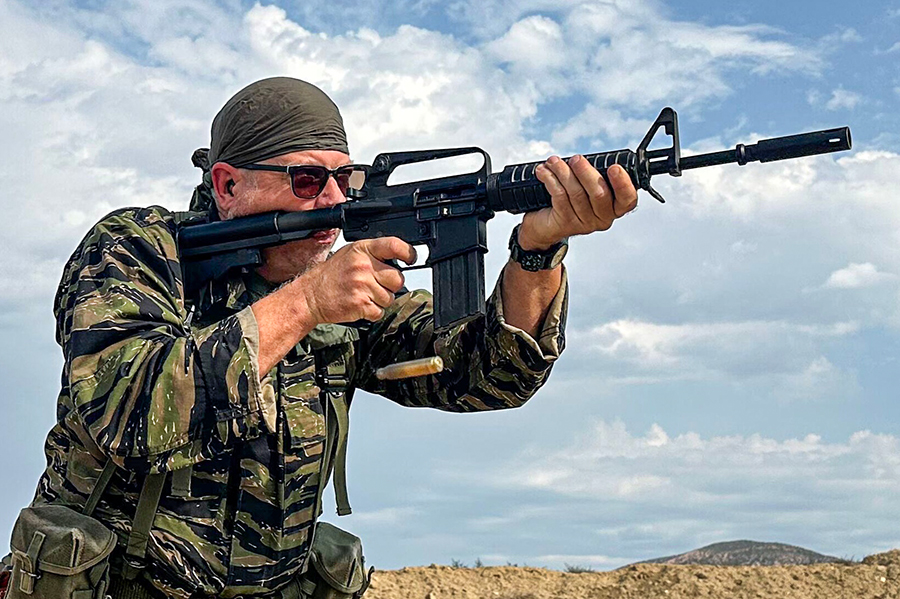
Moving forward with our series of Cold War era guns, the next long gun is one that was originally listed on Colt’s Manufacturing product sheet as a “submachine gun” but would not be viewed as such today. Going back to the heady days of the late 1950s and early 1960s when Gene Stoner and his crew at Armalite were making the “space age” or “futuristic-looking” guns from aluminum and polymers rather than hardwood and steel, the XM177E2 came from the origins of the Armalite Rifle Model 15.
During the pubescent stage of the AR-15, particularly after Colt took over the manufacturing contract, there were numerous prototypes and designs. Some stuck, some did not. That is to say, there was a lot of experimenting going on with the new Stoner gun.
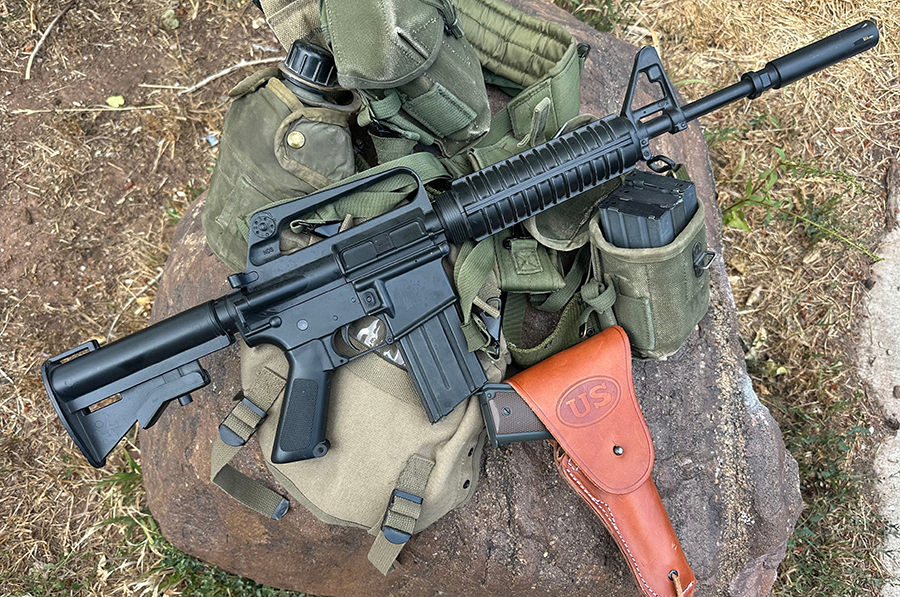
XM177E2
While you might know it as the CAR-15, the precursor to the modern M-4 was an “experimental model” shipped to Vietnam to be tested in the field by certain special operations units; MACV-SOG and the US Navy Seals likely being the most famous examples. This firearm also went by the name GAU-5 and Colt Commando. Operation Ivory Coast, aka the Son Tay Prison Camp Raid, during the Vietnam Conflict is likely one of the most famous operations where these weapons were used.
Returning to our previous discussion, before the US Army formally adopts a weapon, standard practice has been to field a limited number of “X” units and then make any improvements needed before a complete adoption.
While the M16A1 was considered to be very light and easy to maneuver, especially when compared to the WWII battle rifles and the M14, the XM177E2 (“E” is pronounced “echo” in military speak) was super-light and very maneuverable. The original XM177E2 weighed only 6.35 pounds empty, the M14 by comparison was 9.2 pounds empty and 44.3 inches long.
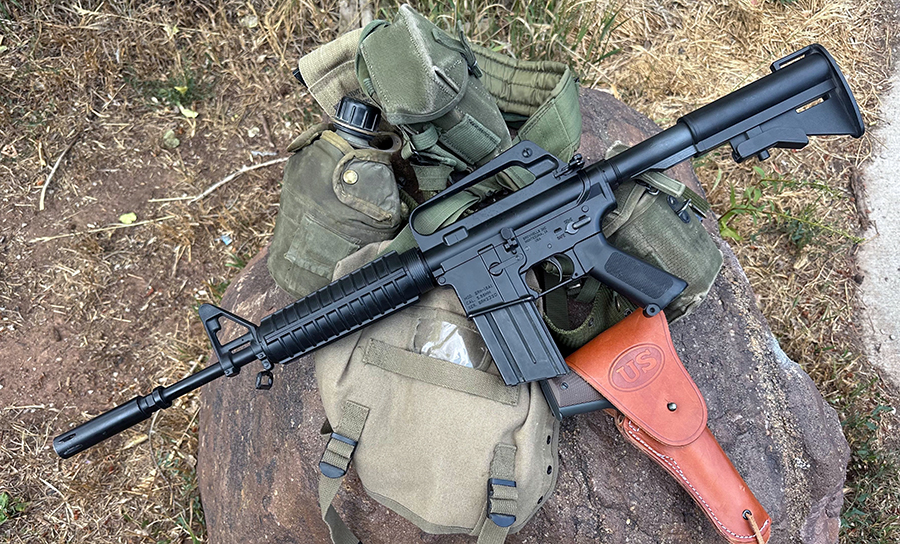
Built on the Stoner-designed AR-15/M16 upper and lower receivers, the XM177E2 used various length barrels, but a 11.5 inch barrel with a specially designed XM177 muzzle device was the most common. Old school Vietnam veterans have reported that the early 10 inch barreled version had reliability issues and the addition of 1.5 inches fixed that problem. Despite the fact that Colt originally dubbed this firearm as a “submachine gun”, it indeed chambered the then-new 5.56mm NATO round and used AR/M16 magazines. The guns had “Safe” “Semi” and “Auto” settings.
Colt Defense kept the carrying handle and A-frame front sight set up and the original guns used the older “A1” sight adjustments; front sight post for elevation, rear sight for windage. Just as was Gene Stoner’s original intent, the tip of an FMJ 5.56mm round was the only tool required for sight adjustment.
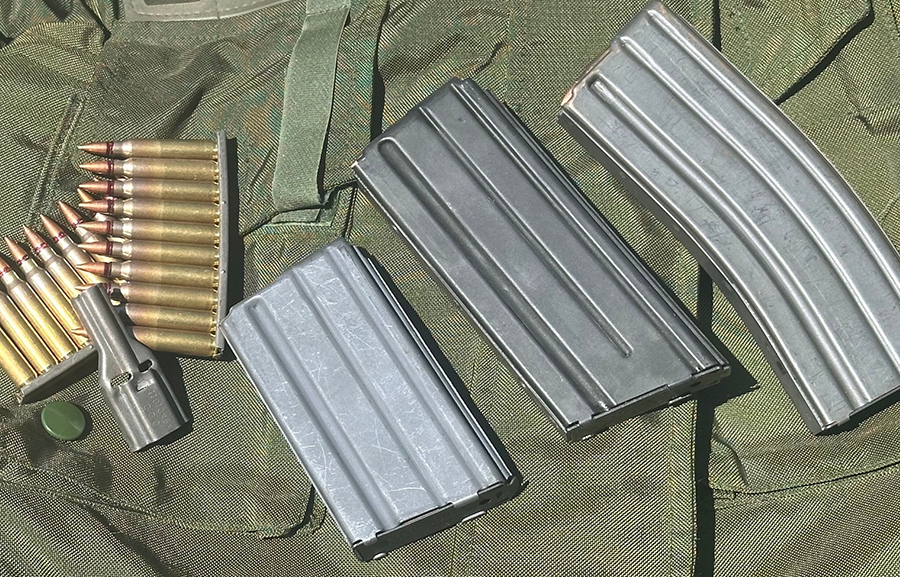
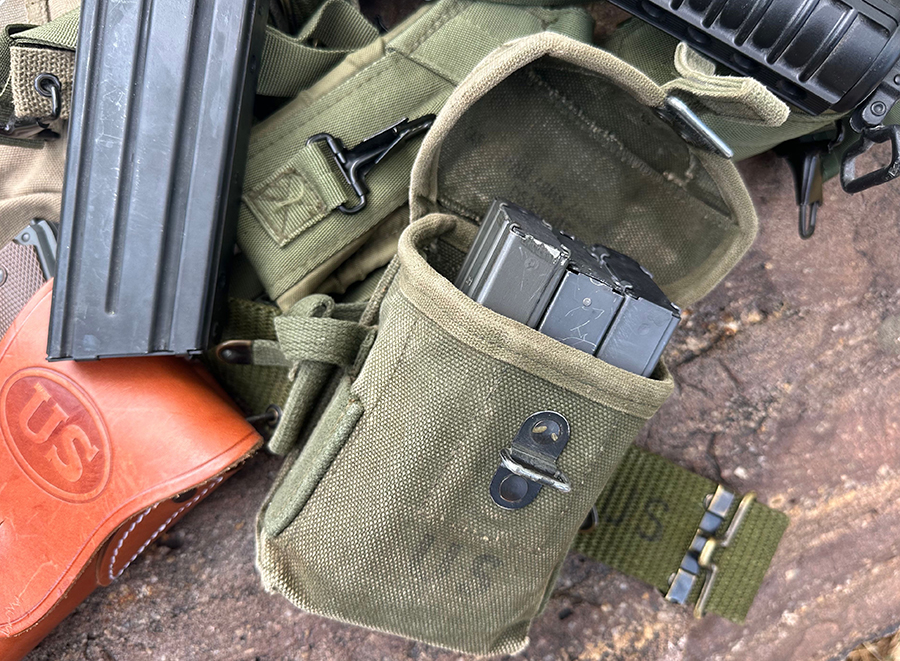
At the rear, the retractable stock set the tone for what was to become the standard for the M4. However, the XM177E2 stock had only two settings; collapsed or extended. Like the XM16E1 that we discussed previously, aircraft grade aluminum and high strength polymer was used whenever possible with steel reserved for the barrel and bolt carrier group. Original magazines were the 20 round aluminum variety and the rare 25 round steel versions, but the 30 round aluminum models soon followed.
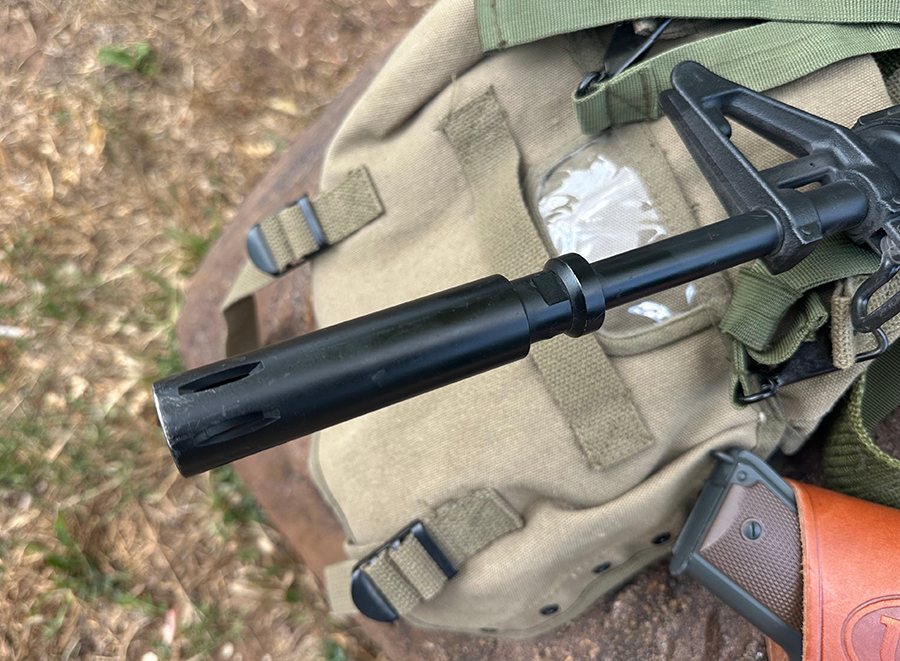
True XM177E2 carbines can be distinguished in the old B&W photos by the flash hider / muzzle device. This feature proved to be not only an extremely effective flash reducing device, but it also served to push the sharp noise of the 5.56mm cartridge away from the shooter’s face, something that should not be disregarded when shooting such a short-barreled gun. Also, for those standing near the shooter, not having the expanding gas and shockwave smacking them in the face is a benefit that cannot be overstated.
If there was a down side to the XM177 flash hider, it could be that it negated the use of a standard M7 bayonet. Armed with commando knives and daggers, we don’t believe the end users felt handicapped by that issue.
The XM177E2 did indeed benefit from the earlier field trials of the XM16E1 as the lower receiver was “fenced” or “gated” around the magazine release button and the bolt carrier group was parkerized, not chromed. Also, by that time, the US Army had realized that issuing cleaning kits to the troops, and teaching them proper field maintenance, was an absolute necessity. Also, the XM177E2 used the paddle-shaped forward assist.
Regardless of the unit or the branch, there have always been weapons and tools that set the elite or special operations warriors apart from the conventional troops. The XM177E2 was certainly one of those. Seeing a soldier with an M4 today doesn’t seem like a big deal, but such was not always the case. Look back at Operation Gothic Serpent; the US Army Special Forces Detachment Delta used the “cool-guy” Colt 723, an upgraded version of the older XM177E2, with an old style Aimpoint optic. During that mission, the Army Rangers and the 10th Mountain Division were carrying the M16A2, no optics.
The Colt 723 was also carried by 1st SFOD-D during Operation Acid Gambit, the prison raid/hostage rescue operation that was essentially the beginning of Operation Just Cause. Interestingly, when I was on active duty with the 6th Marines, our sister battalion 3/6, was involved with the invasion of Panama while our unit 1/6 was on “air alert” for deployment but never went because the hostilities ended quickly.
Optics on Fighting Guns
An interesting historical note regarding the use of 1:1 red dot optics on modern carbines is that the concept was first experimented with by the US Army Special Forces during the preparation and execution of Operation Ivory Coast. The leadership procured a new and relatively unknown sight called the “Singlepoint OEG.” OEG stands for Occluded Eye Gunsight.
The OEG isn’t a traditional optic as you don’t look through it, you zero the Tritium powered dot and shoot with both eyes open; your dominant eye perceives the aiming dot and the non-dominant eye provides the target information. Your brain puts the picture together. This set up allowed the Son Tay Raiders to make extremely rapid and accurate hits on target day and night. The US Army final report on the Son Tay raid stated that 42 enemy personnel were killed by the raiders during complete darkness. Armson USA still produces a modern version of this gunsight today.
It’s easy today to just assume that 1:1 optics on fighting rifles and carbines have always been commonplace, the reality is that they have not. The lessons from Operation Ivory Coast were used to make improvements in tactics and equipment. As mentioned earlier, the fact SFOD-D had Aimpoint optics on their Colt 723 carbines during Operation Gothic Serpent in 1993 can be traced back to November of 1970 and the successful use of such items in Vietnam.
Gun Love?
I do try my best to view firearms as Instruments of Liberty, not objects of affection. Nonetheless, I have found that if I were to apply the term “love” to a gun, the XM177E2 would warrant that expression of endearment. I cannot objectively find flaws with the gun. No, it is not a long range / 500 yard shooter, but that was not the purpose for which it was designed. The XM177E2 was made to be a lightweight, easy to maneuver and shoot fighting carbine for close quarters combat whether in the jungle or in MOUT environments.
The 5.56mm NATO is certainly a loud cartridge, but the felt recoil is such that it can be managed easily by a 100 pound, 12 year old girl, regardless of what a grown man writing for the New York Daily news might have asserted.
While genuine select-fire XM177E2 rifles are difficult to come by and will set you back tens of thousands if you find one, there are a few companies making faithful semi-automatic reproductions. The Harrington & Richardson version is one of these.
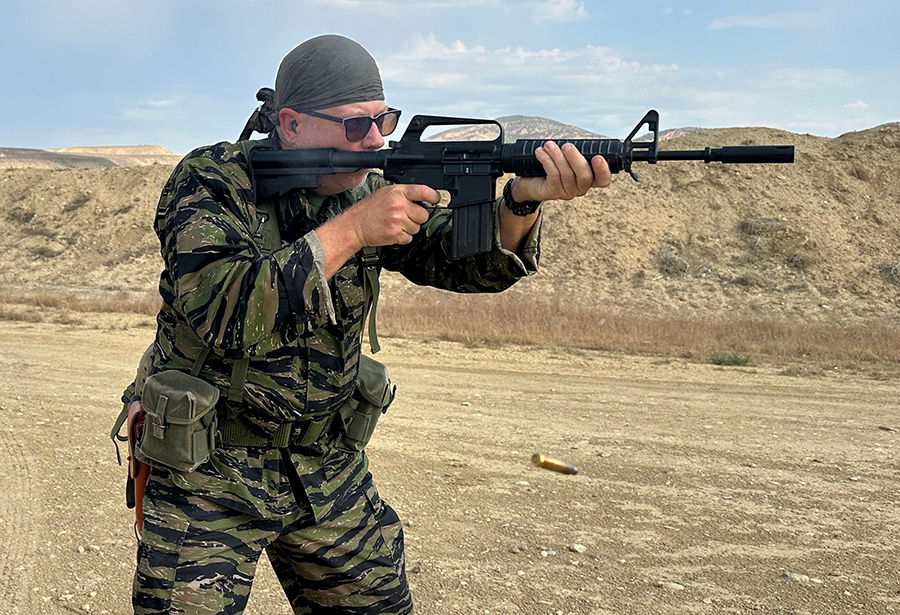
When it comes to guns of the Cold War, the original Colt XM177E2 certainly holds an important place among its brethren.
Specifications
Caliber: 5.56x45mm NATO
Action: Select-Fire
Capacity: 20 (30 and others)
Barrel Length: 11.5 inches
Overall Length: 28.3 inches closed, 32.5 inches open
Weight (empty): 6.35 pounds
Furniture: High Strength, Black Polymer
Paul G. Markel is a combat decorated United States Marine veteran. He is also the founder of Student the Gun University and has been teaching Small Arms & Tactics to military personnel, police officers, and citizens for over three decades.
There were actually two different CAR-15 series – one eventually became the XM177 & GAU-5, the other eventually became the M16/M16E1/M16A1/M16A2/M4.
The ‘CAR’ in ‘CAR-15’ didn’t actually stand for ‘carbine’ in the development programs – it was the internal Colt designation for ‘Colt Armalite Rifle’.
The Colt CAR-15 series (that became the XM177 & GAU-5 eventually) really started in 1964 with the SMG Model 607 they sent to the Army for testing. Then in 1966 Colt came out with the XM177 & GAU-5 series which was an out growth of the Model 607. There were five different variation models in service.
The other CAR-15 series went on to become the M16/M16E1/M16A1/M16A2/M4. (From the M16A2 came variations that eventually led to the M4).
Clarification for: “The other CAR-15 series went on to become the M16/M16E1/M16A1/M16A2/M4. (From the M16A2 came variations that eventually led to the M4).
Colt had made a carbine model of the M16A2, it was the Model 723 and was purchased for use by special operations groups. Then a Canadian company Diemaco, under license from Colt, developed the C8 carbine for Canadian Forces and it was based on and similar to the the Colt Model 723. But the first runs of the C8 were built directly by Colt as the Model 725. In 1984, the U.S. asked Colt to develop a carbine with maximum commonality with the issue M16A2. Colt created a carbine called the XM4 that was based on the Model 723 but also had some C8 variation. That project eventually resulted in the development of the M4 carbine.
All in all, for the civilian market the civilian model MSR (AKA ‘AR-15’) in any form variation never originated as a military only rifle.
Briefly; It all originated with a civilian market rifle Armalite wanted to develop to capture a growing market niche of consumers who wanted a semi-auto rifle with military ‘cosmetics’ styling for a ‘sporting’ type of rifle. So Jim Sullivan and Robert Fremont went to work on design of a civilian market rifle that carried forth the military type of ‘cosmetics’ theme of the AR-10, Stoner joined in. This civilian only rifle was designated AR-15 as it was the 15th rifle in the Armalite design series. While developing the civilian only model Stoner started talking Armalite into trying to capture the military market, his real interest was in military firearms, and took the civilian design designated AR-15 and made changes, and development of the origin civilian model stopped. But the Stoner design still carried the AR-15 designation as it wasn’t a new rifle in the design series but basically just an adaptation to change directions with the design towards a military rifle and eventually he gets the credit for ‘creating the AR-15’ (because what he did design was the AR-15 but only because it carried forth the origin civilian rifle designation) and it gets tagged as a military rifle.
The origin of the M16/M16E1/M16A1/M16A2/M4, the XM177 & GAU-5, and all other variations literally originated from a civilian only rifle design and its origin was never as an ‘assault rifle’ or ‘weapon of war’, its origin was as a civilian market semi-auto sporting rifle with military styling ‘cosmetics’.