

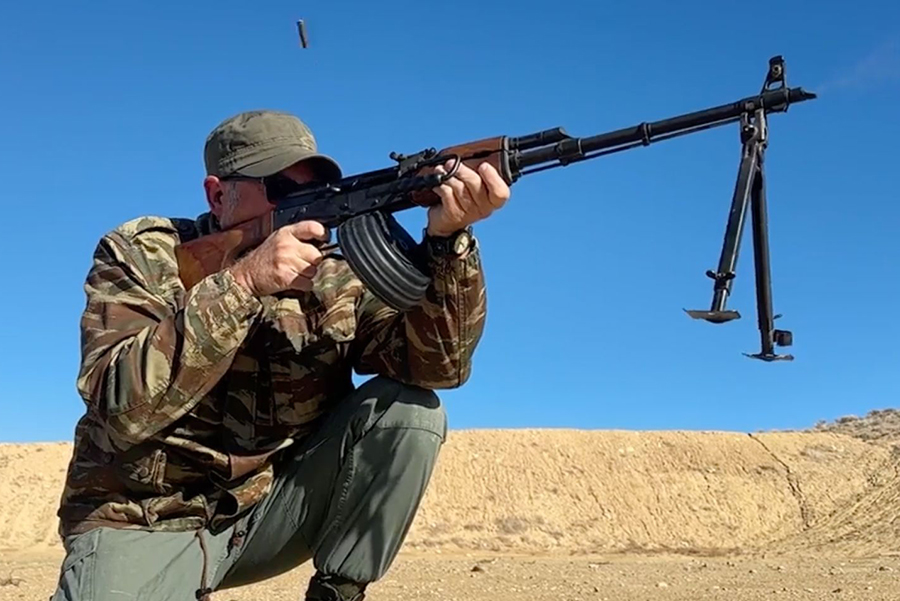
In military vernacular, a “machine gun” uses a centerfire rifle cartridge, while a “sub-machine gun” uses a pistol cartridge of some sort. As far as machine guns are concerned, they are broken down into 3 basic categories: Light, Medium, and Heavy. During WWII, belt-fed machine guns were typically either .30 caliber (medium) or .50 caliber (heavy). It was during the post-WW II era, or the Cold War, that the light machine gun truly came into its own.
Amongst the light machine gun series you will find arms under the classification “squad automatic weapon,” this is where most of these LMGs can be found. Medium and heavy machine guns are “crew-served weapons” requiring a “crew” of two, or in most cases three, men to keep them up and running. Machine gunners, particularly those who run medium and heavy machine guns, are specially trained troops who are given additional training compared to the traditional rifleman. Any trained machine gunner will tell you that it takes much more than just pulling a trigger to keep an M60, M240B, or M2 .50 caliber machine gun running.
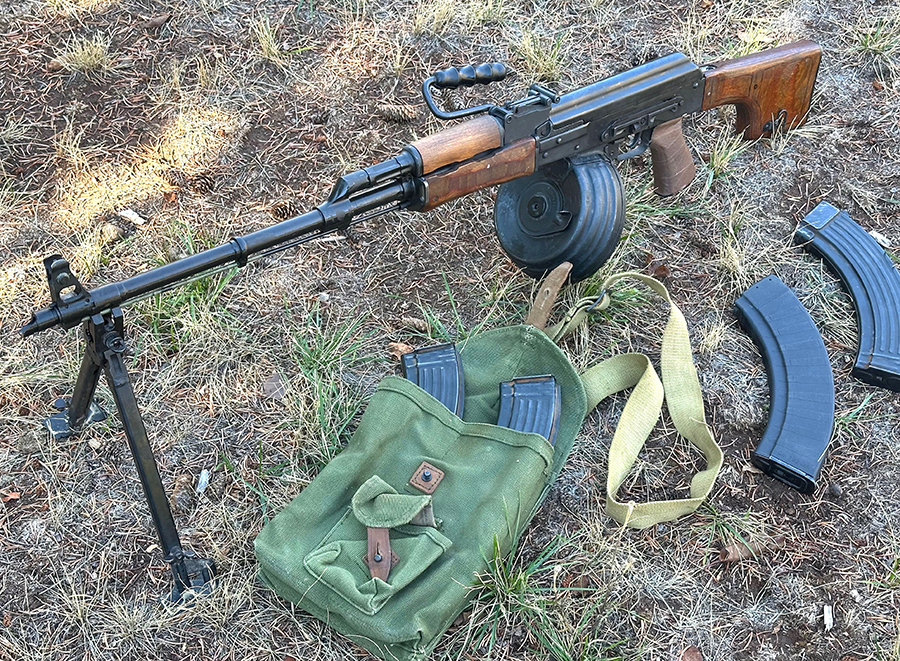
The SAW is a machine gun that can be carried and employed by a single soldier, though most units will have an “Assistant Automatic Rifleman” (AAR) to carry extra ammo and a spare barrel if that particular gun is designed to use one. In a Fire Team or Rifle Squad, the SAW is such an important weapon that should the gunner go down (killed or injured), an AAR will jump on it and keep the gun rocking and rolling. It is this SAW category where the Soviet RPK finds itself.
The RPK
The RPK or Ruchnoy Pulemyot Kalashnikova from its profile is quite naturally a child of Mikhail Kalashnikov and it should be obvious from looking at the weapon that it’s based upon the original AK-47/AKM action.
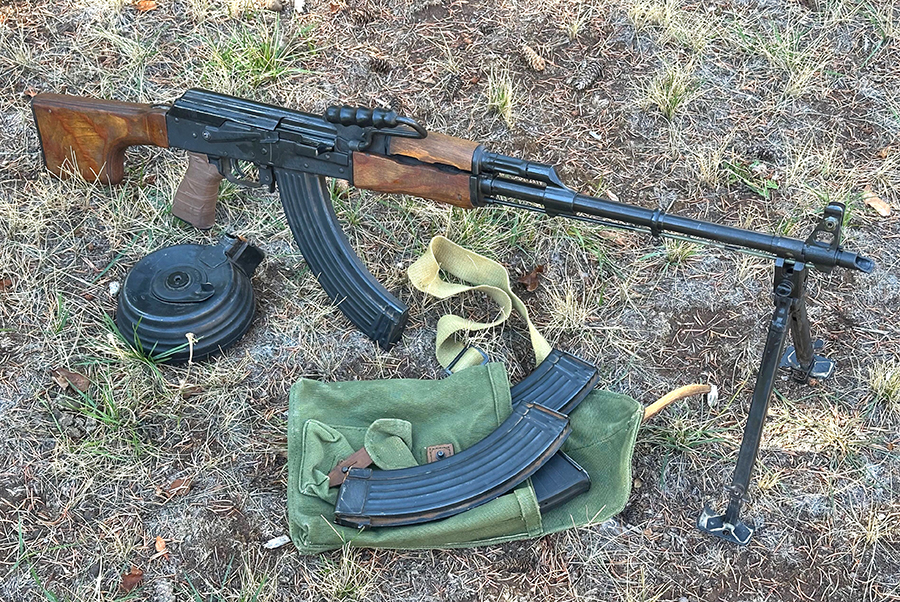
A mash-up of the belt-fed RPD-44 (Ruchnoy Pulemyot Degtyaryova) and the AKM, the RPK uses the “club foot” style stock found on the RPD as well as the barrel mounted bipod. The RPD was fed by belts of 7.62x39mm ammunition and while it was a light machine gun in the category of squad automatic weapons, its operation was a bit more complex than the AKM, thus requiring more specialized training for the end user.
It was the RPK which officially replaced the RPD in 1961 as the standard SAW for the Soviet Army during the Cold War. From a practical standpoint, that made a lot of sense. Every member of the Red Army was taught how to employ the AKM. Transitioning them to the RPK required less training and the operation was straightforward.
The biggest change from RPD to RPK was the use of AKM magazines for the new light machine gun. All AKM pattern magazines; 30, 40, and 75 round drums run in the RPK. Both 75 round drum and then later 100 round drum magazines were developed due to the adoption of the RPK. Speaking of the drum magazines, the two most prevalent designs are the Russian model that loads by opening the back cover, inserting rounds, then winding the spring with a crank/paddle and the Chinese model which loads from the top and has a loading lever on the front of the magazine body that is depressed to remove spring tension so each round can be hand loaded. Both drums magazines have their merits with the Russian version requiring a bit of training to master.
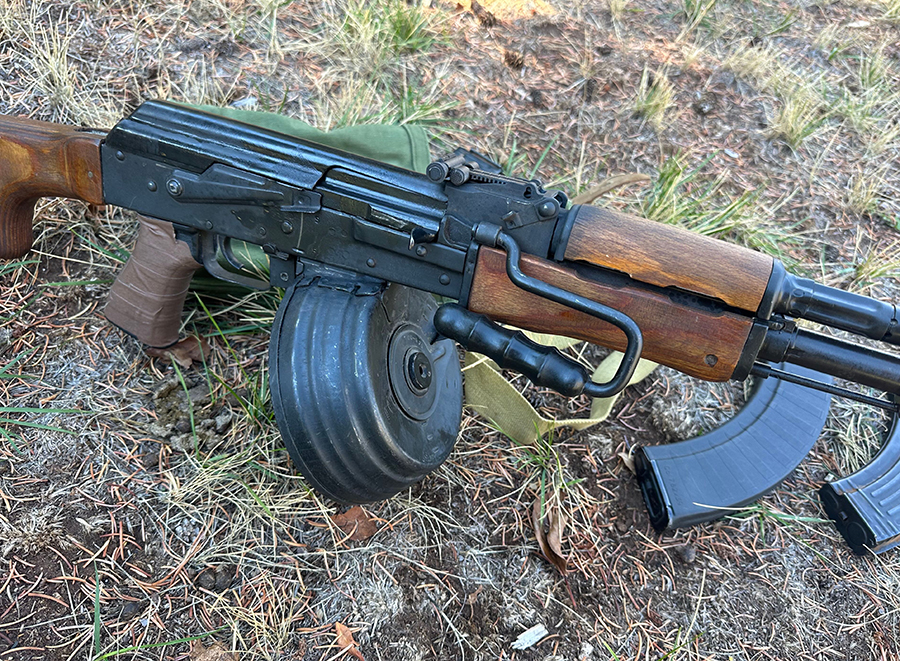
Another plus for the RPK was emergency feeding. While the RPK gunner would begin the firefight with either a drum or extended 40 round magazine in place, if they ran out of ammunition, they could be fed 30 round mags by riflemen to keep the “SAW” running.
From personal experience, the US Army/Marine Corps M249 SAW was supposed to be able to run on 30 round STANAG (M16) magazines in a pinch if the gunner ran out of belted 5.56mm ammo. However, when I was in the infantry, I never encountered a 249 that would reliably run with magazines. Perhaps brand new guns with brand new magazines being fired on the test range might have worked, but I never had that experience in the field.
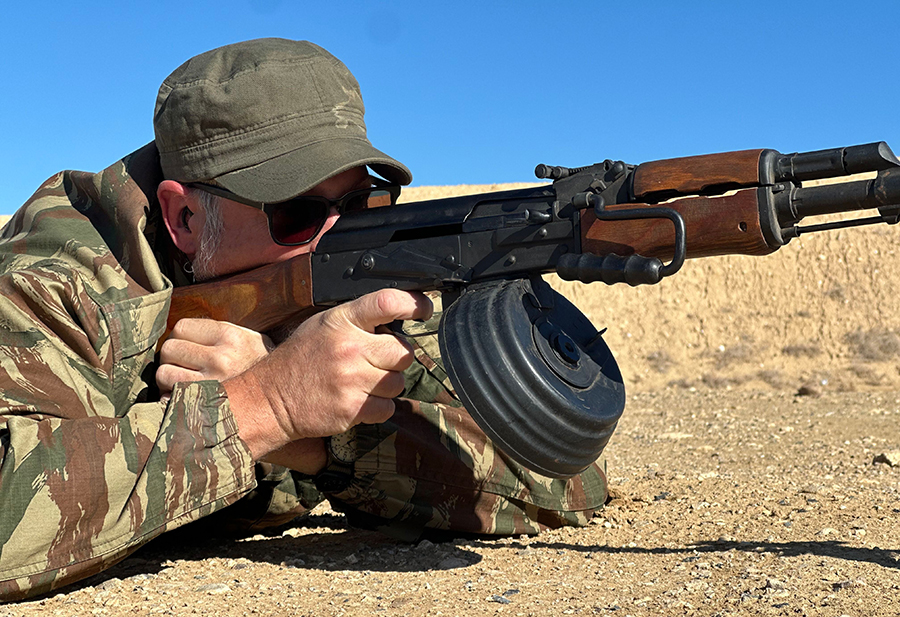
Controls on the RPK mimic those of the AKM; safety lever, magazine release, charging handle, trigger, they are all the same in function and appearance. As mentioned, a wooden “club foot” stock is common, but folding versions of the wooden stock (RPKS) as well as steel “wire” stocks for use by airborne or mechanized troops were produced. The handguard is typical hardwood to match the stock and pistol grips varied from wood or polymer.
The heavy barrel is 23 inches and has a long cleaning rod onto which the steel bipod clips in place when that feature is not deployed. Unlike the lighter-barreled SAW of the NATO forces which used “quick change” barrels, the RPK barrel is fixed and cannot be swapped out.
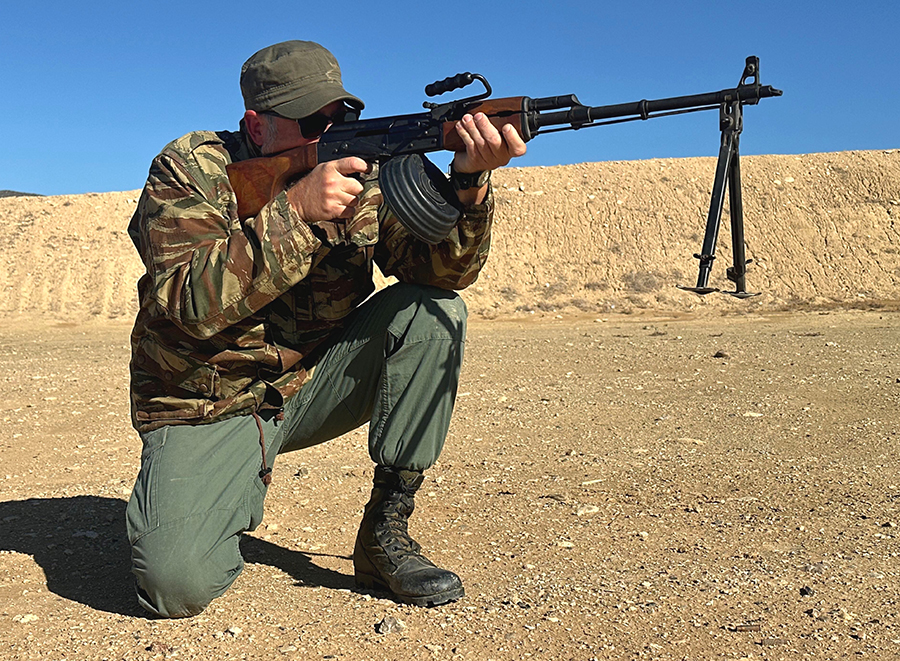
The front sight is typical AKM, but the rear sight on the RPK adjusts for both windage and elevations and has markings out to 1000 meters. The extra long barrel gives the M43 cartridge more practical range than were it to be fired from a 16 inch barreled AKM. These light machine guns weigh 10.6 pounds empty. While ten plus pounds might seem heavy, when compared to the M249 SAW which weighs 17 pounds empty, the RPK, even with a long, heavy barrel, is not that heavy for an LMG. Yes, a 75 round drum is going to add a couple pounds, but that is still less weight than an empty M249.
As you would expect, the RPK was extremely popular and numerous Soviet Allies either adopted the Russian guns or produced their own versions. The Romanian AES-10, which could be had with either a fixed or folding stock for paratroopers, was amongst the most notable copies of the original RPK. The ChiComs, as you would expect, took a shot at developing their own version.
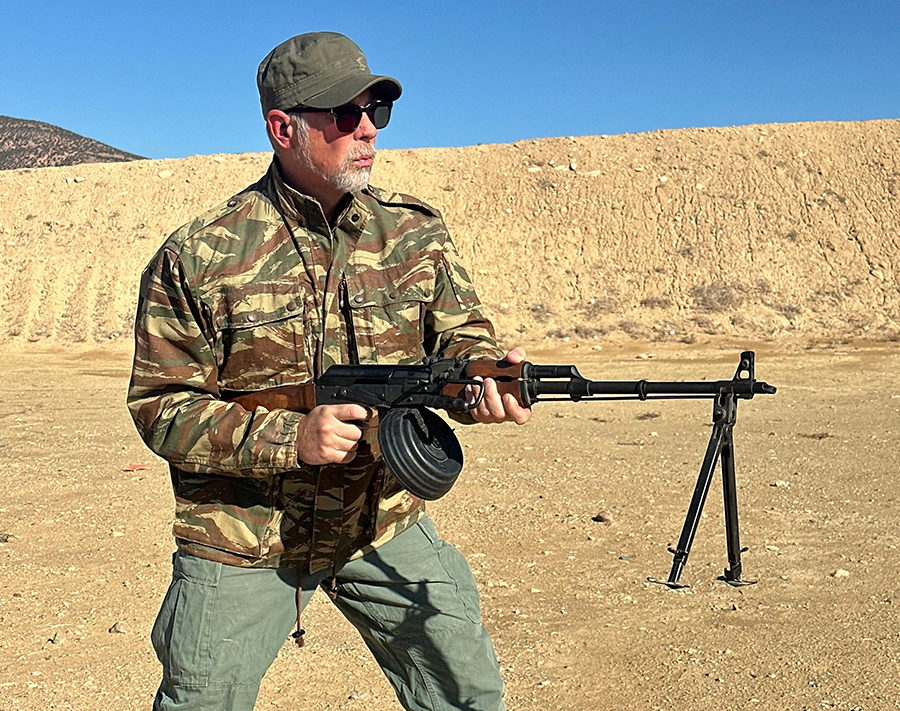
Quite naturally, when the AKM was supplanted by the AK-74, an RPK-74 was produced, and for all intents and purposes, it was identical to the original RPK save the newly designed magazine for the 5.45.x39mm cartridge. Standard capacity for the RPK-74 was a 45 round box magazine in steel, bakelite, or polymer.
As for cyclic rate, the RPK had a relatively low rate of fire for a machine gun at only 600 RPM (rounds per minute). Again, for contrast, the M249 SAW has a cyclic rate of 850 RPM. The slower cyclic rate of the RPK meant that it was controllable not just from the bipod, but from a kneeling or standing position if the gunner fired in controlled bursts, as every skilled machine gunner can do. Also unique amongst machine guns in general, the RPK fired from a closed bolt, not an open one as most belt-fed machine guns do.
Parting Shots
Despite being replaced by the sub-caliber RPK-74, the original RPK remained popular throughout the Cold War with those organizations that still employed the AKM. The RPK saw combat all over Asia and Africa and, along with its newer cousin, the “74” is still in use to this day. Citizens who would like to own a semi-automatic version can purchase new AES-10B rifles from Century Arms.
Specifications: RPK Rifle
Caliber: 7.62x39mm
Action Gas-piston operated
Capacity: 40-round magazine or 75-round drum (others)
Furniture: Hardwood or polymer
Barrel Length: 23 inches
Overall Length: 41.7 inches
Weight: 10.6 lbs (empty)
MSRP: AES-10B $1999.99
Paul G. Markel is a combat decorated United States Marine veteran. He is also the founder of Student the Gun University and has been teaching Small Arms & Tactics to military personnel, police officers, and citizens for over three decades.