

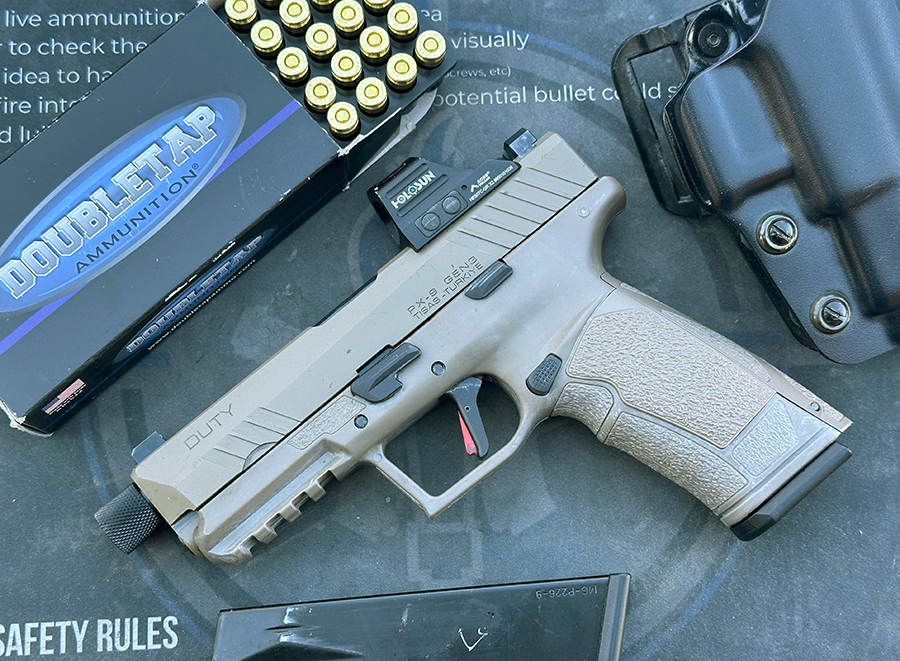
Of late, I have been working with a number of handguns that have optics mounted on them. These would include the traditional red, amber, and green colored reticle options. In the green spectrum, I have a Holosun 507C GR X2 optic mounted to a Tisas PX-9 Gen3 pistol. That led me to consider not just this pistol in particular, but the state of supposed EDC or self-defense handguns today.
Tisas PX-9 Gen3 Duty
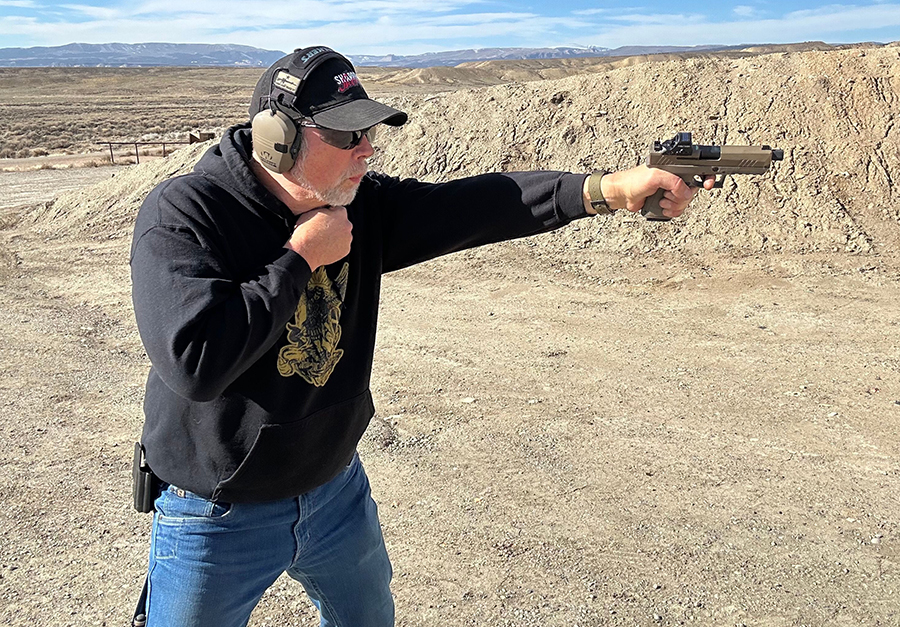
First things first. The PX-9 Gen3 pistols are made in Turkey and imported in the United States by Tisas USA. The pistol in these photos is one of two that I’ve been working with during the last few years. This one, the FDE colored version, is the “Duty” model being about the same size as a G17 or XD-M.
Rather than completely reinvent the wheel, Tisas took popular and accepted designs and adapted them to the PX-9 Gen3. For instance, it uses a SIG P226 pattern magazine, but these hold 18 rounds versus the standard 15 rounds you get with a factory 226. The action is striker-fired, much like a GLOCK or any GLOCK clone, but disassembly is more reminiscent of the Springfield Armory XD-M. There is a takedown lever and a slide lock on the left side of the frame.
Fear not, there’s no grip-safety on the PX-9. The striker-fired trigger has a red trigger safety blade and the gun has a built-in drop safe/firing-pin block. When the striker is cocked the shooter can see the little red button sticking out of a hole in the back.
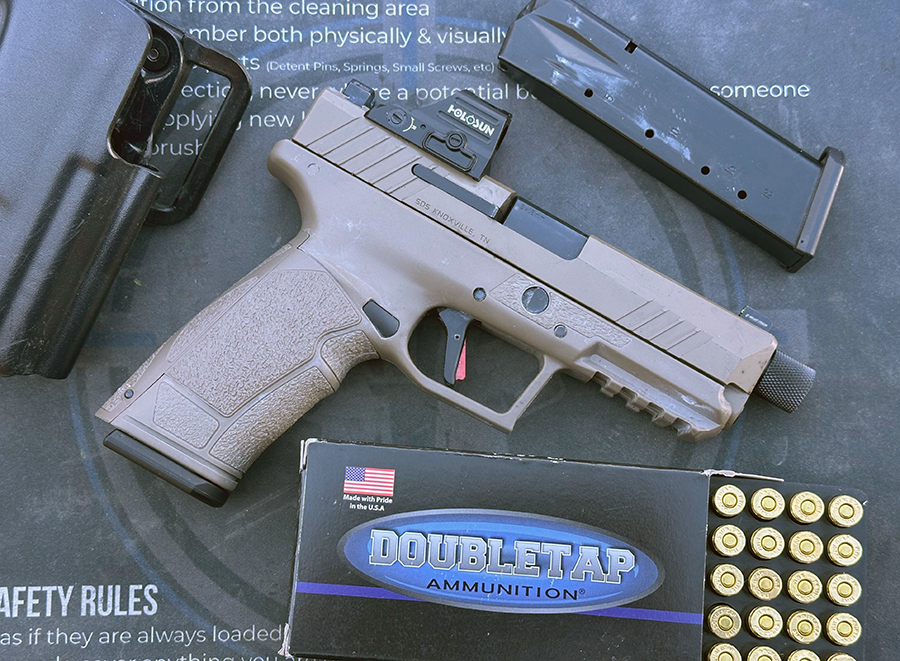
The frame is modular and has interchangeable grip panels and backstraps in small, medium, and large configurations. Also, up front on the dust cover is the accessory rail that you’ve come to know and love since GLOCK introduced them on their Gen3 in 1998. Yes, it’s been 28 years now.
Atop the slide, you’ll find steel and fiber-optic sights fitted with GLOCK standard sight cuts. The pistol featured here had the factory sights replaced with a set of Night Fision Accur8 sights.
As you’d expect, there is a cover plate sitting on the optic mount area on the slide. The PX-9 Gen3 optic mount is configured for a Trijicon RMR footprint which is also the same as the Holosun 507C and numerous other red/green dot sights. The Holosun optic that I used mounts directly to the slide, no plates needed. That meant the optic sits low enough to still be able to use the Accur8 sights and co-witness the bright green reticle right over the tip of the front sight.
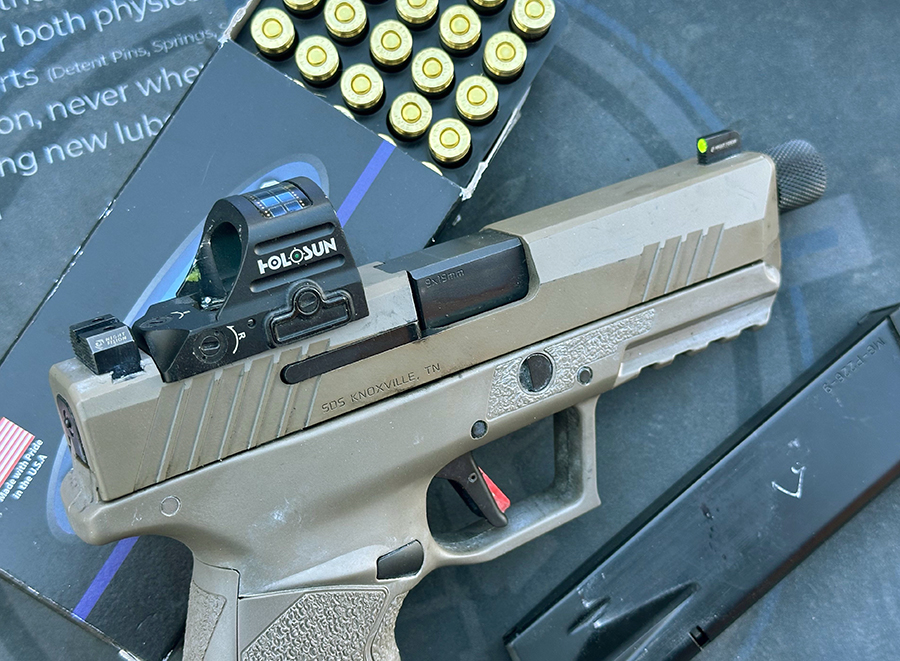
You can get the PX-9 “Duty” sized pistols with or without a threaded barrel. This one has standard American 1/2×28 TPI threading. Of course, if you live in a state where your masters forbid you to shoot your guns quietly, such an option isn’t necessary. For those in Free America, it’s a decent option to have if you own a silencer.
Range Time
While the PX-9 might not be considered a glamorous pistol, I can testify that they run and run well. A few years ago I did a 1000 Round Torture Test on a black stock model. Over the last couple of years I’ve put a thousand-plus rounds through the FDE Duty model featured here.
These guns have cycled every type of 9x19mm ammunition I have tested in them from high-end Black Hills ammo to steel-cased FMJ and everything in between. Accuracy is as good or better than you’d expect. Hits on steel silhouettes out to forty and fifty yards aren’t a problem. I’ve deliberately dropped it in dirt and sand. Then I dropped it into a bucket of water, pulled it out and shot it immediately.
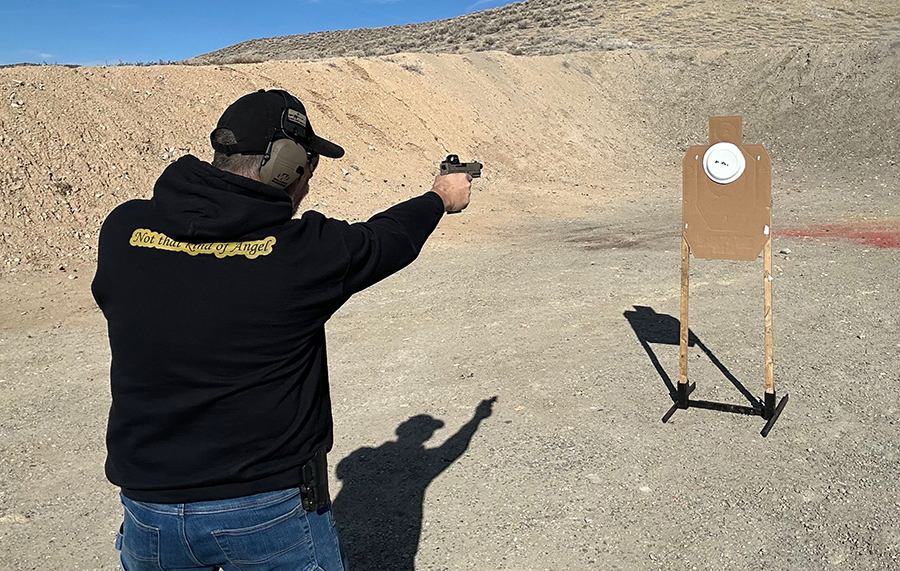
Long story just a bit longer, the PX-9 Gen3 pistols have proven to be reliable and worth every bit of their inexpensive asking price. At press time the average retail price is in the $350 range.
Features! Features! Features!
For about one hundred and fifty years in the United States, cartridge firing handguns designed for fighting and self-defense were distinguished by a limited number of features: action, caliber, metal finish and grip/stock material. That was pretty much it. Variable barrel lengths and sight options were used to spice up older models.
What really set off the “features” craze for handguns was the advent of polymer frames. The HK USP had an accessory/light rail, but that design was proprietary and about as popular as jock itch. Then GLOCK decided on the M1913 Picatinny/Weaver standard accessory rail for their Gen3 pistols. That forced every other polymer-framed pistol maker to retool and come out with their own version with a “light rail.”
For a while, whether a duty pistol had a rail or didn’t was what set them apart. Walther then added another feature to the mix with their P99 pistols with replaceable backstraps for a better fit. The Smith & Wesson 99, a P99 clone, followed suit with “rear grip inserts.”
This move by Walther and S&W forced GLOCK and others to come up with interchangeable grip backstraps. Soon, interchangeable backstraps weren’t enough, you needed to have removable grip panels as well.
While all the gun makers were focusing on adding features to their pistol frames, FN decided to make a factory pistol with an optic mount that used different mounting plates to account for different optic footprints. We all know that every other gun maker eventually campe up with some kind of optic-ready mounting system for their pistols; GLOCK Gen4 MOS, S&W “OR” (optic ready) M&P pistols, SIG P320 RX (ouch!), etc.
By the mid-teens, if you wanted to be competitive in the duty or self-defense handgun market, your polymer-framed, striker-fired guns needed to have a light/accessory rail, modular grips, and be “optic-ready.” Throw in OD green and FDE colored frames just to mix it up.
But it didn’t end there. Once everyone and their brother had a pistol with all of those features, gun makers needed something new. Soon factory-threaded barrels became a new feature in an attempt to stand out. Of course, that didn’t last long because it’s not hard to add a half to ¾ inch to a factory barrel and thread it.
While that was going on, handgun makers were adding extended baseplates to their factory magazines to bump up capacity by two or three rounds. “Our competitor’s gun holds 17 rounds, but our gun holds 20.” It didn’t take too long for every gun maker to offer “extended” mags.
Keep in mind that all of this took place over a relatively short time, say twenty years or so. Think about that for a moment. In 1999, the most popular law enforcement handgun in the USA was the GLOCK 22 Gen 2 or 3 (Gen3 was released in 1998 and it took some time for agencies to convert). The only “cool guy” feature on the Gen3 G22 was a rail. The US Army service pistol was the Beretta M9 and it didn’t have any of the current cool guy features, not even a rail.
I’ve been carrying a handgun on and off duty since 1987. Looking back, I don’t know how we survived. None of our service or duty pistols had holes deliberately carved in the slides so we could see our barrels. The M9 had a wide open slide design and we learned that was okay in garrison…but not so much in the desert. None of our service pistols had ports or compensators to blind us in low light and shoot propellant gasses (and tiny bullet fragments) into our faces when shooting from retention in close quarters.
Is it beneficial to have a light on a duty pistol to positively identify threats? Yes. Before we had weapon lights we had to hold flashlights in our left hand. Can optics on pistols help shooters with vision issues as well as aiding well-trained shooters under stress? Yes. Yes they can.
What’s Next?
Are gun makers still in a cartoonish race to add features to their guns in order to keep up with the latest social media trends? Once might ask where does it all end? What’s next? I would say lasers, but we already went through that phase fifteen years ago.
After every company succumbs to the pressure from the Instagram models to port and comp their supposed self-defense pistols, what then? How soon before some company puts a bottle opener in the grip? Actually, I haven’t tried prying the cap off of a Dos Equis with a pistol comp yet, but that might just work.
Specifications: Tisas PX-9 Gen3 Duty
Caliber: 9x19mm
Capacity: 18+1 rounds
Actions: Striker-fired
Weight (empty): 1.78 lbs.
Barrel Length: 4.69 in. (threaded 1/2×28 TPI)
Slide Length: 7.9 in.
Sights: Steel and fiber optic
Paul G. Markel is a combat decorated United States Marine veteran. He is also the founder of Student the Gun University and has been teaching Small Arms & Tactics to military personnel, police officers, and citizens for over three decades.
Paul, thanks for this article, really enjoyed it – especially the history of how so many features were added to current designs (“I don’t know how we survived” – I lol’d). With respect to the latest trend of porting/compensating concealed carry-oriented handguns, there are undoubtedly trade-offs, but what is your personal opinion whether that configuration is a net positive or net negative overall? I’ve not had an opportunity to try out any compact or smaller ported pistol (e.g., SA Echelon 4.0C Comp) and am wondering if that setup legitimately helps more than it hurts? Thanks
JustMe,
My experience with a ported barrel is limited to a revolver. Having said that, the revolver is a large-frame model chambered in .44 Magnum with a 6-inch barrel. What I can tell you for certain is that shooting medium-power Magnum loads is downright fun and pleasant. How pleasant? So much so that average young women (average height and strength, and body weight on the order of 120 pounds) who are enthusiastic about recreational shooting enjoy shooting it (after learning proper technique).
I figure if barrel porting seems to tame respectable .44 Magnum loads, it has to be helpful with 9mm Luger and .40 S&W semi-auto pistols.
i just wanna know where the schraeder valve goes.