
For a while now, we’ve been heading down the road of smaller, lighter, more compact gear. And that’s awesome… except for the price tag that frequently comes with some of that gear. This is one reason I often gravitate towards Vortex products. They’re generally affordable and offer great quality. Another thing I like about them is their no-questions-asked warranty and customer service.
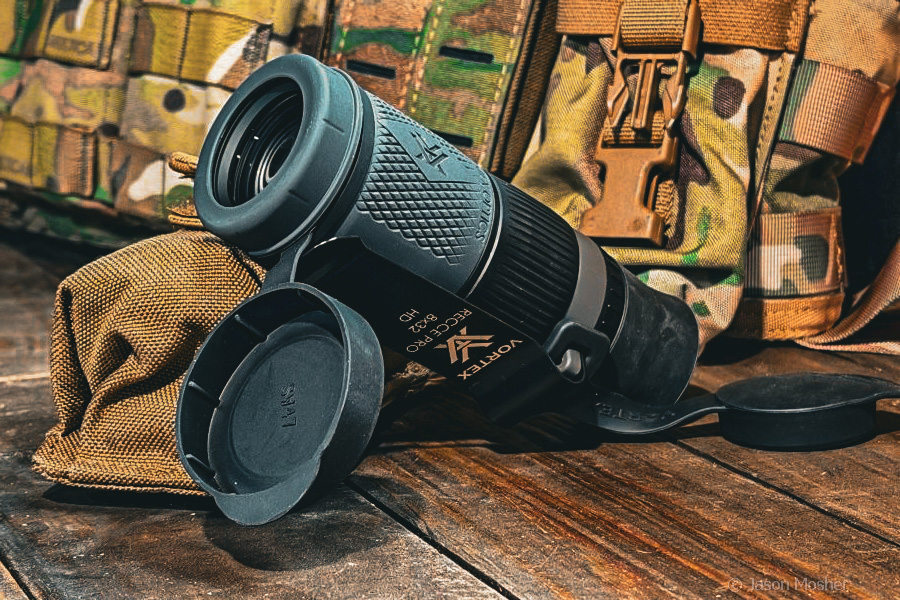
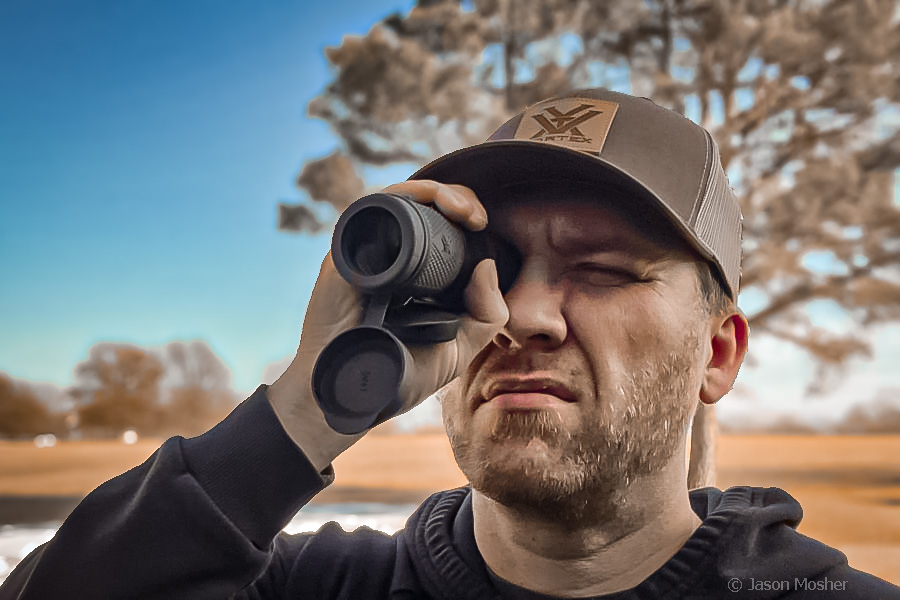
But we’re not here to talk about customer service, were here to look at the RECCE Pro 8X32 Monocular. I have several pairs of hi-power binoculars, but sometimes those are just too big and bulky to carry around. That’s why I find myself carrying around a monocular a lot of the time. For a while, my go-to monocular has been the Vortex Solo 10X36, but the RECCE Pro HD has some added features that I really like.
Vortex RECCE Pro HD 8×32 Monocular
The RECCE Pro HD is a multi-use monocular that runs on a premium XD (extra-low dispersion) glass. This provides crisp, high-contrast images at longer distances. It has multi-coated lenses, which increase light transmission, making it more effective even in low-light conditions. I’ve used my Vortex Solo as a comparison, and the difference is noticeable in the evening hours.
While I like compact gear, the Solo can be hard to adjust because it’s so short. The REECE is a little longer overall and has a wide focus adjustment sleeve in the middle of the tube. That makes it much easier to adjust quickly.
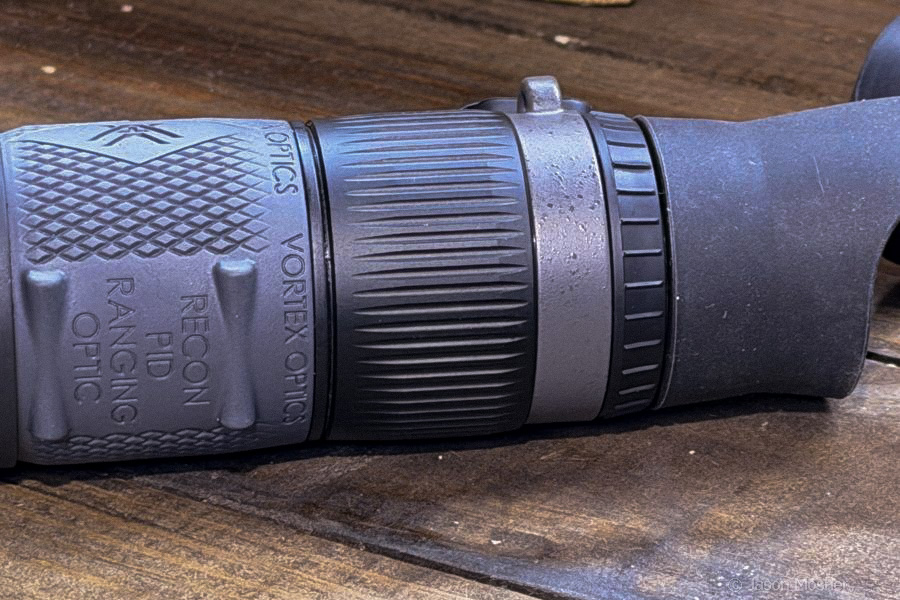
A textured rubber coating gives it a better grip than the Solo as well. As you’d expect for a higher end monocular, the O-rings are sealed and argon purged. That helps keep it waterproof and fogproof. Vortex used an Armortek coating on the lens which is protects the lens from scratches.
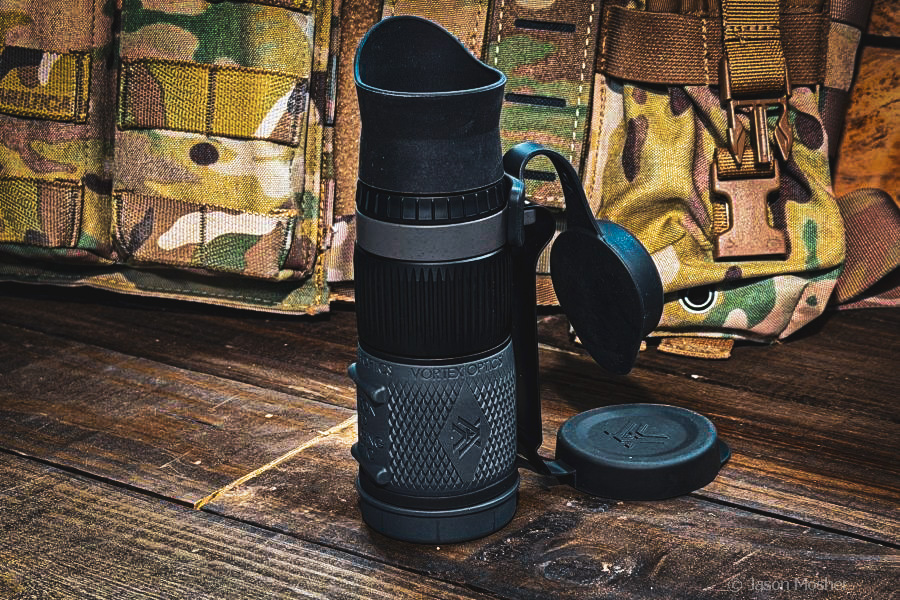
A flared eyecup helps keep light out when using the RECCE, but you can fold it down for use with glasses. One of the biggest features, however, isn’t the adjustment sleeve or texturing, it’s the reticle used in the RECCE. It has a hash-marked reticle with MRAD subtensions for ranging, holdover, and windage corrections.
Specifications:
- Magnification: 8x
- Objective Lens Diameter: 32 mm
- Eye Relief: 14.5 mm
- Exit Pupil: 4 mm
- Linear Field of View: 400 feet at 1,000 yards
- Angular Field of View: 7.6 degrees
- Close Focus: 5 feet
- Length: 6.0 inches
- Width: 2 inches
- Weight: 10.5 ounces
- MSRP: $559.99
MRAD Subtensions and Ranging
One of the main uses for the REECE Pro HD for me is rapid range estimation. To range an object, you first need to know the targets’ approximate size in inches or meters. By aligning the hash marks on the reticle with the target, you can calculate distance. This is done by using a formula for either inches or meters. This method does require some math so how efficient someone is can depend on their ability to do math quickly.
My law enforcement background was in small arms and not long-rang shooting. So of course, using this system takes me a bit longer than others. I have a friend that can look through his REECE and tell me how far a target is within seconds.
One thing that is helpful for the long-range calculating challenged people like me, is the “quick ranging” silhouettes in the bottom right of the lens. It may not be as exact as doing the math, but they get you in the ballpark quickly.
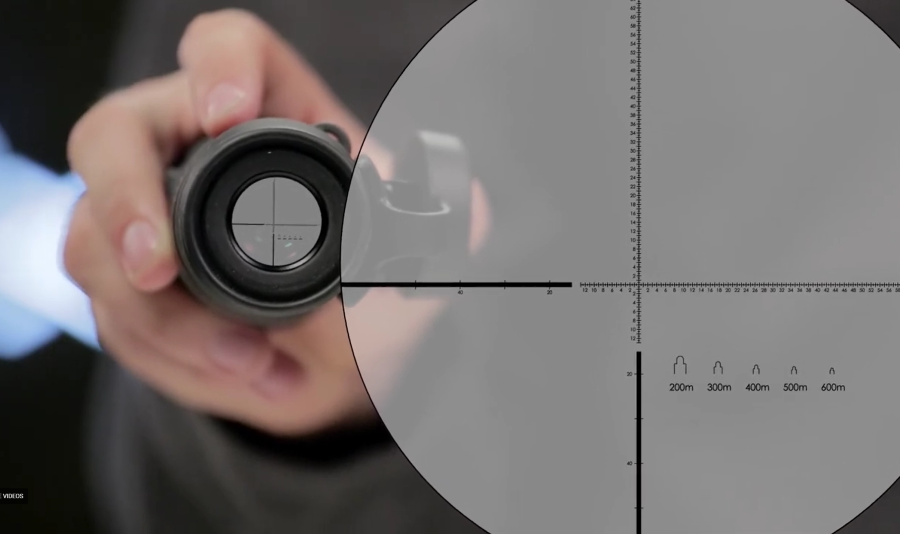
I’ve seen people use different methods for calculating distance using MRAD reticles, but here is the formula I have always used.
Ranging a Target
Multiply the targets estimated size in inches by 27.77 and then divide that total by how many mils (hash marks) the object spans in your reticle. For example, if your target is 36-inches tall, it would look like this:
- Multiply 36 X 27.77 = 999.72 (I’d round to 1,000 for easier math).
- Check the span in your reticle. In this case, let’s say the target spans 2 hash marks on the reticle.
- Divide 1000/2 = 500
- Your target is about 500 yards away.
Of course, this formula is used for yards and not meters. And again, I’m not a long-range shooting guru so if that is not correct, let me know.
Practical Applications
This is a great tool for hunters and even military personnel. But it’s also great for hiking, birdwatching, spying on your weird neighbor, etc. Okay, you shouldn’t spy on your neighbor, even if he is weird.
Another thing to consider is that in some types of emergencies, electronics may fail to work. With all the technology we have available to us today, who needs to calculate distance manually right? But what if your rangefinder stops working and “stuff” really hits the fan. This tool and — the knowledge to use it — could be very beneficial.
What’s in the box?
My RECCE Pro HD comes with a lens cloth, manual, and as I stated above, lens covers. But it also came with a heavy-duty MOLLE pouch…a nice touch and something I will actually use. A lot of gear comes with a thin nylon pouch or case that isn’t really good for much of anything but keeping it safe in the box.
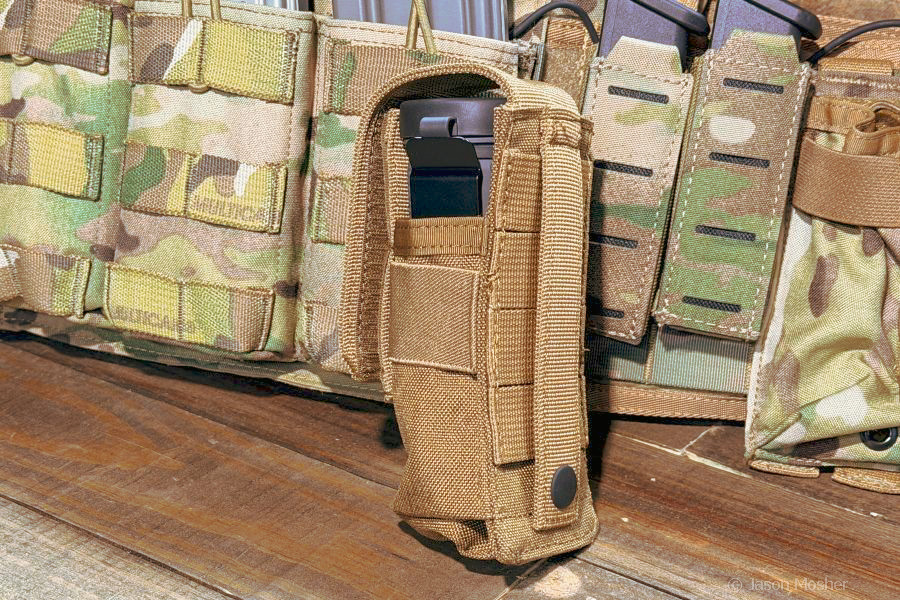
The RECCE also has a heavy-duty metal clip that’s perfect for attaching to it to your belt, vest, or backpack. I put the carrier on my vest, but also like that I can take it on other trips using the metal clip.
Overall, this is a great high-end monocular for the price. I’ll still use my Solo as an emergency monocular in a vehicle or go-bag, but the RECCE will be my primary.
not bad. 6″ x 2″ seems large enough to be at least a 10x though. when i read meters the little russian steel 8x prism monoculars were indespenseable what with locked gates and great danes. and i can close my hand around one of those.
some guys just cut binos in half.