

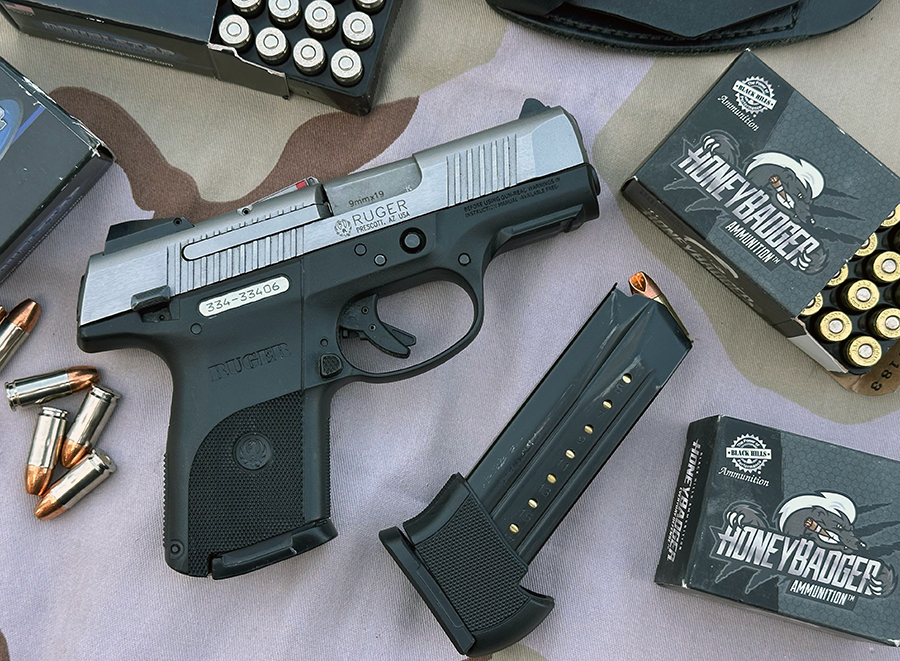
If you have been paying attention to the gun community lately, you will know that there is a bit of a kerfuffle going on between our friends at Sturm, Ruger, Inc. and our Italian friends at Beretta. Without getting into all the he said/she said, I thought this might be a good time to dust off a blaster from Ruger and consider where we are now versus where we were not so long ago.
Ruger SR9C Compact
Although officially discontinued in 2017, for what we can only assume was to make room for the newest, latest thing, the Ruger SR9C pistol did indeed have a good reputation in the community. A striker-fired, polymer-framed gun, the SR9C was one of many affordable or “priced-right” self-defense or home defense handguns on the market. For those who were not paying attention back in the “aughts,” the original full-sized SR9 had a voluntary recall in ’08 and a trigger redesign fixed the potential problem.
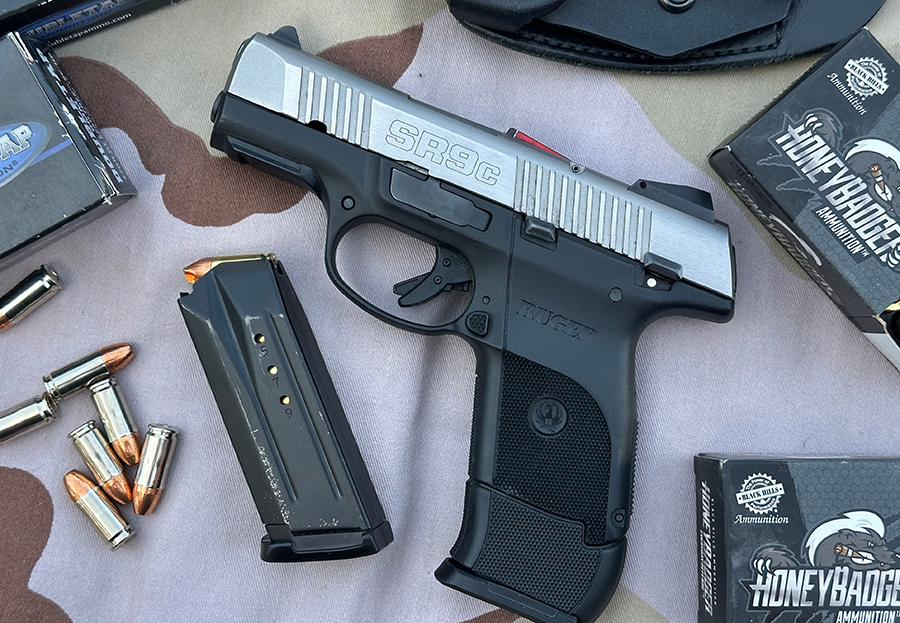
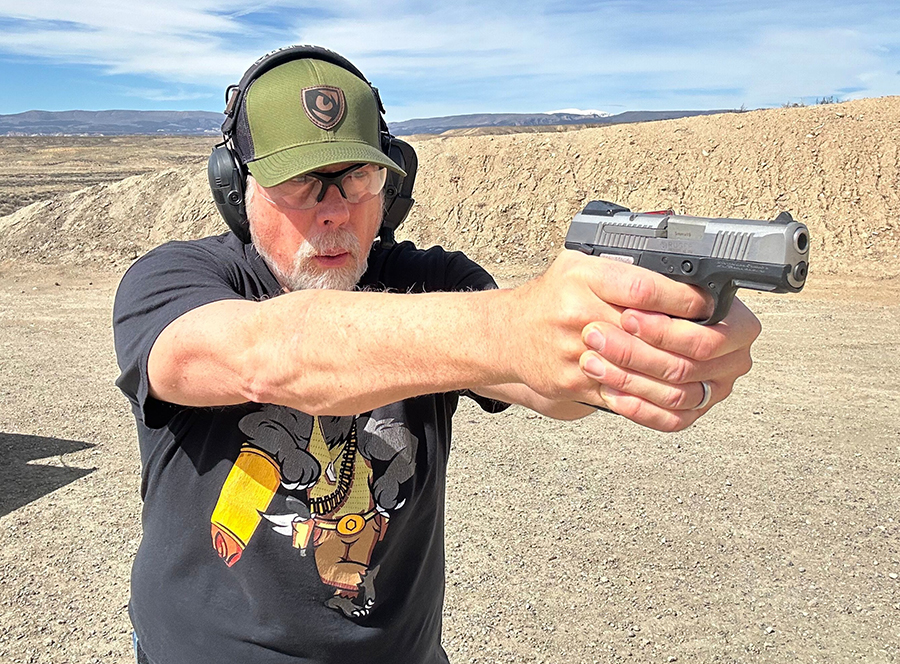
The SR9C model featured herein has a stainless steel slide mated with a black polymer frame. Out of the box you received two magazines; a flush 10-round version for compactness and a 17-round version with a magazine “grip adapter” or spacer if you will to fill in the gap when the long 17-round mag stuck out of the bottom of the frame. While not all that exciting on the face of it, the magazine adapter was in fact an interesting and inexpensive way to extend the frame so that I felt and functioned like a full-size pistol. The compact slide/full-sized frame design made popular with the release of the Glock Model 45 had yet to be fully realized when Ruger introduced the SR9C in 2010.
As you would expect, the SR9C had all the safety features needed to keep the Ruger attorneys happy. Atop the slide is a loaded chamber indicator with red paint that warns you that the chamber is indeed loaded when it is sticking up. An ambidextrous manual safety is found at the rear of the frame in the “up for safe” and “down for fire” configuration. Also, as the SR9C is a striker-fired gun, the trigger has the ubiquitous trigger safety lever found on all such guns except that one pistol from New Hampshire that is prone to self-starting.
The magazine release button is located in the normal place directly to the rear of the trigger guard and is truly ambidextrous and you can use it from either side right out of the box, you don’t need to flip it from one side to the other. Only one other control is found on the SR9C and that is the slide lock lever found in the typical location. At the top the slide is a fixed front sight with white dot and Ruger used their sloped adjustable rear sight configuration. I found that the gun was right on from the factory at ten yards so I never messed with the rear sight.
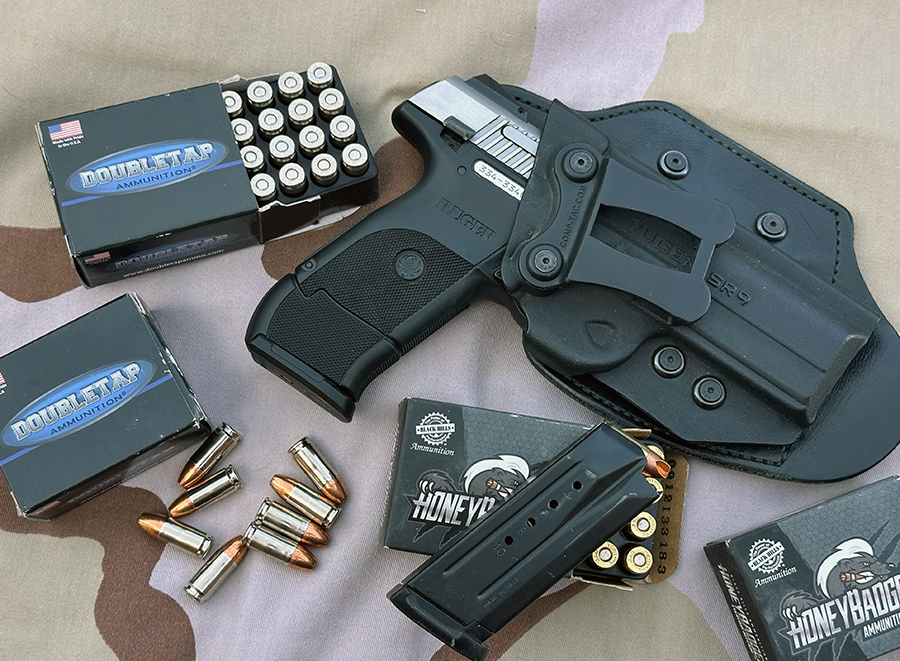
As the SR9C was marketed for both concealed carry and home defense, the ability to alter the profile of the pistol by choosing either a compact (short) ten round magazine or the full-sized seventeen round version with the adapter seemed to be one of those value-added sales options that would attract buyers. I have long since misplaced the original box in which the pistol arrived, but I seem to remember that there was an extended base (finger rest) that could be put on the compact magazine. I’m sure that item is in one of several boxes of gun parts in my garage.
Range Time
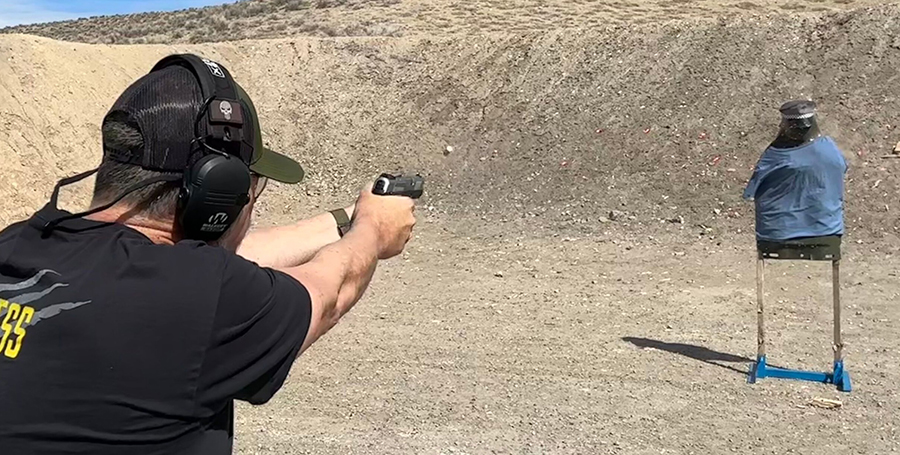
When I first picked up the SR9C I acquired a concealed carry IWB holster for it from Comp-Tac. This was their leather/kydex combo, which I confirmed is their Infidel Ultra Max by checking the website. I took that holster to the range along with a variety pack of 9x19mm ammunition from DoubleTap Ammo and Black Hills Ammunition. Naturally, my OD green steel ammo can had a bunch of loose rounds rolling around, to include some of the gray-steel FMJ loads. I celebrated St. Patty’s Day by blasting away with this classic Ruger pistol.
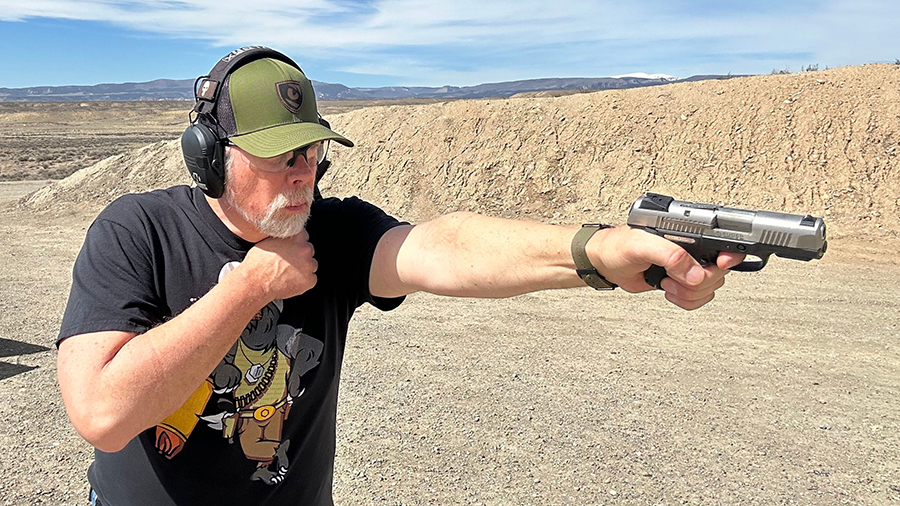
It truly has become redundant to report that a modern pistol chambered in 9mm NATO cycled all manner of ammunition from FMJ to a variety of controlled-expansion rounds, in both supersonic and subsonic configuration, but it did. Younger readers, as in those under forty years old, likely do not know the struggles of their fathers and grandfathers when it came to handgun reliability.
When semi-automatic handguns became popular with American shooters, the only way to guarantee reliable function was to shoot full metal jacket ammunition. Just as gun makers began to sort out the reliability issues of pistols chambered in 9mm and .45 ACP, along came the .40 S&W cartridge to screw everything up. I don’t believe my editor will ding me for hyperbole when I tell you that compact and subcompact pistols in .40 were generally horrible across the board, regardless of maker. The biggest exceptions were the Glock 23 and 27, but even those guns would break if you shot them enough. The service pistols chambering .40 S&W would wear out their recoil springs quickly and then all manner of problems would occur.
Now that we have gone through a two decade “growing pains” period, factory handguns are legitimately the most reliable that they have ever been in history, particularly the inexpensive ones. Yes, the Ruger “SR” series was available in .40S&W. I wouldn’t give you a warm cup of urine for one of those.
Using the two included factory magazines from Ruger, I split my range time shooting with the compact and full-sized versions. When the flush-fit magazine was in place, my pinky finger dangled off of the bottom which is not ideal, but it did not hamper function of the pistol, it just made it perceptibly a bit more “flippy” if I can use that term.
With the 17-round mag in place with the grip adapter, the SR9C was a pleasure to shoot. It just felt right. I deliberately holstered the pistol with the safety in the “on” position and practiced disengaging it on the draw. Although the safety lever is small, the action of the safety was a very positive on/off click. Some folks have stated that they don’t need a safety with a striker-fired gun so they just leave it in the “off” position. To which I would offer, if you don’t practice swiping the safety off, sooner or later it will be in the “on” position and you will be standing there wondering why your gun won’t go “bang.” I probably could have spent all day running drills, but I needed to attend to some chores and get this piece finished.
Parting Thoughts
While the SR9C has gone the way of the dodo, at least from a newly manufactured standpoint, Ruger sold a lot of them and they are still out there in the wild. Despite all of the features on the SR9C, one has to wonder if Ruger could move them in today’s market. There is no way to mount a red dot on them, they don’t have flared magwells nor do they have superfluous holes carved in the slide so you can see your barrel. I mean, how are you supposed to shoot a handgun if you cannot see through the slide to look at your barrel? Additionally, Ruger forgot that the massive recoil of the 9mm cartridge needs to be tamed with gas-ports and compensators.
If you happen to find one of these pistols in the aftermarket, it should treat you right. I’m seeing them listed in the $300 to $400 range.
Paul G. Markel is a combat decorated United States Marine veteran. He is also the founder of Student the Gun University and has been teaching Small Arms & Tactics to military personnel, police officers, and citizens for over three decades.