

As Minnesota’s self-proclaimed only independent, statewide grassroots organization dedicated to “preventing gun violence through community-led solutions, advocacy, and education,” Protect Minnesota’s message is filled with the usual misrepresentation of data. Protect Minnesota, in partnership with the far-left antigun Violence Policy Center, released Gun Death in Minnesota: A Six-Year Trend Analysis, 2018–2023, presenting it as “the most comprehensive data available” on firearm deaths in the state. The study leans heavily on the language of “public health crisis,” using survivor stories and photos to tug at heartstrings and pull readers toward a predetermined political conclusion.
But for those who read past the headlines and dare to investigate the tables and figures, the report repeatedly undercuts its own narrative. The authors acknowledge that both firearm suicide and firearm homicide rates in Minnesota have decreased in recent years, even as they frame the state as spiraling deeper and deeper into gun violence.
This omission isn’t a minor oversight. It’s the central problem with this and many gun control reports: The numbers contradict and undermine the gun control rhetoric.
Suicides Drive the Totals, Even With Lower Than National Rates
The report’s first table shows 525 total firearm deaths in Minnesota in 2023, the majority of which are suicides, and is used to show increases in all firearm-related deaths. However, two pages later, the authors concede that Minnesota’s overall suicide rate is similar to the national rate, while its firearm suicide rate is lower than the national firearm suicide rate.
In plain language, that means Minnesotans struggle with the same mental health pressures as the rest of the country, but are less likely to die by suicide with a firearm. If you’re honestly trying to understand what’s killing people, that points squarely to mental health, social isolation, substance abuse and access to care – not to some uniquely dangerous “gun culture” in Minnesota.
Yet instead of following the data toward better mental health interventions, the report repeatedly folds suicides into a generic “gun violence” label and pivots toward sweeping firearm restrictions. That is policy first, evidence second.
Manipulating Age Bands to Inflate Youth ‘Gun Deaths’
One of the most striking choices in the report is its treatment of Minnesotans age 0-24, grouping children, teenagers and young adults into a single “24 and younger” category. The authors then highlight that firearm homicides in this band nearly tripled between 2014 and 2021.
But the same section admits that firearm suicides among those 24 years old and younger peaked in 2018 and fell back to 2.1 per 100,000 by 2023, returning to the same level as 2020 after only slight upticks in 2021 and 2022. When you track the period covered by the report, firearm suicides in this 0–24 group have actually declined by roughly 40 percent since 2018, with no sustained upward trend.
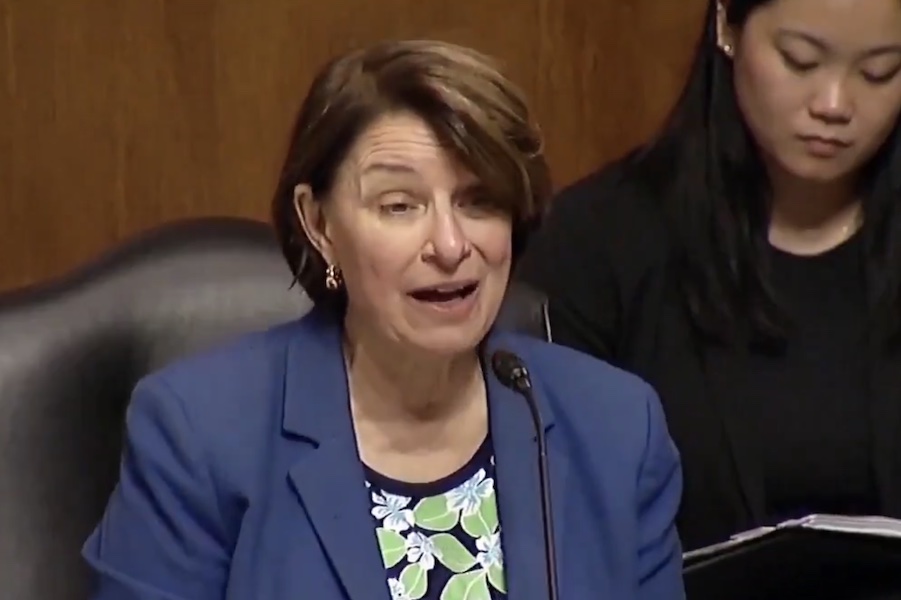
Lumping a 24-year-old gang member into the same bucket as a grade school child isn’t neutral analysis. It’s a deliberate framing choice that prioritizes drama over clarity, obscuring the distinct risks and causes at play for small children versus young adults. This is an old and common tactic of gun control advocates to drive support for gun control legislation, here to increase the required age to purchase a firearm to 21. That’s something U.S. Sen. Amy Klobuchar (D-Minn.) has been pushing over and over and over in recent weeks.
Lowest Gun Death Rate in the Great Lakes Portrayed as a Cautionary Tale
Perhaps the most damning contradiction in the report is tucked into Table 4. Comparing Minnesota to other Great Lakes states, the authors admit Minnesota has:
- the lowest overall firearm death rate in the region,
- the lowest firearm homicide rate, and
- the second lowest firearm suicide rate (behind Illinois).
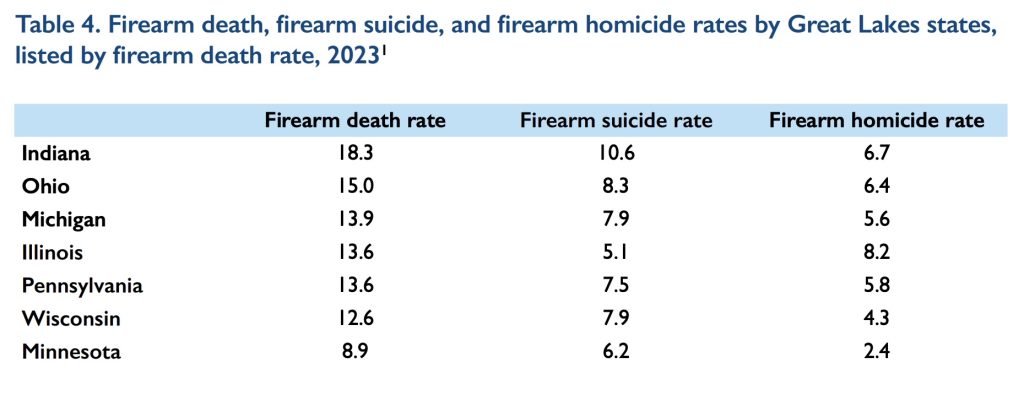
Independent summaries of the same data echo this: Minnesota’s firearm death rate is about 8.9 per 100,000 people – the lowest among Great Lakes states and significantly below the national rate, which is around 13.7 per 100,000. Researchers from Johns Hopkins University that Minnesota has one of the lowest gun homicide rates in the country as well.
Most Minnesotans would view that as relative success, especially given national trends. Instead, Protect Minnesota treats it as proof that the state is failing and must rapidly enact the Violence Policy Center’s gun control wish list.
Targeting Lawful Owners, Not Violent Criminals
The data actually prove Minnesota is performing better than the national average – and best among its regional peers. Yet Protect Minnesota is campaigning to weaken the federal Protection of Lawful Commerce in Arms Act by carving out exemptions that would invite lawsuits against lawful manufacturers and retailers for the criminal misuse of their legal and lawfully sold products. They want to erode Minnesota’s firearm preemption statute so cities can create a patchwork of local gun regulations, a move they explicitly decry in their own “Gun Facts” materials.
By treating the state’s relatively low firearm death rate as a “crisis,” by conflating suicides with street crime and by burying declines in violence under emotionally charged anecdotes, the authors build a narrative designed to justify lawsuits aimed at driving lawful gun retailers and makers out of business, dismantling uniform statewide gun laws and restricting or banning common firearms owned by law-abiding citizens.
None of this is about carefully targeting violent offenders who drive the majority of crimes. It’s about normalizing the idea that the Second Amendment itself is the problem.
Minnesotans Deserve Honest, Straightforward Data
A report that admits Minnesota has the lowest firearm death rate in the Great Lakes, that its firearm suicide rate is lower than the national rate, that its homicide rates are lower than national figures and that key measures have declined since their peaks – while simultaneously insisting that gun ownership is a runaway “public health crisis” – isn’t honest scholarship. It’s a political document designed to advocate for more gun control.
Minnesota, their new motto : ‘Come for the trans, stay for the fraud’.
“…and firearm homicide rate…”
One of the favorite deception tricks of anti-gun is to use the term ‘Homicide’ without defining it by qualification. Is it ‘murder homicide’ or ‘manslaughter homicide’, or ‘justifiable homicide’ which is also known as legal valid self-defense (and defense of others, or defense of home which is actually defense of self or others in the home thus the term ‘home defense’)?
For example, look at the ‘Table 4’ pic and tell me which type of ‘firearm homicide’ it is. You can’t, but if you read what Minnesota did you see this attempt to make the term ‘homicide’ mean ‘murder homicide’ and they know when people see the term ‘homicide’ they will think ‘murder homicide’ from the way its written.
‘Homicide’ (used by its self without qualification) is a general term, not a stand alone category for determining rates of occurrence of specific acts like the anti-gun want to imply it means murder. The term refers to noncriminal acts, as well as the criminal acts of murder or manslaughter. Some homicides are considered justifiable, such as the killing of a person to prevent the commission of a serious felony or to aid a representative of the law or in self-defense (and defense of others, or defense of home which is actually defense of self or others in the home thus the term ‘home defense’).
Its impossible to determine ‘rates’ of occurrences of ‘something’ without defining what that ‘something’ is.
There are terms that need qualification to de defined to have an actual meaning, absent such qualification the term means nothing. The term ‘Homicide’ is one such thing. By its self it is ‘undefined’ because it needs qualification to define it so stand alone as a term it can’t be used to determine ‘rate’ of an occurance. Yet that’s what anti-gun do in their stuff, its statistical deception.