
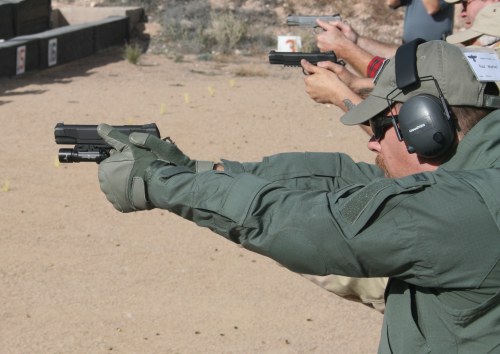
Lots of people on social media seem to have grave concerns as to the “maximum effective range” of certain defensive handguns. Comments are typified by fantasies about the distance at which the legal concept of self-defense is no longer available, with some definitions of “practical range,” and the imagined effectiveness of various caliber/cartridge/bullet type combinations at various distances. Don’t forget the trope that “all self-defense situations happen within (fill in the distance here).“
As to litigation or prosecution concerns, as always, consult your state’s statutes. As to whether someone at a particular distance can present a credible, imminent deadly threat, that’s a matter for the trier(s) of the fact…AKA the jury, unless it’s a bench trial.
As to “it all happens close,” consider that your attacker has a vote in the matter. It’s the offender who determines when and from where a situation turns deadly. There are cases where those distances are significant. Anyone who tells you that “if you shoot beyond (whatever distance), you’ll have a lot to explain yourself” forgets that any time if you use deadly force to stop an immediate threat, you’re going to have a lot to explain.
To address these actual issue requires defining some terms and, frankly, some guesswork. Definitions are easily found, so let’s start there.
“Maximum effective range” has a meaning outside the gun shop and is well explained in a US Army Reserve video by CW2 Andy Knote. It’s the distance at which “… the average trained soldier is expected to be able to produce hits on a man-sized target 50% of the time.” This is as opposed to “maximum range,” which is the longest distance at which a projectile still has lethal capability.
The more general definition is by the Department of Defense War: “The maximum distance at which a weapon may be expected to be accurate and achieve the desired effect.” (Dictionary of Military and Associated Terms. US Department of Defense)
There are some factors in assessing effective range issues. The first is the ability to visually identify an immediately lethal threat that requires shooting. If you can’t see well enough to positively identify the threat, the ‘max effective range’ issue of the firearm in question is the least of your problems. If it’s truly a self-defense issue and not a looking-for-trouble issue, you’ll move away or get behind cover (time = distance + obstacles: Dennis Tueller).
Next, what’s the user’s ability to accurately fire the handgun? The objective isn’t hitting a “man-sized target,” as in the military, but hitting a particular spot on an attacker who’s moving to kill you right now. We’re shooting a defense handgun (a “pitiful little popgun,” as it’s all too frequently called). The accuracy standard is far more than “just anywhere on that huge B-27 target.”
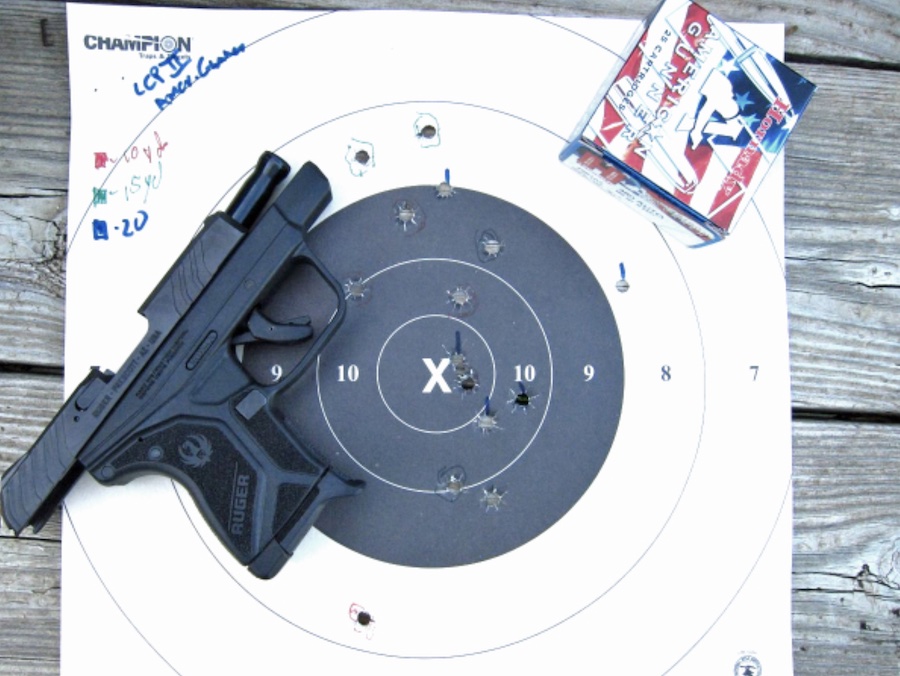
Then there’s the issue of that accuracy level being attained “50% of the time.” That’s a horrible plan for police and civilian defenders.
Misses are a problem. They 1) endanger other people, including the uninvolved, 2) embolden the aggressor, and 3) waste time that you don’t have. I propose another standard: 100% shot accountability, zero misses. That’s rounds into the violent attacker who’s providing the service of being the ballistic backstop.
That one hundred percent ideal standard applies operationally. You will miss on the range. At least everyone I’ve ever known, including me, will miss on the range. The range is a place to determine our capabilities in the best-case scenario.
Knowing your capabilities in ideal conditions and spinning up your skills such that they become reflexive allows you to slow down, settle, and work slowly. Absolute precision as the last thing you do before you leave the range. My oft-quoted source MSG Paul Howe explains – and I often repeat – that you learn slowly, pick up speed, then slow down that last few reps before policing up, cleaning up, and making ready for the real world.
Go slow for form in learning. As you proceed in practice, pick up the pace to operational speed – shooting in assessment time. Finally, settle in and finish slowly for perfect form.
Using this body of techniques, you can determine your real world maximum effective range. Is it staying within the C-zone at fifty yards? Is it staying within the 6×6 head box at 25 yards? Until you work that out, you won’t know. And learning it on the street is a really bad plan.
Conversely, asking internet keyboard warriors isn’t much of a plan either.
What is the actual practical range of you and your handgun? Go and find out.
If you are law enforcement, you may have to engage at longer ranges; however, as a civilian, your first duty is to escape the situation. At longer ranges, you should back out of the situation and call 9-1-1. Ranges in which you cannot escape and must defend yourself with force are very close. According to F.B.I. studies, 85% of self-defense shootings occur at 21 feet (7 yards) or less. Within this, the bulk cluster at 3-5 yards, reflecting sudden, close-quarters threats like muggings or home invasions. Even law enforcement shootings run from 0-5 feet (for officer assaults) and 3-10 yards overall. Don’t engage targets you are not positive you will hit. You could easily end up in prison for manslaughter if you hit a bystander. Civilian gun engagement with criminals should only be as an absolute last resort to protect yourself or others.
“As to litigation or prosecution concerns, as always, consult your state’s statutes.”
To me, I’m concerned slightly less with local statutes, but far more on the politics of where the DGU actually happens.
A leftist-leaning prosecutor’s office looking to make a name for themselves in the future for a career in politics is, by far, my greatest concern…