

The NFA “contains no regulation other than the mere registration provisions, which are obviously supportable as in aid of a revenue purpose,” [Supreme Court, Justice Harlan] Stone added. “On its face it is only a taxing measure, and we are asked to say that the tax, by virtue of its deterrent effect on the activities taxed, operates as a regulation which is beyond the congressional power.” But “every tax is in some measure regulatory,” he said, and “a tax is not any the less a tax because it has a regulatory effect.” The Court refused to “ascribe to Congress an attempt, under the guise of taxation, to exercise another power denied by the Federal Constitution.”
Three decades later in Haynes v. United States, the Supreme Court upheld the prosecution of a man who was charged with possession of an unregistered “firearm” covered by the NFA. The petitioner, Miles Edward Haynes, unsuccessfully argued that the registration requirement violated the Fifth Amendment’s ban on compelled self-incrimination because he had a felony record that barred him from legally possessing guns. Consistent with Sonzinsky, the Court described the NFA as “an interrelated statutory system for the taxation of certain classes of firearms,” adding that Congress “apparently intended to guarantee that only weapons used principally by persons engaged in unlawful activities would be subjected to taxation.”
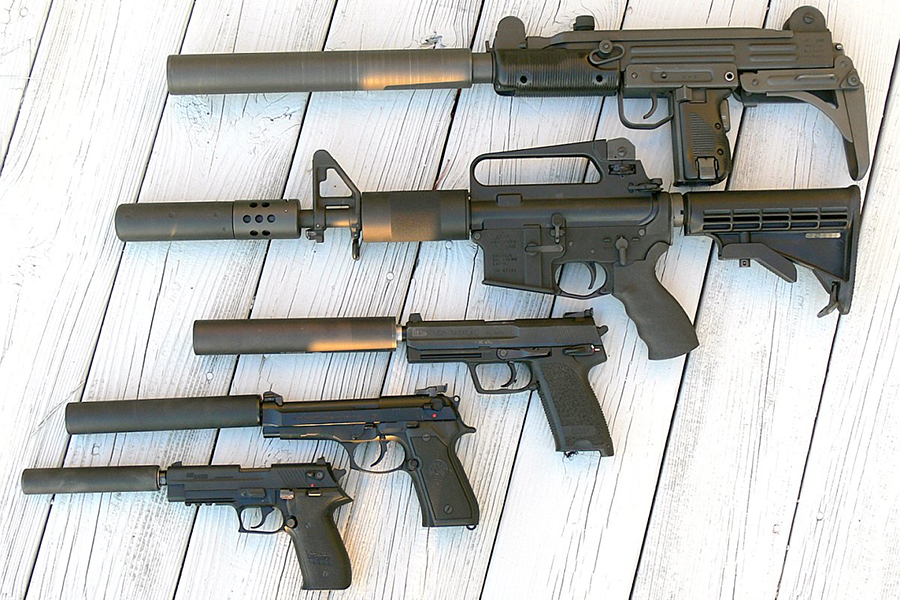
Given the Supreme Court’s reasoning in upholding the NFA’s registration requirements, what happens when three “classes of firearms” [suppressors, SBRs and SBSs] covered by that law are no longer subject to a tax? In Brown v. ATF, two gun owners, a gun dealer, the National Rifle Association, the Firearms Policy Coalition, the Second Amendment Foundation, and the American Suppressor Association argue that registration of those products no longer serves a revenue-raising purpose and is therefore no longer constitutional under the Court’s precedents.
“Without a tax as a foundation,” the plaintiffs argue in support of their motion for summary judgment, “the NFA’s registration provisions as applied to non-taxed NFA firearms are neither a tax themselves nor necessary and proper to levying a tax and are, therefore, unjustifiable as an exercise of Congress’s taxing power. That the NFA can no longer be justified as an exercise of Congress’s taxing power and is thus unconstitutional should be the end of this matter. Congress passed the NFA specifically based on its taxing power and the courts have understood the NFA and upheld it on that basis.”
— Jacob Sullum in This Gun Case Harks Back to Constitutional Concerns About the Limits of Federal Power That Now Seem Quaint
So where is the NRA on this issue???
Have they called for their members to contact their congressional representatives and Senators?
Or are they only concerned with the very wealthy machine gun collectors?
Human innovation and technology are really making the modern machine gun obsolete.
Ever since the kerfuffle surrounding Marion and WLP settled down a few years ago, I’ve heard and seen almost nothing from the NRA. I canceled my membership long ago and have never looked back.
Substituting tendentious rhetorical questions asked behind the NRA’s back for your failure to personally contact the NRA and honestly ask straight up is… irresponsible.
OK. you are correct.
I will add my name to the hundreds of other NRA members and former members. Like myself. Who have sent letters to the NRA.
Asking if they really care about firearms safety??
Because a suppressor IS A SAFETY ISSUE.
They make shooting a gun even safer. For your ears.
It needs to be stated that protecting your hearing has only become a concern since I think the early 1990s.
And suppressors do work on revolver handguns. As long as you use the correct ammunition. I know because I have personally tried it.
And it’s what I use to introduce new shooters to firearms.
The NRA board members all have hearing damage. Because they all grew up without using any hearing protection. So I don’t believe they really care about suppersors at all.
They have shown no interest in them in the past. And the are not featured in any of the NRA publications.
Circa 1928:
In the 1928 case Nigro v. United States, the [SCOTUS] justices rejected a challenge to the Harrison Narcotics Tax Act of 1914, saying it qualified as a revenue measure despite the manifest goal of prohibiting nonmedical use of opiates and cocaine. Writing for the majority, Chief Justice William Howard Taft acknowledged that ‘merely calling an Act a taxing act can not make it a legitimate exercise of taxing power’ when ‘the words of the act show clearly its real purpose is otherwise.’ But he rejected the argument that the Harrison Act was a transparent cover for exercising police powers that Congress was never granted, deeming the law’s official rationale and the ‘substantial revenue’ it raised enough to make it constitutional. That stretch, University of Cincinnati law professor A. Christopher Bryant argued in a 2012 Nevada Law Journal article, qualified as ‘the most disingenuous Supreme Court opinion, ever.’
Circa 1934:
Testifying in favor of the National Firearms Act (NFA) in 1934, Attorney General Homer S. Cummings noted that the federal government ‘of course’ had ‘no inherent police powers to go into certain localities and deal with local crime.’ Rather, ‘it is only when we can reach those things under the interstate commerce provision, or under the use of the mails, or by the power of taxation, that we can act.’
Cummings explained how ‘the power of taxation’ worked in this context: ‘If we made a statute absolutely forbidding any human being to have a machine gun, you might say there is some constitutional question involved. But when you say, ‘We will tax the machine gun,’ and when you say that the absence of a license showing payment of the tax has been made indicates that a crime has been perpetrated, you are easily within the law.’
In other words, “taxation”, “interstate commerce” [and mail], can be used to give the federal government ‘policing power’ it does not constitutionally have.
That is what happened with the Gun-Free School Zones Act (GFZA) of 1990 (enacted as part of the Crime Control Act of 1990). In the 1995 case United States v. Lopez, SCOTUS ruled the 1990 GFZA unconstitutional noting that it “neither regulates a commercial activity nor contains a requirement that the [gun] possession be connected in any way to interstate commerce.” Well, congress responded by adding references to interstate commerce which federal appeals courts deemed sufficient to solve the problem identified in Lopez. The federal government granted its self ‘police powers’ it does not constitutionally have by including ‘interstate commerce’ in the GFZA.
The Constitution doesn’t actually grant authority to Congress to legislate substantively for the general welfare, and no such constitutional authority exists. What does exist constitutionally is the general welfare may be promoted by the exercise of the constitutional powers that are granted. No where in the constitution does it grant the federal government general ‘police powers’, but does in specific contexts such as taxation or interstate commerce or enforcing federal laws.