


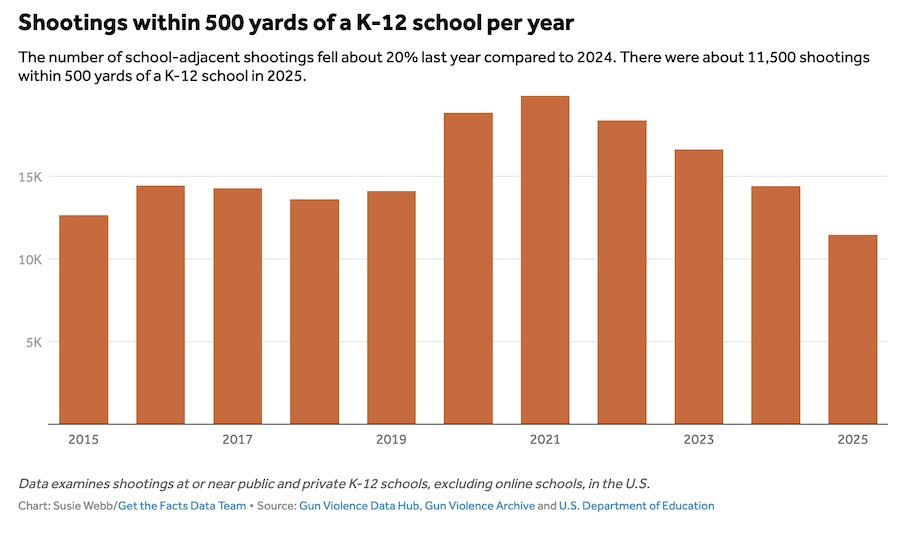
A recent news headline declared, “11,500 shootings occurred within 500 yards of US schools last year.” The obvious implication is that American school children are under daily fire on school campuses nationwide. But, as with most gun control narratives in national media written by reporters who mostly don’t understand the basics of firearms or criminal gun use, that narrative collapses under the slightest scrutiny.
The first glaring red flag in this story is that Hearst Television Data Visualization Journalist Susie Webb and the WCVB (“Boston’s News Leader”) Get the Facts Data Team built their agenda-driven narrative by relying on gun control advocacy site The Trace’s “School-Adjacent Shootings” dataset, which tracks data from the discredited Gun Violence Archive listing incidents that fell within 500 yards of a K-12 school. Even that dataset warns that each row is a shooting-to-school match and must be de-duplicated before anyone totals up the incidents, deaths or injuries.
However, that wasn’t done before Webb and WCVB’s story went live on several news outlets, on social media, on Hearst Television’s YouTube channel and it was even—unsurprisingly—picked up by MSN.
This blatant error isn’t a trivial methodological footnote. It’s the difference between measuring school-related crime and measuring a broad circle on a map. It’s also a trick that’s been seen time and again from the likes of Everytown’s propagandist at The Trace and GVA.
The Data Counts Matches, Not Unique Incidents
The central problem is in the dataset’s own limitations. Each row is a “shooting-to-school match,” meaning one shooting can be linked to multiple schools if several campuses fall within the 500-yard range. That’s a quarter mile. The dataset explicitly tells users they “must de-duplicate incidents” before totaling incidents, killings or other Gun Violence Archive fields. In plain English, the same shooting can be counted multiple times over. In dense urban areas like Chicago, Baltimore, New York City, Philadelphia and others with numerous schools packed closely together, that duplication risk grows.
Yet the media framing pushed a clean, dramatic national count: roughly 11,500 shootings in 2025 – or 31 a day – within 500 yards of schools. The republished report repeats that top line, paired with a narrative that naturally invites readers to think of school shootings in the plain sense of the term. But the underlying methodology does not support that leap. It supports only a location match between a GVA record and one or more school-radius circles.
‘Near a School’
The second problem is how “near a school” is defined. The Data Hub says the 500-yard perimeter is drawn from the school campuses’ center, not the edge of the property or the building boundary. For a small school, that means the captured area outside the school can be much larger than readers would assume. For a large campus, the opposite may be true. Either way, this is not a measurement of criminal violence on school property. It is a mapping exercise built around a center point.
That matters because the rhetoric surrounding these claims is designed to blur categories to support a gun control narrative. “School-adjacent” quickly becomes “school shootings” in the public mind. But a criminal shooting in a parking lot off a nearby street, an after-hours incident, a police intervention, an accidental discharge or a suicide within a 500-yard radius is not the same thing as an attack at a school. Despite the understandable media attention they garner, this basic examination of the facts shows the “School Adjacent Shootings” depiction is still statistically very thin.
The faulty database measures proximity. It does not establish that students were present, classes were in session or the school itself was the target. You could just as easily measure the from incidents to supermarkets or places of worship to paint a narrative to drive a preordained agenda.
Source Data Warning Labels
The records used in this story come from GVA, which relies on media, law enforcement and government reports. GVA has come under scathing criticism for stretching the truth of data and definitions to push an antigun narrative. WCVB itself even noted that the data “may miss some incidents or imprecisely report their locations.” The Data Hub separately warns users to be careful drawing conclusions from sparsely populated fields and acknowledges geographic discrepancies between GVA records and Department of Education school data.
That is a serious limitation for any project built around precise geographic matching. If location data can be imprecise, then claims about a shooting’s exact relationship to a school should be made cautiously, not turned into national alarm slogans.
The school data also has limits. The National Center for Education Statistics’ public school geocodes are based on the Common Core of Data, which NCES says is an annual collection. Private school geocodes are based on the Private School Survey, which NCES says is biennial. The Data Hub likewise says shootings from 2025 on were joined to the 2024-2025 school-year geotable. That means school listings and locations are not a live, real-time inventory.
So, when gun control advocates present these numbers as though they are precise and current down to the schoolyard, they predictably are overselling what the data can actually prove.
Inflated Narratives
This is where the policy problem starts. The public hears “31 shootings a day near schools” and is encouraged to picture students dodging bullets at recess. But the GVA data are more often than not actually criminal and gang activity near or after school hours, accidental discharges, suicides, police interventions near a campus and/or juveniles getting caught with a firearm at school. This means the methodology sweeps in a much wider universe of incidents with duplication risk baked in. Even WCVB’s own write-up says the toll includes suicides and suspects who were killed.
Lawful gun owners and the firearm industry support honest school safety discussions. Real threats should be identified accurately. Criminal misuse, illegal gun trafficking, straw purchasing, secure storage and violent repeat offenders being held accountable all warrant serious policy attention. That conversation is damaged when gun control advocates and willing media partners use bad-faith arguments and stretch a proximity database into a fear-driven narrative that overstates what happened and where.
The result is predictable: bad facts drive bad policy. The issue here is not whether crime near schools is serious. The issue is whether the public is being told the truth. On that question, the answer is clear. The methodology does not support the headline, and the headline does not deserve the public’s trust. We all have a right to expect more from those who hold themselves out as objective journalists.