

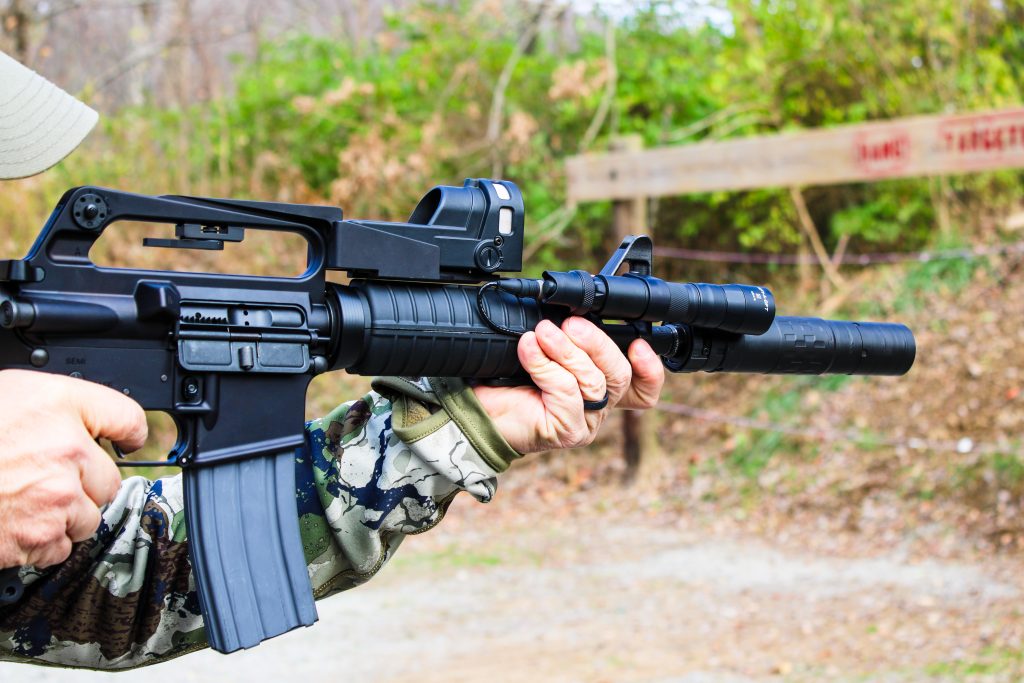
The ongoing debate over the ideal “truck gun” covers a wide range of options, including pistols, shotguns, AR-15s, and PDW-style guns. First, I use the term “truck gun” loosely. In general, this refers to a firearm (larger than a handgun) kept nearby. Whether it’s by your bedside, in the back of a vehicle, or riding shotgun in a side-by-side, the choice often depends on your environment. I see it as a matter of preference, heavily influenced by where you are—be it a large farm, a single-family house in suburbia, or a one-bedroom city apartment. Each situation calls for different gear. Comfort and familiarity are key—think about what you train with most: an AR-15, a handgun, or a shotgun. Your weapon setup should also be considered, with accessories like optics, lights, and slings serving specific roles. Even your ammunition and magazines must be confirmed and tested.
This idea, which isn’t new or groundbreaking, is one I’ve been working on for quite some time—trying different builds, ideas, do-overs, and spending way too many hours Googling and watching YouTube videos. So, for the inaugural article in this series covering the concept of a handy-defense gun/truck gun/end-of-the-world/Koreans-invade gun, I thought I’d keep it a little old-school. Because, of all things, the gun needs to be cool, right? That’s where the Harrington & Richardson Commando comes in.
Caveat: If you are interested in pursuing this concept, be sure to check local laws regarding the transport of guns in vehicles, particularly long guns and NFA items. States with concealed carry or constitutional carry tend to favor handguns. Things can get spicy when long guns and other scary items are loaded in vehicles. Now on with the show.
The Commando
Naturally, since it’s me, the project wasn’t going to be plain or generic. I like my firearms to have personal meaning and character. Maybe it’s my love of 80s action movies or my recent read of Jack Carr’s latest novel, Cry Havoc, that inspired this build, but choosing a Retro-style AR was the right move.
In 2020, Palmetto State Armory acquired the Harrington & Richardson brand. A year later, they purchased Nodak Spud. While these choices might seem unusual on their own, together they have built a strong presence in the retro AR scene. Many people may know H&R for their single-shot rifles, shotguns, and top-break revolvers. However, most are unaware that H&R was a key DoD contractor, producing M14s and early M16 and M4 variants. Meanwhile, Nodak Spud was a major producer of authentic clone parts for collectors and builders throughout the 2000s. As a result, Palmetto State combined H&R’s history with Nodak Spud’s expertise to offer a full line of retro ARs, which is why I ended up with an H&R Commando in 300 BLK.
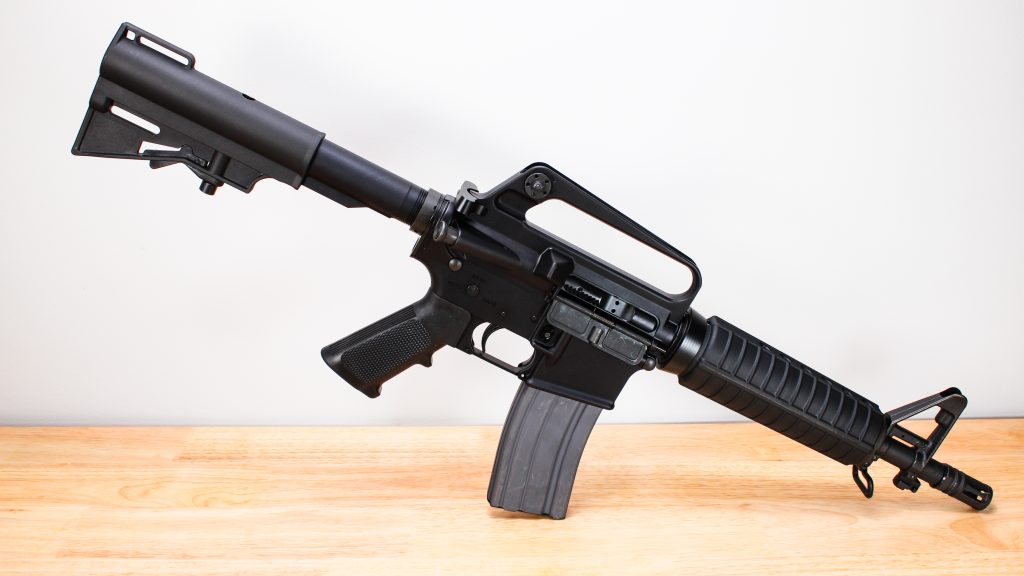
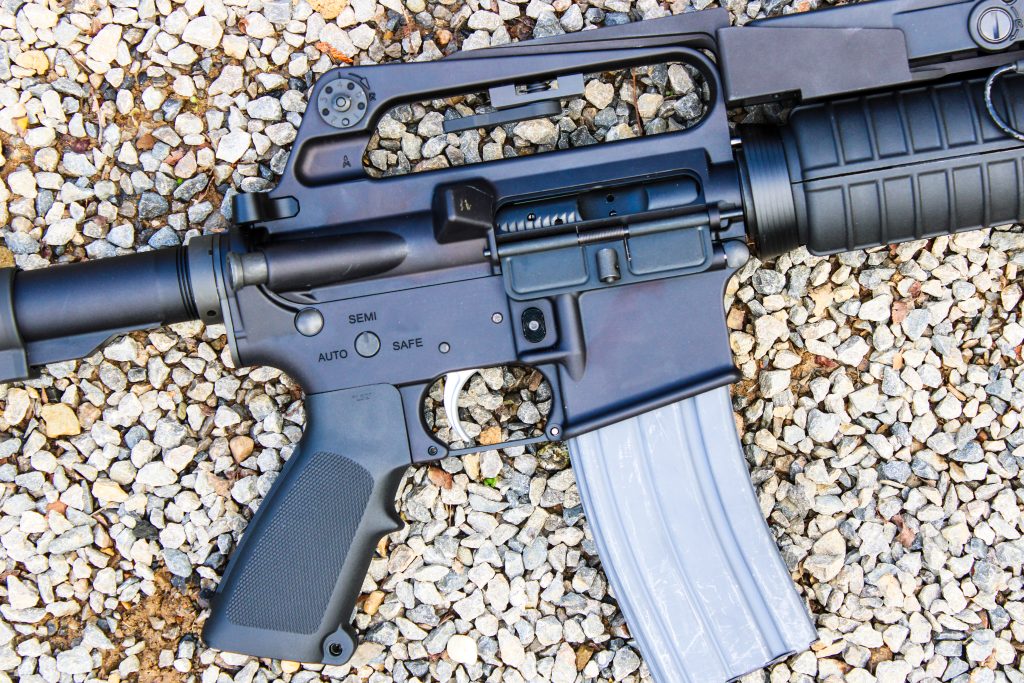
The Commando is a short-barreled AR-15 built for close-quarters combat and designed for special operations use. Most people recognize it from its role in the classic action film, Heat. The Commando is essentially a Colt 733—an evolution of the Vietnam-era XM177E2. This version from H&R features a 10.5-inch barrel, an A2 flash hider, and the HAR-15 brace, which resembles the classic CAR-15 stock. To me, it was the perfect starting point for the ultimate RETRO truck gun.
The Build
The following are the components I used to transform the H&R Commando. While it is great on its own, a few modern updates make it even better.
- Meprolight M21: A classic rifle build calls for a classic optic, right? Of course, you can look for a genuine retro optic, but they can be hard to find, and you often don’t know what you get until it arrives. The M21 first appeared in the early 2000s, when carry handles were still popular. While not perfectly clone correct, it still offers the vintage look I wanted.
- M21 Carry Handle Mount: Unlike mounting an optic on top of the carry handle, this positions the optic forward of the handle—like a cantilever. This method keeps the optic’s height over bore lower and aligned with the iron sights. The downside is that it shifts the firearm’s balance forward, making it slightly front-heavy, especially when a suppressor is added.
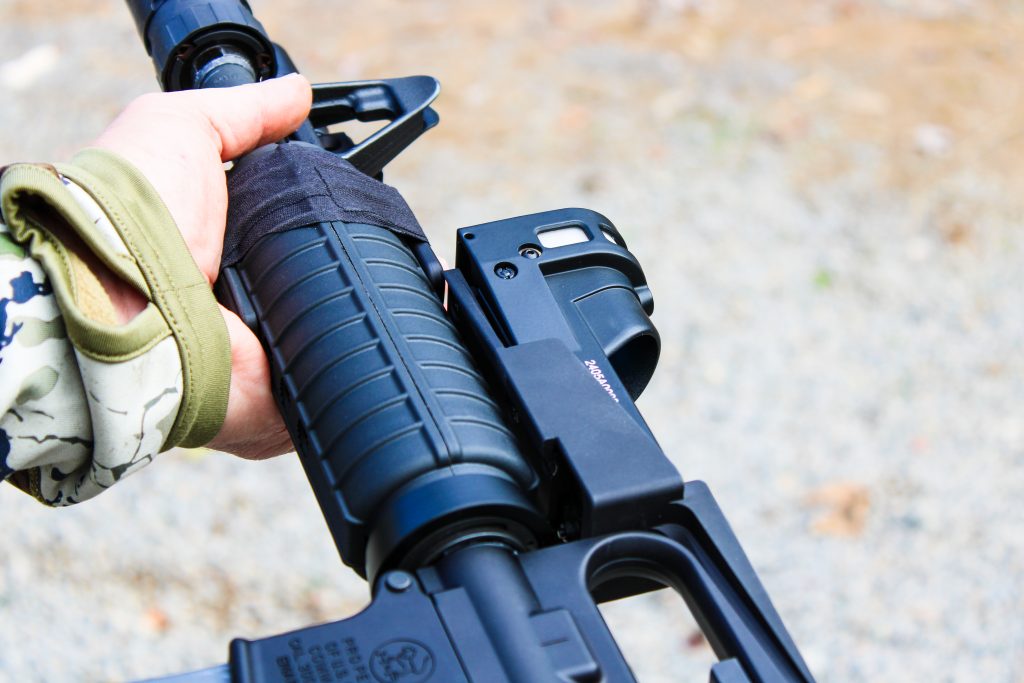
- ALG ACT Trigger: An upgraded version of a mil-spec trigger with less creep and a smoother overall pull.
- B5 Weapons System Retro Grip: Not period-correct, but it looks good. Plus, I find this grip to be very comfortable.
- Silencerco ASR Flash Hider: I’m using a Silencerco Omega 36M with a QD mount, so I need a muzzle device compatible with the Omega 36M. I generally prefer flash hiders to muzzle brakes on AR-style rifles.
- SureFire scout light and Turquoise Design Co. 18650 retro light body: The best of both worlds, old and new. This started as a SureFire Scout light. I removed the light head and tail cap and used a Turquoise Design Co. retro light body. This results in the classic SureFire 1-inch body look with all the modern features.
- IWC MOUNT-N-SLOT Light Mount: Since the Commando features a two-piece handguard, modern mounting systems are incompatible. Luckily, IWC (Impact Weapons Components) still makes accessories that fit into the handguard’s holes. This light mount positions the light perfectly around the front sight post.
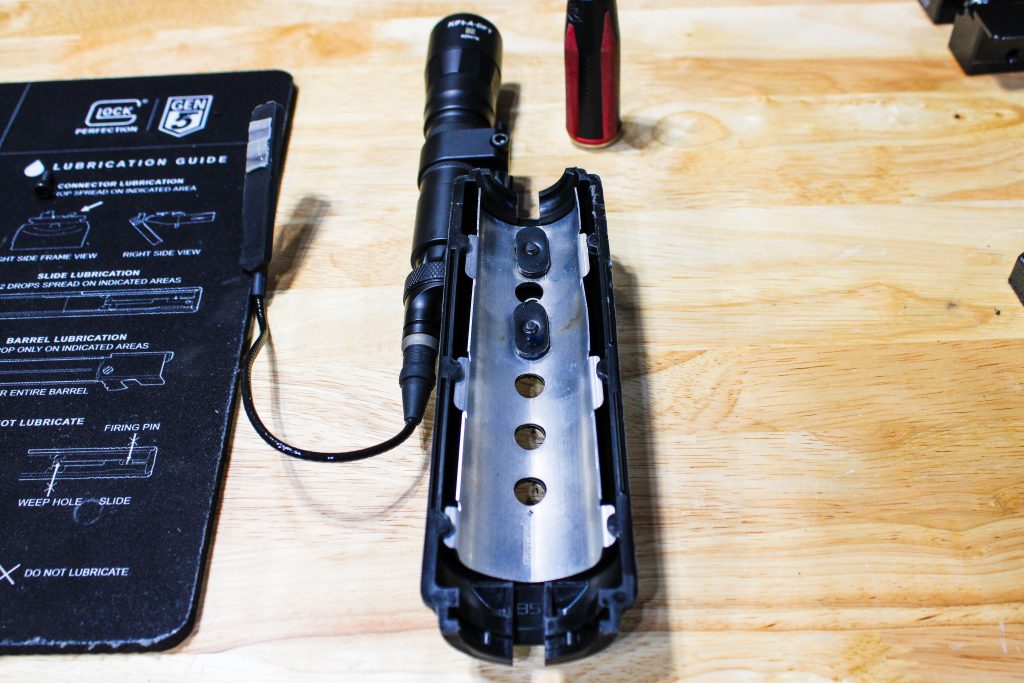
- Howies Hockey Tape: This is specifically for cable management. I might stick with the SureFire tape switch or move the light to the optic sight and use a click cap activated by my support thumb.
All of this comes together to create a practical, functional truck gun with a retro look.
Range Trip and Ammo Testing
The first range trip primarily involved functional checks and sighting in. Unsurprisingly, everything performed flawlessly. The optic was easy to sight in. However, I’ve grown accustomed to tall, 1.93-inch optic mounts. The absolute cowitness of the M21 forces you to keep your head down in the sight’s cheek. For now, it’s manageable, but I might switch to a standard carry handle mount, with the optic on top rather than forward.
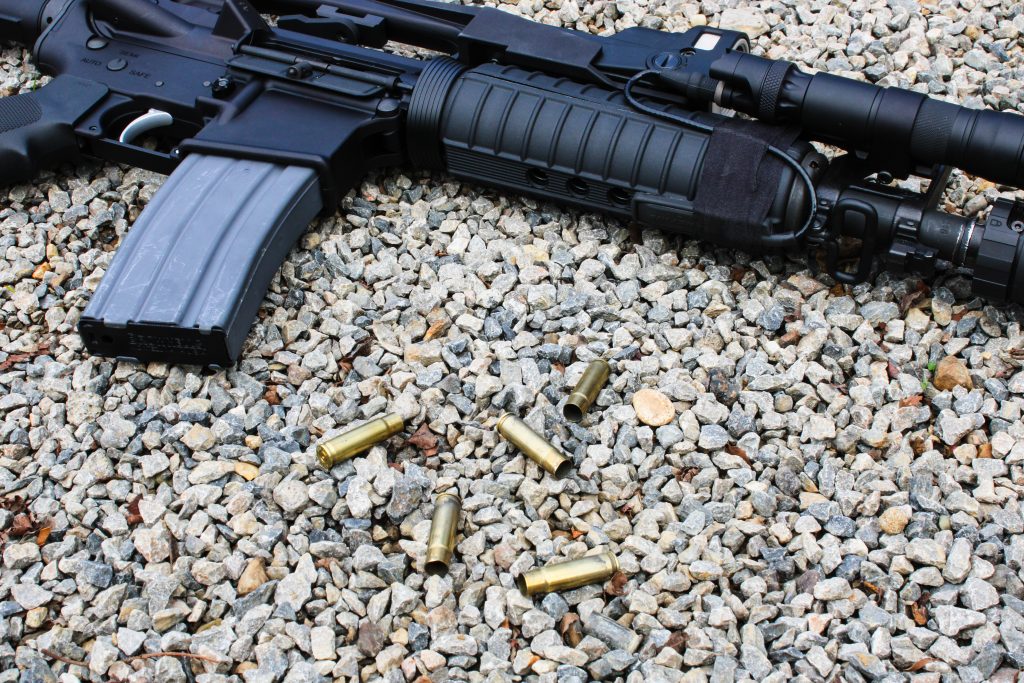
Running the Commando suppressed was the real highlight. With subsonic ammo and the Silencerco Omega 36M in its long configuration, no hearing protection was needed. It was comfortable, with only mild port pop on the first round.
While at the range, I measured the velocity of three subsonic 300 BLK loads using a Garmin Xero C1 Pro chronograph. The results are as follows.
| Velocity Results | ||||
| H&R Commando | ||||
| 300 Blackout | Bullet Weight (gr.) | Muzzle Velocity (fps) | Ext. Spread (fps) | Std. Dev. (fps) |
| Hornday Black AMA | 208 | 1014 | 35.7 | 12.6 |
| Hornday SUB-X | 190 | 1038.4 | 12.7 | 3.9 |
| Fiocchi Subsonic | 220 | 815.5 | 32.3 | 11.9 |
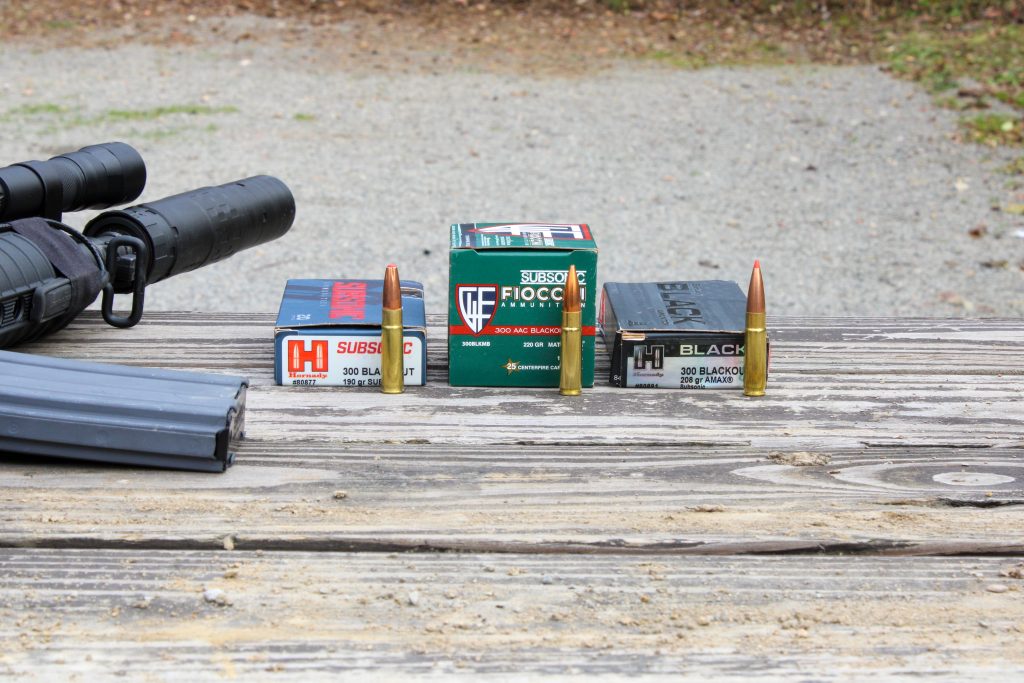
Based on the results, the Hornady SUB-X was the most consistent. I had already intended to use this as my primary defensive load, and the results confirmed that choice. Nothing like a few mags of this ready to fix problems.
Zooming Out
Ultimately, the H&R Commando shows that a truck gun doesn’t have to be dull or purely utilitarian to be effective. This build combines vintage looks with modern performance, offering a compact, reliable platform that’s both enjoyable to shoot and functional. From its classic lines to its suppressed 300 BLK capability, the Commando hits what I look for in a truck gun: familiarity, maneuverability, and lethality. While every environment and user has different needs, this setup reflects my preferences. Now, build one that works for you.
I have been thinking of doing something along the same lines–although I am tempted to chamber it in the new-ish .400 Legend cartridge. I like the idea of a .40 caliber bullet that weighs something like 300 grains for absolutely dependable terminal ballistics when shooting subsonic. I cannot imagine anyone in the world shrugging off a .40 caliber, 300 grain bullet at any velocity above 800 feet-per-second.
Sure, a subsonic .300 AAC Blackout bullet should expand nicely about 150% to something like .45 caliber. Why not go with a subsonic .40 caliber bullet that should expand 150% to something like .60 caliber and weighs 50% more? As the saying goes, “There is no replacement for displacement.”
that’s all valid if there’s .4 legend subsonic.
having levers in .44 and .444 i’m aware of “the lob” that that would require.
but i’m not much for di so, i’ll keep looking.
The “lob” is the same for all subsonic bullets, from 22 LR to 50 Beowulf. There’s tiny differences of coefficient due to bullet shape, but BC’s effect is in the supersonic and tran-sonic regions.
I’m seriously interested in a new scaled down 5.56 cartridge. 1/3 smaller than a full sized 5.56×45. Same ballistics out of a 12″ barrel.
5.45×39 is a thing.