

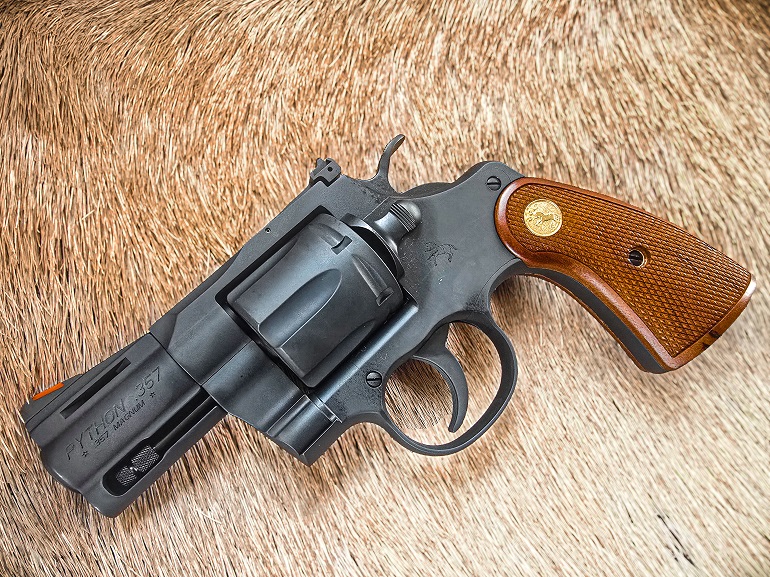
God bless CZ. They’ve been the answer to a lot of wheel gun nerds’ prayers, mine included. After their purchase of Colt, CZ has released version after version of the modern Python, creating a deep bench of great options for revolver fans. One of the more recent versions is the matte blued 2.5″ Python. It’s just like all the other guns in the modern Colt Python lineup…just a bit different than the originals, only better.
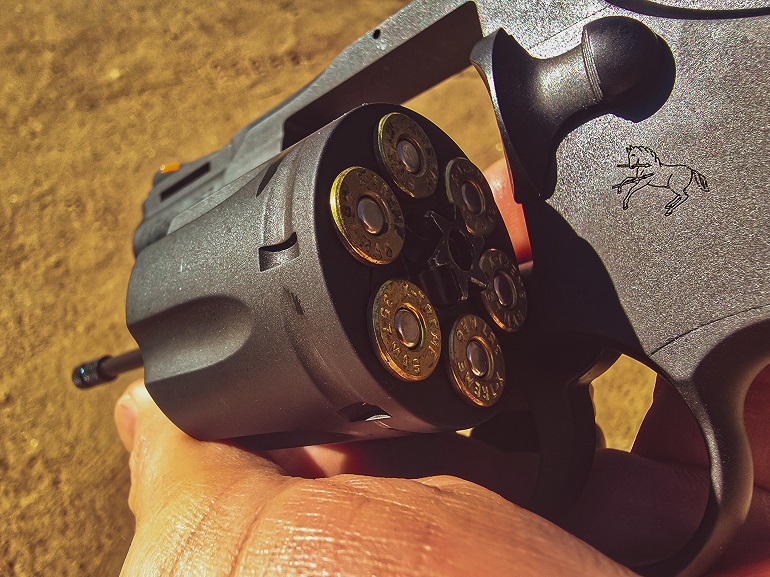
If you look for this particular gun on Colt’s website, you won’t find it. That’s because it’s mislabeled as a 2″ Matte Blued Python. The barrel is not 2″, it’s 2.5″. There are several 2.5″ versions of the Python offered, but this is the only one currently listed as 2″. It’s definitely 2.5″. For longtime visitors to the Colt website, the error is no surprise.
The 2.5″ barrel length was first listed in Colt’s catalogues beginning in 1964. The 3″, 4″, and 6″ versions all came first. Only the 8″ version followed it in 1980.
Just as with all of the other modern Pythons I’ve reviewed, cylinder end shake measured at .002″. Cylinder lock-up is excellent. The cylinder throats all measure at .358″ on a minus pin gauge set and the major bore diameter is .357″. This is all as it should be.
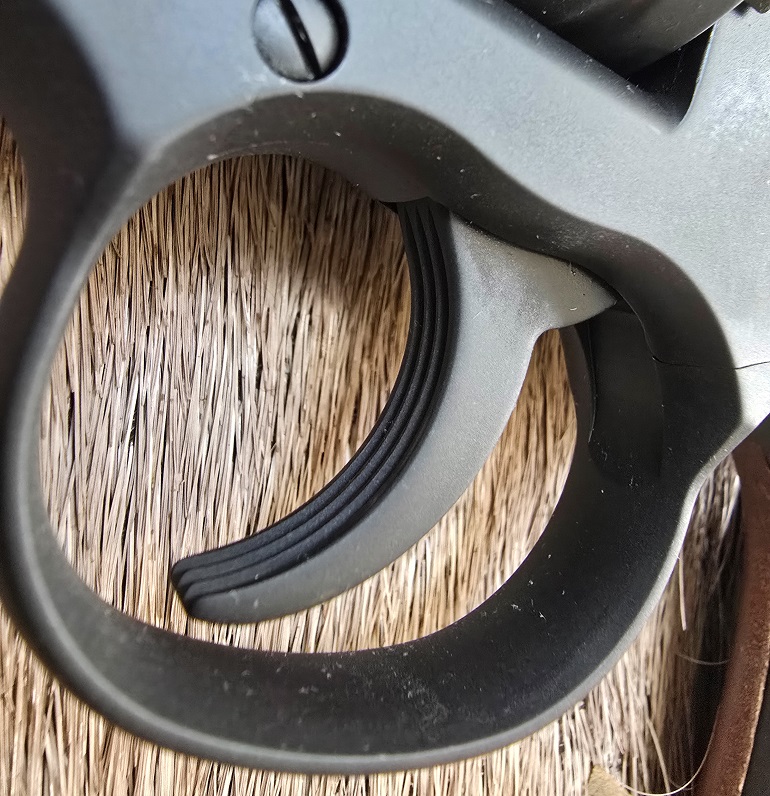
As with all of the modern Pythons, the trigger is excellent. The old Python triggers weren’t bad, but they stacked a good bit. These next generation Pythons don’t have that problem as they use what Colt refers to as a “linear leaf spring” (it’s…a leaf spring) instead of the old coil spring system. The double action trigger pulled to 8 lbs. even, with the single action breaking at 5 lbs., 4.2 oz. averaged over five pulls on my Lyman digital trigger scale.
Something to note — these triggers don’t tolerate bad habits. If you attempt to gently ride the trigger forward, waiting for the catch, you’ll think the trigger is stuck. That’s because there’s a tiny catch right before it’s fully reset. If you take a look at some of the old school great revolver shooters, you’ll see their trigger finger practically slaps the inside of the trigger guard. On a double action revolver, it’s the speed of your trigger finger slowing down the action. Don’t delay, get it moving fully forward, and fast.
There’s really no reason to doubt the modern transfer bar system, as opposed to the original hammer block. The overall engineering of the new Pythons trumps the much beloved old models in every way.
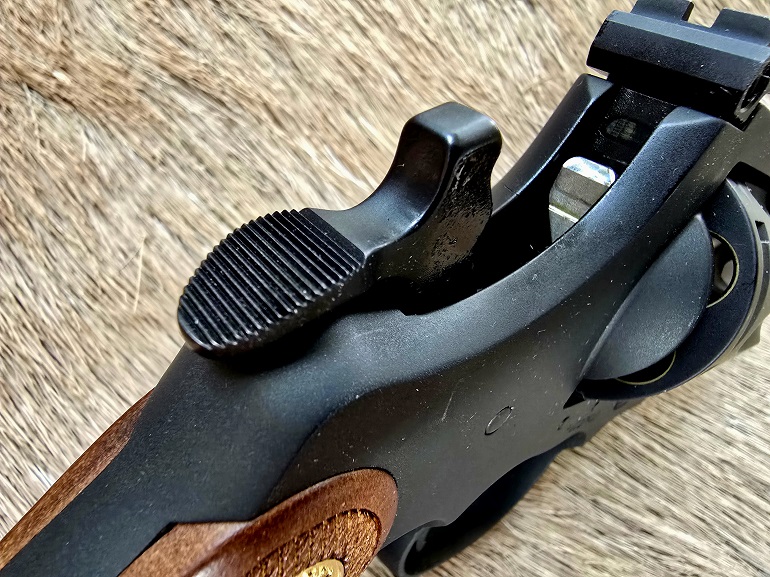
The hammer spur is well designed, wide, and serrated. It’s easy to get to in single action and makes sense for the original purpose of the Python…a gun that crossed the lines between a duty and target gun. It also doesn’t make a lot of sense on this gun. This version of the Python is all matte black, it’s got a 2.5″ barrel, and the smaller, thinner original grips. A bobbed hammer would be more appropriate, given the rest of the package.
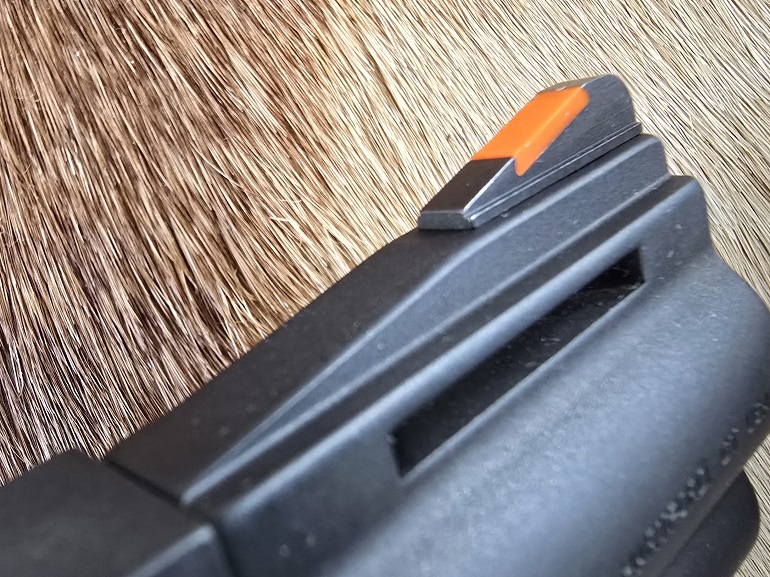
This snub-nosed version has a red ramp front and the target rear sight with a U-shaped notch. It’s adjustable for elevation and windage. I’ve been shooting these guns quite a bit since they came out in 2020, many fthousands of rounds now, and have yet to have a rear sight come out of alignment or lose adjustment in any way.
While much of the original Python remains the same in the new version, there are a few key differences, and they’re all for the better. The change you can actually see on the outside is underneath that rear sight.
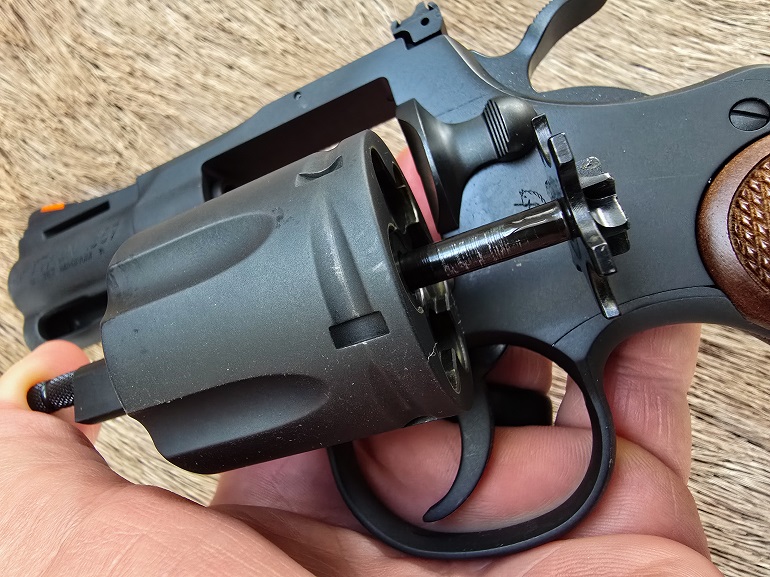
The top strap is obviously thicker, especially under the rear sight (Colt says it’s 30% thicker). In every place that matters, these are more durable guns, less likely to have any frame stretching (if that was ever an issue) and far more tolerant of flame cutting with lightweight rounds at high velocities.
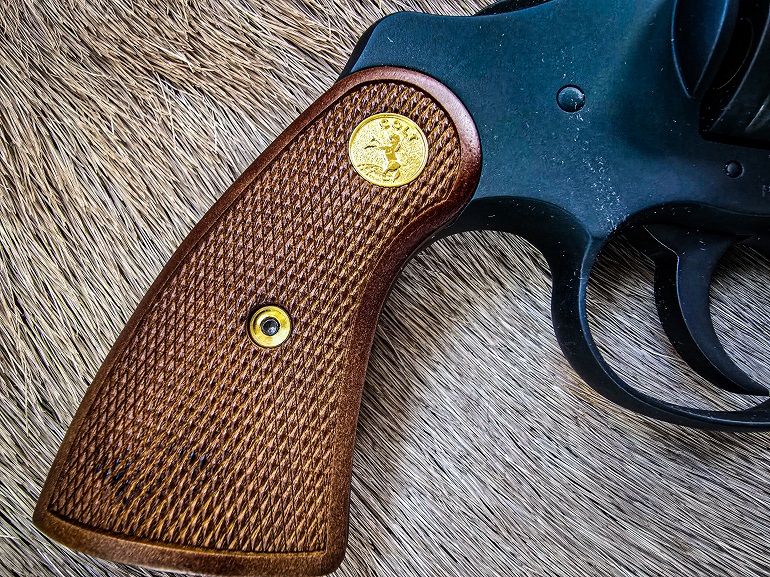
This particular Python includes checkered walnut grips with Colt’s traditional gold “Rampant Pony” medallion. Like all of the modern Pythons, these are interchangeable with almost all of the current or old grips. Colt’s choice with this gun is appropriate, as they’re practically identical to the original service style grips from the 1960’s. They look good and feel good. With the right holster, the grips ride well against the body, easy to grab and draw.
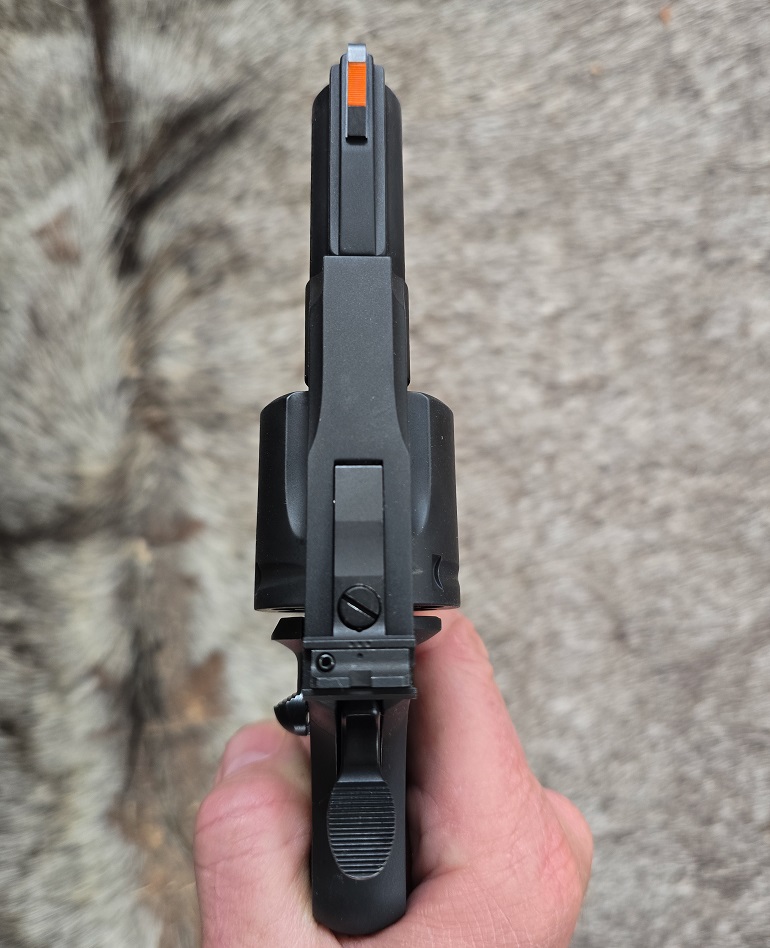
With heavy loads in fast fire, these grips are going to choose how you hold the gun for you. It doesn’t matter who you are or how you start to grip the gun, the recoil drives the nose up and the grip shape doesn’t do much to stop it. You’re going to end up right at the top of the grip, where top turns horizontally into the gun.
If you have size-large hands — and I do — this is going to get the web of your thumb pinched under the hammer, but only in single action fire. As much as I want that to be a problem, it’s not. The hammer doesn’t fall that far back in double action fire, and that’s the only time you should care about fast follow-up shots anyway. Plus, this is actually where you should be holding the gun anyway, assuming you want to manage recoil and get the shots back on target.
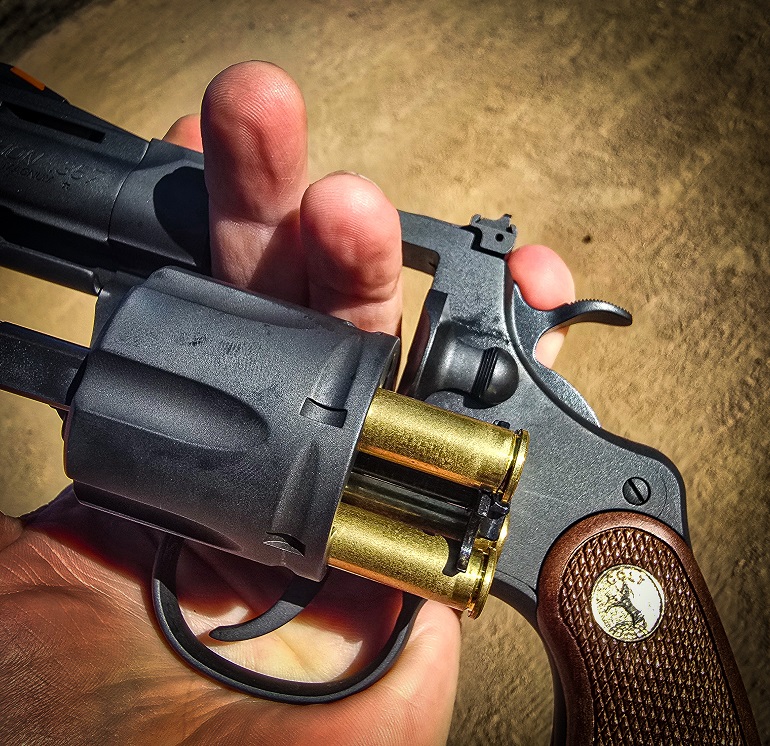
Like all short-barreled magnums, you’re going to have to tip the muzzle up and hammer the ejector on empties if you want the cylinder to give up all six shells with a quickness. That ejector rod’s just not long enough to push the empties all the way out, so you’re going to need a little momentum. This particular gun was finicky about brass fully ejecting, at least in the beginning. Nickel-finished cases fell smoothly, as did all cases after a couple of hundred rounds.
When it comes to precision, I struggled with this particular Python more than the others I’ve reviewed and owned. I blame too much time looking at spreadsheets.
Armscor’s 158gr .38 Special averaged 2.1″ five-round groups over four shot strings. I only had 10 rounds of the Barnes commercial 140gr VOR-TX bullet, but those averaged 2.4″ groups. The exact same bullet, but this one from Buffalo Bore round, fired the best group of any ammunition I tested, at 1.8″. Buffalo Bore’s 180gr hardcast Heavy Outdoorsman round shot the worst, printing right at 3″ (that round produces spectacular results in a carbine-length barrel.)
Those rounds are the full bracket of all commercial rounds I fired for the review. All groups were five rounds, shot untimed, off of bags at 25 yards, in single action and on a fouled bore.
Recoil isn’t as bad as you might think, no matter what round is used. Even that 180gr bullet moving just under 1,300fps from this barrel wasn’t challenging in terms of recoil. Yes, it was stout, but a 20-round box wasn’t painful to the hand, (the effect on the wallet is a different story altogether). Given the report and muzzle flash, this would be the ideal handgun to face multiple assailants in a dark alley. With a single, well-placed shot, you’d have one dead, all the others deaf and blind.
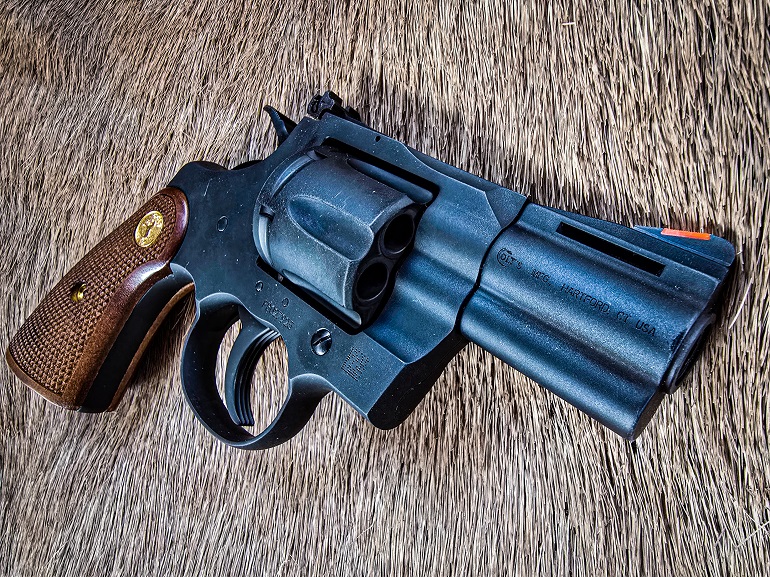
I’ve never been much of a snubby magnum fan, but after shooting another short-barreled Python, I couldn’t keep myself from picking this one up when I saw it in a local Cabela’s counter. It’s a classic big-boy Roscoe with all the improvements of the modern Python. Running a plate rack at 15 yards at 1 second per plate isn’t hard, and especially with .38 special loads, the gun is fun to shoot. Considering the number of holsters that exist for it, it’s also easy to carry.
Not only are these guns mechanically better than the old Pythons, but they’re also considerably less expensive. In 1996, a blued 2.5″ Python would have cost you $851. Inflation would have pushed that to $1,761.66 in today’s dollars. With a current street price of $1,388, you’re getting a deal.
Specifications: Colt Python, 2.5″ Matte Blued
Caliber: .357 Magnum/.38 Special
Capacity: 6 rounds
Barrel: one piece, 2.5″ inches, carbon steel, recessed target crown
Height: 5 inches
Overall Length: 8.5 inches
Weight: 2lbs 2.6oz (on my home food scale)
Width: 1.55 inches
Finish: Matte
Frame: Forged Carbon Steel
Grips: Walnut
MSRP: $1,499
I know I’m risking the frustration of moderation, but here goes.
Two of my biggest gun regrets is letting go of my unshrouded Dick’s Special and my 1903 .32. Deep, deep regret.
I don’t know why, but I was never a Python fan.
That detective special isn’t too hard to find. Colt made a million of them (literally) prior to 1973 when they introduced the hammer shroud. I’ve found these 1st and second series guns online from $600 to almost $3,000, depending on exactly what you are looking for. That said, as a big Colt fan, there’s nothing the DS does for me a Ruger 101 doesn’t.
i know of the earliest sp101 in .38. the owner never shoots/ carries it, won’t part with it.
my ex has my unshrouded detective special. theoretically i could reclaim it.
Barrel shroud, not hammer shroud, although you could get that too.
Only took two hours for this comment to show up. Some of them never show.
What a way to run a rail road.
much higher percentage post here than where we met.
i gave up over there.
I was never a python fan But, oh my gawd I think I am in love.
I’ve never heard of ‘Matte blue’.
Is it a metal coating, like what Ruger does with their LCR in .357? And why not a dirt-simple Parkerizing treatment instead?
Mr Taylor –
I commented on this article the day it was posted, and my comment showed up, but has since, somehow, just disappeared.
I’ll repeat myself –
What is ‘Matte Blue’, is some type of metal coating, like what Ruger does on their LCR in .357?
Hoping this doesn’t also evaporate into the ether…