

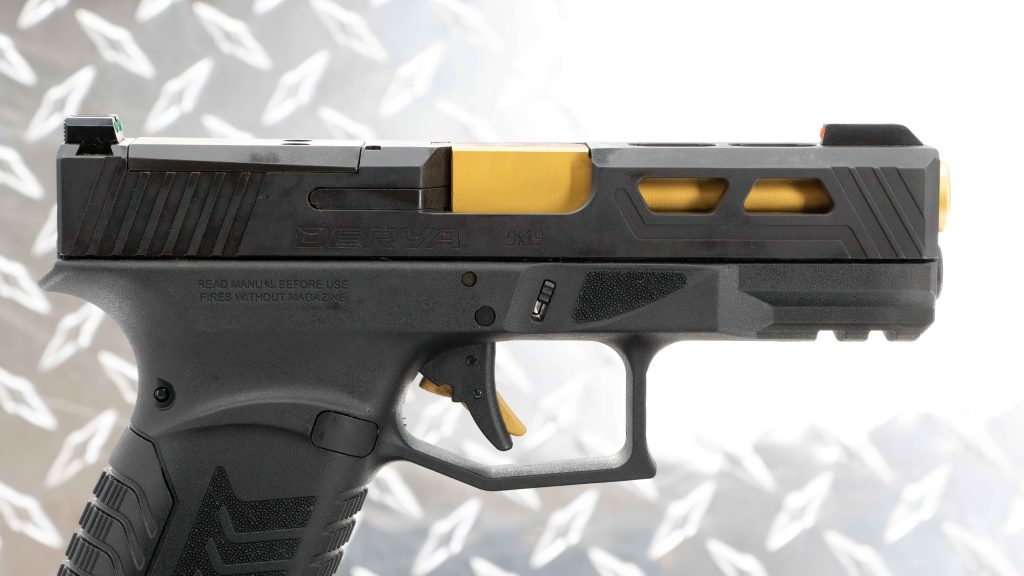
Derya Arms made a splash with an initial offering imported by Rock Island Armory. The early DY9 models were a GLOCK-pattern none-too-fancy build, but with several updates to the basic GLOCK design and at a fraction of the cost. The result of that market test was an instant cult following as the next budget champion for those seeking to get more for their money.
In 2025 Derya Arms opened a US facility and began manufacturing firearms here after assembling an American team of industry professionals that could help direct product development to more quickly match American tastes and trends. Not long after, the US market saw the DY9 Island, DY9 Comp, and the subject of this model, the DY9 Gold. Those looking for something smaller can see the DY9Z we reviewed here.
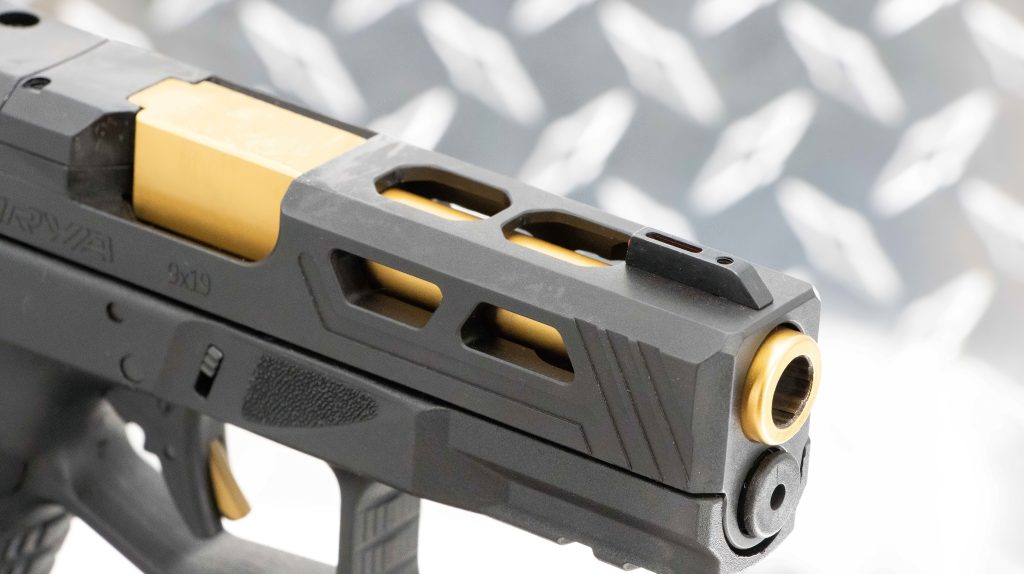
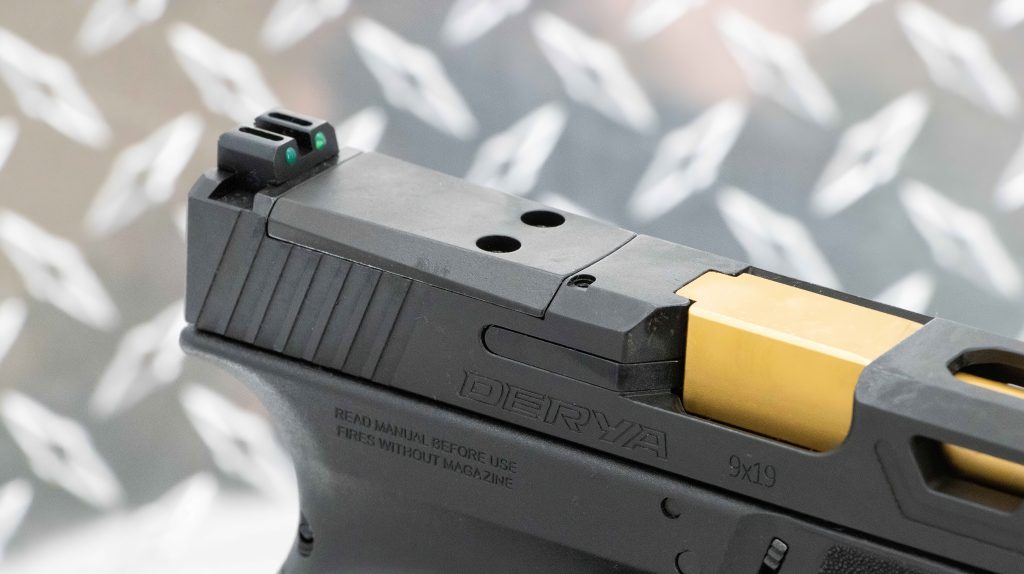
The DY9 Gold takes the original frame and trigger and adds upgrades with an optics-ready slide, GLOCK-pattern sights, mass reduction of the slide, and, of course the gold-colored PVD coating that gives this model its name. I’ve noticed some on the internet mock “speed holes” on pistol slides. I completely understand that those who get into grappling matches in grain silos while carrying with a race holster fear that foreign objects might wiggle into the slide and interfere with operation, but when I see metal lightening cuts I think of something else: physics.
Slide mass is a considerable part of felt recoil. Slow-motion footage has shown that it’s the slide slamming to the rear — not detonation of the round — that causes the most shift in the hand. So it makes sense that the lighter the slide is, the less potential energy is imparted on the shooter when the slide hits its travel limits.
Slide mass however is also an important part of reliability, needing the inertia help chamber the next round. Recoil spring rate also plays a part in all of this and that’s why some custom shop cut slides reduce reliability without a change in spring rate.
When a manufacturer makes such changes, they choose between also changing spring rate, or carefully ensuring changes in slide mass is still within the operational window of the recoil assembly to feed reliably. Of course how much energy is needed to strip a round from a magazine and shove it into the chamber also depends on the quality of the magazine and the ammunition used.
TLDR: It’s a gamble, but it can pay off with reduced felt recoil when it’s done correctly.
How is all of that accomplished while still producing a complete pistol with an MSRP just under $450? Are there corners cut or other shortcomings? Take a look at the Derya DY9 Gold in the tabletop video below:
Specifications:
Front Sight: Truglo Fiber Optic (Red)
Caliber: 9MM
Rear Sight: Truglo Green; Optic Plate
Capacity: 10 or 15 rds
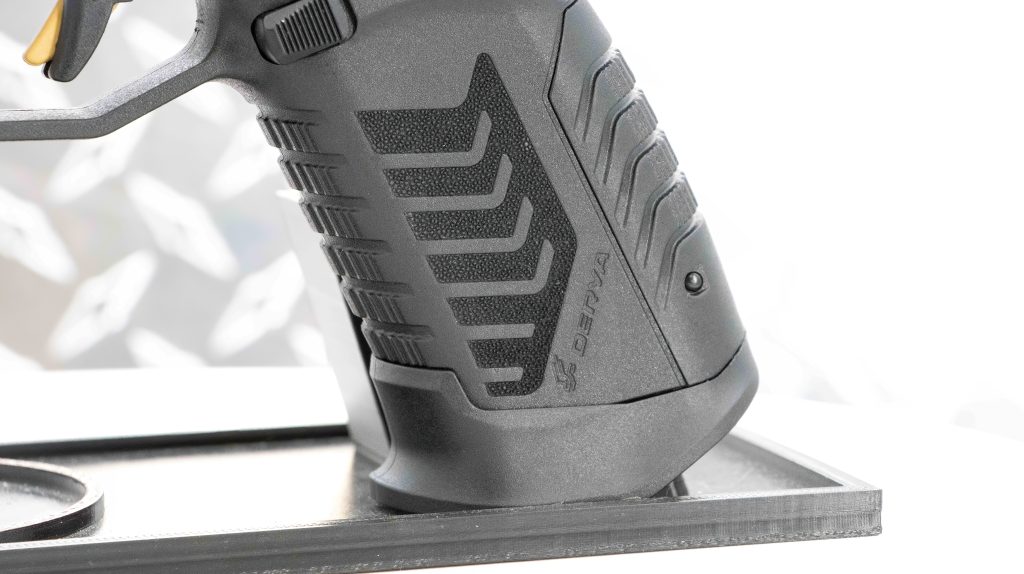
Grip Type: Polymer with changeable back plates
Weight: 1.81 lbs
Action Type: Striker Fired
Barrel Length: 3.86″
Finish: Melonite and Gold PVD Barrel
Overall Length: 6.9″
Overall Width: 1.16″
Overall Height: 4.56″
MSRP: $449
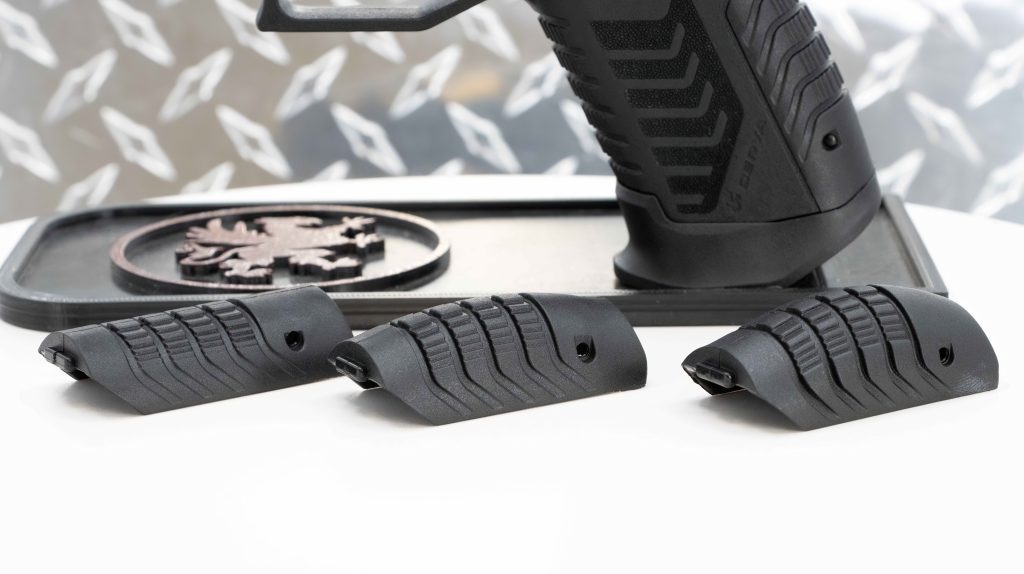
One of the simple upgrades that I appreciate about all of the Derya DY9 pistols is the inclusion of four backstraps and a removable magazine well. These options let the pistol be configured to accommodate most hands comfortably and with good trigger reach. As a larger-handed individual, the magazine well gives my pinky a place to rest and apply pressure for good muzzle control.
In my experience, Derya pistols are reliable, but regardless, I always run guns through the same protocol to get to know them. This range protocol includes:
-
Cold Shots: Truly my first shots through the gun
-
Full Magazine +1: Surprisingly, some modern guns still struggle with this. It’s a test of how much play is in the magazine as well as how the slide cycles with pressure. This is also when I do my best to learn the trigger.
-
Multi-Mag: When a handgun is compatible with common magazines, such as the GLOCK-pattern magazine we test to see how after-market magazines fit. Particularly with GLOCK-pattern magazines the polymer can be of slightly different dimensions from brand to brand resulting in snugger or looser fits, especially if hydrophillic polymer has been exposed to much weather.
-
What’s For Dinner: A test to see what ammunition the gun will eat. Does the gun feed the round from slide lock, will it cycle and feed another round of the same type, does the slide lock to the rear on empty, and is there any notable point of impact change with different loads.
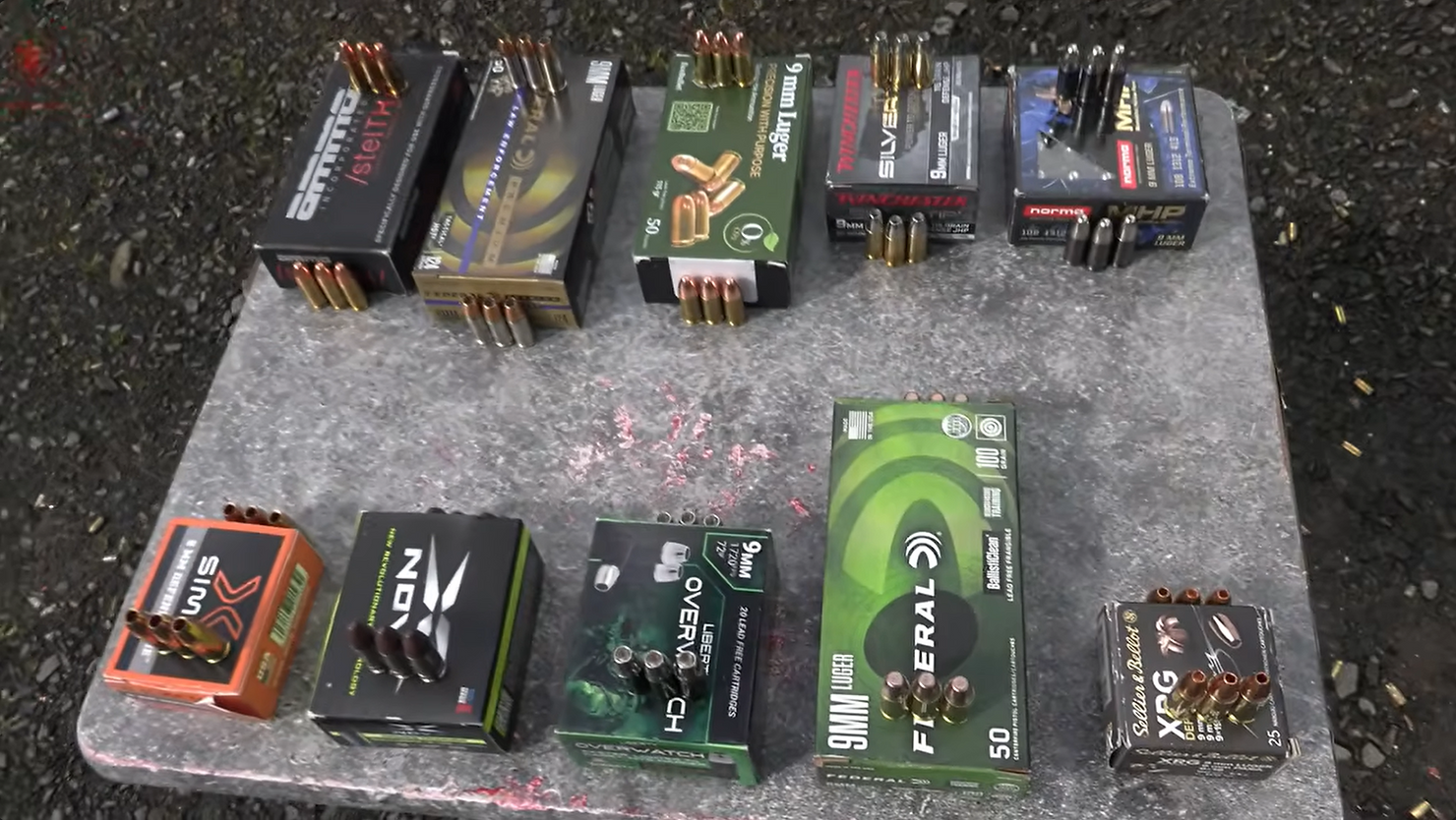
For this gun the following ammunition was used:
45gr Sim-X DEFENSECORE
65gr NovX Crosstrainer
72gr Liberty Ammunition Overwatch
100gr Federal BallistiClean
100gr Sellier & Bellot XRG
108gr Norma MHP
115gr TMJ EcoBullet
115gr Wincherster SilverTip
124gr Federal Premium HST
147gr Winchester Defense
165gr AMMO, Inc. /stelth/
Standard Range amunition was 124gr PMC FMJ
Sights & Trigger Control: on a 6-inch spinner target at a distance of 12-ish yards. We got this from Titan Great Outdoors and use it to gauge how learnable the trigger is and usable the sights are for forced, timed, precise shots.
-
Practical Accuracy: Five shots from a distance of seven yards at a one inch target. This isn’t so much about printing a tight group as it is a culmination of the shooting experience and time for to collect thoughts prior to making a conclusion.
-
After Shots: Final impressions and reflections from the range session.
You can watch the process in the Shooting Impressions video below.
On the range the Derya DY9 Gold was almost what I’ve come to expect form Derya pistols. Easy to shoot, but my example had some feeding issues during the What’s For Dinner segment of the range portion. The gun didn’t want to feed the last round of lighter projectiles with the nose of those rounds getting caught on the feedramp. This could be a magazine issue, or just that those lighter-weight projectiles were just too short in overall length to feed with this barrel. Further investigation is required for a solid answer.
The WFD process is simply meant as a quick assessment of general compatibility to see if there’s any ammunition that one might want to avoid with a particular gun. The good news is with the wide variety of GLOCK-pattern magazines and barrels available, a combination can be found for those really wanting to run one of those loads in this gun.
Those feeding issues also happened with a full magazine of 124gr FMJs, so again, it could be a magazine issue, or a feedramp problem.
If this was my only pistol I might send it back for warranty repair, but as a guy with an entire storage box of GLOCK-pattern magazines and barrels, I may just experiment with what I’ve got on hand before shipping the gun across the country.
This imperfect reliability isn’t representative of my experience with six other firearms from Derya, so I don’t see it as a sign of poor quality, just an imperfection as I’ve experienced with just about every other manufacturer from whom I’ve covered multiple models.