
You’ve read it, you’ve watched it, you’ve heard it, and you’ve likely said it; “This (enter gun model here) feels good in the hand.” It likely feels better there than other places it could be, but what does that mean? Like many, I’ve written and uttered those miserable words before myself. A gun just feels good when you pick it up. But the “feel” experienced in the gun shop, the armory, or elsewhere matters less than two other factors.
Accuracy and time.
I’d picked up a used Colt Combat Commander back in the 1970s after reading Massad Ayoob’s piece on a Combat Commander he’d had done up by John Lawson out in Tacoma. I was doing the same thing. I’d laid in a supply of Federal 185 gr. JHP ammo to feed the gun along with a bullet mold — provided by Lawson — with a pair of cavities to make bullets especially for that custom gun.
While visiting the office of an attorney who was standing in as the agency’s legal advisor, I brought the Lawson Commander out for him to admire. Another officer arrived during our meeting, someone who’d carried various 1911s over his career, but quit carrying when he had one choke when he tried to shoot an armed suspect.
He took the Lawson .45 in his hand, sadly shook his head, and said, “This feels like the handshake of an old friend.”
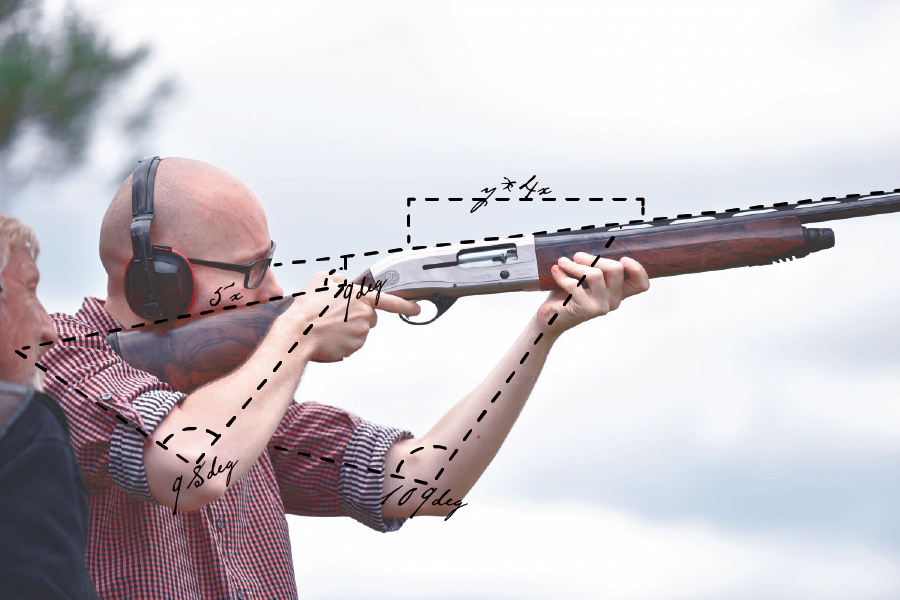
Long guns – rifles, carbines, and shotguns – have a particular feel as well, but consider why it’s easier for nearly anyone to shoot a rifle or shotgun…more points of contact.
With the handgun, it’s just the hand. I know people use both of theirs, but that’s not the same thing. With a long gun, you have the dominant (trigger) hand, the support hand, the cheek on the comb, and the butt against the shoulder.


That’s four to one. You know if the gun fits when you mount it, taking the gun from “ready” to “aimed in.” If the bead/sights naturally appear over the target, it’s a good fit. See those who are successful at the clay bird games. They show how the gun fits them individually.
If the gun doesn’t fit, they don’t hit … quite so often. My dad was a laser beam on mourning doves with his old double 16 gauge, but preferred a semi-auto. He got one…the Remington 1100, an early edition, a 20-gauge on a full size 12-gauge receiver.
That was a superb gun, but he shot it more than he hit with it. Many years later, he took the gun in to be detail-stripped, cleaned and reblued. The gunsmith heard him complain about not being able to hit with it. “Show me,” the gunsmith told him. He watched the mount, measured the stock and said, “The length of pull is too short. I’m adding a thick recoil pad, and that’ll be enough.”
Long story short…that all that was needed. In other words, fit matters.


While muddle-headed freedom haters want to legislatively limit our access to four- and six-position adjustable stocks on AR-15s, all they accomplish is making it harder to fit the gun to the user, decreasing accuracy.
With handguns, it’s the same thing. Back in the “Wonder 9” days, with the S&W 659, Beretta 92 and other double-stack guns, I found I couldn’t reach the trigger in double action without adjusting my grip, or shooting “side saddle” as Jim Cirillo used to call it.


With the Smith 645, the 4506, and single-stack .45’s, it was a stretch, but I made it work. Later, I spent about 3,000 rounds of 9mm to get to where I could use a stock GLOCK 19. The gun didn’t really fit, so I forced myself to fit to it.
Fit means accurate hits accomplished in a timely fashion. You have to shoot the guns to find out. Good hunting.