


By Thomas E. Gift, MD
In a recent medical journal report the authors find that a firearm injury to an adult is associated with a child in the family receiving a psychiatric diagnosis. They imply that distress related to the injury leads to the emergence of psychiatric difficulties and subsequently a psychiatric diagnosis. On its face, this seems plausible.
The authors note some limitations, including relying exclusively on commercial health insurance to obtain data regarding injuries and psychiatric diagnoses. While they utilize a large sample it is perhaps only about 13 percent of the US population. As they note, it excludes families covered by Medicaid, which may be different in important ways from those whose health insurance tends to be through an employer. Additionally, they point out that an alternative explanation for an association between injuries and children’s receiving a psychiatric diagnosis is that the injury prompted a set of interactions with the medical community, thus increasing the likelihood that psychiatric difficulties would be identified and diagnosed in these children. This seems plausible as well.
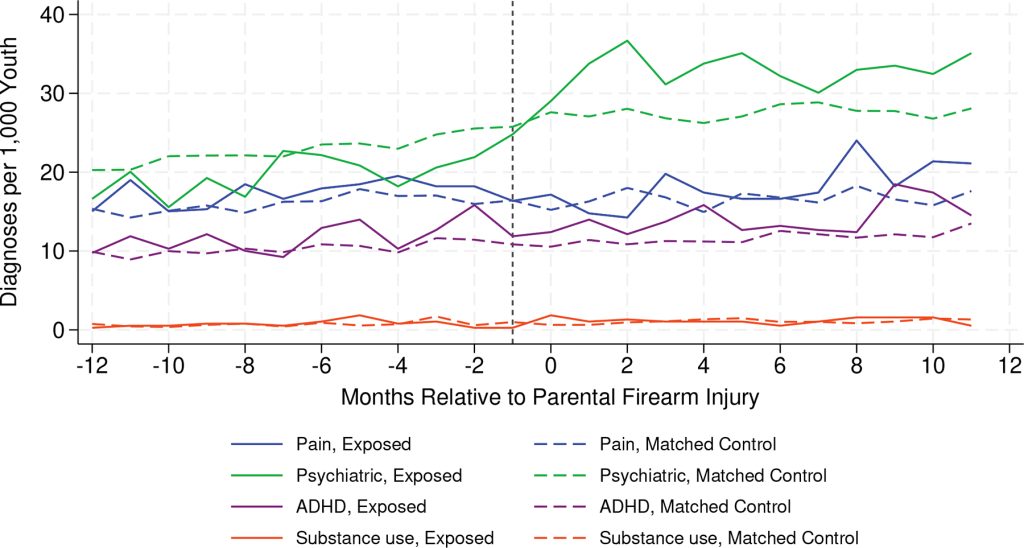
However, the conclusion that an adult’s injury leads to a child’s diagnosis is undercut by the graph they present showing diagnoses both before and after the injury. While the graph indicates that indeed children’s psychiatric diagnoses increased following the injury, they were on an upward curve before the injury. This might suggest that situational factors led to both the diagnosis and the injury.
Although it isn’t central to the authors’ thesis, readers might want to know the role of illegal firearms in producing such injuries. For obvious reasons, the percentage of guns held illegally in the U.S. isn’t known. The percentage of firearm-related injuries associated with such illegally-possessed weapons can’t be known.
Throughout, the authors really only find associations and linkages, but the words “effects” and “consequences” slip in, creating statements as to causality that their data don’t support.
Perhaps this should not be surprising. The first author of the study, Doctor Karandinos, is listed as a part of the Gun Violence Prevention Center, as are several additional authors. This organization beats the drum for “gun violence is a public health crisis” narrative, with all that this distorted concept implies as to debasing the constitutional right to keep and bear arms. So it appears that the authors inappropriately portraying child diagnosis as somehow being caused by parental injury isn’t an innocent slip or a commendable effort to distill a few more drops of truth from the vat of data. Rather, it reflects a deplorable political agenda.
In this regard the authors predictably stand with many of their physician colleagues and medical organizations. To pick one, the American Medical Association is brazen in stating that position, seemingly oblivious to issues of constitutional rights. Also to be considered in this regard is the bizarre notion that firearms somehow have agency…that they make their own decisions and exercise free will. Of course, this ignores the fact that it’s gun users that make decisions and exercise will.
Those pushing for a public health model, the professionals who trumpet making decisions based on data, characteristically ignore, as they do in this report, the distinction between the vast majority of guns that are legally and those that are illegally possessed. There are all sorts of data showing that illegally possessed firearms are involved in almost all gun-related crimes. The conclusion to be drawn, then, is that clamping down on lawbreakers and criminals, rather that restricting constitutional rights, would be the better path forward.
Thomas E. Gift, MD is a child and adolescent psychiatrist practicing in Rochester, New York, an associate clinical professor of psychiatry at the University of Rochester Medical School, and a Distinguished Fellow of the American Psychiatric Association.
This article originally appeared at drgo.us and is reprinted here with permission.