

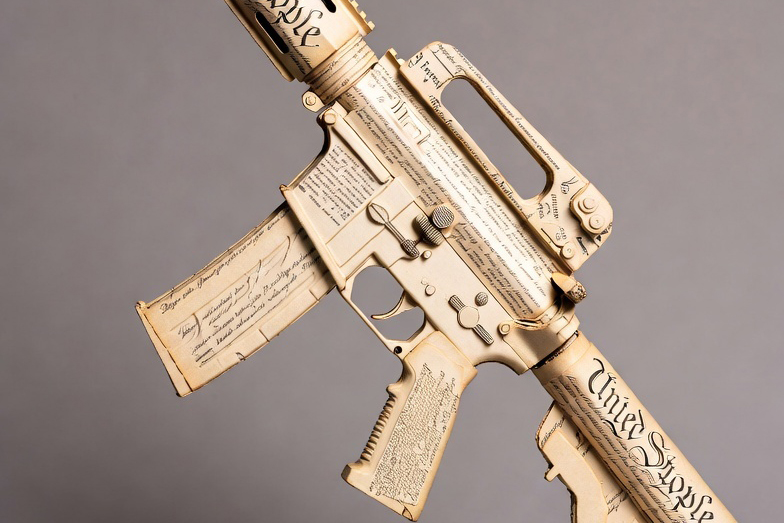
For the first time since quietly creating a new Second Amendment Section inside the Civil Rights Division, the Department of Justice has finally done something gun owners have been demanding for years: it sued the District of Columbia over its long-standing gun ban.
Just before Christmas, the DOJ filed a sweeping federal lawsuit against the District of Columbia, challenging the city’s so-called “assault weapons” ban, a law that doesn’t merely restrict some firearms, but criminalizes the possession of most of them. It’s the DOJ’s first truly aggressive action since announcing its new Second Amendment Section earlier this month.
Now comes the hard part: proving this isn’t a one-off stunt.
D.C.’s ‘Assault Weapons’ Ban Is a Registration Trap
In Washington, D.C., firearm registration isn’t optional. It’s mandatory. But under D.C. law, entire categories of common, modern firearms — including AR-15-style rifles — are simply ineligible for registration.
The result is a clever sleight of hand: the city claims it hasn’t “banned” anything, while ensuring law-abiding citizens can never legally possess these firearms.
The DOJ’s lawsuit cuts straight through that charade. The complaint states plainly that D.C.’s scheme amounts to a de facto ban on firearms that are “in common use” for lawful purposes like self-defense, firearms that are owned by millions of Americans nationwide. The DOJ even acknowledges what gun owners have been saying for years: the AR-15 is the most popular rifle in America.
The DOJ Lawsuit Is More Than Symbolic, It’s a Civil Rights Case
What makes this lawsuit different isn’t just what the DOJ is challenging, it’s how. The Department didn’t merely file a standard constitutional challenge. Instead, it invoked its “pattern or practice” civil-rights authority, the same legal weapon historically used against abusive police departments.
In other words, the DOJ is alleging that D.C. law enforcement has engaged in a systematic violation of civil rights — arresting, prosecuting, and threatening jail time against citizens whose only offense is possessing firearms the city refuses to register.
If the DOJ wins, the consequences could be massive. A ruling wouldn’t just strike down a statute. It could halt arrests, stop prosecutions, and force D.C. to register protected firearms, setting a precedent that could unravel assault-weapon bans nationwide.
A First Test for the DOJ’s New Second Amendment Section
This case is also the first real test of the DOJ’s newly announced Second Amendment Section, housed within the Civil Rights Division and spearheaded by Assistant Attorney General Harmeet Dhillon.
On paper, the move makes sense. For years, Second Amendment cases have been scattered across a bloated DOJ, handled by career bureaucrats, many of whom are openly hostile to gun rights. Centralizing those cases under a dedicated Second Amendment unit could impose much-needed discipline.
But gun owners have learned the hard way: structure alone doesn’t guarantee outcomes.
Gun Owners Have Been Here Before…And They’re Skeptical
That skepticism is well-earned. While the DOJ is now suing D.C., it’s simultaneously defending other gun confiscation regimes across the country including federal NFA regulations, suppressor restrictions, and interstate gun sales bans. More recently, the DOJ even argued that knives aren’t protected by the Second Amendment, something that is easy to debunk.
Most notably, the Department continues to fight the landmark lawsuit brought by Gun Owners of America and Silencer Shop, a case that could dismantle much of the NFA. That contradiction hasn’t stopped establishment gun groups from immediately praising the DOJ. True to form, they rushed to applaud the DOJ lawsuit — carrying water for a bureaucracy that has not yet proven it deserves gun owners’ trust.
Par for the course. For decades, the establishment gun lobby has sought proximity to power — even when it comes at the expense of its membership.
Texas Gun Rights: Cautiously Hopeful, But Not Naïve
Texas Gun Rights isn’t popping any champagne, but it isn’t rooting against the lawsuit either. “This shows what the DOJ can do,” said Chris McNutt, President of Texas Gun Rights. “But gun owners aren’t interested in symbolic gestures. We’re interested in consistent action.”
McNutt was blunt about the stakes. “The DOJ doesn’t get a gold star for doing one thing right while continuing to defend unconstitutional gun laws everywhere else,” he said. “Proof is in the pudding.” Still, Texas Gun Rights remains cautiously hopeful that the new Second Amendment Section could finally streamline gun-rights cases — funneling them under leadership that actually respects the Constitution.
Because right now, the DOJ is still too big, too bureaucratic, and too full of left-wing lawyers that the Trump administration and Attorney General Pam Bondi have yet to fully rein in.
One Lawsuit Won’t Redeem a Department, But It Could Start Something
If the DOJ is serious, this lawsuit should be the beginning, not the exception. Winning against D.C.’s assault-weapons ban would send a clear message: the Second Amendment is a civil right, not a suggestion.
But redemption won’t come from press releases or applause from establishment groups. It will come from consistent victories, real enforcement, and a DOJ willing to confront gun control everywhere…not just where it’s politically convenient.
“The proof will come in what they do next,” McNutt said. “Gun owners are watching.”
The DOJ has taken its first swing. Now it has to prove it’s willing to keep fighting.
“setting a precedent that could unravel assault-weapon bans nationwide.”
Personally, I tend to think that’s overly optimistic.
D.C. is ‘low hanging fruit’ with the way they do it. I mean its obvious the registration scheme is intended to be a defacto ban. D.C. can’t claim states rights, its not a state, but they can chose what to register or not register but they can’t ‘ban’ something constitutionally legal by refusing to register it. And then they can only require registration because the federal government lets them exercise ‘home rule’ but the feds can take that away at any time because in reality D.C. is a federal district that belongs to the federal government. But to regulate in such a fashion as to effectively ban in effect is an obvious ploy at defacto banning using whats available to them which is their ‘registration’ scheme.
So this is really ‘low hanging fruit’ because the ploy is so obvious, and the federal government via the DOJ is basically saying ‘they used a unlawful means (under their home rule) to enact a defacto ban in our area. They can’t ban anything,’
So maybe this is a warm up to get used to doing this for the new section. But the test is going to come when they go after an actual state where the legal landscape ventures into ‘states rights’ territory and that’s what every anti-gun state has tied things up with so far trying to force ‘interest balancing’ back into the court.
And if SCOTUS would quite pussy footing around and take cases with depth that do some good nationally, this would have already been solved … for example, Wolford Was Granted but Antonyuk & Snope Were Denied. While a win with Wolford would be nice it would be limited in scope. But a win with Antonyuk & Snope would have affected nationally because Antonyuk was a direct challenge to states defiance of Bruen and SCOTUS would have had to put their foot down in that one and stomp the states and Snope attacked the question of whether arms in common use may be forbidden because the political class doesn’t like them and wants to call them “assault weapon” when they aren’t to avoid the constitutionality question when they are clearly ‘common use’ constitutionally protected. And the ‘common use’ question also had a chance to be settled back in 2015 but SCOTUS back then denied Friedman v. Highland Park, and ever since the anti-gun states have been using that SCOTUS silence as if permission to continue throwing-spaghetti-against-the-wall-to-see-what-sticks and pushing bans and other unsavory things.
Tracing of Brown University Killer’s Gun Should Shatter Tracing Myths.
ht * tps://bearingarms.com/tomknighton/2026/01/05/tracing-of-brown-university-killers-gun-should-shatter-tracing-myths-n1231096
From the above link (because it would ghost post if I included the below with the post above):
“The mainstream media has a real thing for gun tracing. They’re quick to quote anti-gunners, both activists and politicians, who say that so-called ghost guns are a problem because they can’t be traced. This supposedly deprives law enforcement of a serious tool they need.
Of course, no one has ever found a case that’s been broken by gun tracing, and even if there is one, the truth is that tracing only really works to find the original buyer.
…”
In the ‘Falsehoods, faulty memory, contributory and flat out obvious intentional negligence, cowardice, dangerous and deadly incompetence’ and ‘police have no duty to protect you, and really don’t want to, is not really a meme’, and ‘why we needed armed school staff that day and should have it in every school’ department:
The First Trial of a Uvalde Police Officer Began [Yesterday, 5 Jan 2026].
ht* tps://hotair.com/john-s-2/2026/01/05/the-first-trial-of-a-uvalde-police-officer-began-today-n3810511